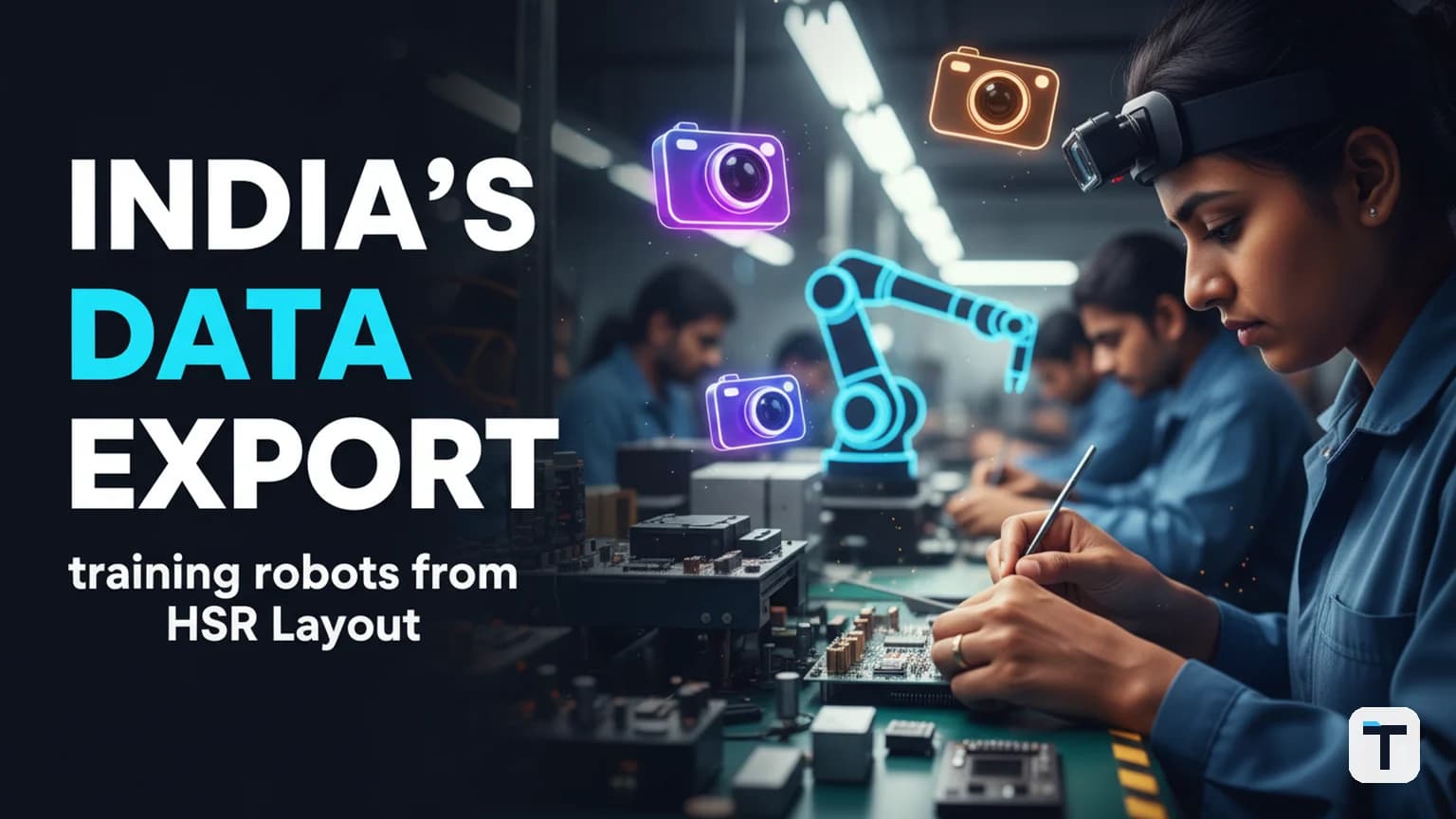

When the world's biggest robotics labs need to teach a robot arm how to fold laundry or pick a ripe fruit, they no longer turn to simulation alone. They need egocentric data — first-person video of human hands performing real tasks, captured through body-worn cameras at close range. And increasingly, that data is being recorded, annotated, and exported from India.
Panoculon Labs, a two-person startup operating out of HSR Layout in Bengaluru, is one of the companies quietly building this new export economy. In just three months, the team says international sales overtook domestic revenue. Their core product is not software — it is tens of hours of carefully structured first-person footage of Indian workers performing manual tasks, packaged into datasets that robotics companies can train on.
It is a story about how the next big shift in AI is not about models or chips, but about the physical-world data needed to make robots useful — and how India's labour-cost advantage, data outsourcing heritage, and emerging startup ecosystem put it at the centre of it.
What is egocentric data, and why do robots need it?
Egocentric data is first-person video, audio, and motion information captured from a wearable device — typically a headband-mounted GoPro or smart glasses — that records what the wearer sees and does. Unlike third-person surveillance footage, egocentric data shows the world exactly from the perspective of the hands performing a task.
This matters for robotics because current models cannot learn manipulation skills from text alone. A large language model can describe how to peel a potato, but a robot arm needs to actually see the grip, the pressure, the angle of the knife, and the give of the skin — from the perspective of the hand holding it. That first-person visual information is precisely what egocentric data provides.
Stellaris Venture Partners, one of India's most active AI-focused VC firms, noted in April 2026 that "physical AI has a massive data problem." Leading robotics labs estimate they need somewhere between 100 million and 1 billion hours of first-person task video over the next 2–3 years to train the next generation of manipulation models. No single country has a workforce available enough, and with enough manual-task density, to record that volume at scale — except India.
The HSR Layout playbook
HSR Layout, a residential-turned-startup neighbourhood in southeast Bengaluru, has quietly become one of the densest AI startup hubs in India. Panoculon Labs operates from here alongside dozens of other early-stage companies. The neighbourhood's mix of cheap co-working space, reliable fibre, and a residential base of tech workers makes it ideal for low-overhead operations.
The Panoculon team — small enough that the entire company fits around one table — has built a process that is simple to describe and hard to execute. They identify target manual tasks (folding garments, assembling electronics, peeling fruit, sorting parcels), recruit Indian workers already performing those jobs in factories and home settings, fit them with camera headsets for a few hours or days, annotate the footage, and package it into clean datasets for global robotics customers.
What makes this an export business is the cost differential. According to reporting by The Economic Times, Indian data-collection companies pay workers roughly ₹250–₹400 (about $3–$5) per hour of recorded footage — a fraction of what equivalent recording would cost in the United States. Even with annotation, quality checks, and overhead, the landed cost for a global robotics lab is low enough that labs buy in bulk.
Why global robotics labs are buying from India
The economics are not subtle. Recording the same first-person footage in the US would cost 10–20x per hour once you factor in wages, consent paperwork, insurance, and the practical difficulty of finding workers willing to wear a camera while performing assembly-line work. Indian factories already employ tens of millions of manual workers in precisely the sort of tasks that robotics labs want to teach machines: garment stitching, electronics assembly, food preparation, warehouse picking.
Panoculon Labs is not alone. The Economic Times reports that companies including Humyn AI, FPV Labs, Neo Cambrian, and Objectways are all entering or expanding into egocentric data collection in India. A separate Silicon Valley startup, Human Archive, raised $8.2 million in May 2026 to collect first-person footage through India's home-services, hotel, and restaurant workforces, and reportedly deployed over a thousand recording headsets.
For founders building in the factory-floor segment of this market, we have written about Samsung's RX Robotics Division and the robotics-misallocation debate between humanoid robots and adaptive arms — both of which frame the broader question of what the robotics market is actually buying in 2026.
The consent problem nobody has solved
Panoculon Labs frames its work as a pure data-export business, but the broader egocentric-data industry in India has a problem it has not fully reckoned with. In April 2026, videos of workers at a garment factory in Gurugram went viral after they showed workers wearing camera-fitted headbands with no meaningful explanation of how the footage would be used. The ORF (Observer Research Foundation) published a detailed essay in July 2026 describing the consent gap as one of "the arrangement" — the worker agrees to wear the device, but has no leverage to ask what their recorded labour will train a robot to do, or whether it will train a robot to do their job.
This is the dark side of the export boom. The same labour-cost arithmetic that makes Indian egocentric data attractive to global labs also means that Indian workers have little bargaining power over how their data is used. India still does not have a comprehensive personal-data protection law in force covering worker data at this specificity, and the DPDP Act rules are still being drafted as of mid-2026.
Founders in this segment who want to build durably should be transparent with their workers about what the footage is being used for and should build anonymisation into the pipeline — face-blurring and licence-plate redaction are largely solved engineering problems today, as the ORF essay notes. The companies that ship clean, consented, anonymised data will win enterprise customers over those that do not.
How this fits into India's broader AI hardware and data stack
Panoculon Labs is not building a model or a chip. It is building the data layer — the unglamorous, expensive-to-collect layer of the AI stack that every robotics lab in the world suddenly needs. That makes it part of a bigger Indian trend: the country is quietly becoming the global back-office for the parts of AI that are not headline-grabbing.
India is already a major exporter of:
- Annotations and labelling labour — the data-labelling industry predates the LLM boom and now serves robotics, vision, and language model customers.
- Synthetic training data — Indian teams are building synthetic pipelines for LLM pre-training (see our synthetic data pipeline guide).
- Frontier-model training data — see our piece on how AI training data markets actually work in 2026, which explains the Verifier's Law dynamic that makes small, fresh, hard-to-find data scarce and valuable.
The egocentric-data export business is a logical extension of this trend — except instead of labelling text or bounding boxes, workers are wearing cameras while performing physical tasks. India's workforce and cost base make it the natural geography for this layer of the stack.
The story also rhymes with India's physical AI data labour trap, which asks the harder question: who profits when Indian workers are paid ₹400 an hour to record footage that trains a robot to eventually replace them? Panoculon Labs is on the exporter side of that equation today, but the company's long-term defensibility depends on whether it can build IP and tooling around the data — not just operate as a low-cost recording service.
What Nvidia's EGoScale paper changed
The technical reason this market exists in 2026 and not in 2023 comes down to a single shift in what robotics models can consume. NVIDIA's EGoScale project — a research-scale effort to build egocentric pre-training pipelines for robotics — demonstrated that large first-person video datasets could be pre-trained on, producing representations that transferred meaningfully to robotic manipulation tasks. Before EGoScale, the gap between "video of a human doing a task" and "policy a robot can execute" was too wide. Pre-trained egocentric representations narrowed it.
Combine that technical enablement with NVIDIA's broader push into physical-AI infrastructure — see our coverage of NVIDIA Cosmos 3 Edge and what it means for builders — and the market dynamics become clear. Robotics labs have models that can finally consume first-person data, hardware vendors (Panoculon-style startups) are cheap enough to provide it at scale, and Indian labour economics make it the cost-optimal place to record. The export case is not subtle.
The HSR Layout story is bigger than Panoculon
Panoculon Labs is a small early example, but the broader HSR Layout startup story is worth understanding for anyone tracking Indian tech. HSR Layout has gone from a quiet residential area to one of the densest startup neighbourhoods in the country in under a decade, partly because it is affordable, walkable, and well-connected if you are a small team that does not need an office park. Companies like Panoculon fit the same template that makes HSR Layout effective: small founding team, low overhead, fast iteration, international customers from day one.
For a broader look at India's startup geography, our pieces on Mysuru as a "Beyond Bengaluru" tech hub and India's AI unicorn boom and brain-drain reversal cover how the next wave of Indian startup growth is distributing outside the traditional Koramangala-Indiranagar corridor. HSR Layout sits right at the seam of that shift.
Should founders enter the egocentric-data export business?
The short answer: only if you can build defensibility beyond cheap labour.
Pure-play egocentric data collection has a poor long-term moat. The barriers to entry are low — a GoPro, a consenting factory, a labelling team — and the cost differential India enjoys today will compress as more domestic competitors enter and as worker wages rise. Companies that win this space over the next 24 months will be the ones that build:
- Tooling around the data pipeline — annotation workflow, quality control, task taxonomy, and structured formats that labs can ingest directly without manual cleanup.
- brand and dataset reputation — labs trust datasets that come with documented consent, anonymisation, demographics, and quality metrics, rather than raw video.
- Vertical specialisation — focus on a specific task family (garment handling, kitchen prep, warehouse picking) and build proprietary depth in that domain.
- worker-facing products — the long-term opportunity is to give workers themselves a stake in the data they generate — for example, royalty arrangements or premium rates for high-quality footage.
Founders weighing this segment should read our guides on how to build synthetic data pipelines for LLM pre-training and India's semiconductor strategy and the $350 billion roadmap to understand the larger compute-and-data story that India is positioning itself inside.
The bottom line
Panoculon Labs is an early, small example of something that is going to get much bigger. India's labour-cost advantage, factory density, and data outsourcing heritage make it the natural geography for the egocentric-data layer of the physical AI stack. Global robotics labs need hundreds of millions of hours of first-person task video; India has the workforce to provide it at a price the labs can afford.
The hard questions — consent, worker rights, long-term defensibility, and whether Indian companies can build IP around the data rather than just sell the footage — are still open. But the market has clearly opened. Three months to exports beating domestic revenue is a signal.
The startups that solve the consent and tooling problems will turn this from a labour export into a durable AI-infrastructure business. The ones that do not will be selling cheap footage until a competitor undercuts them.
FAQ
What is egocentric data? Egocentric data is first-person video, audio, and motion information captured through a body-worn device (usually a headband-mounted camera or smart glasses) that records what the wearer sees and does. Robotics labs use it to train robot arms to perform physical manipulation tasks.
Why is India a hub for egocentric data collection? India has a large informal workforce already performing manual tasks (garment stitching, electronics assembly, food preparation), and recording costs run roughly ₹250–₹400 ($3–$5) per hour — a fraction of US rates. That makes India the cost-optimal place to record the hundreds of millions of hours of first-person task video that global robotics labs need.
What is Panoculon Labs? Panoculon Labs is a Bengaluru-based startup operating out of HSR Layout that collects, annotates, and exports egocentric datasets to global robotics customers. The company claims international revenue overtook domestic sales within its first three months.
What is NVIDIA's EGoScale? EGoScale is a research project from NVIDIA that demonstrated how large first-person video datasets could be pre-trained on to produce representations that transfer to robotic manipulation. It is one of the key technical enablers that made egocentric data valuable to robotics labs in 2026.
Is egocentric data collection replacing Indian jobs? The data is being recorded to train robots that perform similar tasks in the labs of the buyers. The long-term risk is that those robots then replace the Indian workers whose footage trained them. Founders who want to build durably in this segment need to think about consent, anonymisation, and whether workers can share in the value of the data they generate.
Is HSR Layout a tech startup hub? Yes. HSR Layout in southeast Bengaluru has become one of India's densest AI-startup neighbourhoods, driven by affordable co-working space, good fibre, and a residential base of tech workers. Panoculon Labs is one of many small international-focused startups in the area.
Discussion
0 comments