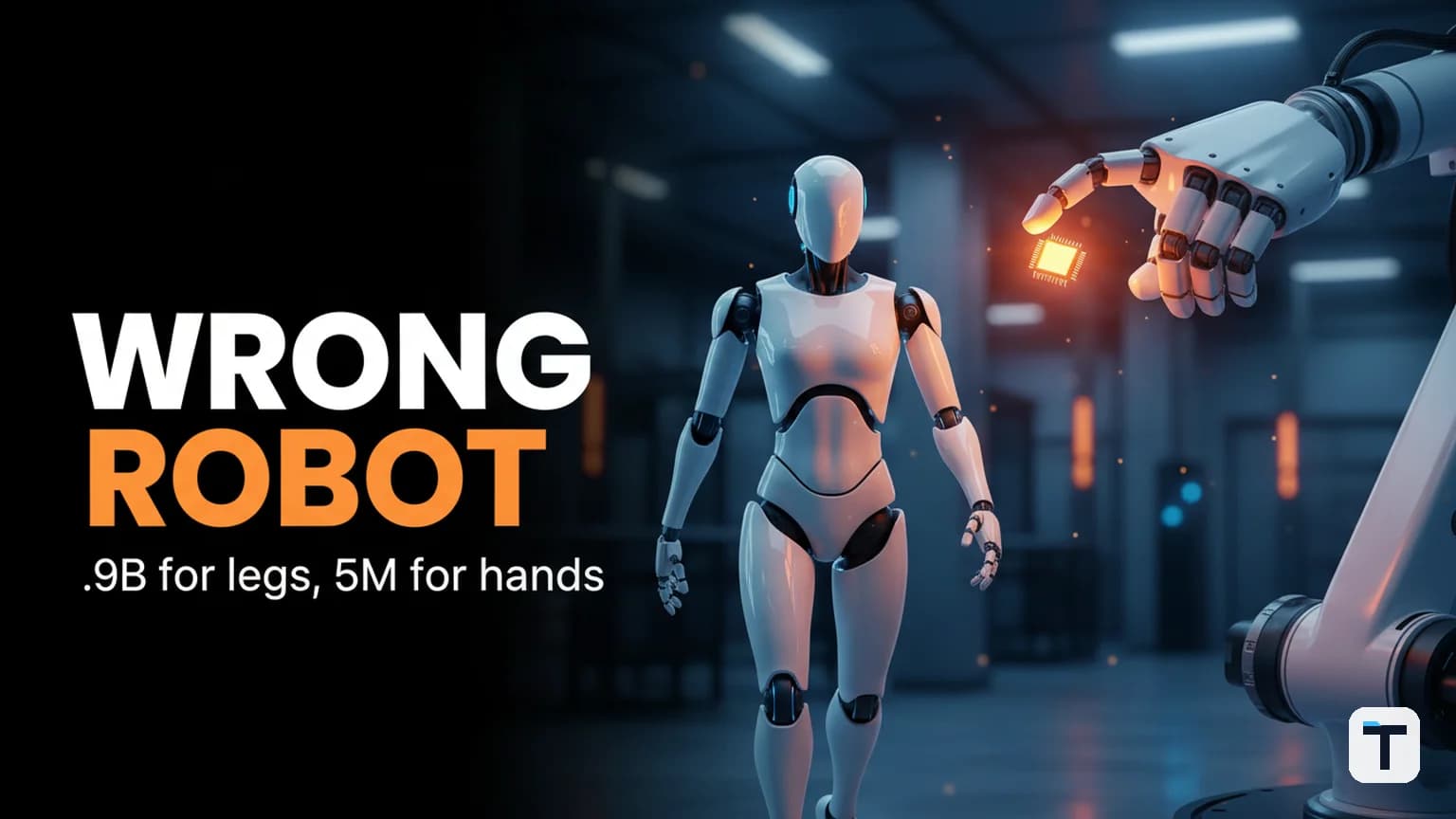

humanoid robot built to look like a person costs $1.9 billion in venture backing and carries a federal whistleblower lawsuit alleging it can "fracture a human skull." A robotic arm that learns to grasp a completely unknown object in 10–15 seconds — the actual bottleneck on every real factory floor — gets $15.3 million. That gap is the single most important fact about the robotics industry in 2026, and it tells you exactly where the next wave of manufacturing value will be captured: not by the company with the biggest humanoid demo, but by the one that solves adaptive manipulation first.
Last verified: 2026-07-29 · Primary keyword: humanoid robots vs adaptive arms · TL;DR: The industry has misallocated roughly 100× more capital to humanoid form factors than to the adaptive manipulation layer that actually unlocks automation. The bottleneck on factory floors is not bipedal walking — it is a robot's ability to handle an object it has never seen before, in lighting that changed, at a tolerance it was not programmed for. That is a manipulation problem, not a locomotion problem.
Why Do Humanoid Robots Get $1.9 Billion While Adaptive Manipulation Gets $15 Million?
Figure AI, the most-funded humanoid robotics company in the world, has raised approximately $1.9 billion total across its Seed, Series A, B, and C rounds, reaching a $39 billion post-money valuation in September 2025 after a Series C that exceeded $1 billion in commitments, led by Parkway Venture Capital with participation from NVIDIA, Microsoft, OpenAI Startup Fund, and Jeff Bezos (Sacra, TechMarketBriefs). In November 2025, Robert Gruendel, Figure's former Head of Product Safety, filed a federal whistleblower complaint in California's Northern District alleging that Figure 02 produced impact force "approximately more than twice the force necessary to fracture an adult human skull" during testing and that the product-safety roadmap was "gutted" the same month Series C closed in a way that "could be interpreted as fraudulent" because investors had reviewed the original safety plan before committing capital (CNBC, Nov 21 2025).
Meanwhile, the actual unsolved problem on factory floors — a robot that can pick up a part it has never seen, oriented in a way it was not programmed for, and assemble it inside a tight space — is being worked on by a handful of startups funded at a fraction of that amount. The disparity is not a coincidence; it is a capital-allocation pattern that mirrors the dot-com era's obsession with "eyeballs" over revenue. Humanoids photograph well. Adaptive arms photograph like a washing machine.
The root cause of the misallocation: venture capital rewards narratives that are easy to visualize (a robot that looks like a person) over problems that are hard to visualize (a robot that can feel a wire connector through a hole it cannot see). The latter is what actually blocks automation across automotive, electronics, and semiconductor manufacturing. Until the industry's capital flow corrects toward manipulation, the billions flowing into humanoids will produce demo videos, not deployed production lines.
What Is the Real Problem on a Factory Floor: Locomotion or Manipulation?
The bottleneck is manipulation — specifically, the inability of traditional robotic arms to adapt to objects and environments that change even slightly. A conventional industrial robotic arm is engineered for repeatability at tolerances of 50–100 microns (about one-fifth the thickness of a human hair). But repeatability is not the same as adaptiveness. If the object shifts by 1–2 mm, or arrives in a different orientation, or has a flexible plastic cover that bends differently each time, the arm forgets what to do. It cannot reconstruct the scene. The problem is that the industry spent two decades pushing precision from 50 microns to 8 microns to 2 microns — assuming the unsolved part was a precision issue — when the actual unsolved part was an adaptiveness issue.
The economic consequence: roughly 70% of the total cost of a robotic-arm solution goes not to the arm itself but to structuring the environment around it — fixtures, jigs, conveyance, vision systems, safety cages, and the engineering hours to make all of it work. The arm is only 30% of the cost. This is why the global industrial robot arm market, estimated at $15.2–31 billion in 2024 depending on the source (Emergen Research, WiseGuyReports) is considered a "small market" by robotics insiders — and why the total robotic-arm solutions market (arm + integration) runs several multiples higher. The integration cost is the tax on rigidity — a tax that compounds across every part variation, and one that the broader AI infrastructure supercycle has not yet begun to reduce.
A human baby picks up an unknown object in seconds with no training. A traditional robotic arm spends 6–9 months retooling to handle a 1 mm dimensional change in a component. That gap — between a baby's zero-shot grasp and a robot's months of reprogramming — is the exact spec a next-generation adaptive manipulation system is trying to close.
Can Foundation Models Trained on Internet Data Produce Physical Intuition?
No — and this is the technical claim that separates the two schools of robotics investment in 2026. Foundation models trained on text and images learn a statistical distribution of tokens and pixels. Physical intuition — the kind that lets a child tilt a coin to read relief, or thread a connector through a hidden hole by feel — is not in that distribution. You cannot mine it from internet-scale data because the relevant signal (force, friction, proprioception, the cross-correlation between what your fingers feel and what your eyes see) was never recorded in text or images at all.
Jensen Huang at NVIDIA GTC 2026 declared "physical AI has arrived — every industrial company will become a robotics company" (NVIDIA Newsroom) and NVIDIA's strategy is to convert the "robotics data problem into a compute problem" by generating millions of synthetic manipulation episodes in Omniverse simulation to pre-train models that need only modest real-world fine-tuning (NVIDIA Blog, GTC 2026). For a deeper look at what Nvidia's physical-AI stack means for builders, see our Nvidia Cosmos 3 Edge physical AI guide. Physical Intelligence, a competing foundation-model-for-robotics startup, raised $400 million in November 2024 led by Jeff Bezos, Thrive Capital, and Lux Capital at a $2.4 billion valuation on the promise of "a single generalist brain that can control any robot" (The Robot Report, Nov 4 2024). The approach generalizes action from fewer examples than traditional AI, with demonstrated tasks including folding laundry and assembling cardboard boxes.
But scale of synthetic data does not automatically produce physical intuition. The counter-thesis: humans do not learn manipulation from a volume of data — a baby grasps, mouths, and throws an object before it has any label for it, using an evolutionary trait the system is born with. That trait is not in a transformer's training distribution because it was never digitized. The implication for builders: a foundation model trained on internet data can produce impressive demos of manipulation tasks that resemble things already on the internet, but generalization to a genuinely novel object in a genuinely novel orientation — the exact thing a Tier-1 automotive supplier needs — remains an open problem. The honest 2026 position, reflected across independent industry analyses (ARC Advisory Group, Jun 2026), is that "the bear case argues the VLA scaling hypothesis is not proven for physical manipulation the way it is proven for language and image generation."
What works, on the honest test floor today, is a hybrid: vision as the primary sensor, but vision understood not as imaging (what a camera captures) but as the cross-correlation between visual stimuli and the manipulation the robot is performing — closer to how hearing differs from listening. The robot's fingers reporting force and friction back into its visual model is what closes the adaptation loop. Pure foundation models without that closed loop produce demos, not deployments.
How Do You Build an Adaptive Manipulation System? The Object-Action-Tool Framework
An adaptive manipulation architecture that actually deploys splits every task into three separable models rather than one monolithic policy. This is the framework practitioners converging on the universal shop floor are using:
- Object model. A representation of the object the robot must handle — not a labeled image, but a functional model that includes how it deforms, where its center of mass sits, and what surfaces are graspable. Critically, the robot builds this model live the first time it sees the object, not from a pre-collected dataset of millions of images.
- Action model. A library of manipulations — pick, place, cap, thread, straighten, mate — that is object-agnostic. The same "thread a connector through a hole" action model can be reused across a wire connector, a plastic cap, or a coolant hose. This is where the generality comes from: actions are portable across objects.
- Tool model. The gripper, finger, or end-effector geometry the robot is actually using. A robot's decision process changes fundamentally depending on whether it has two fingers, a suction cup, or a magnetic gripper — and the action model must account for the tool's limitations the same way a human adjusts grasp depending on whether they are wearing gloves or holding tongs.
A task is then a recipe: the object model × the action model × the tool model. Pick the pen. Remove the cap. Put the pen in a pocket. Three different recipes on the same object, reusing action models that were learned once. This decomposition is what makes a single hardware platform repurposable across tasks through software — the "software-defined factory line" — without the 6–9 month retooling cycle that traps conventional robot arms in a "customization sickness" where the customer has no defensibility when the product version changes. The same architectural principle — separate the task from the hardware, then compose them at runtime — is what powers the 5-layer local AI stack for software workloads, applied here to physical workloads.
| Approach | Pre-training data | Live adaptation | Deployment time | Example |
|---|---|---|---|---|
| Conventional industrial arm | None (hard-coded paths) | None | 6–9 months per change | Welding and paint shops in auto OEMs |
| Foundation model (VLA) | Internet-scale + synthetic sim | Limited to in-distribution objects | Weeks to months, demo-grade | Folding laundry, assembling boxes (Physical Intelligence pi-zero) |
| Object-Action-Tool adaptive | Lightweight, built live per object | 10–15 seconds on a novel object | Function → cycle-time → reliability stages | Audi door-mirror assembly pilot |
What Does the Capital-Misallocation Pattern Mean for Anyone Automating a Line?
Three concrete implications for builders and operators deciding where to place automation bets in 2026:
1. Do not wait for a humanoid. Goldman Sachs projects the global humanoid robot market at $38 billion by 2035 — and Figure's current $39 billion valuation already exceeds that projected TAM nine years out (TechMarketBriefs). That is a market signal, not a technology signal. For any line you need automated within the next 5 years, the deployed solution is an adaptive arm or a cobot, not a biped.
2. Budget for the integration tax, then attack it. If 70% of your robotic solution cost is environment-structuring engineering, the highest-ROI automation investment you can make is in adaptiveness — the layer that lets you skip the fixtures and jigs. A vendor that quotes $20,000 for the arm and $150,000–$200,000 for the integration is telling you the arm is not the product; the adaptiveness is. When you evaluate vendors, ask: how long does it take this system to handle a part it has never seen? Six months is the old world. Ten-to-fifteen seconds is the new world.
3. Match the solution to the task structure, not the form factor. As ARC Advisory Group put it after Automate 2026: "The future of industrial automation is not about building robots that look like humans. It's about building robots that understand and interact with the physical world as effectively as humans do" (ARC, Jun 2026). For high-speed repetitive tasks in structured environments, a conventional arm or cobot still wins. For dynamic, multi-step, contact-rich assembly tasks where the part changes — mirror-into-door, wire-through-hole, connector-mating — the bet is on adaptive manipulation, regardless of whether the body carrying the hand has legs or a base plate. The same "match the architecture to the task, not the hype" principle applies to the single-agent vs multi-agent architecture decision: the interesting question is not which form is more impressive, but which form fits the task's actual constraints.
What Is the Deployment Journey From Demo to Mass Production?
A laboratory demonstration of adaptive manipulation is not a deployable solution. The honest path from a working demo to a mass-production deployment runs through five stages, and knowing them protects you from vendors who show you a Stage-1 video and quote a Stage-5 price:
- Function. The robot completes the task at all, in any time, with any failure rate. This is where demo videos come from.
- Cycle time. The robot completes the task within the production-line's allotted time (e.g., 40 seconds for a mirror-into-door assembly). A task done in 2.5 minutes is not a production task — it is a research artifact. Closing that gap is a multi-month engineering effort.
- Reliability. The robot completes the task repeatedly, across shifts, without human intervention. This is where most adaptive-manipulation startups are today — and where the funding should be flowing.
- Process and safety integration. The robot's workflow is reimagined around robot abilities and inabilities (not human ones), and the safety case is made to regulators and insurance carriers.
- Mass production. Throughput, cost-per-part, and uptime hit the commercial threshold that justifies the line investment.
Buyers evaluating any robotics vendor in 2026 should ask which stage the vendor is at, and refuse to pay Stage-5 prices for Stage-1 capability. The whistle-blower lawsuit against Figure — alleging safety protocols were "gutted" the month the funding round closed (CNBC) — is exactly what happens when investors push a company to skip from Stage 1 to Stage 5 on capital velocity rather than engineering.
What This Means for You
If you are a small business or a mid-sized manufacturer automating a line in 2026, the practical action is this: stop waiting for a humanoid, and start specifying adaptive manipulation as a line-item in your automation RFP. Ask every vendor how many seconds it takes their system to grasp a part it has never seen. If the answer is "we'll need 6 months of programming," you are being quoted 2010-era robotics at 2026 prices. If the answer is "10–15 seconds with a live-built object model," you are looking at the layer where the next decade of manufacturing value is being captured.
If you are an investor or a builder, the asymmetry is the opportunity: the manipulation layer — the actual unsolved problem — is funded at roughly 1/100th of the humanoid layer. The company that closes the adaptive-grasping gap with a deployable, reliable, cycle-time-competitive system has a larger addressable market than the entire humanoid TAM, because every existing industrial robotic arm on Earth is a potential customer for the adaptiveness upgrade. The $1.9 billion chasing humanoids is not wrong because humanoids will never work; it is wrong because the manipulation layer has to be solved first, and it is being starved while the form factor is being fed.
FAQ
Q: What is the difference between a humanoid robot and an adaptive robotic arm?
A: A humanoid robot is built to imitate the human body plan — two arms, two legs, a torso — so it can operate in environments originally designed for people. An adaptive robotic arm is a manipulator (it may or may not be humanoid) engineered to handle objects it has never seen before, in varying orientations, without pre-programmed paths. The humanoid is a form factor; adaptiveness is a capability. They are independent decisions: you can have an adaptive arm without legs, or a humanoid without adaptiveness.
Q: Why did Figure AI raise $1.9 billion while adaptive-manipulation startups raised far less?
A: Venture capital rewards narratives that are easy to visualize and easy to pitch. A humanoid that walks, waves, and carries a box photographs well and maps to a familiar mental model ("a robot butler"). An adaptive arm that quietly grasps a wire connector through a hidden hole in 15 seconds looks like industrial machinery. The funding gap reflects a visualization bias, not a market-size assessment — the manipulation-layer market (every existing industrial arm needing an adaptiveness upgrade) is materially larger than the humanoid market.
Q: Is the Figure AI whistleblower lawsuit about a real safety failure?
A: The lawsuit is real and pending. Filed November 21, 2025 in the Northern District of California by Robert Gruendel, Figure's former Head of Product Safety, it alleges Figure 02 generated impact force more than twice what is needed to fracture an adult human skull, that one robot carved a quarter-inch gash into a steel refrigerator door during a malfunction, and that the safety roadmap was cut the same month Series C closed in a way that "could be interpreted as fraudulent" because investors had reviewed the original plan (CNBC). Figure denies the allegations and counter-sued in January 2026 alleging trade-secret violations. The case is unresolved.
Q: Can a foundation model like GPT-style AI solve robotic manipulation by scaling up?
A: Not proven. Language generation is a forward-pass prediction problem; manipulation is a closed-loop control problem with contact physics that is not represented in a text-and-image training distribution. NVIDIA's bet is that synthetic simulation data in Omniverse closes this gap by generating millions of physically accurate manipulation episodes (NVIDIA GTC 2026). Skeptics argue the sim-to-real gap remains large for contact-rich tasks and that physical intuition — the kind a baby uses to mouth and throw an unknown object — is an evolutionary trait not present in any internet-scale dataset (ARC Advisory Group). The honest 2026 verdict: foundation models produce demos, deployed reliability still requires a closed-loop object-action-tool architecture.
Q: How long does it really take to deploy a robotic arm on a new task?
A: With a conventional industrial arm: 6–9 months per dimensional change in the part, because the environment (fixtures, jigs, vision) must be re-engineered around the arm's rigidity. With an adaptive manipulation system that builds an object model live: 10–15 seconds to learn a new object once the system is integrated. The deployment journey from laboratory demo to mass production still runs through five stages — function, cycle time, reliability, process/safety integration, and mass production — and a vendor showing you a Stage-1 demo video while quoting a Stage-5 price is the most common procurement trap in 2026 robotics.
Q: Should India's robotics policy bet on humanoids or on adaptive manipulation?
A: India's Semiconductor Mission 2.0, approved by the Union Cabinet with a Rs 1.27 lakh crore outlay in July 2026 (Indian Express, Jul 16 2026), is a manufacturing-capacity bet that directly benefits from adaptive manipulation — semiconductor assembly, electronics manufacturing, and automotive supply-chain vendors all need arms that handle flexible parts and changing designs, not bipedal walkers. Read alongside our India PLI Scheme results analysis, the pattern is clear: the practitioners urging policy to distinguish deep-tech IP (methods to make) from manufacturing-capacity investment (localizing motors, fabrication processes) are right — capital routed into the manipulation layer compounds across every sector, while capital routed into a single form factor bets on one product.
Discussion
0 comments