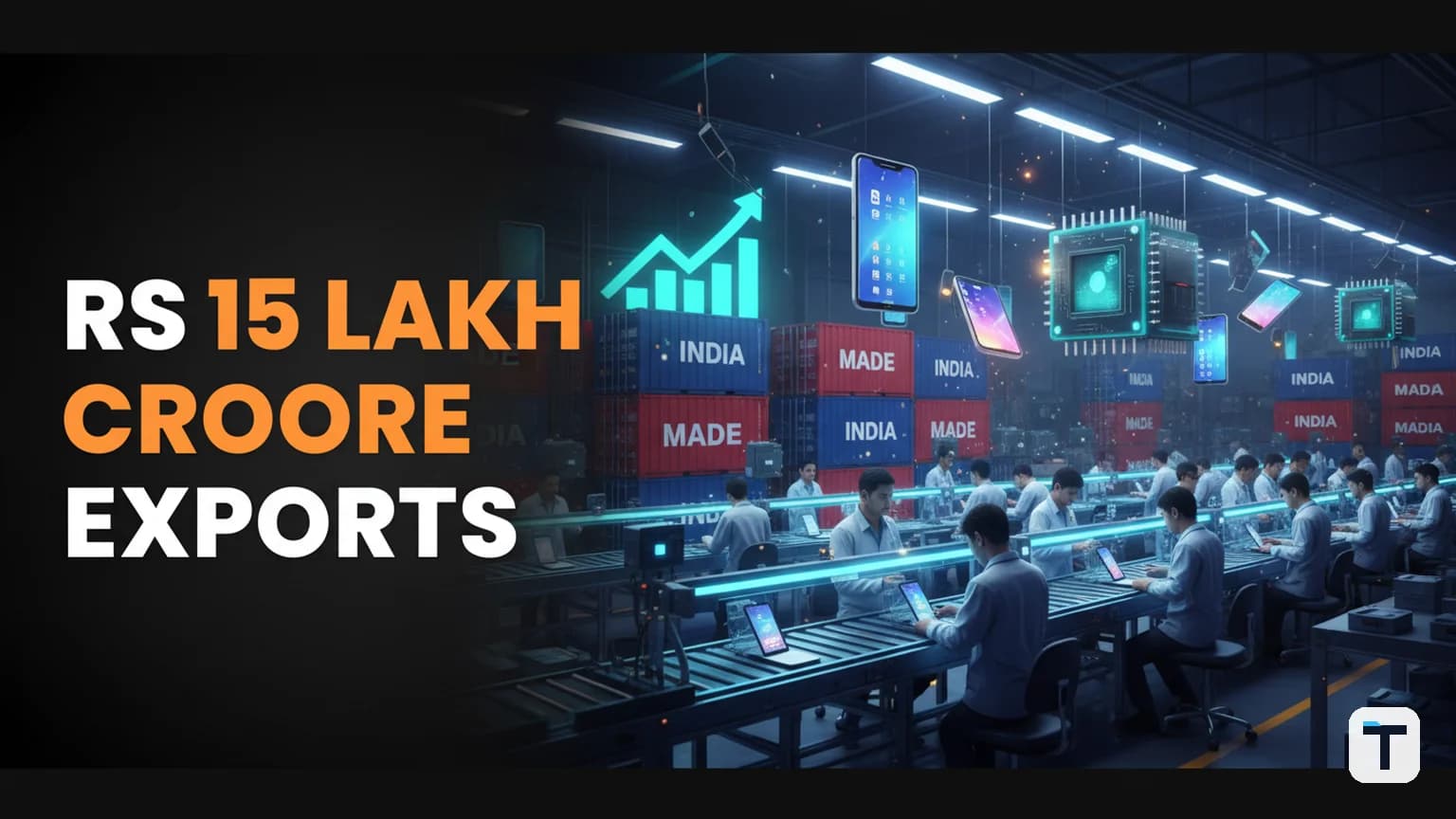

Verdict: India's Production Linked Incentive (PLI) scheme has delivered measurable, audited results by March 2026 — Rs 2.4 lakh crore in actual investment, over 14.15 lakh direct and indirect jobs, and cumulative exports crossing Rs 15.2 lakh crore across 14 sectors. The electronics sector carried most of the weight (mobile production up 2.4x, imports down 77%), but the real story is breadth: five very different industries — electronics, pharmaceuticals, telecom, medical devices, and white goods — all show the same pattern of domestic capacity building scaling toward export markets.
Last verified: 2026-07-29 · Investment: Rs 2.4 lakh crore · Jobs: 14.15 lakh+ · Exports: Rs 15.2 lakh crore+ · Sectors: 14
Volatile facts: Export and investment figures are cumulative through March 31, 2026. Disbursement data (Rs 28,748 crore of the Rs 1.91 lakh crore outlay disbursed) comes from the Ministry of Commerce PIB release of March 27, 2026. Numbers will shift on the next Lok Sabha update (expected Q3 2026).
What Is India's PLI Scheme and How Does It Work?
The Production Linked Incentive (PLI) scheme is a performance-based manufacturing subsidy launched in April 2020. Companies receive cash incentives proportional to their incremental sales of goods manufactured in India — the more they produce and sell above a baseline year's output, the more incentive they earn (typically 4–6% of incremental sales, tapering over five years). Unlike unconditional subsidies, no production means no payout: the government's fiscal exposure is linked to actual output.
The scheme was launched with an approved outlay of Rs 1.97 lakh crore (approximately $26 billion at launch) across 14 sectors, later reported at Rs 1.91 lakh crore in the July 2026 Lok Sabha reply — reflecting minor adjustments as some sub-schemes were rationalized. DPIIT (Department for Promotion of Industry and Internal Trade) is the nodal coordinator; each sector is implemented by its respective ministry. The 14 sectors are: Large Scale Electronics Manufacturing, IT Hardware, Pharmaceuticals, Bulk Drugs (APIs), Medical Devices, Automobiles and Auto Components, Specialty Steel, Telecom and Networking Products, White Goods (ACs and LEDs), Food Products, Textiles (MMF and Technical Textiles), High-Efficiency Solar PV Modules, Advanced Chemistry Cell (ACC) Batteries, and Drones and Drone Components. [PIB, March 2026]
How Much Investment Has the PLI Scheme Actually Attracted?
As of March 31, 2026, the PLI schemes attracted cumulative actual investments of over Rs 2.4 lakh crore (approximately $25.55 billion) across 836 approved applications. This is up from Rs 1.76 lakh crore reported by PIB in August 2025 and Rs 2.16 lakh crore reported as of December 2025 — indicating that roughly Rs 64,000 crore of additional investment was realized in the last quarter of FY2025-26 alone. [ANI / Lok Sabha reply, July 21, 2026] [PIB, March 27, 2026]
The investment-to-outlay ratio matters: Rs 2.4 lakh crore invested against an outlay of Rs 1.91 lakh crore means private capital mobilized exceeds the government's total committed spend. The actual incentive disbursed so far is far lower — Rs 28,748 crore over five years — because disbursements follow verified production, and most sectors are still ramping. [PIB, March 27, 2026] [Fiscal Zenith analysis]
How Many Jobs Has the PLI Scheme Created?
The PLI schemes generated over 14.15 lakh (1.45 million) direct and indirect jobs as of March 31, 2026. Of these, approximately 8.5 lakh were direct jobs and over 5.5 lakh were indirect — with indirect employment concentrated in large-scale electronics manufacturing, IT hardware, and solar PV modules. [Business Standard, July 2026]
Sector-wise, the food products segment generated the highest employment at 3,29,200 jobs, while the advanced chemistry cell (ACC) battery segment created the least at 1,245 jobs — reflecting different maturity stages of each sub-scheme. Solar PV modules attracted the highest investment at Rs 64,873 crore, while drones and drone components received the least at Rs 595 crore. [Business Standard, July 2026]
How Much Have PLI Exports Grown?
Cumulative exports under PLI sectors crossed Rs 15.2 lakh crore (approximately $161.7 billion) since the scheme's inception, as of March 31, 2026. This is up from Rs 4 lakh crore as of March 31, 2024 — a 280% jump in two years. An earlier PIB release reported Rs 8.3 lakh crore in exports as of December 2025, meaning roughly Rs 6.9 lakh crore of exports were recorded in just the last quarter of FY25-26, likely reflecting electronics export momentum ahead of the February 2026 end of the original mobile manufacturing scheme window. [ANI / Lok Sabha reply, July 21, 2026] [PIB, March 27, 2026]
PLI scheme results by the numbers (March 2026)
| Metric | Value as of March 31, 2026 | Previous data point | Source |
|---|---|---|---|
| Cumulative investment | Rs 2.4 lakh crore | Rs 1.76 lakh crore (Mar 2025) | Lok Sabha reply, PIB |
| Cumulative exports | Rs 15.2 lakh crore | Rs 4 lakh crore (Mar 2024) | Lok Sabha reply, ANI |
| Direct + indirect jobs | 14.15 lakh | 9.5 lakh (Aug 2024) | Lok Sabha reply, Business Standard |
| Approved outlay | Rs 1.91 lakh crore | Rs 1.97 lakh crore (initial) | Lok Sabha reply, PIB |
| Incentives disbursed | Rs 28,748 crore | — | PIB, March 2026 |
| Sectors covered | 14 | 3 (at launch 2020) | PIB |
How Did the Electronics Sector Perform Under PLI?
The large-scale electronics manufacturing (LSEM) scheme is the PLI's flagship. Mobile phone production has increased roughly 2.4 times since the scheme's launch. Mobile phone imports have declined by about 77%, and approximately 99.2% of mobile phones used in India are now manufactured domestically. In FY2024-25 alone, electronics production under PLI reached Rs 5.25 lakh crore (up 146% from Rs 2.13 lakh crore in FY2020-21). The electronics sector received Rs 15,554 crore in incentive disbursements — the largest of any sector — with 59 companies reporting incremental production of Rs 2,45,375 crore in FY25-26 through December 2025. [ANI / Lok Sabha reply, July 21, 2026] [PIB, March 27, 2026] [PIB, August 2025]
The shift is structural. India went from importing nearly all smartphones to making 99.2% domestically. That's not incremental progress — it's a near-complete reversal of the phone supply chain. Companies like Foxconn, Pegatron, and Tata Electronics set up or expanded assembly in India, with the Tamil Nadu electronics manufacturing clusters receiving fresh EMC approval for Rs 1,012 crore. This complements India's broader semiconductor ambitions under the India Semiconductor Mission, which also links to emerging LED manufacturing capacity at firms like Seoul Semiconductor's India plant.
What Did the Pharma PLI Scheme Achieve?
The pharmaceuticals PLI scheme recorded cumulative sales of over Rs 3.64 lakh crore. It enabled domestic manufacture of 1,931 pharmaceutical products, including 191 bulk drugs (active pharmaceutical ingredients, or APIs) manufactured in India for the first time ever. India built manufacturing capacity of roughly 55,000 metric tons across 26 critical APIs — reducing import dependence for drugs like paracetamol, levofloxacin, and norfloxacin that India was previously importing the raw ingredients for. [ANI / Lok Sabha reply, July 21, 2026]
The macro picture is telling: India transitioned from a net importer of bulk drugs (Rs 1,930 crore deficit in FY2021-22) to a net exporter (Rs 2,280 crore surplus in FY2024-25). The overall domestic value addition in the sector reached 83.70% as of March 2025. [PIB, August 2025]
How Did Telecom, Medical Devices, and White Goods Perform?
The telecom and networking products scheme supported the development of indigenous 4G technology and domestic manufacturing capability for 5G telecom equipment — strengthening India's telecom manufacturing ecosystem.
The medical devices PLI scheme facilitated domestic manufacturing of advanced medical equipment India previously had to import, with device parks developing in Andhra Pradesh and Tamil Nadu. [PIB, August 2025]
The white goods (air conditioners and LEDs) scheme showed the fastest capacity scaling of any sector: compressor manufacturing capacity grew from 1 million units in 2021 to 10 million units in 2025-26 — a 10-fold increase in under five years. Localization of key components like PCBAs (printed circuit board assemblies) and cross-flow fans improved substantially, enabling domestic manufacturing of several critical AC components that were almost entirely imported just a few years ago. The white goods scheme targets moving domestic value addition from 20-25% up to 75-80% by 2028-29. [ANI / Lok Sabha reply, July 21, 2026] [PIB, August 2025]
PLI Sector Performance Compared
| Sector | Key result | Source |
|---|---|---|
| Electronics (mobile + IT) | Rs 2,45,375 crore incremental production (FY26 through Dec); Rs 15,554 crore disbursed | PIB Mar 2026 |
| Pharmaceuticals | Rs 3.64 lakh crore cumulative sales; 191 bulk drugs first-time domestic | Lok Sabha Jul 2026 |
| Telecom | Indigenous 4G + 5G equipment manufacturing capability | Lok Sabha Jul 2026 |
| Medical Devices | New device parks in AP and TN; import substitution of advanced equipment | PIB Aug 2025 |
| White Goods | Compressors 1M -> 10M units; AC component localization surged | Lok Sabha Jul 2026 |
| Solar PV | Highest investment at Rs 64,873 crore; 48 GW targeted capacity | Business Standard Jul 2026 |
| Automobiles | Rs 2,377.56 crore disbursed; Rs 67,690 crore committed investment | PIB Mar 2026 |
| Food Products | Highest job creation at 3,29,200 jobs | Business Standard Jul 2026 |
| Textiles | MMF exports Rs 525 crore (FY25); outlay Rs 10,683 crore | PIB Aug 2025 |
What This Means For You
If you run or invest in a manufacturing business: India's PLI scheme has created real production capacity across 14 sectors, with verified export numbers — not just promises. The compliance framework is transparent (production-linked, audited by the government). If you're in electronics assembly, pharma APIs, solar PV, auto components, or specialty steel, the incentive window for some sub-schemes is narrowing while budgets for 2025-26 were significantly increased (electronics from Rs 5,777 crore to Rs 9,000 crore; autos from Rs 347 crore to Rs 2,819 crore). Talk to the relevant sector ministry or DPIIT. [PIB, Budget 2025-26]
If you work in supply chain sourcing: India now manufactures 99.2% of its mobile phones and has started making pharmaceutical APIs that it previously imported from China. This changes sourcing risk calculations — some India-based suppliers are now viable alternatives for components and APIs, similar to what the Amara Raja Telangana cell qualification plant signals for the battery value chain.
If you follow industrial policy as an analyst: The PLI is India's largest experiment in performance-linked industrial subsidy. At Rs 28,748 crore disbursed against Rs 2.4 lakh crore invested, the fiscal multiplier is strong, but the scheme is entering its phase-out window for early sub-schemes. The question is whether newer bets — Semicon 2.0, the revised mobile manufacturing scheme, and ACC batteries — can replicate LSEM's track record, or whether execution risk grows with ambition. Global context: China's manufacturing is over 25% of GDP; India's is under 17%, so the structural gap remains real. [Arthneeti Global, March 2026]
If you are tracking India's broader economic trajectory: This connects to the consumer battery manufacturing story in the Amara Raja Telangana plant, the Odisha industrial stack (Rs 4,573 crore across 23 projects), the Ford Tamil Nadu engine plant revival (Rs 3,250 crore), and UAE-India $5 billion sovereign wealth investment — all pieces of the same export-pivot story.
Related reading
FAQ
Q: What is the total investment attracted by India's PLI scheme? A: Over Rs 2.4 lakh crore (approximately $25.55 billion) as of March 31, 2026, across 836 approved applications in 14 sectors. This is up from Rs 1.76 lakh crore in March 2025. The approved outlay is Rs 1.91 lakh crore, meaning private capital has exceeded the government's total committed spend. [ANI / Lok Sabha reply, July 21, 2026]
Q: How many jobs has the PLI scheme created? A: Over 14.15 lakh (1.45 million) direct and indirect jobs as of March 2026, including approximately 8.5 lakh direct and 5.5 lakh indirect jobs. Food products generated the most jobs at 3,29,200; ACC batteries the least at 1,245. [Business Standard, July 2026]
Q: How much have exports grown under the PLI scheme? A: Cumulative exports crossed Rs 15.2 lakh crore (approximately $161.7 billion) as of March 31, 2026, up 280% from Rs 4 lakh crore as of March 2024. [ANI / Lok Sabha reply, July 21, 2026]
Q: Which PLI sector has performed the best? A: Large-scale electronics manufacturing is the flagship. Mobile production increased 2.4x, imports fell 77%, and 99.2% of phones in India are now made domestically. The sector received Rs 15,554 crore in disbursements — the most of any PLI sub-scheme. [PIB, March 27, 2026]
Q: How much has the government actually paid out under the PLI scheme? A: Rs 28,748 crore has been disbursed over five years across all sectors. The scheme is performance-linked — payouts follow verified incremental production — so disbursement is lower than the Rs 1.91 lakh crore approved outlay. Electronics (Rs 15,554 crore) and automobiles (Rs 2,377.56 crore) are the top disbursed sectors. [PIB, March 27, 2026]
Q: Can India's newer PLI schemes (Semicon 2.0, mobile manufacturing 2.0) replicate this track record? A: The early data is promising but the answer is not yet settled. The original electronics scheme succeeded because it combined a large domestic market, willing global OEMs (Foxconn, Pegatron, Tata Electronics), and a focused incentive structure. Newer schemes targeting semiconductors and ACC batteries face higher entry barriers (capex, technical complexity). The government's own data shows sector maturity varies: solar PV already drew Rs 64,873 crore while drones drew only Rs 595 crore. Execution risk is expected to grow with ambition. [Business Standard, July 2026]
Discussion
0 comments