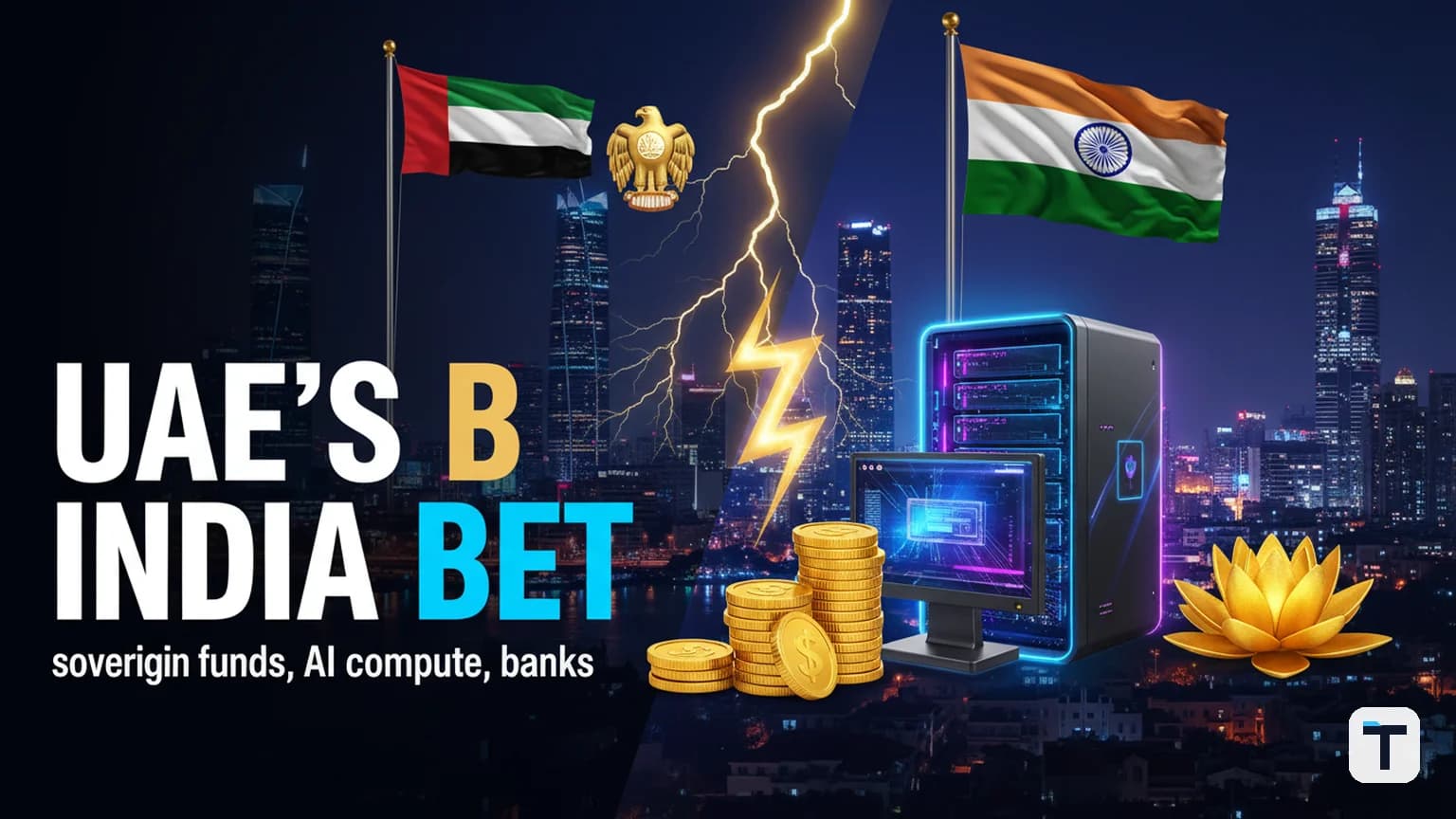

Verdict: The headline figure — roughly $5 billion in fresh UAE sovereign and corporate capital committed to India during Prime Minister Narendra Modi's May 2026 visit to Abu Dhabi — is real, but the more important story is the shape of the money. Across 2025–2026, the UAE has moved from being India's largest Arab-world trade partner to becoming a co-architect of India's AI, financial, and energy infrastructure: Emirates NBD bought a controlling stake in RBL Bank for ~$3 billion, the International Holding Company took 41.5% of Sammaan Capital for $1 billion, ADIA deepened its infrastructure-fund backing, G42 and C-DAC signed a term sheet to deploy an 8-exaflop AI supercomputer, and ADNOC expanded India's strategic petroleum reserves to up to 30 million barrels. Most of the cash has now landed — but plenty of the headline figure is still mandates and term sheets, not deployed capital. Watch the deployment pace, not the announcement count.
Last verified: 2026-07-29
- $5B+ in UAE capital committed across Indian financial services, infrastructure, AI compute, and energy in 2025–2026.
- Four anchor sectors: AI infrastructure, financial services, food security / agri-processing, logistics.
- UAE now supplies more than 70% of all GCC investment inflows into India (UAE Ministry of Investment, July 2026).
- Bilateral trade target: $200 billion by 2032, up from ~$100 billion in FY 2024–25.
- Pricing/limits change often — last checked 2026-07-29.
What's the big deal: is this just a normal bilateral investment, or something more?
It is materially more. The UAE–India corridor has shifted from a trade relationship (oil and gems flowing one way, rice and pharma the other) into a shared-infrastructure partnership. Three signals distinguish 2025–2026 from earlier rounds of UAE capital heading into India:
- Equity, not just loans. Emirates NBD put primary capital into RBL Bank — a controlling stake, not a portfolio bet. IHC took a promoter's role in Sammaan Capital, with rights to appoint a majority of the board. That is not "writing a cheque" — it is taking ownership of an Indian financial franchise.
- Compute, not just cash. The G42–C-DAC 8-exaflop Condor Galaxy India deal is part of India's sovereign AI Mission. It puts Cerebras-based AI training capacity inside India under Indian jurisdiction, with a UAE-hosted operations team. The bilateral investment treaty that entered force in 2024 created the legal scaffold; in 2026 the projects that flow through it are explicitly co-developed, not just capital-funded.
- Energy security, not just trade. ADNOC's expanded crude-storage agreement with India's ISPRL — up to 30 million barrels in Indian underground reserves — is a physical buffer inside India, not a supply contract on a tanker route. India is also exploring storage at Fujairah, the UAE's eastern hub outside the Strait of Hormuz. That is a two-way hedge against disruption, not a vendor relationship.
For builders, this matters because where Gulf sovereign capital goes, capability follows: GPU capacity, banking licences, logistics corridors, and cold-chain infrastructure come along with the money, and the bilateral governance framework decides which rules apply.
Who is investing the $5 billion, and where did it actually go?
The "$5 billion" figure, widely reported around Modi's May 2026 visit, is best understood as the sum of several distinct UAE sovereign and corporate investments across India — not a single bag dropped at one ceremony. Here are the pieces, verified against primary sources.
Emirates NBD → RBL Bank: ~$3 billion (controlling stake)
- What: Emirates NBD Bank (P.J.S.C.), Dubai's largest bank, acquired a majority controlling stake in Mumbai-listed RBL Bank through a primary capital infusion of approximately USD 2.75 billion (~INR 26,000 crore), with the total deal value (including a mandatory open offer for 26% of public shares at ₹280 each) approaching $3 billion. (RBL Bank press release, 18 June 2026; Economic Times, 15 May 2026)
- When: Announced 18 October 2025; RBI approval April 2026; Government of India final nod 15 May 2026; completion 18 June 2026.
- Why it matters: India's biggest foreign direct investment in financial services, and the first foreign acquisition of a majority stake in a listed Indian private bank. Emirates NBD's India branches will be folded into RBL Bank, extending UAE banking reach into India's retail and corporate lending — not just trade finance.
IHC (International Holding Company) → Sammaan Capital: ~$1 billion (promoter stake)
- What: Abu Dhabi's International Holding Company PJSC (IHC) acquired approximately 41.5% of Sammaan Capital Limited (formerly Indiabulls Housing Finance) on a fully diluted basis, for a total transaction value of approximately US$1 billion (INR 8,850 crore), executed through its affiliate Avenir Investment RSC. Sammaan Capital is now classified as an IHC "Promoter," with rights to appoint a majority of the board. (WAM, 31 March 2026; Sammaan Capital news page)
- When: Announced 3 October 2025; first tranche of ₹5,652 crore received 31 March 2026; mandatory tender offer for up to 26% public shares to follow.
- Why it matters: IHC is a strategic investor at promoter scale — the kind of position that lets the UAE shape a large Indian NBFC's strategy, not just collect dividends. IHC parked Sammaan inside its newly formed financial services vehicle, Judan Financial.
ADIA → India's second NIIF Infrastructure Fund
- What: The Abu Dhabi Investment Authority (ADIA) deepened its participation in India's National Investment and Infrastructure Fund (NIIF), with Abu Dhabi reported to be putting $1 billion into the second infrastructure fund (Fund II), which is targeting roughly $3.5 billion total. The Government of India has already contributed nearly half of the target. (Infrastructure Investor, 2 July 2026; ETV Bharat, January 2026)
- Context: ADIA was already the first institutional investor in NIIF Master Fund I back in 2017 with a $1 billion anchor (The National, October 2017). The second fund, slated for launch in 2026, formalises that recurring relationship.
- Why it matters: NIIF is the Indian government's channel for foreign capital into long-horizon infrastructure — roads, energy transition, digital infrastructure. A sovereign wealth fund committing ahead of first close is a forward bet on India's infra pipeline, not a single-project stake.
G42 → 8-exaflop Condor Galaxy India AI supercomputer (C-DAC partnership)
- What: Abu Dhabi-based G42, in partnership with US AI chipmaker Cerebras and India's Centre for Development of Advanced Computing (C-DAC), will deploy Condor Galaxy India — an 8-exaflop AI supercomputing cluster comprising 64 Cerebras CS-3 wafer-scale systems. G42 is responsible for installation, deployment, operations and maintenance. All data stays under Indian jurisdiction. (GCC Business News, 16 May 2026; Inc42; pressinsider.com)
- When: Term sheet signed during Abu Dhabi Crown Prince Sheikh Khaled bin Mohamed bin Zayed Al Nahyan's visit at the India AI Impact Summit, February 2026; framework and commercial terms finalised during Modi's May 2026 visit. Originally announced as a bilateral MoU in 2024.
- Scale context: India's two flagship AI supercomputers today (AIRAWAT and PARAM Siddhi-AI) combine to about 410 petaflops of peak compute. Condor Galaxy India's 8 exaflops is roughly 19× that combined peak — a step-change for India's sovereign compute posture under the IndiaAI Mission. (Inc42)
This is the most strategically interesting piece of the $5B story — and it is the one I'd track most closely. Sovereign AI compute is becoming a dividing line between capital-exporting and capital-importing economies. If you want to see how the same dynamic is playing out in Europe (Microsoft pouring billions into Mistral's sovereign GPU capacity inside France), read our analysis of the Microsoft–Mistral AI partnership and what sovereign compute deals actually buy you.
ADNOC → India's Strategic Petroleum Reserves (SPR) + LPG supply
- What: ADNOC signed a strategic collaboration agreement with Indian Strategic Petroleum Reserves Limited (ISPRL) during Modi's May 15, 2026 visit, aiming to boost crude holdings in India's SPRs to up to 30 million barrels at existing and new sites — Mangaluru, Visakhapatnam, and Chandikhol. India will separately explore crude storage at the UAE's Fujairah hub. A long-term LPG supply agreement was signed between Indian Oil Corporation and ADNOC. (S&P Global Platts, 15 May 2026; Republic World, 15 May 2026)
- Earlier LNG piece: On 19 January 2026, ADNOC Gas separately signed a 10-year LNG supply agreement with Hindustan Petroleum Corporation Limited (HPCL) for 0.5 million metric tonnes per year starting 2028. (IBEF, India-UAE trade timeline)
- Why it matters: ADNOC already held ~5 million barrels in ISPRL's Mangaluru facility since 2018. The new target — 30 million — is six times that, and it puts Indian-controlled emergency reserves inside the UAE as a hedge against Strait-of-Hormuz disruption. That is genuine energy-security architecture, not a vendor renewal.
Summary table — capital flows, 2025–2026
| Investor (UAE) | Indian target | Headline amount | Asset / stake | Status as of July 2026 | Primary source |
|---|---|---|---|---|---|
| Emirates NBD | RBL Bank | ~$3B (≈$2.75B primary infusion + open offer) | Majority controlling stake (~60%) | Completed 18 June 2026 | RBL press release; Economic Times |
| IHC (via Avenir) | Sammaan Capital | ~$1B (₹8,850 crore) | 41.5% fully-diluted (Promoter) | First tranche received Mar 2026; open offer pending | WAM; Sammaan Capital |
| ADIA | NIIF Infrastructure Fund II | ~$1B (reported) | LP commitment | Ahead of first close ($3.5B target) | Infrastructure Investor |
| ADNOC | ISPRL (India SPR) | Up to 30M barrels (physical) | Crude storage in India + Fujairah | Agreement signed 15 May 2026 | S&P Global Platts |
| G42 + Cerebras | C-DAC (India AI Mission) | Capacity (not equity) | 8-exaflop AI cluster, 64 CS-3 systems | Term sheet Feb 2026; framework May 2026 | Inc42; GCC Business News |
The "$5B" widely reported for the May 2026 visit is best read as the sum of Emirates NBD–RBL ($3B) and IHC–Sammaan ($1B), plus ADIA's NIIF and ADNOC/ISPRL commitments reported around the same window. The G42–C-DAC supercomputer is a capacity-and-operations deal, not a single cheque, and is tracked separately by India's Ministry of External Affairs.
What sectors are the UAE funds actually targeting in India?
Four sectors keep showing up across every major announcement in 2025–2026 — and they are not random. They map directly to where the UAE sees India's next-decade growth and where India needs foreign capital and capability the most.
1. AI infrastructure and sovereign compute
This is the most strategically novel pillar. G42's Condor Galaxy India is the headline, but the surrounding stack matters: India's AI infrastructure build-out is being co-financed by foreign sovereign actors in ways the old telecom or roads infrastructure never was. The IndiaAI Mission has approximately 34,333 GPUs empanelled across cloud providers as of mid-2026, with a stated target of 100,000 public GPUs by December 2026 (PIB; IndiaAI compute portal). Condor Galaxy India's 8 exaflops sit on top of that — it is dedicated AI supercomputing capacity, not general cloud GPU, and it is operated from outside the hyperscaler gatekeeper model.
The IndiaAI Mission was approved by the Cabinet in March 2024 with a Rs 10,371 crore (~$1.24B) outlay and seven pillars: compute, foundation models, datasets, application development, AI safety, startup support, and skills. UAE participation is concentrated in the compute pillar. Other sovereign-compute deals (Korea, in the SK-Nvidia $500B factory story; Europe, in the Microsoft-Mistral deal) are following the same template — foreign capital and operations capability into India's or Europe's domestic jurisdiction. For a deeper read on the global AI infrastructure supercycle that contextualises this deal, see our analysis of the SK-Nvidia $500B deal and what it means for AI builders.
2. Financial services
Three of the four headline 2025–2026 deals are in financial services: Emirates NBD → RBL Bank, IHC → Sammaan Capital, and First Abu Dhabi Bank's branch in GIFT City. India's banking and NBFC sector has been one of the biggest magnets for foreign capital in 2026 — Fairfax separately took a stake in IDBI Bank worth approximately ₹53,000 crore, the largest foreign investment in an Indian lender on record (Economic Times, 15 July 2026).
The UAE funds are not chasing returns; they are buying operating platforms in the world's fastest-growing large banking market. The GIFT City presence (FAB + DP World branches) gives UAE banks and a global logistics player a regulated base inside India's only International Financial Services Centre — a beachhead that existed conceptually for years but only became operational for UAE institutions in 2026 (India Strategic).
3. Food security and agri-processing
India is the UAE's food-security hinterland. The CEPA agreement, signed 18 February 2022 and in force since 1 May 2022, dropped tariffs on more than 80% of products on day one (UAE Ministry of Economy; Deloitte, 21 Sep 2022). Food products are explicitly highlighted as a fast-growing non-oil trade category. LuLu Group separately announced a $416.6 million Ahmedabad project at the July 2026 Investopia Dialogues (Economy Middle East) — that is a retail-food processing complex, not a bank.
4. Logistics
DP World's GIFT City presence is part of a wider logistics corridor play; the India-Middle East-Europe Economic Corridor (IMEEC) and a planned Rupee–Dirham settlement channel are the connecting tissue. Logistics is the sector where Gulf capital has the longest operating runway in India — DP World has run container terminals at Indian ports for over a decade.
Why did the UAE-UAE corridor intensify only in 2025–2026?
Three legal and institutional pieces had to land before the capital could flow at this scale.
- CEPA, in force 1 May 2022. Tariff removal on 80%+ of products on Day 1; the formal platform that made two-way trade cheaper and made UAE investment in Indian services firms commercially rational.
- Bilateral Investment Treaty, in force 2024. Gave UAE investors legal protection (investor-state dispute settlement, fair and equitable treatment) in India — the prerequisite for promoter-scale equity stakes like Emirates NBD → RBL Bank and IHC → Sammaan Capital. (UrduPoint / WAM, 23 July 2026)
- Second NIIF Infrastructure Fund + IndiaAI Mission approvals, 2024–2025. The Indian government created the receiving vehicles: a fresh infra fund with ⟦1⟩ government seed capital, and a sovereign AI Mission with a compute pillar that could accept foreign-operated capacity on Indian soil.
Once those three were in place, the 2025–2026 wave was the predictable consequence: large UAE institutions finally had the legal infrastructure they needed to put real money — not just MoUs — into Indian banks, NBFCs, infrastructure, and compute.
What is the bilateral trade target the announcements reference?
$200 billion in bilateral trade by 2032, up from approximately $100 billion in FY 2024–25. The target was set by Modi and Sheikh Mohamed bin Zayed Al Nahyan during the UAE President's visit to New Delhi on 19 January 2026 (AP News; Khaleej Times, 20 Jan 2026; India Strategic). Doubling a trade volume in seven years is aggressive but not unprecedented — bilateral trade had already nearly doubled in the three years following CEPA's 2022 entry into force.
The structure of the trade target is worth noting: $200B is goods and services combined, and a meaningful slice of the new flows is non-oil. UAE Ministry of Economy figures show non-oil trade with India growing at double-digit rates, driven by food products, pharmaceuticals, engineering goods, electronics, and gems. This is not a story about oil money going one direction — it is a diversified bilateral trade balance that both sides want to scale.
How much UAE investment has actually flowed into India cumulatively?
The UAE is the 7th largest investor in India with cumulative FDI inflows of approximately US$16 billion through 2026 (IBEF). The 2025–2026 wave adds roughly $5 billion more in new capital — a one-year step-up that exceeds typical annual FDI rangetrails from the UAE. In FY2026, Gulf sovereign wealth funds invested about $1.7 billion into India (NewsBytes, 7 July 2026) — their biggest half-year investment since 2024 and nearly triple the previous half. State-level FDI is also surging in parallel: Karnataka nearly doubled its FDI to $12.9 billion in FY2026 (our analysis). To see how that state-level surge connects to the national investment pattern, read our Karnataka FDI surge analysis.
At Investopia Dialogues in Ahmedabad on 23 July 2026, the UAE Ministry of Investment's Under-Secretary Abdulrahman Mohammed Alhawi (named in some sources as Mohammad Al Lahabi) confirmed that the UAE now accounts for more than 70% of all GCC investment inflows into India, and that nearly 4,000 new Indian companies joined the Dubai Chamber of Commerce in Q1 2026 alone (WAM via UrduPoint, 23 July 2026; Gulf News). The 70% figure is the one I would anchor on — it is a UAE-government source, it is the most recent, and it is consistent with the reported $1.7B H1 2026 Gulf-fund inflow figure (~70% of which would be UAE-origin).
How does the UAE-India corridor compare to other sovereign-fund flows into India?
This is the part most coverage gets wrong by treating the UAE corridor as a normal bilateral FDI story. It is better understood as the largest single South-South sovereign capital flow currently running.
- vs. Singapore (Temasek, GIC): Singapore's sovereign funds have been in India since 2015 and are the more diversified portfolio investors — Temasek alone announced up to $10B over three years. The UAE funds are concentrated in equity-control deals (Emirates NBD → RBL Bank) and capability partnerships (G42 → C-DAC), not broad minority stakes.
- vs. US/Canada: Western funds are mostly financial sponsors doing minority-stake or PE-style deals. The UAE is taking majority positions in regulated Indian banks/NBFCs — a category that Western funds have generally avoided because of RBI approval friction.
- vs. other GCC (Saudi, Qatar, Kuwait): The UAE alone delivers 70%+ of total GCC investment into India. Abu Dhabi's sovereign fund stack (ADIA, IHC, Mubadala, G42) is more operationally integrated into Indian counterpart institutions than Saudi's PIF or Qatar's QIA, which have done headline India deals but fewer operational joint platforms.
The structural reason is CEPA. The UAE was first-mover on a bilateral trade agreement with India (signed 2022, in force the same year), first-mover on a Bilateral Investment Treaty (in force 2024), and first-mover on dedicated institutional presence in GIFT City. Every other GCC sovereign fund is now playing catch-up to the legal scaffolding the UAE already has in place.
What this means for you
For founders and AI builders in India: The G42–C-DAC 8-exaflop cluster is the single most important near-term capability change. If Condor Galaxy India is commissioned on the stated timeline, Indian startups and academic researchers will have access to AI training capacity at a scale that is currently only available via hyperscaler contracts — under Indian jurisdiction, with Indian-data-residency compliance built in. That changes the unit economics of training India-language foundation models and vertical models for financial services and healthcare. Watch the commissioning timeline, not just the term-sheet announcement — G42 and Cerebras have not yet disclosed a commissioning date, pricing, or allocation model (pressinsider.com).
For operators in finance and logistics: The GIFT City presence (FAB, DP World) is the operational signal. A regulated UAE bank branch inside India's IFSC means UAE desks can originate, syndicate, and settle cross-border deals without routing through Singapore or London. If you are in trade finance, NBFC lending, or cross-border payments, expect competitive pressure on UAE-corridor pricing within 12–18 months.
For investors and strategics: The deployment-vs-announcement gap is the thing to watch. ADIA's second NIIF fund commitment is an intent — first close has not yet happened. G42's 8-exaflop cluster is a term sheet, not a switch-on. ADNOC's 30M-barrel SPR target is an ambition, not filled storage. The 2025–2026 announcements establish the framework; the 2026–2027 cycle is whether the actual capital deployment keeps pace. Track NIIF Fund II's first close, Condor Galaxy India's commissioning announcement, and ISPRL's Mangaluru/Visakhapatnam/Chandikhol site progress.
For operators in the broader India industrial stack: The UAE corridor is part of a larger pattern — India is using foreign sovereign capital to accelerate its strategic manufacturing, semiconductor, electronics, and compute build-out. We have tracked this in detail across the Seoul Semiconductor India plant announcement (Semicon 2.0 incentives, Rs 1.27 lakh crore) and the RMZ–Colt $21B Visakhapatnam data centre — the pattern is the same: foreign capital and operating capability, Indian land and jurisdiction, bilateral treaty scaffolding.
FAQ
Q: How much has the UAE invested in India in 2025–2026?
A: Approximately $5B in new headline commitments across 2025–2026 — Emirates NBD put ~$2.75B (primary infusion) into RBL Bank, IHC put $1B into Sammaan Capital, ADIA committed ~$1B to NIIF Infrastructure Fund II, and ADNOC expanded crude-storage targets to 30M barrels. Cumulative UAE FDI in India was approximately $16B through 2026, so the 2025–2026 wave adds roughly a third of the historical total in one cycle.
Q: Is the $5B figure actually deployed, or just announced?
A: Mixed. Emirates NBD–RBL Bank ($3B headline, $2.75B primary) completed on 18 June 2026 — that is capital in the bank. IHC–Sammaan Capital received its first tranche (₹5,652 crore) on 31 March 2026, with the balance coming through share warrants and a public open offer still pending. ADIA's NIIF Fund II commitment is ahead of the fund's first close. G42–C-DAC is a term sheet, not a commissioning date. ADNOC's 30M-barrel SPR target is an agreement, not filled storage. Treat the headline as a framework, not a wire transfer.
Q: Why is the UAE investing so heavily in India right now?
A: Three pieces of legal infrastructure had to land first: the CEPA trade agreement (in force May 2022), the Bilateral Investment Treaty (in force 2024), and Indian-side receiving vehicles (NIIF Fund II and the IndiaAI Mission, both formalised in 2024–2025). Once the legal scaffolding was in place, large UAE institutions finally had the certainty they needed to take controlling equity stakes in Indian banks and NBFCs, deploy into Indian infrastructure funds, and operate AI compute inside Indian jurisdiction. The 2025–2026 wave is the consequence, not the cause.
Q: What is the G42–C-DAC 8-exaflop supercomputer actually for?
A: It is intended as a "foundational asset" under India's IndiaAI Mission — a dedicated AI training and inference cluster, operated by G42 in partnership with C-DAC, using 64 Cerebras CS-3 wafer-scale systems, with all data remaining under Indian jurisdiction. The cluster will be open to startups, academic researchers, and public-sector entities. Commissioning timeline, pricing, and allocation model have not yet been disclosed. India's current flagship AI supercomputers (AIRAWAT and PARAM Siddhi-AI) combine for about 410 petaflops — the Condor Galaxy India target of 8 exaflops is roughly 19× that.
Q: What does the UAE get out of investing in India?
A: Diversification away from oil, operating platforms in a faster-growing market, and geopolitical hedging. UAE sovereign funds are long-horizon investors; an Indian bank or NBFC franchise gives them durable cash-flows in INR and an operational learning platform in the world's fastest-growing large economy. The AI compute deal puts UAE-operated capacity inside India's AI ecosystem, positioning G42 as a default partner for any Indian sovereign-AI initiative. Energy deals with ADNOC lock in India as a long-term buyer of UAE crude and gas even as the UAE diversifies its own economy.
Q: How does this compare to UAE investment in other countries?
A: The UAE–India corridor is the largest single South-South sovereign capital flow currently running. The UAE's bilateral treaty scaffolding with India (CEPA 2022 + BIT 2024) is more developed than with any other major economy in the Global South. UAE-origin flows account for 70%+ of all GCC investment into India per the UAE Ministry of Investment (July 2026). The pattern — foreign sovereign capital + operating capability + Indian jurisdiction + bilateral treaty scaffolding — is now the template other capital-exporting countries are starting to copy for India.
Discussion
0 comments