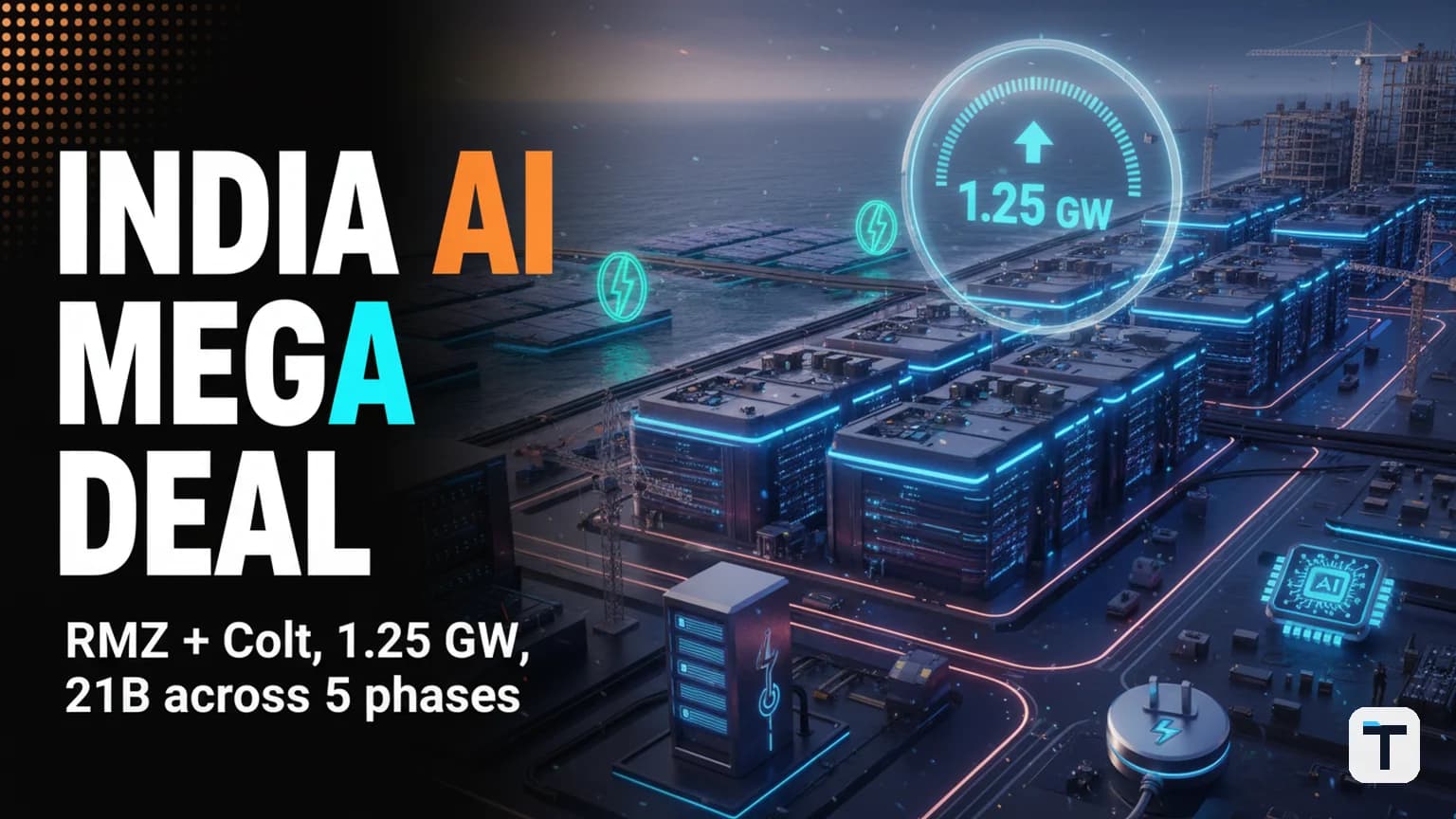

Verdict. RMZ Corporation and Colt Data Centre Services have locked in a 50:50 joint venture to build a 1.25 gigawatt (GW) hyperscale data centre campus in Anandapuram, on the edge of Visakhapatnam in Andhra Pradesh. The headline figure is ₹1.77 lakh crore — roughly $21 billion at current exchange rates — spread across five phases running from 2027 through 2036, on roughly 200 acres identified at Jagnadhapuram village. The first servers are scheduled to go live within 37 months of approval. This is the fifth data-centre project approved under Andhra Pradesh's Data Centre Policy 4.0 (2024–2029) and the second-largest by capacity after Reliance's 1.5 GW cluster — and it pushes the state's approved tally to 4.55 GW, leaving roughly 1.45 GW to go before its 6 GW target.
TL;DR — Last verified: 2026-07-29
- Parties: RMZ Corporation (Bengaluru real-assets platform) + Colt Data Centre Services (UK wholesale hyperscale operator), 50:50 JV.
- Capacity: 1.25 GW hyperscale, five phases, 2027→2036.
- Investment: ₹1.77 lakh crore (approximately $20–21B at July 2026 rates — the dollar figure is a conversion of the rupee headline; primary sources state the rupee number).
- Location: Anandapuram mandal, Visakhapatnam district, Andhra Pradesh; ~200 acres at Jagnadhapuram village.
- State context: Brings Andhra Pradesh's approved data-centre pipeline to 4.55 GW against a 6 GW target.
Pricing, land rates, and phase timelines change — re-check before using these figures in a deadline.
Why is the RMZ–Colt data centre being built near Visakhapatnam?
Visakhapatnam (Vizag) sits at the rare intersection of the four things a gigawatt-scale AI data centre actually needs: coastal water for cooling, subsea cable proximity for global traffic, large land tracts for captive solar + the IT hall footprint, and an inland grid corridor away from saturated metros. Mumbai and Chennai — India's legacy hyperscaler hubs — are now near saturation and fighting each other for grid capacity. Andhra Pradesh read that bottleneck as an opening and rolled out the Andhra Pradesh Data Centre Policy (4.0) 2024–2029, which adds AI-specific incentives, single-window approvals through the State Investment Promotion Committee (SIPC), and explicit compute-capacity targets. The RMZ–Colt campus, approved by SIPC on the back of an MoU signed at the World Economic Forum in Davos, is the next-largest project to follow from that policy stack. (Economic Times, Biltrax Media, Swarajya)
Who are RMZ and Colt, and what does each bring?
RMZ Corporation is a Bengaluru-headquartered real-assets platform and one of Asia's largest privately-owned alternative asset owners; it has been explicit that roughly half of its planned $35 billion, five-year India push is earmarked for digital infrastructure — colocation plus what it calls "AI factories" purpose-built for training and inference workloads. (Crypto Briefing, June 2026) Colt Data Centre Services, the JV partner, is a UK-based wholesale hyperscale operator with 25 years of operating history (first data centres built in 1999; hyperscale operations since 2016), 15 operational sites and 12 under construction across nine cities in the UK, Europe, India, and Japan. (coltdatacentres.net)
This isn't the first time the two firms have shared a fund. In November 2024 they committed $1.7 billion to develop 250 MW of colocation capacity across Navi Mumbai and Chennai — a much smaller, separate deal whose Mumbai campus ultimately targets up to 134 MW. (Data Centre Dynamics, coltdatacentres.net — Mumbai 1 & 2) The Visakhapatnam campus is roughly five times larger by capacity and an order of magnitude larger by stated capital — making it a distinct strategic bet, not a phase of the older JV.
How does 1.25 GW fit into Andhra Pradesh's 6 GW target?
The Vizag announcement is the fifth project cleared under Andhra Pradesh's data-centre push. Cumulative approved capacity now looks like this (per Economic Times and AP policy disclosures):
| Developer | Approved capacity | Role in the stack |
|---|---|---|
| Reliance Industries | 1.5 GW | Largest single project in the state, paired with a 6 GW captive solar buildout |
| RMZ + Colt (this deal) | 1.25 GW | Wholesale hyperscale capacity, multi-phase to 2036 |
| 1.0 GW | Asia-largest-by-capital AI campus, foundation stone laid April 2026; $6B total investment | |
| Sify | 500 MW | ICT operator facility (alternately reported as 550 MW) |
| CtrlS | 300 MW | Wholesale + managed services capacity |
| Approved total | 4.55 GW | ~76% of the state's 6 GW target |
Sources: Economic Times, Communications Today, NewsBytes. The 1.45 GW gap to the 6 GW state target is now the most-watched pipeline slot — Reliance is widely expected to expand first.
What is the timeline and the land footprint?
Per the SIPC approval, the project will be built over five phases running 2027 to 2036, with phase 1 commissioned within 37 months of approval — meaning the first servers go live in roughly the 2030 window. Roughly 200 acres of land have been identified at Jagnadhapuram village in Anandapuram mandal, Visakhapatnam district. The deal itself rests on an MoU signed at the 2026 World Economic Forum in Davos between RMZ and the Andhra Pradesh government — a $10 billion broader envelope covering mixed-use, GCC, and industrial/logistics parks statewide, of which the data centre is one strand. From handshake to SIPC clearance took approximately seven months, which both sides are citing as evidence that Andhra Pradesh's single-window process is actually moving at CV speed. (Economic Times, Biltrax Media, ETRealty)
What is the deal worth in dollars?
Treat the dollar figure with care. Primary sources quote the deal as ₹1.77 lakh crore (1.77 trillion rupees). At a July 2026 exchange rate of roughly ₹87–88 per US dollar, that converts to ≈ $20–21 billion — identical to the round-number "$21 billion" headline now in wide circulation but technically a conversion of the rupee figure, not a figure named in the primary documents. Note dollar figures on Indian infrastructure deals move materially with the INR/USD rate; cite the rupee number if precision matters. (Cross-reference: the same logic produced the "1.77 lakh crore" headline in Biltrax and Economic Times while Crypto Briefing frames RMZ's broader India push as $35B with ~$17.5B for digital infra over five years — Crypto Briefing.)
What is the bigger India opportunity a deal like this addresses?
India generates an estimated 20% of the world's data but hosts only ~2% of global data-centre capacity — a structural mismatch Colt's own country head has said is driving foreign hyperscalers into India at speed. (Crypto Briefing, June 2026, Colt Mumbai data-centre page) Andhra Pradesh's bet is to capture that inflow by leading on policy: explicit capacity targets, AI-specific carve-outs in Data Centre Policy 4.0, single-window approvals, and corollary build-outs of three planned undersea cable landing stations in Vizag that would make the city a digital gateway between India and Southeast Asia. (Communications Today) The state aims to generate 10 GW of power — mostly renewable — over five years to feed these facilities; Reliance has separately said it would build a 6 GW solar project to power its AI data centre. (NewsBytes)
For a wider lens on why India's domestic compute build matters to builders — including how the same Vizag region is now hosting an OpenAI 1 GW campus run by TCS subsidiary HyperVault — see our OpenAI 1 GW India data centre explainer. For teams paying the cloud-GPU tax, our India cloud cost reduction guide covers how domestic capacity like this lowers the premium for inference and training workloads.
How does this connect to India's sovereign AI story?
You can't read the Vizag campus in isolation. It sits on top of three overlapping trends:
- Sovereign AI as policy. India's government is now actively advocating that inference for critical government workloads runs on Indian-controlled infrastructure, not foreign cloud. Our sovereign AI — Last Mile to First Mile guide walks through how BharatGen and related initiatives are ending the open-loop "rent-everything" model.
- Coopetition between frontier labs. Meta is reportedly in early talks to lease AI compute to Anthropic in a $10B, two-year deal — see our Meta–Anthropic compute deal analysis. Deals like RMZ–Colt are the supply-side pressure that makes such cross-leases possible.
- Infrastructure-readiness gap inside enterprises. Per our enterprise AI strategy readiness analysis, roughly 82% of enterprises cannot currently run AI on their own infrastructure. The Vizag sprint is therefore not just a hyperscaler story — it is the facilities layer underpinning the wave of on-continent enterprise inference that has to follow.
What is the controversy surrounding Vizag's data-centre lands?
Important caveat: the controversy that has attracted national coverage is not specifically the RMZ–Colt land at Jagnadhapuram — it is the related, larger land acquisition conflict around nearby data-centre projects in Anandapuram mandal (notably the Google AI data centre at neighbouring Tarluvada village, also in Anandapuram mandal). The conflict matters because it is the template the RMZ–Colt deal will likely run into if it scales land take faster than compensation.
Farmers and Dalit communities in Anandapuram mandal — many on land originally allotted to Dalit families in the 1970s — have been protesting land acquisition for the data-centre cluster, demanding higher compensation, permanent jobs, and protection of drinking-water reservoirs in what is a water-stressed region. Police have detained political leaders backing the displaced farmers. The state has revised the per-acre rate from ₹17 lakh to ₹20 lakh and committed to pay 2.5×, plus outsourced jobs, shops, and three cents of land for housing; some villagers still call it below market and label the project "a hostile takeover of the AI revolution." Sources: The Hindu — protest at Tahsildar's office, The Hindu — CPM detentions, Frontline — "When Google Comes for Dalit Land", TBS News overview. The cooling-water claim in the video — that Vizag's coast is strategic partly because AI servers run hot and need ocean cooling — is corroborated by the policy emphasis on coastal land and by the state's separate renewable-power build-out to provide green energy.
The takeaway is uncomfortable: Vizag is winning the global compute war, but only as long as its land politics don't break first.
What this means for you
The RMZ–Colt wager is most useful as a planning signal, not a sales-pitch bullet:
- For cloud architects and SREs: and hyperscaler-adjacent builders. The 1.25 GW coming online through 2036 means domestic Indian colocation and hyperscale capacity at meaningful scale by the end of the decade — by 2030 you'll plausibly be able to run inference for India-origin workloads on Indian-controlled iron with Indian-priced power, not just reselling US-region cloud. Plan data residency and procurement on the assumption that India-region pricing for tier-1 inference will compress over the next 18–24 months.
- For founders and SMBs: you won't be a direct Colt/RMZ customer, but you will be a beneficiary downstream — watch for deals like the domestic provider cloud cost play becoming more aggressive as supply hits the market.
- For investors and analysts: the dollar headline is a working-document conversion (₹1.77 lakh crore ≈ $20–21B); treat anything labelled "$21B" with a "reported" tag, because primary policy documents name the rupee number rather than the dollar conversion.
- For policy people: the deal is a stress test for the Andhra Pradesh single-window cadence — and for the land politics it shares a mandal with. Watch the protest cycle, not just the megawatts.
FAQ
Q: How much is the RMZ–Colt Visakhapatnam data centre worth? A: Primary sources state the deal at ₹1.77 lakh crore (1.77 trillion rupees). At roughly ₹87–88 per US dollar in mid-2026, that converts to approximately $20–21 billion — the "$21 billion" headline is a rounded conversion, not a number named in the policy documents. (Economic Times)
Q: When will the first servers go live at the RMZ–Colt campus? A: Phase 1 is scheduled to be commissioned within 37 months of SIPC approval, putting the first servers in roughly the 2030 window. The full campus runs across five phases through 2036. (Biltrax Media)
Q: How big is 1.25 GW of data-centre capacity in practice? A: 1.25 gigawatts of IT load is roughly five times the capacity of any single current Colt–RMZ campus and substantially larger than most operational hyperscale sites in India today. For scale, Colt's Navi Mumbai campus targets ~134 MW at full build-out — Vizag is an order-of-magnitude larger. (coltdatacentres.net)
Q: How does this compare to Google and Reliance data centres in Andhra Pradesh? A: Andhra Pradesh has now approved 4.55 GW: Reliance 1.5 GW, RMZ–Colt 1.25 GW, Google 1.0 GW (foundation stone laid April 2026, $6B), Sify 500 MW, CtrlS 300 MW. RMZ–Colt is the second-largest by capacity. (Economic Times, Communications Today)
Q: Who owns Colt Data Centre Services and who owns RMZ? A: Colt Data Centre Services is a UK-based wholesale hyperscale and colocation operator (operating since 1999, hyperscale operations since 2016, ~15 operational sites across 9 cities in UK, France, Germany, Netherlands, India, Japan). RMZ Corporation is a Bengaluru-based privately-owned alternative assets platform and real-assets developer. The Visakhapatnam deal is structured as a 50:50 joint venture, building on a separate $1.7B / 250 MW JV between the two firms from November 2024 covering Navi Mumbai and Chennai. (coltdatacentres.net, Crypto Briefing, Data Center Dynamics)
Q: Why is Visakhapatnam becoming India's data-centre capital? A: Coastal cooling, subsea cable proximity to global traffic, large land tracts for captive solar plus IT halls, and grid corridor availability — the four capacities a gigawatt-scale AI facility needs. Mumbai and Chennai are saturated on grid capacity, and Andhra Pradesh's Data Centre Policy 4.0 added AI-specific incentives and a single-window SIPC approval channel that compressed the RMZ–Colt handshake-to-clearance to roughly seven months. (Andhra Pradesh Data Centre Policy 4.0, Swarajya)
Q: Are there land-acquisition protests affecting the Visakhapatnam data-centre cluster? A: Yes — surrounding data-centre acquisitions in Anandapuram mandal have triggered farmer and Dalit community protests over promised compensation, permanent jobs, and drinking-water reservoirs in a water-stressed region. Police have detained political leaders backing the displaced farmers. The state has raised the per-acre rate to ₹20 lakh with a 2.5× multiplier and added jobs + housing land — villagers still dispute that the rate is fair. (The Hindu, Frontline)
Discussion
0 comments