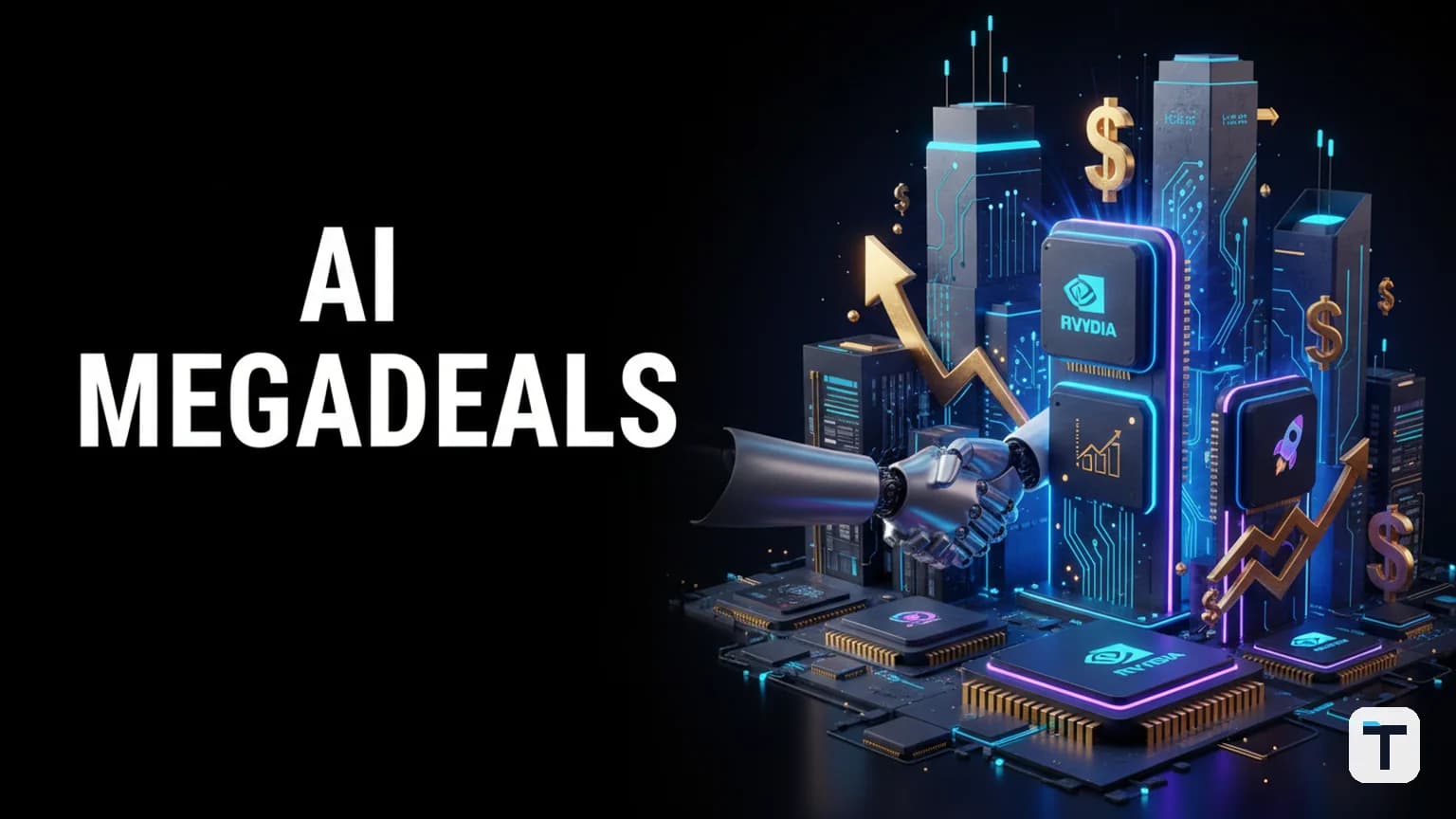

The last week of July 2026 delivered the most consequential cluster of AI announcements since the GPT-5.6 launch earlier that month. South Korea's SK Group and Nvidia signed letters of intent for a $500-billion-plus partnership spanning AI factories and next-generation memory (NVIDIA press release, July 24, 2026). Anthropic released Claude Opus 5, a model that comes within roughly half a percentage point of its frontier Fable 5 on coding benchmarks at half the price (Anthropic, July 24, 2026). And Samsung separately signed a $200 billion memorandum with Broadcom for memory and sub-2nm foundry services (Reuters, July 24, 2026). Together, these moves signal a clear shift: the AI race is no longer just about who has the smartest model — it is about who controls the supply chain and who can deliver the lowest cost per token.
Last verified: 2026-07-29
- SK Group–Nvidia: $500B+ partnership, 2 GW AI factory (2027), long-term HBM4 supply.
- Claude Opus 5: $5/$25 per M tokens (half Fable 5's $10/$50), adjustable effort, fast mode at 2x.
- Samsung–Broadcom: ~$200B MOU covering memory, sub-2nm foundry, advanced packaging.
- South Korea total: ~$950B in announced AI deals. Pricing, model versions, and deal terms are volatile — re-check before relying on any figure.
What happened? A four-story week, decoded
The week of July 24–27, 2026 compressed an entire year's worth of AI industry signals into four stories. Here is each one in a sentence, with the primary source.
- SK Group and Nvidia announced a $500B+ partnership to build a 2-gigawatt AI factory in Korea (powered by Nvidia's Vera Rubin platform and SK Hynix HBM4 memory, first phase online 2027) and to co-develop next-generation AI memory beyond HBM4. (NVIDIA official press release, July 24, 2026)
- Anthropic released Claude Opus 5 at $5 per million input tokens and $25 per million output tokens — identical to Opus 4.8 and roughly half of Fable 5's $10/$50 pricing — with a new adjustable effort setting and a fast mode running 2.5x at 2x cost. (Anthropic announcement, July 24, 2026)
- South Korea announced ~$950 billion in total AI deals orchestrated at a San Francisco summit hosted by President Lee Jae Myung, pairing domestic giants Samsung and SK Group with US tech firms including Nvidia and Broadcom. (Reuters, July 24, 2026)
- India's prime minister appointed Nandan Nilekani — the Aadhaar architect and Infosys co-founder — to lead a high-powered task force on exam reform, following the NEET-UG 2026 paper leak and the resignation of the education minister. (Livemint, July 26, 2026)
The unifying thread is that AI has moved from a software story to a physical infrastructure story. The constraint is no longer who can train the biggest model — it is who can secure the memory, power, and chips to run it.
What is the SK-Nvidia $500 billion deal and why does it matter?
The SK Group–Nvidia partnership splits into two major pieces: a massive AI factory and a long-term memory supply lock-in. Both address the two bottlenecks now throttling the AI industry: power capacity and high-bandwidth memory supply.
Piece 1 — The 2-gigawatt AI factory. SK Telecom will build a 2 GW AI data center in Korea built on Nvidia's DSX full-stack AI factory architecture and powered by Nvidia's Vera Rubin accelerated computing platform, using SK Hynix HBM4 memory. The first phase is targeted to come online in 2027. For context, 2 GW is enough to power roughly 1.5 million homes simultaneously — this is data-center-scale compute on a level rarely seen outside hyperscalers. Nvidia's framing is that the DSX platform "delivers the lowest token cost at maximum energy efficiency" (NVIDIA press release, July 24, 2026).
Piece 2 — Long-term HBM4 memory supply. Nvidia and SK Hynix are entering a long-term AI memory partnership that locks in a stable supply of high-bandwidth memory for Nvidia and gives both companies a shared pipeline to co-develop the next generations of memory technology beyond HBM4. SK Group Chairman Chey Tae-won said the goal is for Korea to "transcend its role as a leading adopter of AI and become a global hub that drives AI innovation" (NVIDIA press release, July 24, 2026). Jensen Huang, Nvidia's CEO, called South Korea a potential "global AI powerhouse" with "world-class networks and data centers, leadership in chip technology and vast industrial scale."
Why it matters for the supply chain. SK Hynix is already the world's dominant producer of HBM — the memory technology inside every major AI accelerator. Nvidia's GB200 and Rubin-class systems depend on HBM4 and its successors. By locking in a multi-year supply deal and co-developing future memory generations, Nvidia de-risks the single most constrained component in AI hardware. And by building a 2 GW factory in Korea, SK ensures its memory and infrastructure capacity is consumed for years, not just sold on the open market.
| Component | Detail | Primary source |
|---|---|---|
| Deal value | $500 billion+ (letters of intent signed) | NVIDIA press release, July 24, 2026 |
| AI factory size | 2 gigawatts | NVIDIA press release, July 24, 2026 |
| Computing platform | Nvidia Vera Rubin (DSX architecture) | NVIDIA press release, July 24, 2026 |
| Memory | SK Hynix HBM4 | NVIDIA press release, July 24, 2026 |
| First phase online | 2027 | NVIDIA press release, July 24, 2026 |
| Co-development | Next-gen memory beyond HBM4 | NVIDIA press release, July 24, 2026 |
What is Claude Opus 5 and how much does it cost?
Claude Opus 5 is Anthropic's fourth new model in under two months, launched July 24, 2026. It is positioned as a cost-conscious near-frontier model: close to Claude Fable 5's intelligence at roughly half the price. Anthropic says Opus 5 "comes close to the frontier intelligence of Claude Fable 5, which is its most powerful model, but at roughly half the price" (Anthropic, July 24, 2026).
Pricing (API):
| Model | Input (per M tokens) | Output (per M tokens) | Positioning |
|---|---|---|---|
| Claude Fable 5 | $10 | $50 | Max frontier ceiling |
| Claude Opus 5 | $5 | $25 | Near-frontier at half price |
| Claude Opus 4.8 (previous) | $5 | $25 | Replaced by Opus 5 |
Opus 5's pricing is identical to Opus 4.8 — $5 per million input tokens and $25 per million output tokens — so existing users get an outright capability upgrade at no cost increase. A fast mode runs approximately 2.5x the default speed for twice the base price (Anthropic, July 24, 2026).
The headline feature: adjustable effort. Opus 5 introduces an effort setting (low to high, plus a max tier) that lets users decide how much computational effort the model spends on a task. Anthropic says even at lower effort levels, Opus 5 preserves much of its performance while using fewer tokens — directly targeting the common enterprise complaint of runaway token bills. This is the same effort dial we covered in our Claude Opus 5 agent routing guide, and it matters because it lets one model cover both "cheap-and-fast" tasks (low effort) and "slow-and-brilliant" work (high/max effort) without swapping models.
Two beta features shipped alongside Opus 5:
- Mid-conversation tool changes — developers can now change which tools Claude can use mid-conversation without invalidating the prompt cache. This is a meaningful improvement for agentic workflows where available tools shift as a task progresses.
- Automatic fallbacks — requests flagged by safety classifiers can now reroute to another available model instead of simply being blocked. Anthropic notes that biology-related requests blocked on Fable 5 will now route to Opus 5 rather than Opus 4.8 (Anthropic, July 24, 2026).
Opus 5 is the default model on Claude Max (Anthropic's premium consumer tier) and the strongest model available on Claude Pro. The API model identifier is claude-opus-5. For a deeper review of benchmarks and where Opus 5 fits versus Fable 5, see our Claude Opus 5 review.
How does the South Korea $950 billion AI buildout fit together?
The SK-Nvidia deal is the headline, but it is part of a larger sovereign push. South Korea announced approximately $950 billion in AI initiatives at a San Francisco summit hosted by President Lee Jae Myung, pairing domestic giants with top US tech firms to address the global chip shortage. SK Group signed deals worth a total of $750 billion (headlined by the $500B Nvidia partnership), while Samsung Electronics signed a roughly $200 billion memorandum of understanding with Broadcom covering memory chips, cutting-edge sub-2-nanometer foundry services, and advanced packaging for next-generation AI accelerators (Reuters, July 24, 2026; Devdiscourse, July 25, 2026).
This is not just corporate deal-making — it is statecraft. President Lee personally convened US tech CEOs including Jensen Huang and Sam Altman to deepen bilateral ties. These partnerships complement Lee's domestic strategy of building state-backed data centers and semiconductor manufacturing clusters inside Korea. The message is clear: with US companies dominating the software and design side of AI, Samsung and SK Hynix need to lock down their status as the indispensable hardware backbone of the AI era — and these multi-hundred-billion-dollar, long-term commitments guarantee their foundries and memory production lines run at full capacity for years.
How does India fit into the global AI infrastructure picture?
India's AI story this week split into two threads: governance and exam reform.
Karnataka chose Anthropic. Karnataka's IT Minister Priyank Kharge announced the state will form two dedicated working groups with Anthropic — one with the Centre for E-governance and one with the Home Department — to identify priority AI use cases across governance, education, and innovation. The discussions covered AI-enabled citizen services, multilingual experiences, leveraging existing government datasets for public service delivery, and expanding AI skilling through Claude certifications for students and professionals (The Indian Express, July 25, 2026; The Hindu, July 2026).
Notably, this contrasts with Bihar's earlier choice to build its citizen-facing AI stack around Sarvam AI — an explicitly Indian foundation model built for Indian languages under India's own compute mission. Karnataka, the state that houses Bengaluru, went straight to a US frontier lab instead. The two philosophies represent India's emerging AI governance split: Bihar bets on indigenous capability, while Karnataka is currently betting on capability regardless of origin. For more on Karnataka's broader investment trajectory, see our analysis of Karnataka's record FDI surge to $12.9 billion in FY2026.
Nandan Nilekani and the exam reform task force. Prime Minister Modi appointed Nandan Nilekani — the Aadhaar architect and Infosys co-founder — to chair a six-member high-powered task force on examination reforms, following the NEET-UG 2026 paper leak and the resignation of Education Minister Dharmendra Pradhan after a 36-day student agitation (Livemint, July 26, 2026; The Quint, July 27, 2026). The panel includes former ISRO chairman S. Somanath, former Intelligence Bureau director Tapan Deka, IIT Madras director V. Kamakoti, former education secretary Anita Karwal, and logistics expert Amrit Lal Meena — assembled, as one report noted, "like a security and systems integration project." The government also introduced a Public Examinations Amendment Bill proposing fast-track courts for paper-leak cases. The open question is whether this task force's recommendations will actually be implemented — a 2024 committee under former ISRO chief K. Radhakrishnan produced 101 recommendations, most of which were not fully implemented before another paper leak occurred in 2026.
What does this mean for the AI supply chain?
The AI industry's binding constraint has shifted. In 2023–2024, the bottleneck was chip design — who could produce the most powerful GPU. In 2025–2026, the bottleneck is memory supply and power capacity. SK Group's chairman said industry leaders including Nvidia, Broadcom, Anthropic, and OpenAI are demanding "significantly more memory capacity than anyone originally forecasted" and that "the current supply chain just couldn't keep up with this explosive demand."
The implication: nation-state-level capital is now required to build the physical infrastructure of AI. A single 2 GW data center is a multi-billion-dollar capital expenditure that no startup — and few companies outside the top hyperscalers — can fund alone. The deals of July 2026 show that the AI supply chain is being vertically integrated and geopolitically locked in: the companies and countries that secure memory, power, and advanced packaging now will dominate AI compute for the next decade.
This matters even for pure-software builders. If you are building AI applications, the cost and availability of inference compute depends on decisions made at this scale. The AMD-Anthropic $5 billion investment in Claude compute infrastructure is another face of the same trend — and Microsoft's multi-billion-euro partnership with Mistral for European AI compute shows it is happening on every continent.
How does Claude Opus 5's pricing change the model selection decision?
Claude Opus 5's launch crystallizes a second shift happening in parallel with the infrastructure story: AI pricing is increasingly competing on cost per task rather than raw capability. For builders and small businesses choosing models, the decision is no longer "what is the smartest model?" but "what model is smart enough at the lowest cost?"
Here is a practical decision framework:
| Your task | Recommended model | Why |
|---|---|---|
| Trivial (formatting, extraction, simple Q&A) | Claude Opus 5 at low effort | Cuts token spend while preserving quality on routine work |
| Standard coding, debugging, single-file work | Claude Opus 5 at medium effort | Balance of cost and reasoning; default for most tasks |
| Complex multi-system architecture, hard debugging | Claude Opus 5 at high/max effort | Within ~0.5% of Fable 5 on coding at half the cost per task |
| Multi-day autonomous frontier research | Claude Fable 5 | Still the ceiling; Anthropic recommends it for the most advanced autonomous work |
The effort setting means you can stay on one model (Opus 5) and dial effort up or down per task, rather than maintaining and routing across multiple models. That said, if your workload is already efficiently served by a cheaper model — Google's Gemini 3.6 Flash planner with 3.5 Flash-Lite executor pattern, for instance — the effort toggle gives you a new option without forcing a migration.
What this means for you
If you build AI applications: Claude Opus 5's effort setting and unchanged $5/$25 pricing mean you can likely replace Opus 4.8 immediately (same model ID structure, same price, better output) and start using the effort dial to cut costs on trivial sub-tasks. Test it on your real workload — measure tokens consumed and output quality at each effort level before defaulting.
If you run a business buying AI services: The infrastructure buildout means inference prices have room to fall further as new capacity comes online in 2027 and beyond. But do not plan around a single vendor. The supply-chain lock-ins of July 2026 are exactly the kind of concentration that creates pricing power — so multi-model, multi-vendor architectures are the prudent hedge. For guidance on keeping your stack modular as these giants consolidate, our agent OS vs agent framework comparison and single-agent vs multi-agent decision guide lay out the routing patterns that survive vendor shifts.
If you build in India: The Karnataka-Anthropic partnership signals that even India's most AI-forward state prefers frontier-lab capability over homegrown models for governance — at the exploratory stage. Watch whether the two working groups become contracts, and whether Sarvam AI and other Indian models get layered in for multilingual citizen-facing services where they may have a genuine edge.
FAQ
Q: How much is the SK-Nvidia deal worth and what does it cover? A: SK Group and Nvidia signed letters of intent for a $500-billion-plus partnership with two pieces: a 2-gigawatt AI factory in Korea (powered by Nvidia Vera Rubin and SK Hynix HBM4, first phase online 2027) and a long-term AI memory supply and co-development agreement covering HBM4 and beyond. Source: NVIDIA press release, July 24, 2026.
Q: How much does Claude Opus 5 cost and how does it compare to Fable 5? A: Claude Opus 5 costs $5 per million input tokens and $25 per million output tokens — identical to Opus 4.8 and roughly half of Fable 5's $10/$50 pricing. A fast mode runs about 2.5x faster at 2x the base price. Anthropic says Opus 5 comes close to Fable 5's intelligence at half the cost. Source: Anthropic, July 24, 2026.
Q: What is the Claude Opus 5 effort setting and how do I use it? A: The effort setting (low to high, plus a max tier) controls how much computational effort the model spends on a task. Lower effort is faster and cheaper for simple jobs; higher effort spends more tokens for top-tier reasoning. The practical use is to keep Opus 5 as your default model and dial effort up or down per task rather than routing across multiple models.
Q: What is South Korea's total AI investment announced this week? A: South Korea announced approximately $950 billion in AI deals at a San Francisco summit hosted by President Lee Jae Myung. SK Group signed $750 billion in total deals (including the $500B Nvidia partnership), and Samsung signed a ~$200B memorandum with Broadcom covering memory chips, sub-2nm foundry services, and advanced packaging. Source: Reuters, July 24, 2026.
Q: Why did India appoint Nandan Nilekani to lead exam reform? A: Prime Minister Modi appointed Nandan Nilekani — the Aadhaar architect and Infosys co-founder — to chair a six-member task force recommending technology-driven and structural reforms to the National Testing Agency, following the NEET-UG 2026 paper leak and the resignation of Education Minister Dharmendra Pradhan after a 36-day student protest. Source: Livemint, July 26, 2026.
Q: Will the SK-Nvidia deal lower AI inference prices? A: Not directly or immediately. The first factory phase is targeted for 2027, and the deal is primarily about securing supply and co-developing future memory rather than cutting per-token costs today. However, by increasing available AI factory capacity and ensuring stable HBM4 supply, it should ease the memory bottleneck that constrains current production — which could put downward pressure on inference pricing over time as the new capacity comes online.
Discussion
0 comments