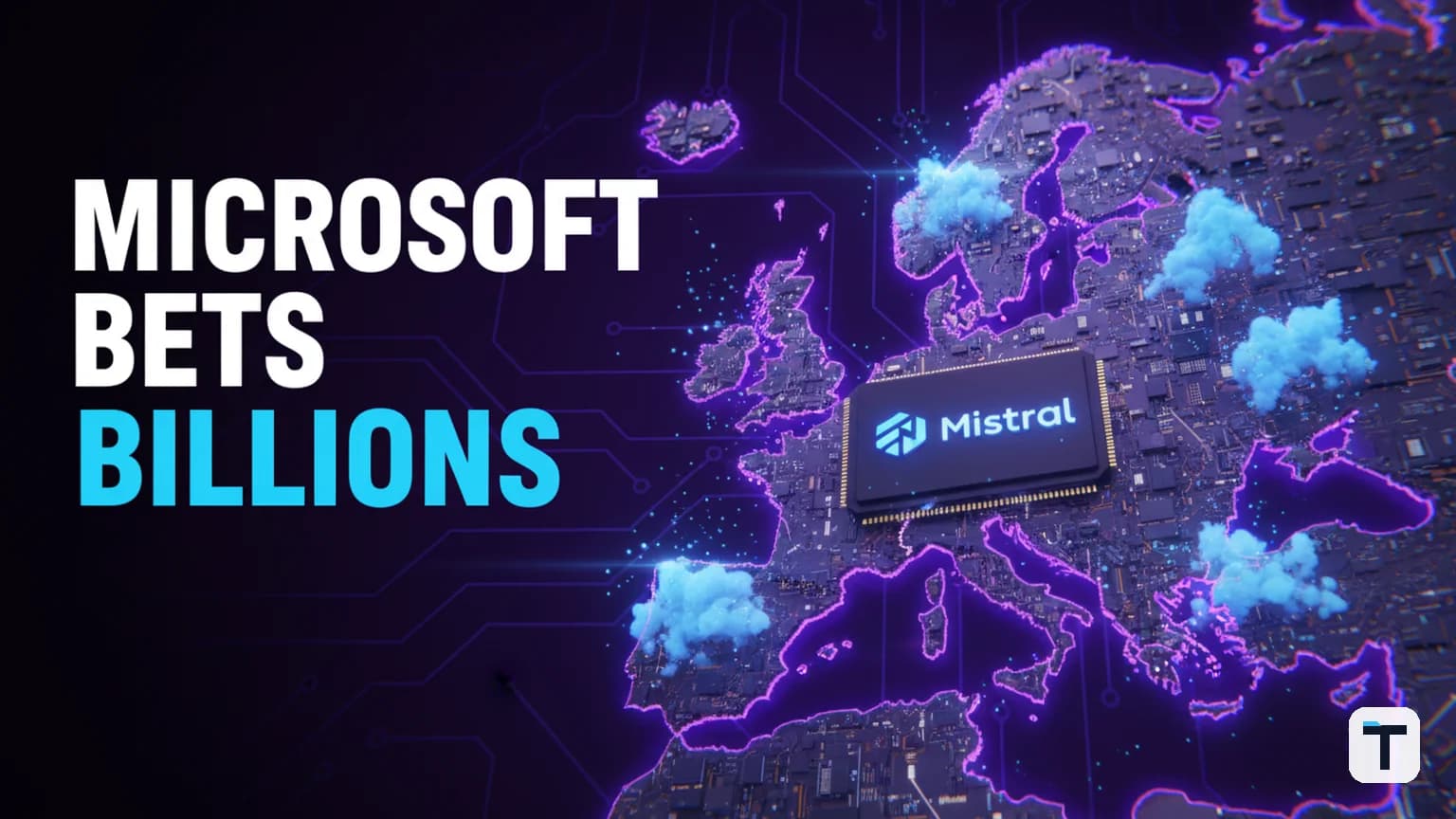

On 21 July 2026, Microsoft and Mistral committed several billion dollars to European GPU capacity, moved Mistral's models into Azure's sovereign cloud portfolio, and gave regulated customers a supported way to run frontier AI in fully disconnected environments. Microsoft is buying European compute it does not fully own — and that combination makes this more than a routine model listing.
TL;DR
- Microsoft and Mistral expanded their strategic partnership with a multibillion-dollar deal announced from Redmond and Paris on 21 July 2026.
- Mistral is adding thousands of NVIDIA Vera Rubin GPUs to its European footprint; Microsoft will share that capacity for training and inference.
- Mistral Medium 3.5 and Mistral OCR 4 are now available in Microsoft Foundry and Copilot Studio.
- Deployment covers three modes: Azure public cloud, cloud-connected Azure Local, and fully disconnected Azure Local.
- Fully disconnected frontier AI is the standout feature; neither OpenAI nor Anthropic offers this directly today.
- The move formalises a multi-model Azure stack alongside OpenAI and Microsoft's in-house MAI models.
What did Microsoft and Mistral actually announce?
On 21 July 2026, Microsoft and Mistral expanded their partnership with a multibillion-dollar commitment focused on European AI infrastructure. Microsoft will use Mistral's expanded, Europe-based GPU footprint for its own AI development, while Mistral's models move deeper into the Microsoft platform.
Two model additions are live immediately. Mistral Medium 3.5, an open-weight general model, and Mistral OCR 4, a document extraction model, are available in Microsoft Foundry, with Medium 3.5 also in Copilot Studio. Both can deploy across Azure public cloud, cloud-connected Azure Local, or fully disconnected Azure Local.
The exact dollar figure was not disclosed, but Reuters characterises it as a several-billion commitment. What is disclosed is the hardware: Mistral's build-out features thousands of NVIDIA Vera Rubin GPUs, which NVIDIA claims deliver up to 10x agentic AI throughput at scale versus Grace Blackwell.
Why is Microsoft funding a rival model lab?
Microsoft is the largest investor in OpenAI, so writing a multibillion-dollar cheque to another frontier lab looks contradictory only if you assume Microsoft wants a single-model stack. It does not. The company has been building optionality: OpenAI's GPT family for general reasoning, its own MAI models for cost-controlled inference, and now Mistral for European deployments and sovereign scenarios.
There is a compute story underneath. Microsoft's capacity is stretched, and the company combines its own data centres, leased facilities, and strategic partnerships to keep up. Sharing GPUs with Mistral gives Microsoft European capacity without building every megawatt itself, in a jurisdiction where sovereignty rules are tightening.
For Mistral, the deal solves distribution. Enterprise buyers rarely procure directly from a young lab; they buy through hyperscalers with existing contracts and compliance certifications. Bringing Medium 3.5 and OCR 4 into Foundry puts Mistral in front of every Azure customer that has cleared procurement.
What does "sovereign AI compute" actually mean here?
Sovereign AI compute means running frontier models under a specific jurisdiction's control, on hardware and software the customer or its regulator can verify. In Europe that translates into three requirements: data residency in the EU, operational independence from US legal reach for sensitive workloads, and, in some sectors, the ability to run without any external network path.
The deal maps to those requirements through three deployment modes:
- Azure public cloud in European regions. Hosted access to Mistral models alongside other Foundry models, for teams needing EU data residency but comfortable with a managed hyperscaler.
- Azure Local, cloud-connected. Customer-controlled hardware with Azure services reachable for updates. Suits banks and manufacturers wanting local execution with centralised management.
- Azure Local, fully disconnected. Same stack, no outbound connectivity. For defence, intelligence, sensitive healthcare, and critical infrastructure that cannot rely on internet-connected inference.
Brad Smith, Microsoft's Vice Chair and President, framed the intent as giving European customers frontier AI "on their own terms" and aligning with Microsoft's European Digital Commitments made in 2025. Mistral CEO Arthur Mensch pitched it as putting frontier AI into organisations while keeping them in control of their technology. The disconnected deployment is the concrete new capability.
How does this change the enterprise AI stack?
For an Azure customer, a single subscription now spans at least three model families: OpenAI's GPT-5.6 line, Mistral's Medium 3.5 and OCR 4, and Microsoft's own MAI models, routed inside Foundry. That is a meaningful shift from the 2024-2025 pattern of picking one lab and building around it.
A few implications worth planning for:
- Model routing becomes a first-class concern. With multiple viable models behind one endpoint, teams need policies for which requests go where, on cost, latency, licence terms, and data-handling grounds. Our cost-routing guide for smaller models covers the same pattern for Gemini's Flash tier.
- Deployment topology becomes a procurement lever. Regulated buyers can now ask for the same model in cloud, hybrid, or air-gapped form and compare pricing. That reshapes RFPs that previously assumed a single hosted API.
- Compute hedging is normalising across the industry. Microsoft's Mistral deal sits alongside AMD's $5 billion Anthropic arrangement and OpenAI's India build-out with TCS. Every major lab and hyperscaler is spreading its bets on chips and geographies.
- Security scope widens. Running frontier models on customer hardware pulls in patching, key management, and physical security concerns that hosted APIs abstract away. See our note on LLM infrastructure security for the baseline controls.
If you are early in this journey, the question of what to build in-house versus consume is worth revisiting; see enterprise AI infrastructure readiness.
What are the honest limitations?
A few caveats: the exact spend is not public, so any specific dollar figure is an estimate. Vera Rubin capacity is being built out, not fully online — enterprises should ask Microsoft for regional availability dates. NVIDIA's 10x agentic throughput claim is a vendor benchmark, not independently audited. And "sovereign" is a spectrum: Azure Local disconnected is strong, but ultimate legal exposure depends on vendor contracts and jurisdictions involved.
FAQ
Q: When was the Microsoft Mistral AI partnership expansion announced? A: 21 July 2026, jointly from Redmond, Washington and Paris.
Q: How much is Microsoft investing in Mistral? A: Described as multibillion-dollar without a disclosed exact figure. Reuters characterises it as a several-billion commitment tied to European GPU capacity.
Q: Which Mistral models are available in Microsoft Foundry? A: Mistral Medium 3.5 and Mistral OCR 4, with Medium 3.5 also in Copilot Studio. Both run on Azure public cloud, cloud-connected Azure Local, and fully disconnected Azure Local.
Q: What GPUs is Mistral using for the new European capacity? A: Thousands of NVIDIA Vera Rubin GPUs, the generation succeeding Grace Blackwell, designed for agentic AI workloads at scale.
Q: Can I run frontier AI in an air-gapped environment through this deal? A: Yes. Fully disconnected Azure Local deployments run Mistral Medium 3.5 and OCR 4 without external network paths, targeting defence, sensitive healthcare, and critical infrastructure.
Q: Does this replace Microsoft's OpenAI partnership? A: No. Microsoft's OpenAI investment remains. The Mistral deal adds European sovereign capacity and model diversity alongside OpenAI and Microsoft's own MAI models.
Discussion
0 comments