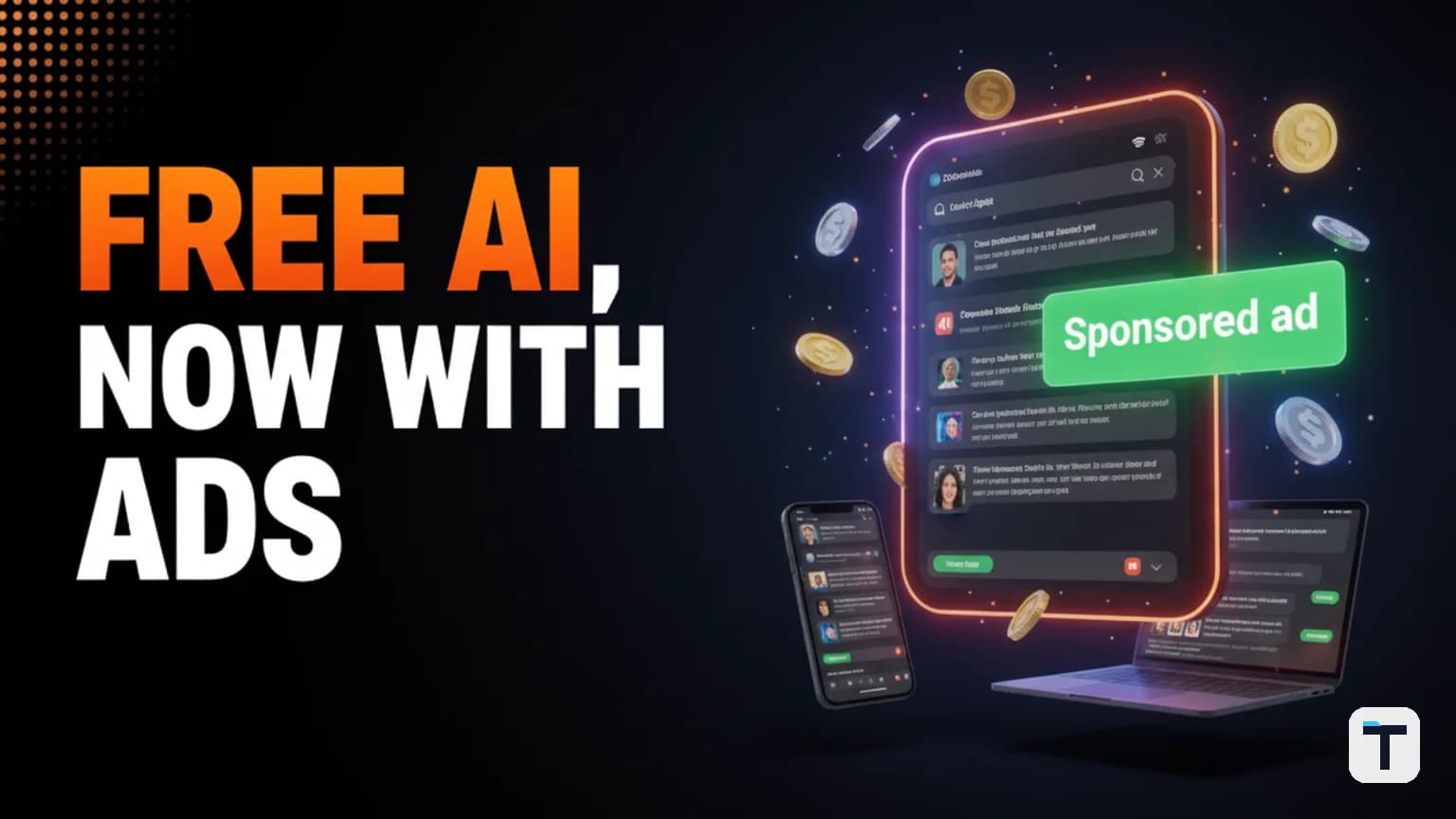

Verdict: OpenAI began serving sponsored ads inside ChatGPT on February 9, 2026, for Free and Go-tier users in the U.S. — and the implications are bigger than a new revenue line. Ad-supported AI is now a validated product category, and it shifts the economics of "free AI" toward an ad-subsidized model that resembles Google Search more than a free trial. For most users, this is a net positive (you get frontier-class answers without paying), but the long-term risk is not price — it is trust. If ads ever influence the answer rather than sit beside it, the model stops being a tool and starts being a sales funnel. For now, OpenAI's own published principles and early results suggest the answer and the ad are kept separate. Treat that promise as the load-bearing wall and watch it.
Last verified: 2026-07-24 · Best free AI access: ChatGPT Free (with ads) or ChatGPT Go at $8/month (with ads) · Best ad-free: Plus at $20/month · Watch: whether answer-independence holds as the ad business scales.
What are ChatGPT ads, and who sees them?
ChatGPT ads are sponsored placements that appear at the bottom of ChatGPT's response in a clearly labeled, visually separated box. They are shown to logged-in adult users on the Free tier and the Go tier ($8/month) in the United States, with expansion to Canada, Australia, and New Zealand announced on March 26, 2026, and a planned expansion to the UK, Mexico, Brazil, Japan, and South Korea announced on May 7, 2026. Users under 18 never see ads, regardless of tier.
Five subscription tiers remain completely ad-free: Plus ($20/month), Pro ($200/month), Business, Enterprise, and Education.
| Tier | Price | Ads shown? | Who it's for |
|---|---|---|---|
| Free | $0 | Yes (US/CA/AU/NZ) | Anyone trying ChatGPT |
| Go | $8/month | Yes | Price-sensitive power users |
| Plus | $20/month | No | Daily professional use |
| Pro | $200/month | No | Heavy research / agentic workflows |
| Business/Enterprise/Education | Custom | No | Organizations |
Free users also have a third option: opt out of ads entirely by accepting a reduced number of daily free messages. OpenAI has not published the exact message reduction, but the choice is meaningful — it means ad-supported access is opt-in, even within the free tier.
The ads themselves are context-aware. OpenAI says ad selection is based on the topic of your current conversation, your past chats, and your past interactions with ads — but advertisers never receive your conversation content, only aggregate performance data like views and clicks.
How did we get here? (The 18-month reversal)
In May 2024, OpenAI CEO Sam Altman said at a Harvard University fireside chat: "Ads plus AI is sort of uniquely unsettling to me. I kind of think of ads as a last resort for us for a business model." He further described advertising as something that "somewhat fundamentally misaligns a user's incentives with the company providing the service."
Less than two years later, that last resort is live. The pivot happened in three steps:
- January 16, 2026 — OpenAI's CEO of Applications, Fidji Simo, published "Our approach to advertising and expanding access," establishing five principles (mission alignment, answer independence, conversation privacy, choice and control, long-term value) and announcing the ChatGPT Go tier.
- February 9, 2026 — The ad test went live for Free and Go users in the U.S.
- March–May 2026 — International expansion began; OpenAI reported "no impact on consumer trust metrics, low dismissal rates of ads, and ongoing improvements in relevance."
What changed between Altman's "last resort" remark and the launch? Press coverage points to three converging forces: (a) compute costs that scale faster than subscription revenue, (b) competition — Google, Anthropic, Meta, and xAI all serve capable models for free or cheap, eroding willingness-to-pay, and (c) infrastructure commitments like the Stargate data-center project. The economics forced a new revenue line.
Why does free ad-supported AI matter beyond ChatGPT?
The reason this is bigger than OpenAI is the validation signal it sends to every other platform. When the world's most-used AI chatbot — with over 800 million weekly users as of October 2025 — successfully monetizes free access with ads, every company with an engaged audience follows the same logic.
Consider the precedent. Alphabet's Google generated $264.6 billion in advertising revenue in 2024 and $294.7 billion in 2025, per Alphabet's SEC filings — advertising accounts for roughly 74–76% of Alphabet's total revenue. That is the ceiling OpenAI can see and chase. Uber, a company no one associates with advertising, built an ads business from zero to a $2 billion annualized run rate by Q4 2025, up over 50% year-on-year — and at very high margins relative to its core ride and delivery revenue.
The pattern across these companies is the same: ads carry extraordinarily high margins, and those margins subsidize something the user gets for free or cheap (Google Search, the Uber app). For OpenAI, the subsidy target is free-tier inference cost.
This matters for you regardless of whether you use ChatGPT. If ad-supported AI proves viable at ChatGPT's scale, then:
- Anthropic (which ran a Super Bowl ad on February 8, 2026, promising Claude stays ad-free) faces pressure to hold that line or lose the margin to compete on price.
- Google, which already has the world's largest ad business and serves Gemini for free, has a structural advantage: it knows how to sell ads and already has the advertiser relationships.
- Meta, with AI integrated into WhatsApp, Instagram, and Facebook, has billions of users and a mature ad platform — the only company that can match OpenAI's distribution combined with ad infrastructure.
- xAI (Grok) and others have smaller distribution but the same incentive structure.
The competitive question is not whether AI gets ads — it already did. It is whether answer independence (the answer is never altered by the ad) survives as a binding commitment once the ad revenue becomes material.
Does the ad change ChatGPT's answer?
No — at least not in how OpenAI has built and described it. OpenAI's published principle is explicit: "Ads do not influence the answers ChatGPT gives you. Answers are optimized based on what's most helpful to you." The ad appears after the answer is generated, in a visually separated, "Sponsored"-labeled box. The technical design streams the answer first and the ad second.
This is the single most important design choice in the entire product, and it is the one thing to monitor over time. There are two ways it could break:
Slow drift: Ad selection could become so "relevant" that the answer and the ad converge — you ask about fridges, the answer mentions features, and the ad points you to a specific retailer. Even if the answer itself is unbiased, the experienced relationship (answer → ad → purchase) may feel like a funnel. OpenAI's three restricted-topic categories (health, mental health, politics) suggest they are aware of where this risks going wrong, but commercial queries are not currently restricted.
Regulatory mismatch: In many jurisdictions, sponsored content must be clearly distinguished from editorial/recommendation content — this is the same rule YouTube creators follow when they label "paid promotion." If the boundary between the AI's recommendation and the advertiser's pitch erodes, OpenAI (and any competitor who copies the model) faces legal exposure. Labs headquartered outside jurisdictions with strong ad-disclosure rules could exploit the blur to offer even cheaper or free inference — at the expense of trustworthy answers.
For now, the answer and the ad are separate. That is your guarantee and your watch-item.
How much does ChatGPT actually cost to run, and can ads cover it?
This is where the "free AI paid by ads" thesis lives or dies. The economics are not published in full, but the visible data points tell a coherent story.
OpenAI's annualized revenue reached approximately $25 billion by February 2026, up from $10 billion in June 2025 — roughly $2 billion per month. The vast majority comes from subscriptions (50 million paying subscribers across Plus, Pro, Business, and Enterprise as of April 2026) and API revenue. Free-tier inference cost is the gap between subscription revenue and total compute spend.
The ad model works only if the revenue per free-tier user from ads exceeds the marginal cost of serving them. Early industry reports cited a CPM (cost per thousand impressions) of roughly $60 for ChatGPT ad inventory and an invite-only launch with a reported minimum spend of $2,000/month — though neither figure is confirmed by OpenAI, and self-serve buying opened on May 5, 2026, with no published minimum spend. Treat those numbers as Reported, not Confirmed.
The forward-looking thesis from the research behind this piece: as open-weight models (DeepSeek, Kimi, Qwen, etc.) get cheaper to host — potentially approaching $0.01 per million tokens at the extreme low end — the marginal cost of serving free inference could fall low enough that relatively modest ad revenue per user covers it. At that point, a frontier-class model served free with ads becomes economically viable rather than a promotional loss leader.
This is not happening today. The models serving free-tier users are likely smaller and faster than the frontier models serving paid tiers, and ad revenue per user is early-stage. But the directional logic — falling inference cost, rising ad revenue per conversation, and 800-million-user scale — points toward a future where ad-supported frontier AI is a real business, not a PR move.
What should you do about it? (For users)
If you use ChatGPT Free: You now see ads. The ads are targeted to your current conversation topic, not surfaced to advertisers. You can dismiss them, share feedback, view why you saw a specific ad, delete ad data with one tap, manage personalization, or toggle use of past chats for ad targeting. If you want zero ads without paying for Plus, accept the message-volume reduction when prompted.
If you use ChatGPT Go ($8/month): Same ad experience as Free. Go gets you expanded messaging, image creation, file uploads, and memory — but ads still appear. If you want no ads at this price you'll need to go to Plus.
If you pay for Plus or higher: Nothing changes for you. You will not see ads on any paid tier through Plus, Pro, Business, Enterprise, or Education.
If you care about ad targeting transparency: OpenAI states that advertisers receive aggregate data only (views, clicks), never conversation content, chat history, memories, or personal details. You can confirm and manage this in Settings → Personalization.
What should small businesses do? (For advertisers and builders)
For small businesses, ChatGPT ads are a new ad channel — potentially the most significant new inventory since Google launched search ads. Three things to think about:
Contextual targeting, not behavioral tracking. ChatGPT ads fire on conversation topic, not on cross-site cookie tracking. That means a user asking "how do I optimize my Shopify checkout" is reachable by e-commerce tool advertisers in a way that no cookie-based platform can match. Your creative needs to be genuinely useful within the conversation context, or dismissal rates will bury it.
The advertiser platform is real and live. OpenAI accepts advertiser interest at openai.com/advertisers, with self-serve buying open as of May 2026. Budget expectations remain unclear publicly — treat any specific CPM or minimum-spend figures you see online as Reported, not Confirmed, until OpenAI publishes official rate cards.
The trust bargain cuts both ways. As an advertiser on ChatGPT, your product appears inside a tool the user trusts for honest answers. If the ad is misleading or the answer ever reads like a sales pitch, you lose the user and you contribute to the pressure that could get the whole model regulated. Useful, clearly-labeled advertising is not just the right thing — it is what keeps this channel solvent.
For builders who rely on OpenAI APIs and worry about how ads affect the developer surface: ads currently appear only inside the ChatGPT consumer app, not in API responses. If you build on the API, your users see no ads and OpenAI's ad business does not affect your integration.
How does ChatGPT compare to ad-free alternatives in 2026?
If the ad experience bothers you, the alternatives are not all paid. We've written about this ecosystem extensively — here is where ad-supported ChatGPT sits alongside free and ad-free options this year.
| Tool | Ad-supported free tier? | Pricing posture | Best for |
|---|---|---|---|
| ChatGPT Free + Go | Yes (free and $8/mo) | Hybrid ads + subscription | General-purpose assistant at scale |
| Claude (Anthropic) | No (ad-free) | Subscription + free trial | Long-context reasoning; coding; Anthropic has publicly committed to staying ad-free |
| Google Gemini | Free tier exists, no ads yet | Search/ads-funded elsewhere | Integration with Google Workspace, Android |
| Meta AI | Free, and Meta is the world's #2 ad business | Ads-funded parent | WhatsApp / Instagram users at scale |
| Kimi K3 (Moonshot AI) | Free, ad-free | Open-weight + API | Heavy context windows, free workflows |
Several genuinely free ad-free options exist if you want to avoid the model entirely. Our free Claude Code setup guide walks through how to use Anthropic's model at zero cost, and our best free AI tools roundup covers a three-tool stack that replaces a paid subscription. If you care about open weights and self-hosting so ads are structurally impossible, see our open-weight vs closed-weight AI comparison and our list of 10 free open-source AI tools you can run yourself.
What this means for you
The ad-supported free AI model is likely here to stay — the economics point one direction, and the user base would rather give up attention than money. Your action depends on who you are:
- Casual user: Stay on Free, ignore the ads, use the opt-out toggle if ads annoy you.
- Daily user: Go ($8/month) is the best value/cost ratio in consumer AI right now — but ads come with it. Plus ($20/month) is the price of no ads and better models. Pick based on how much you use the tool.
- Small business / advertiser: Register interest at openai.com/advertisers. Treat ChatGPT as a contextual, high-intent ad surface — different from search, different from social — and write creative that earns its place in the conversation.
- Builder: Nothing changes in the API. But pay attention: if OpenAI's answer-independence guarantee holds and the economics scale, you may soon be able to ship AI features to your own users on an ad-subsidized basis through OpenAI's ecosystem or a copy-cat competitor.
The one thing everyone should monitor: does the answer stay independent from the ad? That promise — written, repeated, and currently observable in the product — is what keeps ad-supported AI trustworthy. If it breaks, ad-supported AI stops being free AI and becomes a higher-friction sales channel parading as an assistant. Watch it.
FAQ
Q: Does ChatGPT show ads now? A: Yes. As of February 9, 2026, ChatGPT shows sponsored ads to logged-in adult users on the Free tier and the Go tier ($8/month) in the U.S., with expansion to Canada, Australia, New Zealand, the UK, Mexico, Brazil, Japan, and South Korea following through May 2026. Plus, Pro, Business, Enterprise, and Education tiers are completely ad-free.
Q: Can I use ChatGPT for free without ads? A: Yes. Free users can opt out of ads by accepting a reduced number of daily free messages. The exact reduction is not publicly specified. Alternatively, the Plus tier ($20/month) and everything above it never show ads.
Q: Do the ads change ChatGPT's answer? A: No, per OpenAI's published design and early results. Ads appear in a visually separated, "Sponsored"-labeled box after the answer is generated. OpenAI states: "Ads do not influence the answers ChatGPT gives you." This is the key design commitment to monitor over time.
Q: How does ChatGPT decide which ad to show me? A: Ad selection is based on the topic of your current conversation, your past chats, and your past interactions with ads. Advertisers receive only aggregate performance data (views, clicks) — never your conversation content, chat history, memories, or personal details.
Q: What is ChatGPT Go? A: ChatGPT Go is a $8/month subscription tier introduced in January 2026, positioned between the free tier and Plus ($20/month). Go includes expanded messaging, image creation, file uploads, and memory — but it does still show ads. It launched in 171 countries before arriving in the U.S.
Q: Will other AI companies add ads too? A: Likely, if OpenAI's model proves economical at scale. Google already runs the world's largest ad business and offers Gemini for free; Meta has billions of users and mature ad infrastructure. Anthropic has publicly committed to keeping Claude ad-free as of February 2026, but that stance may shift if ad-supported competitors undercut it on price.
Q: Are ChatGPT ads safe for sensitive topics? A: OpenAI does not show ads for users under 18, and does not show ads near sensitive or regulated topics including health, mental health, and politics. Commercial queries are not currently in the restricted set.
Discussion
0 comments