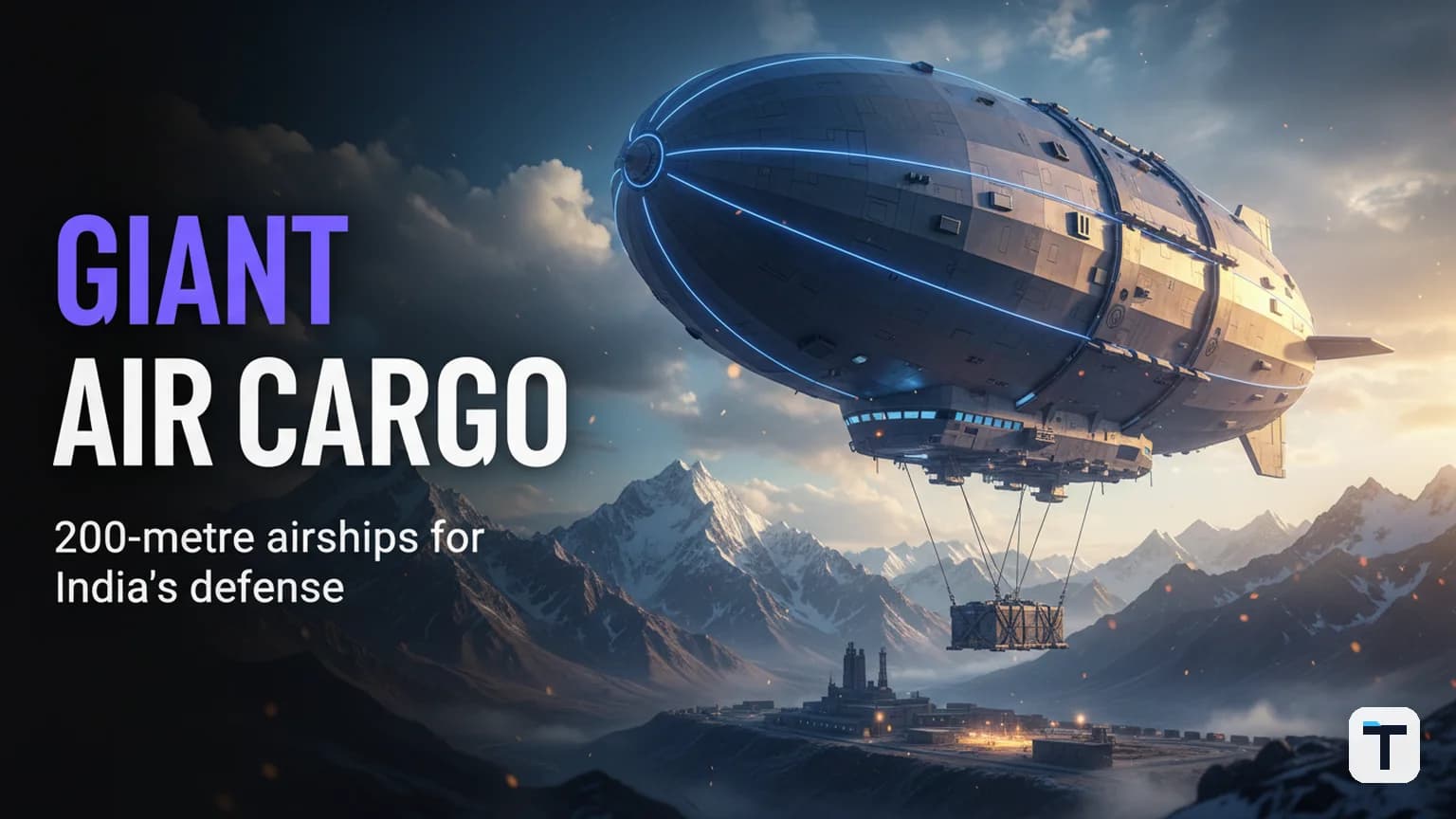

India's defence logistics problem is uniquely brutal: thousands of kilometres of Himalayan border where roads don't exist, runways can't be built, and helicopters strain under thin air and heavy loads. The Bharat Forge–Flying Whales partnership to build the 200-metre LCA60T heavy-lift airship in India is the first credible plan to crack that problem at scale. Signed at the Farnborough International Airshow on July 22, 2026, the deal pairs six decades of Indian manufacturing muscle with French-Canadian airship technology specifically for sovereign defence applications — and it arrives on top of three other India partnerships Flying Whales has signed in the last five months.
Last verified: 2026-07-22 · MoU signed July 22, 2026 at Farnborough · LCA60T: 200 m long, 60-tonne payload · ₹11,000 cr defence order book · Technology readiness: first flight slipped, no production airships yet
TL;DR
- What happened: Bharat Forge's Aerospace Division signed an MoU with Flying Whales (French-Canadian) to develop, manufacture, and field heavy-lift airships in India for defence — signed at Farnborough Airshow 2026 on July 22, 2026.
- The platform: The LCA60T is a 200-metre rigid helium airship that carries 60 tonnes, hovers to load/unload, needs no runways or ports, and runs on hybrid-electric propulsion.
- Why it matters for defence: India's Himalayan borders (Ladakh, Arunachal Pradesh) have minimal ground infrastructure. Heavy-lift airships bypass it entirely.
- The caveat: This is an MoU, not an order. The LCA60T has not yet completed its first flight. MoUs signal intent — delivery requires execution, certification, and years of investment.
What Is the Bharat Forge–Flying Whales Airship Partnership?
It is a Memorandum of Understanding signed on July 22, 2026, between Bharat Forge Limited (through its Aerospace Division) and Flying Whales, a French-Canadian aerospace company, to jointly develop, manufacture, and field the LCA60T heavy-lift airship platform in India for defence and strategic applications. The MoU was signed at the Farnborough International Airshow 2026 by Guru Biswal, CEO Aerospace at Bharat Forge, and Sébastien Bougon, President of Flying Whales.
According to the official NSE press release filed by Bharat Forge's Company Secretary, the partnership is "aligned to the Government's Aatmanirbhar Bharat and Make in India initiatives" and focuses on creating "sovereign capabilities in a strategically important aerospace segment." Amit Kalyani, Vice Chairman & Joint Managing Director of Bharat Forge, stated that the partnership redefines "how nations move and sustain forces."
What Is the LCA60T and How Does It Work?
The LCA60T (Large Capacity Airship, 60 Tons) is Flying Whales' flagship platform — a 200-metre rigid airship filled with 180,000 cubic metres of helium, designed to carry 60 tonnes of cargo to locations with zero ground infrastructure. Here are the verified specs from Flying Whales' official platform page:
| Parameter | LCA60T Specification |
|---|---|
| Length | 200 metres |
| Diameter | 50 metres |
| Cargo hold | 96 m × 8 m × 7 m |
| Payload capacity | 60 tonnes (132,000 lbs) |
| Helium volume | 180,000 m³ |
| Maximum speed | 100 km/h (54 knots) |
| Flight ceiling (60t payload) | 3,000 metres (10,000 ft) AMSL |
| Flight altitude (typical) | Several hundred metres AGL |
| Power | Up to 4,000 kW (5,360 hp), hybrid-electric |
| Structure | Rigid composite frame, textile skin, unpressurised helium cells |
| Loading | Vertical hover loading — no landing required |
| Future propulsion | All-electric via hydrogen fuel cells (planned) |
The key innovation is hovering cargo transfer: the airship doesn't need to land. It can hold position and lower heavy cargo by winch — eliminating the need for airstrips, helipads, ports, or roads. This is what makes it uniquely suited to the kind of terrain that dominates India's defence logistics challenge.
Why Does India Need Heavy-Lift Airships for Defence?
India maintains significant military deployments along its northern and western borders — in Ladakh, along the Line of Actual Control with China, and in the trans-Himalayan region. The terrain sits above 15,000 feet in places, with poor road access that takes years to build and is frequently blocked by avalanches and heavy snow.
The Indian Air Force has already signalled the gap. In April 2026, the Ministry of Defence issued a Request for Information to procure three Ultra Heavy Lift Helicopters (UHLHs) on a damp-lease arrangement — essentially admitting it cannot get heavy cargo to extreme-altitude border positions fast enough.
That RFI specifies platforms that must operate at altitudes of 5,500 metres and endure temperatures to minus 60 degrees Celsius. The only known helicopters that meet those specs are the Russian Mil Mi-26 and the Boeing CH-47 Chinook — both with payload ceilings well below the LCA60T's 60 tonnes. The Mi-26 maxes out at around 20 tonnes.
Heavy-lift airships like the LCA60T occupy a fundamentally different payload class. A comparison:
| Platform | Max Payload | Needs Runway | Needs Road Access | Altitude Limit | Status |
|---|---|---|---|---|---|
| LCA60T airship | 60 tonnes | No | No | 3,000 m AMSL (60t) | In development (no first flight yet) |
| Mil Mi-26 helicopter | ~20 tonnes | No | No | ~4,600 m (limited) | In service, limited availability |
| CH-47 Chinook | ~10–12 tonnes | No | No | ~6,000 m (light load) | In service (IAF operates 15) |
| C-17 Globemaster | 77 tonnes | Yes | Yes (needs major airbase) | Standard jet altitudes | In service (IAF operates 11) |
The LCA60T is the only platform in this list that can carry 60 tonnes to a remote site with no infrastructure at all. The trade-off: it's slower (100 km/h vs 500+ km/h for the C-17), the 3,000 metre flight ceiling means it cannot cross the highest Himalayan passes with a full load, and the technology is still unproven.
What Other Flying Whales Partnerships Exist in India?
Flying Whales has been building an Indian industrial ecosystem through three earlier collaborations, each addressing a different layer of the logistics stack:
TCI (Transport Corporation of India) — February 17, 2026: A strategic collaboration signed in the presence of Prime Minister Modi and President Macron to explore civilian airship logistics in India. The joint press release explicitly named defence, green energy corridors, HVDC transmission in Ladakh, and "border infrastructure like high-altitude developments in Tibet-facing areas" as target use cases.
BLP Group + Government of Tamil Nadu — April 2026: An agreement to establish a Final Assembly Line (FAL) for the LCA60T in Tamil Nadu, making India Flying Whales' third global industrial hub after France and Canada. The project is expected to generate nearly 1,000 highly skilled jobs.
Finance Minister meeting — late June/early July 2026: Finance Minister Nirmala Sitharaman met with Flying Whales leadership in Paris to discuss building out a full manufacturing ecosystem in India.
The Bharat Forge MoU adds the defence-focused manufacturing partner to this growing list. Where TCI brings logistics expertise and BLP brings the assembly line, Bharat Forge brings deep defence manufacturing credibility — the piece that matters most for sovereign military applications.
What Is Bharat Forge's Defence Track Record?
Bharat Forge, the flagship of the Kalyani Group (a ~$3 billion conglomerate based in Pune), has spent the last decade pivoting from a pure auto components maker into one of India's largest private defence manufacturers. Three examples:
Armoured vehicles with Paramount Group: Bharat Forge and its subsidiary Kalyani Strategic Systems partnered with Paramount (originally South African, now UAE-headquartered) to produce the Kalyani M4 and a broader range of armoured vehicles for the Indian Army and global export. The Mbombe 4 platform was localised as the Kalyani M4.
Air defence systems with Israel Aerospace Industries (IAI): Bharat Forge expanded its joint venture with IAI to jointly build, market, and manufacture selected air defence systems and ground-to-ground and ground-to-sea munitions in India. The JV combines IAI's missile system expertise with Bharat Forge's manufacturing.
Artillery (ATAGS): Bharat Forge co-developed the Advanced Towed Artillery Gun System with DRDO. Field trial completion is expected in H2 FY27, which would unlock the production ramp.
As of FY26, Bharat Forge reported a defence order book of approximately ₹11,000 crore (~$1.3 billion) with defence revenue of ₹1,562 crore that year alone. The defence segment now represents roughly 70% of standalone revenue. That book includes the ₹1,662 crore CQB carbine contract signed under the government's fast-tracked procurement process.
The airship MoU extends this defence logic upward and outward — from ground platforms into the unoccupied space of heavy strategic airlift.
What Defence Missions Would LCA60T Airships Actually Fly?
The official NSE press release and the TCI joint release converge on a set of mission profiles:
- Forward operating base resupply: Transporting rations, ammunition, fuel, batteries, and medical supplies to remote border outposts without ground convoys or helicopter sorties.
- Oversized equipment delivery: Moving howitzers, armoured vehicle modules, bridge-laying equipment, and generators that are too heavy for helicopters and too large for mountain roads.
- Power transmission infrastructure: Deploying HVDC pylons and transformer modules for inter-state transmission lines in Ladakh and the green energy corridor programme — a dual civilian-defence use case.
- Disaster relief and healthcare: Rapid delivery of field hospitals, water purification systems, and tents to earthquake, flood, or avalanche zones where roads are destroyed.
- Intelligence, surveillance, and reconnaissance (ISR): The airship's large volume and long endurance make it a natural platform for persistent surveillance payloads and communication relay.
- Humanitarian assistance: The same hover-and-lift capability that serves forward bases supports disaster response in remote areas.
The TCI release specifically named "Trans-Himalayan tunnel construction" and "high-altitude developments in Tibet-facing areas" — language that points directly at the infrastructure build-up along the Line of Actual Control.
What Are the Realistic Risks and Limitations?
This matters more than the hype, so let's be direct.
Technology readiness: The LCA60T has not yet completed its first flight. The consortium of 50+ companies has designed the airship using Dassault Systèmes' 3D EXPERIENCE platform, and a factory is under construction near Bordeaux, but every timeline Flying Whales has published has slipped. The "launch / first flight" date listed on airframer directories has been blank or deferred for years. Until a production prototype actually flies and delivers cargo, this is a programme, not a capability.
Altitude ceiling: At 3,000 metres AMSL with a full 60-tonne payload, the LCA60T cannot clear the highest Himalayan passes (Khardung La is 5,359 m; the Depsang Plains sit above 5,000 m). Flying Whales' spec sheet lists the 3,000 m ceiling for maximum payload; partial loads may go higher, but the platform is not a like-for-like replacement for helicopter-based high-altitude resupply. It is a complementary system that excels at medium-altitude or flat-terrain heavy lift.
MoU ≠ contract: Every Flying Whales India partnership — TCI, BLP, Bharat Forge — is a Memorandum of Understanding. MoUs signal intent. They do not fund construction, guarantee orders, or commit to delivery timelines. Bharat Forge itself noted in its press materials that the programme targets "future export opportunities." Real procurement requires a government order, a funding line, and certification — none of which exists today for airships in Indian airspace.
Certification: Operating a 200-metre rigid airship in Indian airspace requires regulatory approval from the DGCA, military certification, and integration with existing airspace management. Flying Whales is pursuing certification through the French civil aviation authority (DGAC) via EASA, but there is no parallel Indian certification pathway for military airships because the class doesn't exist yet in India's defence procurement system.
Helium supply: India imports most of its helium. The LCA60T requires 180,000 m³ per airship. A fleet of operational airships would create a significant and recurring helium supply dependency — a strategic vulnerability for a sovereign defence platform.
Competition from autonomous VTOL: In January 2026, Airvolve and ASAIC Global signed a Letter of Intent to deploy 1,500+ Airlift-U500 heavy-lift autonomous VTOL aircraft in India, with initial trials starting in 2026 for altitudes above 5,000 metres. These autonomous systems — while lower payload per sortie — operate at higher altitudes, don't need pilots, and could become a competing or complementary solution for the same border logistics mission.
What This Means for You
If you're watching India's defence supply chain: The airship partnership signals that the MoD's logistics gap along the Himalayan border is now openly acknowledged by industry — not just government. Look for LCA60T first flight, DGCA/EASA certification progress, and a Production Order (not just another MoU) as the three signals that this is moving from intent to capability.
If you're in aerospace manufacturing or supply chain: Flying Whales' India hub in Tamil Nadu will need a tier-2 and tier-3 supplier base. Rigid composite frames, specialised textiles, helium containment systems, hybrid-electric propulsion, and avionics are all in scope. The consortium of 50+ companies built around the LCA60T in France will need Indian counterparts.
If you're an investor: Bharat Forge's ₹11,000 crore defence order book is real and executable. The airship MoU is incremental optionality, not a near-term revenue catalyst. The worth of the announcement is strategic positioning — it adds an entirely new aerospace segment to the defence portfolio that currently drives the growth thesis.
If you're in the broader AI / tech audience: The LCA60T's hybrid-electric propulsion (and planned hydrogen fuel-cell upgrade) represents one of the most ambitious "sustainable aviation" platforms in development. The autonomous VTOL alternative (Airlift-U500) makes clear that the same border logistics mission is being attacked from two technology directions — unmanned drones and manned airships — and the two may ultimately share airspace and missions.
For related coverage of India's electric vehicle exports, see Tamil Nadu's emergence as India's fastest-growing export state. For how AI infrastructure investment is reshaping India's industrial base, see OpenAI's 1 GW India data centre build. And for how AI agents are reshaping enterprise secure system access in defence-adjacent infrastructure, see AI agent production access security in 2026.
FAQ
Q: What is the LCA60T airship?
A: The LCA60T (Large Capacity Airship, 60 Tons) is a 200-metre rigid airship developed by Flying Whales, a French-Canadian aerospace company. It carries up to 60 tonnes of cargo, uses 180,000 m³ of helium for lift, and can hover to load and unload without landing — eliminating the need for runways, roads, or ports.
Q: What is the Bharat Forge–Flying Whales MoU?
A: It is a Memorandum of Understanding signed on July 22, 2026, at the Farnborough International Airshow, under which Bharat Forge's Aerospace Division and Flying Whales agree to jointly develop, manufacture, and field the LCA60T airship in India for defence and national security applications.
Q: Can the LCA60T fly above 5,000 metres in the Himalayas?
A: No. The LCA60T's flight ceiling with a full 60-tonne payload is 3,000 metres AMSL (above mean sea level), per Flying Whales' official specifications. With reduced payload it may fly higher, but it cannot clear the highest Himalayan passes at maximum load. For that altitude, helicopters like the CH-47 Chinook or Mil Mi-26 remain the only viable options — albeit with much lower payloads.
Q: Has the LCA60T actually flown yet?
A: No production LCA60T has completed first flight as of July 2026. The airship remains in the development and certification phase, with a 50+ company consortium building subsystems and a production facility under construction near Bordeaux, France.
Q: How much does Bharat Forge's defence business generate?
A: Bharat Forge reported FY26 defence revenue of ₹1,562 crore with an executable defence order book of approximately ₹11,000 crore, including a ₹1,662 crore Close Quarter Battle (CQB) carbine contract. The defence segment accounted for roughly 70% of standalone FY26 revenue.
Q: What are the alternatives to airships for Himalayan logistics?
A: India's alternatives include the Mil Mi-26 (~20 tonne payload) and Boeing CH-47 Chinook (~12 tonne payload) helicopters, the C-17 Globemaster transport aircraft (77 tonnes, but requires a runway), and a new generation of autonomous heavy-lift VTOL drones like the Airlift-U500, which is being trialled in India starting in 2026 for altitudes above 5,000 metres.
Discussion
0 comments