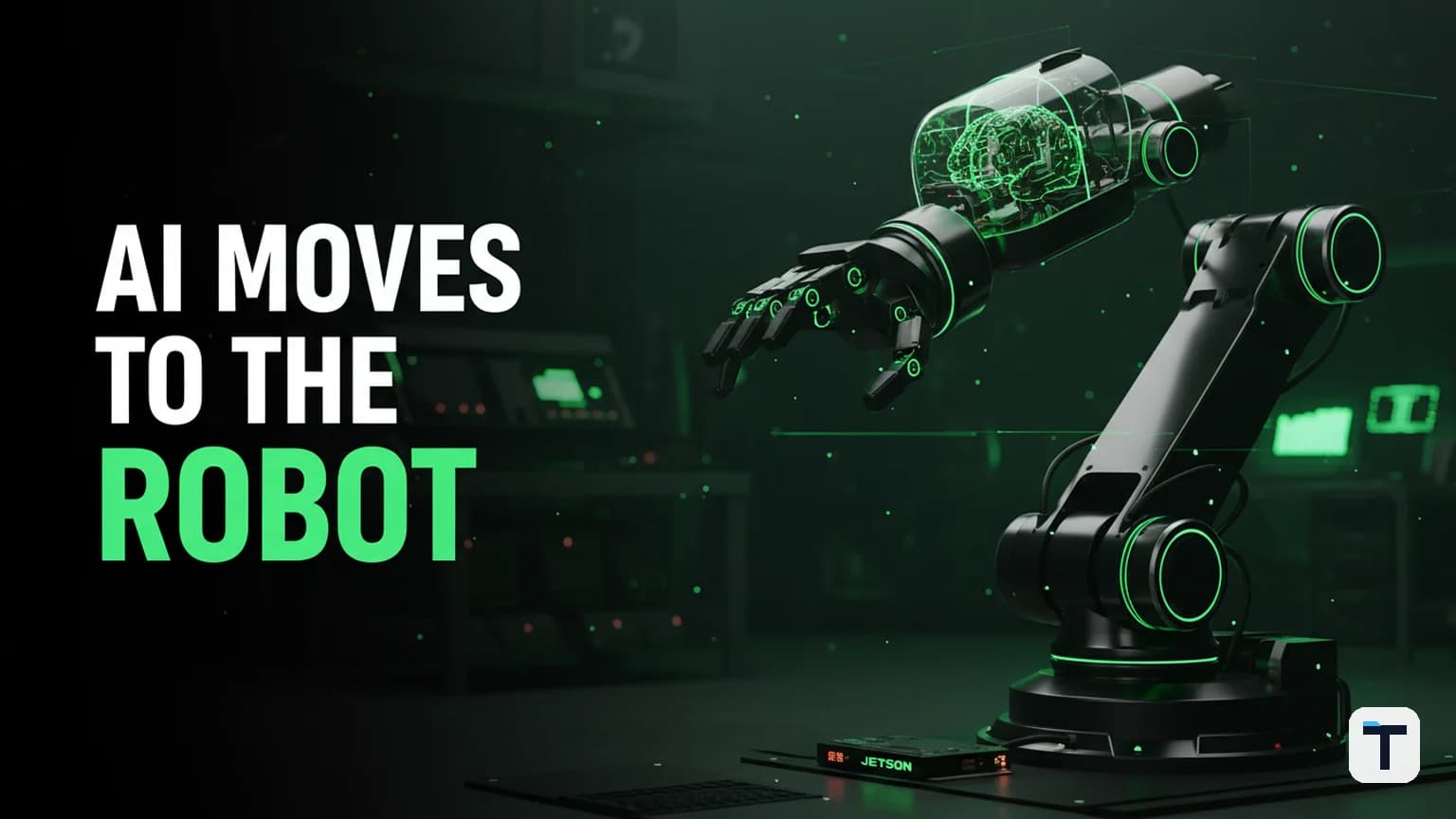

Nvidia Cosmos 3 Edge is the moment "physical AI" — AI that perceives the real world and acts in it — moves out of the data center and onto the machine itself. Announced in Tokyo on July 15, 2026, it is a 4-billion-parameter "world model" small enough to run inside a robot, camera, or vehicle, generating up to 32 actions per inference at 15 Hz on Jetson Thor hardware. For builders, the open-weights model is downloadable now and post-trainable for a new embodiment in roughly a day using Isaac Sim. For small businesses, the bigger signal is structural: the gap between a system that waits for a cloud response and one that acts in real time is collapsing — and that pattern will not stay confined to robots.
The honest verdict: the announcement is real, but most of the specific deployments are still "intended." 22 Japanese industrial giants (Fanuc, Yaskawa, Kawasaki Heavy, Fujitsu, Sony, SoftBank, Hitachi, Honda R&D, NEC, Preferred Networks and more) intend to join the Cosmos Coalition, and Fujitsu is exploring — not shipping — a shared control platform. The model and the new Jetson Thor T3000/T2000 modules ship Q1 2027. What is downloadable today from Hugging Face is the 4B-parameter Edge model for prototyping on RTX, DGX, and existing Jetson AGX Thor dev kits. So treat July 2026 as the "get ready" checkpoint, not the "deploy to production" checkpoint.
What this article covers
Last verified: 2026-07-26 — volatile facts (model versions, hardware availability, partner claims) re-checked against Nvidia's official press release, Jetson blog, and HuggingFace model card.
- What Cosmos 3 Edge is — a 4B world model for on-device robot + vision-AI control
- What ships vs. what is "intended" — model is open now; T2000/T3000 hardware lands Q1 2027
- The "1-day post-training" claim — realistically aspirational; plan for ≈1–3 days per embodiment
- What it actually means for builders — concrete starting points (RTX card, Isaac Sim, DROID policy)
- What it means for small business — the real-time/reactive-AI pattern, not the robots themselves
- A FAQ for AI-citation readiness
What is Nvidia Cosmos 3 Edge?
Nvidia Cosmos 3 Edge is a 4-billion-parameter open world model in Nvidia's Cosmos 3 family, explicitly built to run vision reasoning and robot policy generation directly on edge devices — not in a cloud. It was announced in Tokyo on July 15, 2026, alongside new Jetson Thor T2000 and T3000 modules, as part of Nvidia's expanding physical AI push into Japan's manufacturing ecosystem. Nvidia's Hugging Face page describes it as ranking #1 among 4B-class models on the VANTAGE-Bench for vision analytics and state-of-the-art for robot policy learning. It generates 32 actions per inference at 15 Hz on Jetson Thor while running at a robot-control resolution of 640×360.
The key shift worth slowing down for: most AI models you read about weekly are language models trained on words. Cosmos 3 Edge is trained on physics, motion, and cause-and-effect — a ball rolling, a person walking toward a door, a car turning a corner. A language model finishes your sentence. A world model finishes a movement. That distinction is why Nvidia calls it a "world model" rather than a chat model, and it is why on-device inference matters: a robot arm cannot wait 250 ms for a cloud round-trip when it is moving beside a person.
How does Cosmos 3 Edge differ from cloud AI and from a regular LLM?
A cloud AI waits for you to ask; an edge AI watches, decides, and moves — that is the entire framing of Cosmos 3 Edge. The model runs locally on Nvidia Jetson Thor modules, RTX GPUs, or DGX systems, so the latency, privacy, and reliability that break cloud inference on a factory floor or in a moving car are no longer load-bearing concerns. Versus an LLM, Cosmos 3 Edge is a world model: it predicts what happens next in the physical world and outputs actions, not tokens. Versus older vision models, it adds a reasoning + diffusion transformer ("mixture-of-transformers") architecture so it can both understand a scene and generate the next world state + the robot action that produces it.
For a concrete illustration: the old way to run a robot arm in a warehouse was to stream its camera video to a cloud model, wait for an answer, and stream instructions back. Every second of latency is a safety risk when an arm is moving near a person. With Cosmos 3 Edge, the thinking happens on the arm's controller — no round trip, no waiting. Think of it as the difference between calling a friend for directions at every turn versus already knowing the route because you have driven it a hundred times.
What shipped on July 15, 2026 vs. what is only "intended"?
This is the single most misread part of the announcement, so it deserves its own section.
Shipped and verifiable now:
| Item | Status | Source |
|---|---|---|
| Cosmos 3 Edge 4B-parameter model (open weights) | Available on Hugging Face, downloadable today | Nvidia / Cosmos3-Edge on Hugging Face |
| Cosmos 3 Edge Policy (DROID) — pick-and-place post-training scripts | Released | Hugging Face blog |
| Metropolis libraries built on Cosmos — claim ≥6x faster vision-AI dev | Announced; libraries are part of Nvidia's existing Metropolis SDK | Nvidia newsroom |
| Original Cosmos 3 family (Super, Nano; Edge was "coming soon") | Launched May 31, 2026 at GTC Taipei | Nvidia Cosmos 3 launch press release |
Announced as "intended" — not shipping:
| Item | Real status | When |
|---|---|---|
| Jetson Thor T3000 module (865 FP4 TFLOPS, 32GB, 70W) | Announced; availability Q1 2027; emulation via JetPack 7.2.1 available end of July 2026 | Q1 2027 |
| Jetson Thor T2000 module (400 FP4 TFLOPS, 16GB, 40W) | Announced; availability Q1 2027; T2000 emulation in a later JetPack release | Q1 2027 |
| 22-company Japan Cosmos Coalition (Fanuc, Yaskawa, Kawasaki Heavy, Fujitsu, Hitachi, Sony, SoftBank, Honda R&D, NEC, Preferred Networks, Mitsui, Mitsubishi, Mujin, TIER IV, TRON, Turing, Classmethod, AIRoA, Enactic, GROOVE X, Kubota, Telexistence) | "Intend to join" — explicit language in Nvidia's press release — products not all shipping | Rolling, watch this space |
| Fujitsu × Fanuc × Yaskawa × Kawasaki collaborative control platform | "Exploring business opportunities" per Nvidia's own release | Unknown |
| ~1-day post-train time per new robot embodiment | Vendor claim; treat as aspirational. Nvidia's own ecosystem partner analysis characterizes 1 day as realistic only for simple embodiments and suggests planning for 1–3 days for non-trivial platforms | Vendor claim |
The word "intend" is the load-bearing word in the entire announcement. Three of Japan's industrial-robotics giants (Fanuc, Yaskawa, Kawasaki Heavy Industries) controlling a meaningful share of the global industrial robot market signaling intent to build on the same AI stack is a procurement signal, not a research press release — but it is still a signal, not a shipment. Watch what ships over the next 6–12 months, not what was announced on stage.
What does the hardware actually look like?
Two new Jetson Thor modules were announced alongside the model:
| Module | Compute | Memory | Power | Target | Ships |
|---|---|---|---|---|---|
| Jetson Thor T3000 | 865 FP4 TFLOPS, 1536-core Blackwell GPU | 32 GB LPDDR5X at 273 GB/s | ~70W | Humanoids, industrial arms with multimodal reasoning | Q1 2027 |
| Jetson Thor T2000 | 400 FP4 TFLOPS, 1024-core Blackwell GPU | 16 GB LPDDR5 at 137 GB/s | ~40W | Visual AI agents, autonomous mobile robots, industrial manipulators, intelligent cameras | Q1 2027 |
The T3000 is roughly half the size and power draw of the existing flagship T5000 while delivering similar multimodal inference performance — a deliberate trade given current elevated memory prices and limited power budgets on factory floors. The T2000 is the entry-level option for cost-constrained edge deployments. Together, the Jetson portfolio now spans roughly 70 TOPS to >2000 TFLOPS, letting developers pick hardware by model size, sensor load, and power envelope rather than defaulting to the maximum. NVIDIA has not announced commercial pricing for either module.
How long does it really take to adapt Cosmos 3 Edge to a new robot?
The realistic answer is somewhere between one and three days for a non-trivial embodiment — Nvidia's headline "about a day" is true for straightforward sensor/embodiment combinations but optimistic for platforms with novel kinematics or diverse operating environments. Mechanically, the process uses Isaac Sim for synthetic data (Nvidia states Isaac Sim can generate over 1 million labeled synthetic images per hour) plus platforms like CosmosWriter for domain adaptation; the resulting checkpoint becomes a local action policy for a specific arm, mobile base, or humanoid.
Why this matters even if the "1-day" number is aspirational: the previous state of the art required months of bespoke data collection to bridge the sim-to-real gap. Reducing that to even 3 days is a meaningful compression of the timeline from "we have a new robot" to "we have a working policy," and it is what makes Cosmos 3 Edge genuinely usable for prototyping rather than a lab curiosity.
For builders, the practical path is:
- Download
nvidia/Cosmos3-Edgeand the DROID post-training scripts from Hugging Face. - Pick an embodiment to post-train for — start with the released Cosmos 3 Edge Policy (DROID) to see pick-and-place end-to-end before tackling a custom arm.
- Generate domain-matched synthetic data with Isaac Sim against your CAD/sim environment.
- Fine-tune on an H100 or DGX Station cluster — Nvidia's model card confirms an H100 cluster or DGX Station is the recommended fine-tune compute envelope.
- Deploy to a Jetson AGX Thor dev kit (emulating T3000 via JetPack 7.2.1) until the T2000/T3000 modules ship in Q1 2027.
What does this mean for builders who don't work on robots?
The play for builders outside robotics is twofold: (1) the model is open-weights and a competent 4B vision-reasoning VLM even if you never use the policy head, and (2) the broader pattern — move inference to where the action is, not to where the GPU cluster is — applies to virtually every latency-sensitive AI system.
If you are building AI agents for real work rather than demo videos, the Cosmos 3 Edge release is two lessons compressed into one announcement:
- Pattern transfer. The architectural shift from cloud-AI "wait then answer" to edge-AI "watch, decide, act" is the same shift happening in the AI agent ecosystem at large. The trend toward autonomous agents that take action rather than wait for instructions is the agent-side mirror of what Cosmos 3 Edge does for robots.
- Latency is a feature. On-device inference removes a whole class of failure modes: cloud outages, network jitter, data egress costs, and the privacy exposure of streaming raw sensor footage. These are exactly the same reasons self-hosted agentic stacks have been winning in 2026 — see our self-hosted AI workspace guide for the agent-side equivalent.
For a deeper parallel, our piece on perception agents and AI computer-use reliability covers how the same "perceive → reason → act" loop is finally becoming reliable in software agents — Cosmos 3 Edge is the hardware-side and robotics-side instance of the same idea.
What does this mean for a small business that is not building robots?
The real lesson for a small business is structural, not technological. The same pattern — the gap between systems that react instantly and systems that react slowly is widening permanently — is what makes AI agents worth deploying in the first place, even if you never touch a robot. Customer questions answered the instant they come in. Leads followed up the moment they show interest. Inventory reorders triggered the second a sensor sees a low shelf. These are all the same shape of system that Cosmos 3 Edge is for a robot: watch what is happening, decide, act, no human in the latency loop.
If you run a small business and have not started building this pattern, the more practical starting point is still a small business AI-agent automation stack — Cosmos 3 Edge is for the hardware-tier build, but the same instant reaction philosophy is what makes a $20K/month support team replaceable. The hardware announcement is a forcing function, not the working playbook.
What are the real limitations a builder should plan around?
Five caveats worth planning around before treating Cosmos 3 Edge as production-ready:
- No module-level hardware is shipping today. T2000 and T3000 ship Q1 2027. For 2026 work, the dev path is RTX GPUs, DGX, or existing Jetson AGX Thor dev kits (with T3000 emulation via JetPack 7.2.1 end of July 2026).
- "One-day post-train" is a best case. Treat it as a 1–3 day planning envelope per embodiment for non-trivial work.
- 640×360 observations are the policy-mode resolution. Cosmos 3 Edge is not a high-resolution vision model; downstream perception tasks may need a separate front end. This is fine for robot control but not for fine-grained inspection.
- No commercial pricing yet. The T2000/T3000 cost is unannounced. The value of the modules depends heavily on whether Nvidia prices them below the existing Jetson AGX Orin and higher-capacity Thor configurations.
- The coalition is intent, not shipped product. Fanuc, Yaskawa, and Kawasaki are the heaviest signals, but Fujitsu's collaborative control platform is explicitly "exploring," per Nvidia's own wording.
What this means for you
If you are a robotics or AI builder: download the model today, run through the DROID post-training scripts to see end-to-end policy training, and validate against T3000 emulation via JetPack 7.2.1 before the physical modules land Q1 2027. Treat the "1-day" claim as a 1–3 day plan and budget for H100-class fine-tuning compute. The model card is the source of truth.
If you run a small business: take the lesson, not the hardware. The narrowing gap between instant reaction and slow reaction is the big shift. If you have not yet wired basic AI-agent-driven automation into your customer/lead/inventory loops, the relevant playbook is the small business AI agent stack, not Cosmos 3 Edge.
If you are an investor or analyst: watch what ships from the 22-company Japan coalition over the next six months, not what was announced. Fujitsu's collaborative platform is the bellwether. Fanuc alone accounts for roughly a quarter of industrial robots manufactured globally — that depth makes this the most concentrated single-country commitment the Cosmos Coalition has received.
FAQ
Q: What is Nvidia Cosmos 3 Edge? A: Cosmos 3 Edge is a 4-billion-parameter open world model in the Cosmos 3 family, designed to run vision reasoning and robot policy generation on-device at the edge. It was announced July 15, 2026 in Tokyo and is downloadable from Hugging Face today; matching Jetson Thor T2000/T3000 modules ship Q1 2027.
Q: How is a world model different from a language model? A: A language model is trained on text and predicts the next token. A world model is trained on physical scenes, motion, and cause-and-effect, and predicts the next world state plus the action that produces it. A language model finishes your sentence; a world model finishes a movement.
Q: Can small businesses actually use Cosmos 3 Edge? A: Directly, no — the model targets robotics and vision-AI builders with H100-class fine-tuning compute and Jetson Thor hardware. Indirectly, yes: the same act in real time rather than wait for a cloud answer philosophy is what small businesses get from AI agents that trigger on events instead of waiting for a human to notice. The small-business pattern is the takeaway, not the model.
Q: Does the "1-day post-training" claim hold up? A: It holds for straightforward embodiments, but ecosystem-partner analysis suggests you should plan for roughly 1–3 days for non-trivial platforms. Even at 3 days that is a meaningful reduction from the months of data collection the sim-to-real gap historically required.
Q: When will Jetson Thor T2000 and T3000 hardware be available? A: Both modules are scheduled for Q1 2027. Developers can target the T3000 today using JetPack 7.2.1's T3000 emulation mode, released end of July 2026; T2000 emulation follows in a later JetPack release.
Q: Which companies are actually building with Cosmos 3 Edge? A: 22 Japanese industrial firms intend to join the Cosmos Coalition, including Fanuc, Yaskawa, Kawasaki Heavy Industries, Fujitsu, Hitachi, Sony, SoftBank, Honda R&D, NEC, Preferred Networks, and others. "Intend to join" is the explicit language in Nvidia's press release, so this is best read as a procurement signal rather than a shipped-product commitment.
Discussion
0 comments