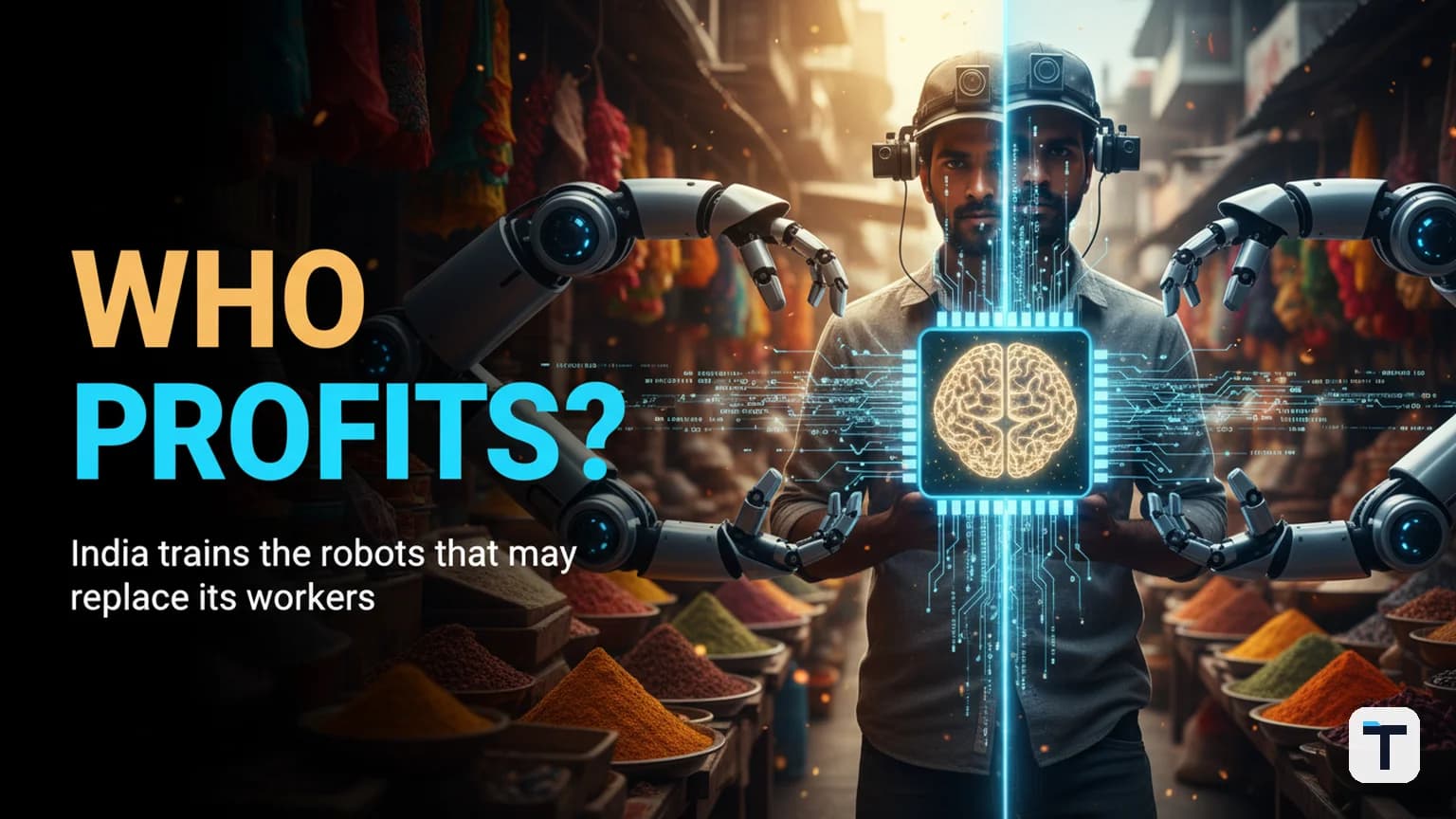

India is becoming the world's training ground for physical AI. Startups funded by Silicon Valley's top investors are paying Indian workers ₹250–350 per hour ($3–$4) to wear camera-equipped caps and record their movements so robots can learn to fold clothes, pack boxes, and clean houses. The data these workers generate is invaluable — but the systems it trains may ultimately replace the very people who built them. The question isn't whether India will supply this data. It already does. The question is whether India learns from three decades of doing the grunt work for other people's AI products, or walks into the same trap a fourth time.
- India dominates global physical AI data collection, but the IP and profits stay in San Francisco
- Human Archive raised $8.2M from Y Combinator, Wing VC, and angels from OpenAI, Nvidia, and Meta
- Physical AI market projected to hit $15.24B by 2032 (47.2% CAGR from $1.50B in 2026)
- Workers earn ₹250–350/hour ($3–4/hour) recording their own physical tasks
- India's 490 million informal workers are most exposed to the robots they're training
- DPDP Rules 2025 carry penalties up to ₹250 crore for data protection failures
What Is Physical AI Data Collection and Why Does India Dominate It?
Physical AI — also called embodied AI — refers to AI systems that learn from real-world physical interactions rather than text or images scraped from the internet. To train a robot to fold a shirt, you can't feed it Wikipedia. You need first-person video footage of a human actually doing it, captured with depth-sensing cameras that record grip position, wrist angle, hand force, and the timing of each motion. This is called egocentric data, and it is the fundamental bottleneck of the robotics industry today.
Unlike text and images, robotic manipulation data cannot be scraped from the web — it must be collected in the real world, one physical demonstration at a time. Scale AI, in which Meta holds a 49% stake, calls this "the robotics data gap" and has logged over 100,000 production hours at its San Francisco prototyping laboratory. The open-source datasets available today — including DROID and Open X-Embodiment — offer only about 5,000 hours of interaction data combined, which is far too little for physical AI to handle real-world complexity. [1][2]
India has become the center of this collection effort for three structural reasons: a massive, low-wage informal workforce (~490 million people, or roughly 90% of total employment per NITI Aayog), loose regulatory oversight of data collection, and deep existing infrastructure for tech outsourcing built during three decades of IT and BPO work. [3][5]
How Big Is the Physical AI Data Market?
The physical AI market was valued at approximately $1.50 billion in 2026 and is projected to reach $15.24 billion by 2032, growing at a compound annual growth rate (CAGR) of 47.2%, according to MarketsandMarkets. [4] Grand View Research sizes the broader embodied AI market at $4.6 billion in 2025, projected to grow to $67.63 billion by 2033 at a 39.7% CAGR. [6]
India's share of the data annotation market — the broader category that includes physical AI data collection — is projected to reach $492.4 million by 2030, growing at a 29.2% CAGR. India accounted for approximately 7.9% of the global data annotation tools market in 2023 and is the fastest-growing regional market in Asia Pacific, according to Grand View Research. [7]
| Metric | Value | Source |
|---|---|---|
| Physical AI market (2026) | $1.50B | MarketsandMarkets [4] |
| Physical AI market (2032 projection) | $15.24B | MarketsandMarkets [4] |
| Physical AI CAGR (2026–2032) | 47.2% | MarketsandMarkets [4] |
| India data annotation tools market (2030 projection) | $492.4M | Grand View Research [7] |
| India data annotation CAGR (2024–2030) | 29.2% | Grand View Research [7] |
| India informal workforce | ~490M (~90% of total) | NITI Aayog [3] |
| Human Archive seed funding | $8.2M | TechCrunch [8] |
| Scale AI physical AI production hours | 100,000+ | Scale AI [2] |
Which Companies Are Collecting Physical AI Data in India?
Several companies are now actively collecting egocentric physical data from Indian workers. Here are the key players, what they do, and what we can verify about their operations.
Human Archive
Human Archive is the highest-profile player. Founded in 2026 by UC Berkeley and Stanford researchers Samay Maini, Rushil Agarwal, Shloke Patel, and Raj Patel, the Y Combinator-backed startup raised $8.2 million in seed funding from Wing Venture Capital, NVP Capital, Y Combinator, and angel investors from OpenAI, Nvidia, Google, Mercor, AfterQuery, BAIR, SAIL, and Meta. The company has deployed over 1,000 camera headsets across workers in residential homes, restaurants, hotels, construction sites, logistics facilities, and industrial environments globally, with a significant portion of operations in India. [8][9]
Human Archive supplies workers with rigs that include downward-facing cameras recording 4K video at 30 frames per second, paired with depth-sensing cameras and a wide-angle lens. Co-founder Raj Patel has said plainly: "Our technology will become foundational infrastructure for automating manual labor, increasing global abundance." [9][10]
Scale AI
Scale AI is the largest data-for-AI company in the world, now overlapping directly with Human Archive's space. Scale's "Data Engine for Physical AI" has completed more than 100,000 production hours at its San Francisco prototyping laboratory and works with leading physical AI companies including Physical Intelligence, Generalist AI, and Cobot. In March 2026, Scale partnered with Universal Robots to launch "UR AI Trainer" for physical AI and robotics training. Meta holds a 49% stake in Scale AI following a $15B investment in June 2025. [2][11]
Objectways
Objectways is a US-based AI data solutions company that collects egocentric data from hundreds of workers across India — on factory floors, and at home recording tasks like cutting fruits and vegetables, cleaning utensils, and folding clothes. Workers are paid anywhere between ₹250–350 per hour depending on the task, the video's length, and quality. In Tamil Nadu, several women workers have been filmed wearing Meta smart glasses while packing items in plastic covers. Objectways' president Ravi Shankar confirmed India is their biggest source of physical AI data. [12]
Other Players
NxtEd.ai (based in India) markets first-person egocentric video with depth, hand pose, and 6-DoF trajectory data for robot training. Roborax.ai, part of the Omind portfolio, provides outsourced data collection for embodied AI. Egolab.AI (founded January 2026) calls itself "India's largest first-person POV Data Aggregator," collecting egocentric footage from garment factory workers at suppliers including Pearl Global. [13][14]
How Does the Data Collection Actually Work?
The physical AI data pipeline works in stages:
Recruitment and onboarding. Workers are recruited through gig economy platforms, local networks, or factory-floor partnerships. Human Archive taps India's existing gig infrastructure — the same networks powering food delivery, ride-hailing, and logistics. For home-based collection, Objectways provides a mobile app through which workers can record tasks. [8][12]
Hardware deployment. Workers are given wearable rigs: camera-equipped caps, smart glasses, or body-mounted sensors. Human Archive's rigs include downward-facing 4K cameras at 30fps, depth-sensing cameras, and wide-angle lenses that capture hand movements from a first-person perspective. [9]
Task recording. Workers perform everyday physical tasks — folding clothes, mopping floors, washing dishes, packing items, sorting produce, navigating crowded markets — while the sensors record. The footage captures grip patterns, wrist angles, motion timing, and environmental context.
Data processing. The raw footage is anonymized (faces blur redacted), annotated, and processed before being formatted for machine learning models. Human Archive's team handles this layer. [9]
Sale to robotics labs. The processed datasets are sold to frontier AI labs and robotics companies building "Large Behaviour Models" (LBMs) — the physical-world equivalent of large language models that map human movements into robot instructions. [10]
How Much Do Workers Earn Versus What the Data Is Worth?
Worker pay is the sharpest edge of this entire story. Objectways pays ₹250–350 per hour ($3–4/hour) depending on the task and quality. [12] Human Archive has not disclosed specific pay rates publicly, but its model is built on India's cost-of-labor advantage: the same egocentric data collection in the US or EU would be dramatically more expensive. [8]
Meanwhile, the companies buying this data are backed by billions in venture capital. Physical AI and robotics raised approximately $55.8 billion in 2026 alone. [15] Human Archive raised $8.2 million to build a data pipeline whose end product — trained robot models — will be deployed in markets where a single humanoid robot costs tens of thousands of dollars. [8][4]
The gap between data-generators' compensation and the value the data unlocks is the crux of what makes this structural rather than just another gig-economy story. A worker earning ₹250/hour generates footage that trains a robot potentially worth millions in deployment revenue. The worker gets a day's wages. The startup gets a proprietary dataset. The robotics lab gets a trained model. The investor gets a 10x return. The worker's economic position does not improve.
Who Owns the Intelligence When a Robot Learns from a Human's Movements?
This is the hardest question in physical AI, and current frameworks offer no clear answer.
Under existing data law, the moment a worker sells footage to a data company, the company owns it. The worker has no ongoing claim on the derivative intelligence the robot develops from studying their movements. This is analogous to how call center workers eventually trained the automated systems that replaced them: their voices, scripts, and thousands of hours of customer interactions became the training data for the AI that now handles those calls without them.
India has been here before. Data annotators spent years labeling images and tagging objects to build the computer vision AI that now runs without them. The products carried American names. The intellectual property stayed in San Francisco. The profits went to shareholders in New York. Now physical AI wants India's bodies — its farmers, warehouse workers, cooks, and nurses moving, demonstrating, and performing so that robots can learn to do what they do. [5]
NITI Aayog has explicitly noted that most public discussion of AI and employment focuses on white-collar knowledge work, without examining how automation affects the informal sector that forms the backbone of the Indian economy. [3]
What Are the Privacy and Regulatory Risks?
India's Digital Personal Data Protection (DPDP) Rules 2025 were notified on November 14, 2025, operationalizing the DPDP Act 2023. The Rules are being implemented in phases: Consent Manager registration by November 2026, and full operational compliance — including core fiduciary obligations, data principal rights, penalties, and cross-border data processing — by May 2027. [16][17]
The highest penalty, up to ₹250 crore (approximately $30 million), applies to failure of a Data Fiduciary to maintain reasonable security safeguards. Failure to notify the Board or affected individuals of a personal data breach, and violations involving children's data, can each attract penalties up to ₹200 crore. [18]
For physical AI data collectors operating in India, the DPDP Rules raise serious questions:
- Do workers providing egocentric footage understand what their data is being used for? Human Archive's co-founder says workers are "very curious and excited" when shown the technology, but the consent framework for recording bodily movements for robot-training purposes is largely untested. [5]
- What about third-party privacy? Workers recording in homes, kitchens, factories, and crowded markets capture footage of other people — family members, colleagues, customers — who have not consented to being part of a training dataset.
- When workers are recording in factories, does the employer consent? If a textile firm allows Objectways to film its workers, does the firm own that consent or do the workers?
These are not academic questions. India's data protection regime is now operational, and the penalties are serious. Companies collecting physical AI data at scale without robust consent and privacy frameworks face real legal exposure — possibly more than the gig-economy networks recruiting the workers.
How Does This Compare to India's Previous AI Labor Chapters?
| Phase | What India Provided | Who Kept the IP | Who Kept the Profits | Were Workers Replaced? |
|---|---|---|---|---|
| Call centers / BPO (1990s–2000s) | Voice, scripts, customer interaction processing | US / European clients | US / European shareholders | Yes — automated IVR and chatbots replaced many |
| Data annotation (2010s–2020s) | Image labeling, object tagging, conversation classification | US frontier AI labs | US frontier AI labs | Many tasks partly automated; annotators shifted to RLHF/prompting |
| Physical AI data (2025–present) | Egocentric movement data, physical demonstrations | US startups + robotics labs | US VCs, robotics companies | TBD — the robots trained on this footage may replace physical workers |
The pattern is consistent. India provides labor and data. The IP, the trained models, and the profits stay in the US. The workers are well-paid by local standards but earn a fraction of the value they create. When the model is trained, their work is done — and the systems they enabled may reduce demand for the physical tasks they themselves perform for a living.
Is There a Better Path? What Could India Do Differently?
The answer is not to stop collecting data — physical AI will happen with or without India. The question is whether India captures more value than a day's wage for its workers.
Several alternative models are emerging or being proposed:
Treat physical data as an asset class, not a service. Indian companies could build their own proprietary datasets — doctor-patient conversations, skilled labor demonstrations, agricultural workflows — and lease them to model builders rather than selling them outright. This is fundamentally different from selling raw data: it keeps ownership and pricing power on the Indian side. Some Indian companies are already thinking this way. [5]
Build the intelligence layer, not just the data layer. India has the workforce and the domain complexity to build trained models for specific verticals — agriculture robotics tuned for Indian farms, manufacturing robotics tuned for Indian textile lines — and export those models rather than raw data. NITI Aayog has proposed building Indian datasets for agriculture, manufacturing, healthcare, logistics, and disaster management to improve model robustness in local conditions. [3]
Move up the skill chain. The annotators who survived the first wave were those who transitioned from labeling to RLHF (reinforcement learning from human feedback), activation patching, and model evaluation — higher-skill, better-paid work. NITI Aayog's "Roadmap for Job Creation in the AI Economy" estimates India could create up to 4 million new AI-related jobs in the next five years, but only with aggressive reskilling. [19]
Regulate physical data collection. The DPDP Rules exist but are not yet fully enforced (May 2027). There is a window to create specific guidelines for egocentric data collection — consent structures for bodily data, revenue-sharing models, and limits on which tasks can be trained away. Without this, the same companies will extract the same value and leave the same workers behind.
Negotiate terms. Some Indian data companies report that clients initially refused human-in-the-loop pricing and pushed for the cheapest possible collection. Workers and their representatives need a seat at the table when the value of their data is being priced — or the price will always be set at the lowest level the market will accept.
What Does This Mean for Businesses Building with AI?
If you are a small business, builder, or entrepreneur working with AI in 2026, the physical AI data race matters to you in concrete ways:
- The robotics tools you depend on may be trained on underpaid labor. If you build on physical AI models, the provenance of the training data is an E-E-A-T (Experience, Expertise, Authoritativeness, Trustworthiness) and procurement question — increasingly, enterprise customers ask where data comes from.
- Data quality = model quality. The companies that win in physical AI will be the ones with the best training data, not just the best algorithms. If you are collecting any form of demonstration data (for training, onboarding, or automation), treat it like a strategic asset, not a commodity. See our guide to building synthetic data pipelines for LLM pre-training for how data quality decisions ripple downstream.
- The same dynamic applies to your AI agents. If humans grade, correct, or demonstrate tasks for your AI agents, you are running a microcosm of this physical AI data economy. How AI training data markets actually work explains why verifier's law — the workers who spot the model's mistakes create the next version of the model — determines whether your AI agent loop improves or stalls. Paying them more and sharing the upside is a competitive moat.
- India's regulatory window is an opportunity. If your business operates in India or collects data from Indian workers, compliance with the DPDP Rules is not just a legal check — it is a trust signal that differentiates you from extractive competitors. See India's semiconductor revolution for how India is positioning to capture more value in the broader tech stack.
What This Means for You
If you are building AI products that depend on any form of human-generated data — physical or digital — you are part of this story. The companies that win the next phase of AI are the ones that treat data provenance, worker compensation, and regulatory compliance as strategic advantages rather than cost centers. The ones that treat their data generators as disposable will face the same trap India faces at a macro scale: building systems that eventually remove the need for the very people who created them.
For workers and builders in India and similar markets: the data you generate is worth more than you are being paid for it. The question is whether you negotiate that gap or accept it.
FAQ
Q: What is physical AI and how is it different from regular AI? A: Physical AI — also called embodied AI — refers to AI systems that learn from real-world physical interactions (human movement, environmental manipulation) rather than text or images from the internet. A language model can describe how to fold a shirt, but a robot cannot perform the fold without first-person physical demonstration data showing grip, motion, and timing. This data must be collected in the real world; it cannot be scraped from the web.
Q: How much are Indian workers paid to collect physical AI data? A: Workers at Objectways earn ₹250–350 per hour (approximately $3–4/hour), depending on the task, video length, and quality. Other companies have not disclosed specific pay rates but the model is built on India's cost-of-labor advantage — the same collection in the US or EU costs dramatically more. Confirmed by Ravi Shankar, President of Objectways, in an interview with The Indian Express. [12]
Q: Who owns the training data that workers generate? A: Under current law, once a worker sells footage to a data company, the company owns it. The worker has no ongoing claim on the derivative intelligence the robot develops from their movements. This mirrors the pattern from India's BPO and data annotation eras, where worker-generated intelligence became company IP that traveled to US frontier labs and shareholders.
Q: Is India's DPDP Act 2025 relevant to physical AI data collection? A: Yes. India's DPDP Rules 2025 were notified on November 14, 2025, with full operational compliance phased in by May 2027. Penalties for failing to maintain reasonable security safeguards can reach ₹250 crore (~$30 million). Physical AI data collectors operating in India face questions about consent, third-party privacy (people filmed incidentally), and whether bodily movement data counts as personal data under the framework.
Q: How big is the physical AI market? A: The physical AI market was valued at approximately $1.50 billion in 2026 and is projected to reach $15.24 billion by 2032, growing at a CAGR of 47.2%, per MarketsandMarkets. The broader embodied AI market is projected at $4.6 billion (2025) growing to $67.63 billion by 2033 at a 39.7% CAGR, per Grand View Research. [4][6]
Q: Will robots replace the Indian workers who train them? A: The dynamic is genuinely cyclical and concerning. India's ~490 million informal workers (per NITI Aayog) are the population most exposed to physical automation. Workers need income, take camera-wearing gig work, generate training data, that data improves robot models, and those models reduce demand for the physical tasks the workers perform for their primary income. NITI Aayog has warned that most AI employment discourse ignores the informal sector, where the biggest displacement risk actually lies. [3]
Discussion
0 comments