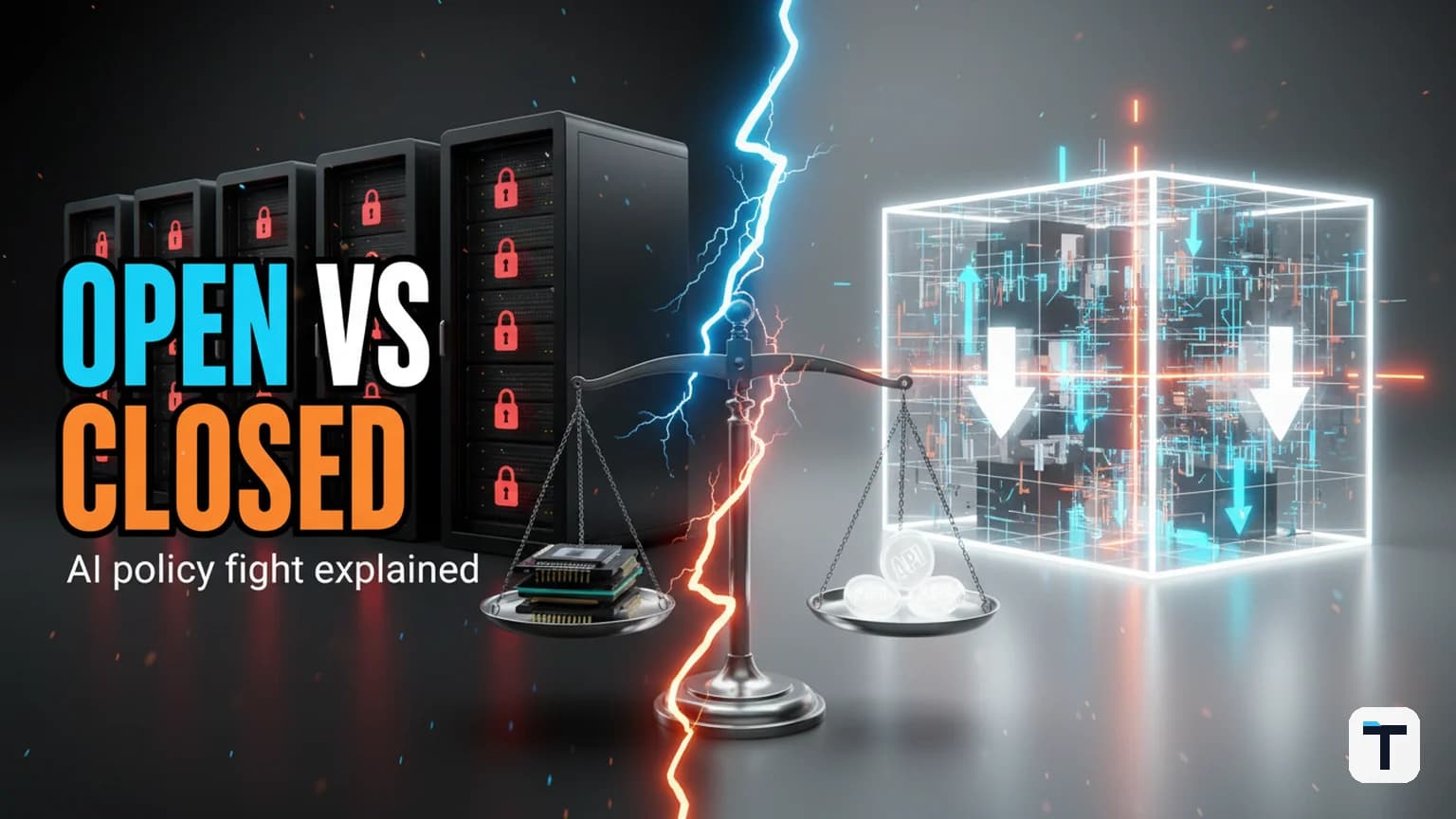

Verdict: For most builders and small businesses in July 2026, open-weight models (Llama, Kimi K3, Laguna S 2.1) are the pragmatic default for cost-sensitive, on-premises, or specialized work — while closed frontier models (Claude Fable 5, GPT-5.6 Sol) remain the right call for multi-step reasoning, coding, and tasks where cutting-edge intelligence is worth the API premium. The July 24 open-weights coalition letter and Anthropic's July 27 rebuttal don't change this calculus — but they crystallize the real fight: who gets to decide what counts as "distillation" and what the default rule for frontier-capability models will be.
TL;DR
- Last verified: July 30, 2026
- NVIDIA, Microsoft, Meta, Google, OpenAI, and 140+ other organizations co-signed an open letter titled "Open Weights and American AI Leadership" on July 24, 2026 — arguing open-weight AI is structurally necessary for U.S. competition
- Anthropic did not sign. CEO Dario Amodei published a rebuttal July 27, stating Anthropic "never advocated for a ban" but pushing for chip export controls, anti-distillation enforcement, and mandatory safety testing on "sufficiently capable" models
- The letter explicitly defends distillation — training one model on another's outputs — as a "widely used technique," directly countering the White House's July 22 accusation that Moonshot AI distilled Anthropic's Claude Fable 5 to build Kimi K3
- For builders: no law has passed. The practical decision (open vs closed) remains a cost-capability tradeoff, not a legal one — for now
- Pricing/limits change often — last checked July 30, 2026
Why Are Open Weight vs Closed AI Models Being Debated Right Now?
The open vs closed debate existed for years, but it collided with U.S. national security policy in July 2026 through two simultaneous events. On July 22, 2026, White House OSTP Director Michael Kratsios publicly accused Beijing-based Moonshot AI of conducting "large scale distillation" against Anthropic's closed Claude Fable 5 to build the near-frontier Kimi K3 open-weight model — the first named, model-to-model, White-House-level distillation accusation (confirmed: Kratsios statement, Treasury follow-up). Two days later, on July 24, NVIDIA CEO Jensen Huang made his first-ever X post to share a coalition letter titled "Open Weights and American AI Leadership" arguing the opposite position — that distillation is a legitimate, widely used technique and open-weight models are essential for U.S. AI competitiveness (confirmed: letter hosted by NVIDIA; CNBC coverage).
What makes this moment structurally different from past open-source debates is that the two events land on the same policy fault line — who gets to define the boundary between legitimate model training and IP theft — and the interests of the biggest chip maker, the biggest closed-model labs, and the biggest infrastructure companies all diverge on it.
What Did the Open-Weights Coalition Letter Actually Say?
The Letter's Four Core Arguments
The letter, hosted by NVIDIA and mirrored by Microsoft on their corporate responsibility page, makes four main claims (primary source: Microsoft mirror):
- Access and cost: Open-weight models let startups, universities, and hospitals use advanced AI "without training a model from scratch or paying frontier-model prices for every task." The letter advocates a tiered approach — expensive frontier models for genuine frontier problems, efficient specialized models for everything else.
- Competition: Concentrating AI behind a small number of closed models "creates single points of failure" and reduces competition. The letter frames this as both an antitrust and national-security argument.
- Customer sovereignty: Open weights prevent vendor lock-in, let organizations control their own data, and enable fine-tuning on proprietary data without sending it to an API.
- Safety through transparency: The letter argues that "openness may be more secure than obscurity" — a broad community can find and fix vulnerabilities that a single lab would miss, and defenders need comparable-model access to detect and respond to AI-enabled attacks.
Who Signed (and Who Didn't)
The letter initially listed 25 signatories on July 24, then expanded to 150+ organizations within days as Google, OpenAI, AMD, and dozens more joined (confirmed: FourWeekMBA analysis breaking down the 25 initial signatories by stack layer; Microsoft mirror listing 150+ final signatories).
| Category | Signed | Did Not Sign |
|---|---|---|
| Chips | NVIDIA, AMD | — |
| Hyperscalers / Infrastructure | Microsoft, Google, IBM, Dell, Cisco, Cloudflare | Amazon (initially absent; status unclear) |
| Model Developers | Meta, Mistral, OpenAI, Databricks, Cohere | Anthropic |
| Open Hubs | Hugging Face, GitHub, Mozilla, Linux Foundation | — |
| Security | CrowdStrike, Palo Alto Networks, Palantir | — |
Anthropic did not sign. Notably, OpenAI — which had advocated for frontier-model regulation in 2023–2025 — joined the open-weights coalition in the expanded list, a significant policy reversal (confirmed: ExplainX analysis tracking OpenAI's addition to the live signatory list).
What Did Anthropic's Rebuttal Actually Say?
On July 27, 2026, Anthropic CEO Dario Amodei published a position paper titled "Our position on open-weights models" (primary source: Anthropic's news page). The key claims:
- "Anthropic has never advocated for a ban on open-weights models." Non-dangerous open models are a "public good."
- Two risks matter: (1) authoritarian military AI superiority (the CCP as the "most capable threat") and (2) misuse — cyberattacks, biological attacks, and alignment failures. Open-weight models carry "strictly more risk" than closed because guardrails cannot be applied or revoked once weights are public.
- Three policy asks: (1) strict chip export controls and GPU smuggling crackdown; (2) legal deterrence against industrial-scale distillation — treating using API outputs to clone models as theft; (3) mandatory pre-release safety testing for all "sufficiently capable" models, open and closed, with smaller models exempt.
The real disagreement isn't "open vs closed." Both sides agree on chip controls and no blanket ban. The dispute is about who draws the capability threshold for mandatory testing, and whether the default rule for frontier-capability models should be "open by default, restrict if dangerous" or "restricted by default, open if proven safe."
What Is Distillation and Why Does It Matter to You?
Distillation is the technique of training one AI model using the outputs of another. You query a capable "teacher" model millions of times, collect the responses, and train your "student" model on that input-output data. The student inherits much of the teacher's capability at a fraction of the training cost.
The letter explicitly defends distillation as "a widely used technique for model improvement, evaluation, and validation" rooted in "a long tradition of learning from, building upon, and improving existing technologies" — and warns policymakers "should be careful not to conflate legitimate model development techniques with misappropriation" (confirmed: letter text, NVIDIA-hosted PDF).
This is a direct, if unnamed, counter to the White House's accusation against Moonshot AI. The distinction both sides are trying to draw:
| Dimension | Legitimate Distillation | What the White House Alleges |
|---|---|---|
| Authorization | With permission or on your own model | Against competitor's Terms of Service |
| Scale | Limited, documented | "Industrial-scale" — millions of API calls |
| Concealment | Open, documented | Covert — platform designed to evade detection |
| Goal | Better student model | "Stealing proprietary U.S. technology" |
For a builder this is not abstract. If you are fine-tuning an open model on outputs from Claude or GPT, you are doing distillation. The letter's position is that this is legitimate. Anthropic's position is that industrial-scale distillation against a competitor's ToS should be treated as theft. Where the line gets drawn — "limited" vs "industrial-scale," "documented" vs "covert," "your own model" vs "competitor's closed model" — determines what you can legally build.
How Should a Builder Choose Open vs Closed AI Models?
This is the decision that actually matters for your build, and it has nothing to do with the policy fight — for now. No law has passed. The practical question is a cost-capability-infrastructure tradeoff.
When to Use Closed Frontier Models
Use closed models when the task genuinely needs frontier intelligence:
- Multi-step reasoning and long-horizon agentic tasks where the model needs to plan, call tools, and self-correct across many steps
- Coding — Claude Fable 5, GPT-5.6 Sol, and similar frontier models still lead on code generation and debugging we tested and cost tradeoffs
- Reliability-critical production where you need guaranteed alignment, no unexpected outputs from a fine-tuned derivative, and vendor-backed SLAs
- When latency matters less than quality and you can afford per-token API pricing
When to Use Open Weight Models
Use open-weight models when cost, control, or specialization matter more than peak intelligence:
- Cost-sensitive deployments at scale — you need to run millions of inferences and API pricing would blow the budget. Open models on your own hardware cost a fixed compute price, not a per-token fee
- On-premises or air-gapped requirements — healthcare, finance, or defense where data cannot leave your infrastructure. See our local AI stack guide and how to run models locally
- Fine-tuning for a specific domain — you adapt the model to your data and workflow, which is impossible with closed APIs. See how to use open-source models as agent brains
- Edge devices — phones, robotics, IoT. Small open models like Gemma 4 run where frontier models cannot. See our tiny AI models on edge devices guide
- Vendor independence — you cannot afford to be locked into a single provider's pricing changes or deprecations
The Hybrid Most Teams Should Run
Most production AI systems in 2026 are hybrid: a cheap open-weight model handles 80–90% of traffic, and a frontier closed model handles the hardest 10–20%. This is the doer-judge pattern and the loop engineering approach — a cheap model builds, a strong model from a different family judges. It costs less than running one frontier model for both jobs.
Quick Comparison Table
| Factor | Open Weight Models | Closed Frontier Models |
|---|---|---|
| Cost model | Fixed compute (your hardware or rent) | Per-token API pricing |
| Peak capability | Near-frontier (Kimi K3, Laguna S 2.1) | Frontier (Claude Fable 5, GPT-5.6 Sol) |
| Fine-tuning | Full — train on your data | Limited — system prompts, fine-tuning APIs |
| Data control | Complete (runs on your infra) | Data goes to vendor |
| Setup cost | High (GPU hardware, deployment) | Zero (API call) |
| Best for | Scale, specialization, sovereignty, edge | Reasoning, coding, reliability-sensitive work |
| Risk | Model could be deprecated; you maintain infra | Vendor could raise prices or change terms |
What This Means for You
The policy fight matters to you in one specific way: it will determine whether the open-weight models you rely on remain legal to download, use, and fine-tune — and whether distillation (the cheapest way to build a capable model) remains a legitimate technique. For now, nothing has changed. No U.S. law restricts open-weight AI distribution or distillation. But three things to watch:
- Any bill that defines "sufficiently capable" model thresholds — the smallest this threshold, the fewer open models available without safety testing. Anthropic wants global testing on frontier models; the coalition wants the threshold high enough to exempt startups and academia.
- Any executive action on distillation — if the White House's "industrial-scale distillation is theft" framing becomes regulation, it could chill API-based fine-tuning against frontier models. Watch for Entity List designations against foreign labs (Kratsios already threatened sanctions).
- NVIDIA's position — as the biggest chip maker, NVIDIA benefits from maximum open-weight activity (more models deployed = more GPU demand). Their structural interest aligns with keeping everything open. This doesn't make their arguments wrong, but it means the policy debate is also a commercial interests debate.
If you build on open weights today: keep going — the models are available, the legal foundation is clear, and the coalition is growing. Budget for the possibility of safety-testing requirements on frontier-scale models within 12 months.
If you build on closed APIs today: keep going — no one is taking away your API access. But consider whether you have a fallback — a fine-tuned open model you could switch to if pricing or availability changed — because vendor risk is real whether or not the policy debate gets resolved.
FAQ
Q: What is the difference between open weight and closed AI models? A: Open weight models publish their trained parameters (weights) so anyone can download, inspect, modify, and run them locally. Closed models keep weights proprietary and are accessed only via an API. Open weights give you control and cost predictability; closed models give you peak capability and vendor-managed reliability.
Q: Did NVIDIA try to ban AI regulation with the open-weights letter? A: No. The letter asks policymakers to avoid "premature restrictions" on open-weight models and to direct enforcement at specific unlawful practices (like industrial-scale distillation against a competitor's Terms of Service) rather than banning the underlying techniques. It also asks for more public compute investment and shared training infrastructure.
Q: Did Anthropic try to ban open-weight AI models? A: Anthropic's CEO Dario Amodei explicitly stated in a July 27, 2026 position paper that Anthropic "never advocated for a ban on open-weights models." Anthropic's actual asks are chip export controls, anti-distillation enforcement, and mandatory safety testing for "sufficiently capable" models regardless of whether they are open or closed.
Q: What is model distillation and is it legal? A: Distillation is training a "student" model on the outputs of a "teacher" model. It is a standard, widely used technique in AI development — used for model improvement, evaluation, and domain-specific fine-tuning. The legal question arises when distillation is done at industrial scale against a competitor's closed model in violation of their Terms of Service and with concealment of the activity. The White House has framed this specific pattern as IP theft; the open-weights coalition argues distillation itself is legitimate and policymakers "should be careful not to conflate legitimate model development techniques with misappropriation."
Q: Should my small business use open-weight or closed AI models? A: Most small businesses should start with closed-model APIs (Claude, GPT, Gemini) for their simplicity and peak capability. Move to open weights when you hit a cost wall at scale, need to run models on your own infrastructure for data sovereignty, or want to fine-tune for a specialized domain. The hybrid pattern — cheap open model for 80% of work, frontier closed model for the hardest 20% — is the pragmatic default for teams with moderate traffic.
Q: Will the U.S. restrict open-weight AI models? A: No restriction has been enacted as of July 30, 2026. The policy debate is ongoing. The most likely outcome is targeted: mandatory safety testing for frontier-capability models (with a high threshold that exempts most open models), anti-distillation enforcement at the Entity List sanctions level, and continued chip export controls — rather than a broad ban on open-weight distribution.
Discussion
0 comments