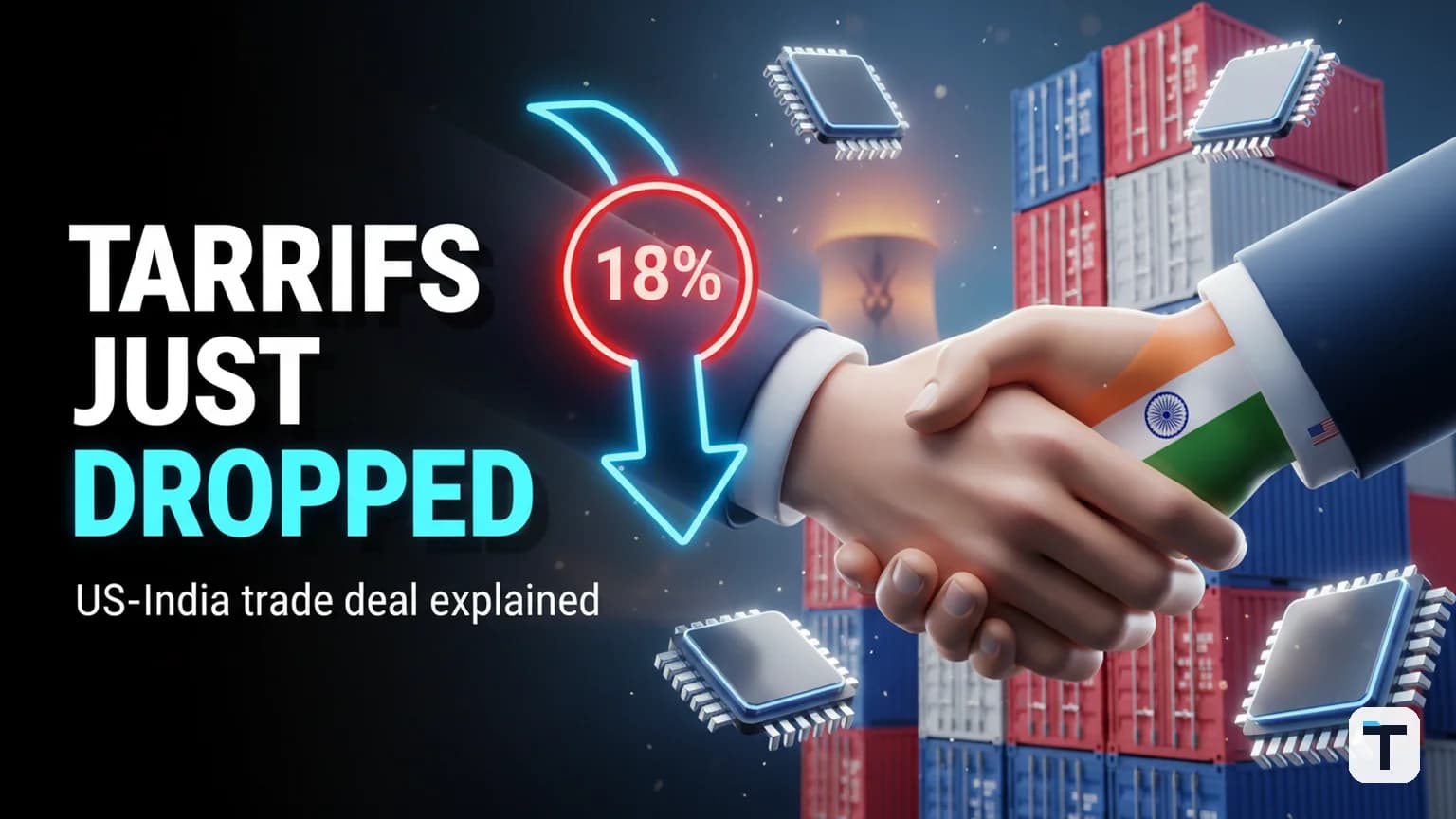

The United States cut its reciprocal tariff on Indian goods from 25% to 18% on February 3, 2026, and removed a separate 25% punitive duty that had pushed the effective rate to roughly 50% last August. The combined reduction gives Indian exporters their best access to the US market since the tariff escalation began, and it folds into a broader strategic package — defense, civil nuclear energy, semiconductors, and AI — that the two governments call the US-India COMPACT and the TRUST initiative. Here is what the deal actually changes, what it leaves out, and where the strategic through-line runs.
Last verified: 2026-07-30 · Base reciprocal tariff: 25% → 18% · Punitive 25% surcharge (Aug 2025) removed · Effective rate: ~50% → 18% · India's pledge: $500B US purchases over five years · Trade goal: $500B bilateral trade by 2030 ("Mission 500"). Note: tariff figures and sector exclusions are volatile — last checked July 30, 2026.
Why did the US cut tariffs on Indian goods from 25% to 18%?
The cut is the headline term of an interim trade agreement reached on February 2–3, 2026, after a year of escalating friction. The reduction has two components, and conflating them is the most common mistake in coverage of this deal. The US lowered the base reciprocal tariff from 25% to 18% and separately rescinded a 25% punitive surcharge imposed in August 2025 over India's purchases of Russian crude oil. Taken together, the effective tariff on most Indian goods fell from a peak near 50% to 18%. The White House Fact Sheet frames the reduction as a reward for India's willingness to "confront systemic imbalances" and to align on national-security priorities — chiefly, India's commitment to wind down Russian oil purchases and redirect energy procurement toward the US.
How did we get here? The tariff escalation, briefly
Understanding the 18% number requires the path that produced it. In mid-2025 the US matched India's average tariff rates with a 25% "reciprocal" duty. When India continued buying Russian crude through the Ukraine war, Washington added a 25% punitive layer in August 2025, taking the total near 50%. Mint reported that exports to the US fell 12% in September 2025, the fourth consecutive monthly decline, and that the US share of Indian exports dropped from 24% in June to 15% in September. India responded by cutting duties in its Union Budget on items like bourbon and heavy motorcycles. The trade-economic through-line is "transactional diplomacy": the tariff was the lever; Russian oil, defense interoperability, and supply-chain alignment were the asks.
What did India give in exchange?
The deal is not one-way. Per the White House Fact Sheet and India Today's breakdown, India's commitments include:
- Energy pivot: a stated intent to halt or sharply reduce Russian crude imports and buy more US LNG and crude (with Venezuela as a possible alternate source).
- Market access: eliminating or reducing tariffs on a wide range of US industrial goods, food, and agricultural products — tree nuts, dried distillers' grains, red sorghum, fresh and processed fruit, soybean oil, wine and spirits.
- $500 billion purchase pledge: India intends to buy over $500 billion of US energy, information and communication technology, coal, and other products over the next five years.
- Sensitive-sector protection: dairy, wheat, and rice remain protected on the Indian side.
- Buy-American posture: a stronger US-procurement stance for government and large industrial purchases.
The bilateral relationship is framed by both governments as a "win-win," but the asymmetric commitments (the $500B pledge and the energy pivot are largely Indian concessions) reflect the leverage the tariff had built.
Which Indian export sectors benefit most?
The sectors with the thinnest margins and the highest US exposure get the fastest relief, because a 32-percentage-point drop in effective duty resets price competitiveness almost overnight. India Today and govthunt's analysis identify the principal beneficiaries.
| Sector | Why it gains | Verification status |
|---|---|---|
| Textiles and apparel | Thin margins, labor-intensive, was shedding orders fastest under 50% | Confirmed (India Today, Reuters, Mint) |
| Pharmaceuticals | India secured 0% duty on generic pharma under the deal | Confirmed (govthunt, Drishti IAS) |
| Gems and jewelry | 0% duty access; Surat and Jaipur clusters exposed | Confirmed (govthunt) |
| Engineering goods and machinery | Export-heavy, previously tariff-burdened | Confirmed (Reuters, Drishti IAS) |
| Electronics and smartphones | Fastest-growing export category; Make-in-India tailwind | Confirmed (govthunt, Drishti IAS) |
| Footwear and chemicals | Labor-intensive; price-sensitive to duty | Confirmed (Reuters) |
| Aircraft and aerospace parts | India secured 0% duty access | Confirmed (govthunt) |
Geographically, export clusters in Tiruppur, Panipat, Agra, Kanpur, Moradabad, Jaipur, and Surat are expected to feel order-flow changes first, per India Today. These are deeply price-sensitive clusters where even a small duty shift moves volumes.
How does India's 18% tariff compare with rival exporters?
This is the competitive edge the deal actually buys. Drawing on the competitor-rate table compiled by Drishti IAS and govthunt (approximate US tariff rates, 2026):
| Country | Approx. US tariff rate | India's edge |
|---|---|---|
| India | 18% | — |
| Pakistan | 19% | +1 pt |
| Indonesia | 19% | +1 pt |
| Vietnam | 20% | +2 pts |
| Bangladesh | 20% | +2 pts |
| China | ~34% | +16 pts |
An 18% rate puts India ahead of every major regional rival for US market share, and roughly half the rate China faces. That positional advantage is the strategic significance of the deal — more than the headline dollar savings, it makes India the cheapest "China Plus One" option for labor-intensive and light-engineering supply chains. The trade-policy framing dovetails with India's broader manufacturing push, which we analyzed in India's $1.5 trillion manufacturing bet by 2035.
What is the US-India COMPACT, and how does the tariff fit in?
The tariff cut is one piece of a larger strategic package. On February 13, 2025, Prime Minister Narendra Modi and President Donald Trump launched the US-India COMPACT (Catalyzing Opportunities for Military Partnership, Accelerated Commerce & Technology) for the 21st Century during Modi's working visit to Washington. The COMPACT's commerce pillar is "Mission 500," a goal to more than double bilateral trade to $500 billion by 2030, backed by Bilateral Trade Agreement (BTA) negotiations targeted for fall 2025. The tariff reduction is the first concrete down-payment toward the $500B trade vision, removing the largest near-term obstacle exporters have faced since the 50% peak.
What about defense and the AI-strategic layer? TRUST, semiconductors, and critical minerals
This is where the trade deal connects to the technology story most relevant to builders. The same February 13, 2025 summit that launched the COMPACT also launched the TRUST initiative (Transforming Relationship Utilizing Strategic Technology) — the evolution of the earlier iCET (Initiative on Critical and Emerging Technology) originally established in 2022. TRUST covers AI, semiconductors, quantum computing, biotechnology, energy, and space, and adds a critical-minerals supply-chain track. A central component is an AI Infrastructure Roadmap that provides market access, investment, and infrastructure to accelerate US-origin AI build-out in India, per the Indian government's Principal Scientific Adviser office. In June 2026, US Secretary of State Marco Rubio's visit to India advanced implementation, including the PAX Silica Declaration — a US-led coalition securing critical-mineral and rare-earth supply chains from mining through deployment — and India's semiconductor push, including the Shakti Semiconductor Fab developing compound semiconductors for EVs and aerospace.
For builders, the practical signal is this: India is being positioned as the trusted, tariff-advantaged node in a US-aligned AI hardware and energy supply chain. That positioning has industrial-project counterparts already underway — Kaynes Semicon's wafer-fab push under ISM 2.0 and Micron's Gujarat chip plant with L&T both plug into the same semiconductor track the tariff deal de-risks. Atmanirbhar Bharat (self-reliant India) and US strategic alignment turn out to be the same project viewed from two sides.
Why nuclear power is suddenly part of an AI trade story
The most underappreciated link between this trade deal and AI is energy. India's SHANTI Act (Sustainable Harnessing and Advancement of Nuclear Energy for Transforming India), 2025 came into effect on December 21, 2025, repealing both the Atomic Energy Act of 1962 and the Civil Liability for Nuclear Damage Act of 2010. It permits limited private and foreign participation in the civil nuclear sector under a graded-liability framework, and sets a target of 100 GW of nuclear capacity by 2047, up from roughly 8.8 GW today. Norton Rose Fulbright, Holtec International, and India's Press Information Bureau all confirm the legislative timeline and the capacity target.
The connection to the AI track is concrete, not speculative. Proponents argue nuclear power is the only baseload-clean energy source dense enough to meet the electricity demand of large AI data centers — and the US-India TRUST framework explicitly treats AI infrastructure and energy as a coupled problem. The SHANTI Act's opening of nuclear to private and foreign capital and the US-India civil-nuclear cooperation under COMPACT are the two enabling moves; the tariff deal is the commercial lubricant that makes the whole package attractive to US capital. The strategic-tech dimension also raises an AI-governance question for Indian states buying frontier models — see how Karnataka picked Anthropic over India's own Sarvam AI for the trade-off between sovereignty and capability.
What this means for you
- If you export to the US from India: the 18% rate is the best window since escalation began — particularly for textiles, pharma, gems, engineering goods, and electronics. Re-quote US customers now while the advantage is fresh; the clusters that move first (Tiruppur, Surat, Jaipur) tend to lock in order flow.
- If you build AI hardware or run data centers: India's nuclear-plus-semiconductor-plus-AI-infrastructure stack under TRUST and the SHANTI Act is positioning the country as the trusted, tariff-advantaged node in a US-aligned supply chain. Watch for joint-venture opportunities in compound semiconductors (Shakti Fab), critical minerals (PAX Silica), and civil nuclear Small Modular Reactors.
- If you are a "China Plus One" planner: India's 18% rate is now the lowest among major Asian sourcing alternatives. Combined with the ISM 2.0 semiconductor incentives and Make-in-India, the cost-of-tariff math for relocating assembly (and eventually deeper manufacturing) has materially improved.
- If you are an investor in Indian equities: export-sensitive names in textiles, pharma, gems, and electronics saw an immediate sentiment lift on February 3, 2026 (the Sensex reportedly surged over 3,600 points the morning of the deal). The structural story is the $500B purchase pledge and Mission 500 — but watch which sectors actually capture it versus which face new competition from zero-tariff US imports.
FAQ
Q: What is the new effective US tariff rate on Indian goods under the 2026 trade deal? A: The effective tariff has been reduced to 18%, down from a peak of roughly 50% (which combined a 25% reciprocal tariff and a 25% punitive duty imposed in August 2025 over India's purchase of Russian crude oil). The base reciprocal rate itself moved from 25% to 18%, and the punitive 25% surcharge was rescinded.
Q: Why was a 25% punitive tariff imposed on India in August 2025? A: The US added the 25% punitive surcharge because of India's continued purchases of Russian crude oil during the Ukraine conflict, on top of a 25% reciprocal tariff matched to India's average rates earlier in 2025. Removing that surcharge was a condition of the February 2026 deal, tied to India's commitment to pivot energy procurement toward the US.
Q: Which Indian export sectors benefit the most from the 18% tariff reduction? A: Textiles and apparel, pharmaceuticals (which won 0% duty on generics), gems and jewelry (0% duty), engineering goods, electronics and smartphones, footwear, and chemicals. Aircraft and aerospace parts also secured 0% duty access. Sensitive Indian sectors — dairy, wheat, and rice — remain protected.
Q: How does India's 18% tariff compare with its regional competitors? A: At 18%, India now faces a lower US tariff than Pakistan (19%), Indonesia (19%), Vietnam (20%), Bangladesh (20%), and China (~34%). That makes India the cheapest major "China Plus One" sourcing option among Asian exporters to the US.
Q: What is the US-India COMPACT and how is it related to the tariff cut? A: The US-India COMPACT (Catalyzing Opportunities for Military Partnership, Accelerated Commerce & Technology) for the 21st Century was launched by Modi and Trump on February 13, 2025. Its commerce pillar, "Mission 500," targets $500 billion in bilateral trade by 2030. The February 2026 tariff cut is the first concrete down-payment toward that goal, backed by negotiations for a Bilateral Trade Agreement (BTA).
Q: What is the TRUST initiative, and why does it matter for AI and semiconductors? A: TRUST (Transforming the Relationship Utilizing Strategic Technology) is the evolved form of the earlier iCET, also launched at the February 13, 2025 summit. It covers AI, semiconductors, quantum computing, biotech, energy, and space, plus critical-mineral supply chains under the PAX Silica Declaration. A core component is an AI Infrastructure Roadmap designed to accelerate US-origin AI build-out in India — making the tariff deal part of a coupled trade-and-AI-hardware strategy.
Q: Does the deal cover all Indian goods, or are some sectors excluded? A: Some products are not covered by this interim agreement. Steel, aluminium, and certain copper items that carry earlier US national-security-linked tariffs remain unaffected and will be taken up separately during broader BTA negotiations. India's dairy, wheat, and rice sectors also remain fully protected on the Indian side.
Discussion
0 comments