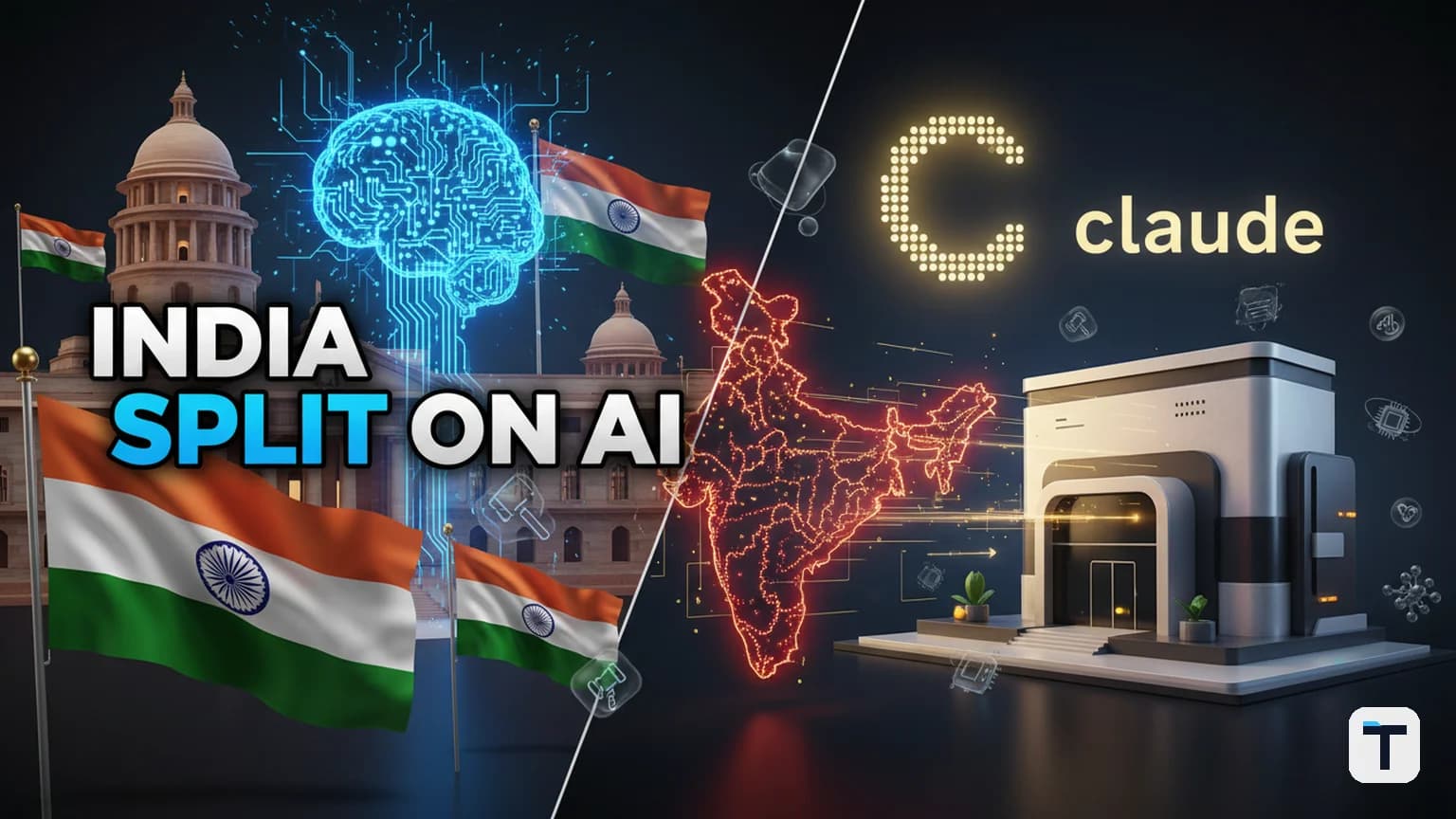

Karnataka — the state that houses Bengaluru and India's first government-run AI university — has picked Anthropic, a US frontier lab, as the partner for its first serious AI governance push, forming two working groups with the company in July 2026. The move is striking because India already has a homegrown sovereign model, Sarvam AI, built explicitly for Indian-language citizen services under the IndiaAI Mission — yet Karnataka went straight to the American frontier. Bihar, in the same window, signed MoUs with Google, Microsoft, CoRover, and Sarvam AI for its own AI governance stack. India's AI governance story is splitting into two competing philosophies: build on indigenous capability (Bihar's bet) or partner with whoever is most capable, regardless of origin (Karnataka's bet). For builders and small businesses watching from the sidelines, the signal is not abstract geopolitics — it is a concrete preview of which AI stack your next government-facing contract will run on, which certifications will be worth more in the Bangalore job market, and whether "sovereign AI" is a procurement checkbox or a real moat.
TL;DR · Last verified: 2026-07-30
- What happened: Karnataka IT/Home Minister Priyank Kharge announced two AI working groups with Anthropic on 25 July 2026, covering citizen services, multilingual delivery, skilling (Claude certifications), and education.
- The counter-bet: Bihar signed MoUs with Sarvam AI + Google + Microsoft + CoRover for an explicitly Indian-foundation-model governance stack.
- The signal for builders: Expect Claude certifications and Anthropic-partnered RFPs to appear in Karnataka procurement within 6–12 months. Expect Sarvam-API work to dominate Bihar-style contracts. Both stacks need integrators — the opportunity is multi-model, not either/or.
- Karnataka is the same state that announced India's first government-led AI university on 14 July 2026 — so this is the implementation arm of an already-announced ambition, not a soft pilot.
Why did Karnataka choose Anthropic instead of Sarvam AI?
Karnataka's decision to pair with Anthropic appears to be a capability-first procurement choice rather than a sovereignty-first one. The announcement, made by Minister Priyank Kharge on X on 25 July 2026 after he visited Anthropic's Bengaluru office, framed the partnership as building a "globally competitive AI ecosystem" — wording that emphasizes raw capability over origin (ANI, 25 Jul 2026; The Hindu, 25 Jul 2026).
Two factors likely drove the choice:
- Frontier capability. Anthropic's Claude model line (Opus 5, Fable 5) sits at or near the top of the Artificial Analysis Intelligence Index, scoring 64+ versus Sarvam 105B's 18 on English-centric frontier benchmarks. For a state that just announced an AI university and wants AI-driven governance, raw reasoning and agentic capability matters for anything beyond rote translation (explainx.ai, India Sovereign AI Status, updated 24 Jul 2026).
- Anthropic's Bengaluru footprint. Anthropic has a physical Bengaluru office (the visit was to that office; the meeting was with Irina Ghose, Managing Director of Anthropic India). For a state headquartered in Bengaluru, an on-the-doorstep frontier lab with a local MD is an easier partner than a Delhi-anchored government-tender process.
The announcement also went beyond a generic AI pitch. Kharge said the two sides discussed how existing government datasets could be leveraged directly to improve public service delivery — which is the substance that distinguishes real deployment from a press release — and the state agreed to constitute two working groups: one with the Centre for e-Governance (CeG), one with the Home Department (Moneycontrol, 25 Jul 2026; Economic Times, 25 Jul 2026).
What is Sarvam AI and why does the homegrown option exist?
Sarvam AI is India's government-anointed sovereign foundation model builder. Selected in April 2025 from 67 applicants under the IndiaAI Mission, the Bengaluru-based startup was given access to 4,096 NVIDIA H100 GPUs (via Yotta Data Services) and roughly ₹99 crore in compute subsidies to train India's sovereign LLM. In exchange, the government takes an equity stake and the model stays governed inside Indian borders (PIB, 30 May 2025; Indian Express, 27 Apr 2025).
In February 2026, Sarvam unveiled two open-source models — Sarvam-30B (a 32B-parameter Mixture-of-Experts model with ~2.4B active parameters, 65K context) and Sarvam-105B — at the India AI Impact Summit, trained on Indian-language data using IndiaAI Mission compute (explainx.ai, updated 24 Jul 2026). As of mid-2026, the IndiaAI Mission has deployed ~34,000 GPUs accessible to registered startups at roughly ₹65 per GPU-hour, and the government has confirmed backing for 15 indigenous foundation models total (AI4Planet, 30 Jun 2026; PIB, 30 May 2025).
The pitch for Sarvam is that global frontier models (GPT, Claude, Gemini) are trained mostly on English internet data; the fraction that includes Indian languages is biased toward formal text rather than how Indians actually speak — code-mixed Hinglish, Tamil-English, Bengali-English. Sarvam explicitly targets the 22 scheduled Indian languages and is positioned as sovereign-by-design: built, deployed, and operated entirely in India (Sarvam.ai; indiasbestaitools.com review, 10 May 2026).
So Karnataka — the state where Sarvam is physically headquartered — passing over Sarvam for citizen-service AI is the frontier-capability-versus-indigenous-capability tension made literal.
How does Bihar's AI strategy differ from Karnataka's?
Bihar's approach is the philosophical counterweight. In July 2026, the Bihar government signed MoUs with Google, Microsoft, CoRover, and Sarvam AI for AI-driven governance — a partnership stack that explicitly includes the Indian foundation model (eGov Elets, 22 Jul 2026; Analytics India Magazine).
The comparison, side by side:
| Dimension | Karnataka | Bihar |
|---|---|---|
| AI governance partner (Jul 2026) | Anthropic (US frontier lab) | Sarvam AI + Google + Microsoft + CoRover |
| Indian foundation model included? | No (Sarvam not in the announcement) | Yes (Sarvam is a signatory) |
| Announced by | IT/Home Minister Priyank Kharge, 25 Jul 2026 | State IT department, mid-Jul 2026 |
| Stack posture | "Most capable available, regardless of origin" | "Indigenous foundation + global hyperscalers" |
| Skilling angle | Claude certifications for students/professionals/enterprises | AI skilling for govt officials, teachers, youth |
| Use-case focus | Citizen services, multilingual, responsible AI, datasets | Citizen services, skilling, innovation pipeline |
| Stage | Working groups formed; no contract signed | MoUs signed |
Sources: ANI, 25 Jul 2026; eGov Elets, 22 Jul 2026.
The differentiator is not "Bihar is sovereign and Karnataka is not" — both states are exploring. But Bihar's MoU stack explicitly names Sarvam AI as a foundation layer, whereas Karnataka's announcement names only Anthropic and the two state departments. For a state whose capital is Bengaluru — the place most likely to have a homegrown AI champion on its own doorstep — that choice is the signal.
What does the Karnataka-Anthropic partnership actually cover?
The scope laid out in Kharge's announcement is concrete, not vague:
- AI-enabled citizen services — practical applications in public-service delivery.
- Multilingual experiences — relevant for Karnataka's linguistically diverse population (Kannada, Tulu, Konkani, Urdu, Kodava, and migrant Hindi/Tamil/Telugu speakers).
- Responsible AI deployment — Anthropic's safety positioning is a fit for a governance buyer.
- Leveraging existing government datasets to improve public-service delivery — the most concrete line; implies some form of model-on-state-data integration.
- Claude certifications for students, professionals, and enterprises across the state.
- Anthropic's AI for Science and Claude for Education programs — signaling collaboration beyond a single pilot.
The two working groups — one with the Centre for e-Governance, one with the Home Department — are the operational vehicle. Both are exploratory (no contracts signed yet), and the partnership is governance-focused rather than a procurement (The Hindu, 25 Jul 2026; NewKerala, 25 Jul 2026).
Is "sovereign AI" real if a state government imports its model?
This is the pointed question lurking under the story. India's sovereign-AI claim rests on three pillars — sovereign data (the AI Kosh dataset platform, 22 scheduled languages, agricultural records, UPI transaction data), sovereign compute (34,000+ IndiaAI Mission GPUs), and sovereign models (Sarvam, Krutrim, Bhashini). All three are real and partially built (explainx.ai, updated 24 Jul 2026; PIB, 30 May 2025).
But there is a fourth pillar the sovereign-AI argument often glosses over: sovereign procurement. When a state government — especially the state that hosts the sovereign model's own headquarters — picks a US lab for citizen-service AI, the procurement signal undercuts the broader sovereignty posture. The analogy India's own policymakers use is UPI: India runs its own payment network rather than depending purely on Visa and Mastercard. The Karnataka-Anthropic choice is roughly equivalent to a state government deciding to issue citizen payments on Visa because Visa's fraud detection is better — defensible on capability grounds, but it weakens the UPI narrative.
The honest read: India's sovereign AI is real in infrastructure and partial in model capability, but it is contested at the deployment layer. Sovereignty is not just what you can build — it is what your buyers actually choose to deploy. Karnataka's choice is a real datapoint, not a rhetorical one.
What stage is Karnataka's AI ambition actually at?
Karnataka has been moving fast on AI in 2026. On 14 July 2026, Chief Minister D K Shivakumar announced India's first government-driven AI University and an AI Hub at Google I/O Connect India 2026, alongside an explicit ambition to become an "AI-native state" with AI integrated across education, healthcare, agriculture, and citizen services (Economic Times, 14 Jul 2026; India Today, 14 Jul 2026; Outlook India, 14 Jul 2026).
The state already contributes nearly 40 percent of India's software exports and hosts more than 17,000 startups plus thousands of Global Capability Centres — a base the government cited to justify its AI-leadership ambition (India Today, 14 Jul 2026). Read against that backdrop, the Anthropic partnership 11 days later is the implementation arm of an already-announced ambition — not a stand-alone pilot. The state has also been deepening its semiconductor play through KWIN City (KWIN City chip park investor guide; Karnataka KWIN City semiconductor park) and the broader Karnataka "Beyond Bengaluru" tech expansion (Mysuru Beyond Bengaluru hub).
What does this mean for you (builders, small businesses, integrators)?
The split has practical, money-on-the-table implications for anyoneselling AI services inside India:
- For integrators bidding on Karnataka contracts: assume Claude-family APIs (Opus 5, Fable 5) will be the default back end for citizen-service pilots in the next 6–12 months. Anthropic-partnered RFPs and Claude-certified-team requirements are a real possibility — getting your team Claude-certified ahead of that wave is the cheap insurance play. The announcement explicitly mentioned Claude certifications for students, professionals, and enterprises.
- For integrators bidding on Bihar-style contracts: the stack is multi-vendor. Sarvam gets the foundation-model layer; Google and Microsoft handle cloud and tooling; CoRover provides the conversational layer. The skill bar is broader — you need Indian-language + hyperscaler-stack chops, not just one frontier model.
- For small businesses in Karnataka: expect AI-skilling programs built around Anthropic's stack to roll out through the proposed AI University. Multiple existing AI tools and Claude guides on this blog cover the same Anthropic stack you'll be learning through a state program — get ahead of it.
- For Sarvam-ecosystem builders: Karnataka skipping Sarvam is a real signal, not noise. Sarvam is strongest where the task is Indian-language voice/translation, sovereign data residency, or where the buyer needs an Indian-data-trained model (e.g., Aadhaar-adjacent services, judicial systems). Those use cases are not going away — but they are not the universal governance-AI use case Karnataka appears to be shopping for.
- For the broader India chip + AI-sovereignty story: the Karnataka choice is the deployment-layer reality check on India's sovereign-AI narrative. India can build GPUs (with NVIDIA chips) and open-source models, but if its largest tech state imports the model that actually runs citizen services, the sovereignty circle is not closed. Worth tracking the same way you'd track India's semiconductor buildout — infrastructure does not equal adoption.
- For job seekers in Bangalore: Claude certifications entering the state's official skilling pipeline is a load-bearing signal. State-sponsored certifications become procurement prerequisites, and procurement prerequisites become hiring filters. Skill up now; the certification wave is cheap to ride early and expensive to catch late.
FAQ
Q: Has Karnataka signed a contract with Anthropic? A: No. As of the 25 July 2026 announcement, the state has constituted two working groups (one with the Centre for e-Governance, one with the Home Department) to identify priority use cases. These are exploratory groups, not binding procurement contracts (ANI, 25 Jul 2026).
Q: Why didn't Karnataka pick Sarvam AI, which is headquartered in Bengaluru? A: Neither the minister's announcement nor the partner publications give an explicit reason. The likely drivers are Anthropic's frontier-grade capability (Claude scores ~64 on the Artificial Analysis Intelligence Index vs. 18 for Sarvam 105B on English benchmarks) and Anthropic's local Bengaluru office + India MD. Sarvam's strength is Indian-language voice and translation, not frontier reasoning — the two are not direct substitutes for every governance use case.
Q: What are Claude certifications and who can get them? A: The announcement mentions Claude certifications for students, professionals, and enterprises, but does not specify the curriculum, cost, or issuing body. Anthropic has not yet published a public certification program structure as of late July 2026.The detail will likely firm up as the working groups produce their first use-case reports.
Q: Is Karnataka's choice a setback for India's sovereign AI push? A: It is a real datapoint against the deployment layer of the sovereignty claim. India has real sovereign infrastructure (34,000+ IndiaAI Mission GPUs, ₹65/GPU-hour) and open-source models (Sarvam-30B, Sarvam-105B). But if a state government — especially the state hosting Sarvam's HQ — imports its citizen-service model, the procurement signal undercuts the broader narrative. Sovereignty is what your buyers deploy, not just what you can build.
Q: What's the difference between Sarvam 30B and Sarvam 105B? A: Sarvam-30B is a ~32-billion-parameter Mixture-of-Experts model (~2.4B active per token, 65K context), tuned for speed and positioned comparably to Gemini 3. Sarvam-105B is the larger flagship, trained from scratch on Indian-language data using IndiaAI Mission compute. Both were unveiled at the India AI Impact Summit in February 2026 and open-sourced under Apache 2.0 (explainx.ai, updated 24 Jul 2026).
Q: Should an Indian small business use Anthropic's Claude or Sarvam AI today? A: It depends on the task. For Indian-language voice, translation, OCR, or sovereign-data-residency-sensitive work, Sarvam's stack is the cleaner fit and priced in INR. For frontier reasoning, agentic tasks, English-centric customer support, or anything requiring frontier-class coding ability, Claude (or GPT/Gemini equivalents) remains ahead on benchmarks. The Karnataka-vs-Bihar split mirrors the real procurement decision Indian buyers face — multi-model is increasingly the honest answer.
Discussion
0 comments