
| Feature | Vanilla LLM (2025) | Recursive Agent (2026) |
|---|---|---|
| Context Limit | ~200K - 1M tokens (with rot) | Virtually unlimited (100M+ tokens) |
| Reliability | "Stochastic" (hit or miss) | High (verified sub-tasks) |
| Reasoning | Linear (Chain of Thought) | Recursive (Tree/Graph of Agents) |
| Best For | Chat & simple functions | Repo-scale migrations & audits |
Last verified: June 26, 2026
Key Tech: Recursive Language Models (RLMs), OpenProse, Claude Dynamic Workflows.
Why are today's AI agents "Mismanaged Geniuses"?
The Answer: Today’s frontier models have enough raw intelligence to build a SaaS app from a single prompt, but they lack the reliability to do it consistently. This is the "Mismanaged Genius" problem—a term coined by MIT researchers to describe models that know the entire internet but can't reliably hold a thread for more than a few thousand tokens.
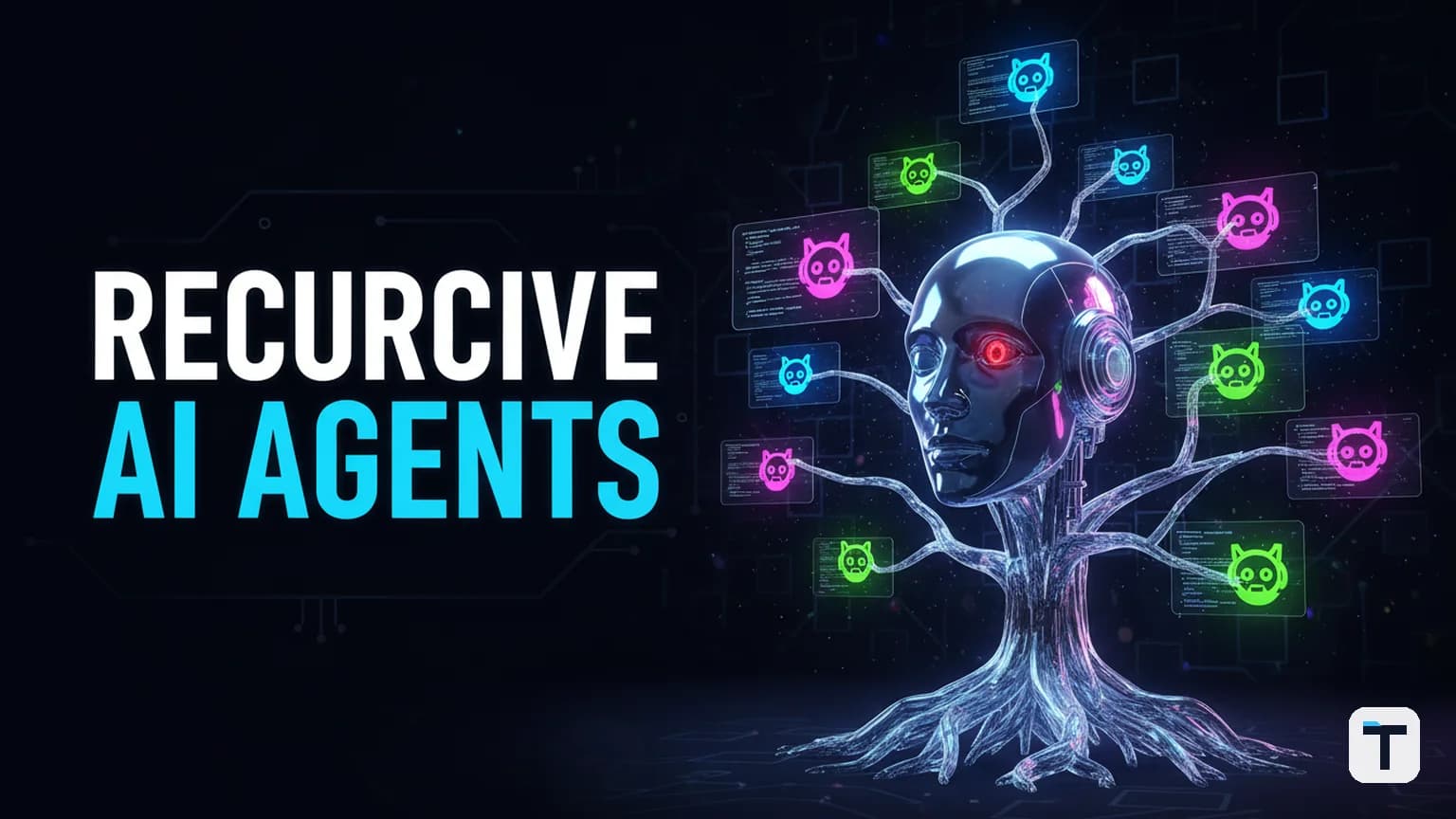
The culprit is Context Rot. As prompts get longer, even models with 2M-token windows begin to lose track of details in the "middle," leading to hallucinations and failure on dense tasks. Recursive Coding Agents solve this by offloading the context into an external environment and using code to "page" data in and out of the model’s immediate reasoning window.
What is a Recursive Language Model (RLM)?
The Answer: A Recursive Language Model (RLM) is an inference paradigm where the model treats the user prompt as a symbolic object in a programmable environment (like a Python or Node.js REPL).
Instead of reading the whole prompt, the RLM writes code to:
- Examine the prompt symbolically (searching, chunking, or indexing).
- Decompose the task into smaller sub-queries.
- Recursively call itself (or sub-agents) on those snippets.
- Aggregate the results into a final, verified answer.
Research from MIT (Zhang et al., 2026) shows that an RLM-harness using a small model like Qwen 3.5 9B can actually beat frontier models like GPT-5 on long reasoning benchmarks (Long CoT). By scaling "inference-time compute" through recursion, we get smarter outcomes without larger models.
How do Recursive Coding Agents work in practice?
The Answer: In the coding world, recursion turns a single agent into a "Swarm of One." For example, when performing a codebase-wide migration, a recursive agent doesn't try to refactor 1,000 files in one go.
Instead, it follows this "Fan-out" pattern:
- The Orchestrator: Analyzes the repo and spawns sub-agents for each module.
- The Workers: Each sub-agent performs a local refactor and runs local tests.
- The Adversary: A separate sub-agent reviews the work of the worker.
- The Loop: If tests fail or the review is rejected, the sub-agent recurses until the task is complete.
This isn't theory. In May 2026, Claude Opus 4.8 and 'Dynamic Workflows' were used to port the entire Bun runtime from Zig to Rust—roughly 750,000 lines of code—with 99.8% test parity in just eleven days.
Tools of the Trade: Building Recursive Workflows
To deploy recursive agents in your own business or AI Agent Operating System, look at these three frameworks:
1. OpenProse
OpenProse is a natural-language programming system for agent workflows. It allows you to write a .prose.md file in "Logical English" that your coding agent compiles. You can explicitly declare sub-agent work, required skills (like "SEO Audit"), and tools as dependencies. It’s the "Source Code" for your agent sessions.
2. Claude Dynamic Workflows
Shipped in mid-2026, Dynamic Workflows allow Claude to write its own custom JavaScript harness for a task. Instead of 50 manual prompts, you give one high-level goal, and Claude writes the code to coordinate sub-agents in parallel.
3. Agentica (Symbolica)
The Agentica SDK gained fame by hitting a 36.08% score on ARC-AGI-3—a benchmark where frontier LLMs typically score less than 1%. It achieves this by combining RLM principles with specialized graph-based reasoning.
What this means for you
If you are a small business owner or a developer using tools like Hermes Background Computer Use, the shift to recursive agents means you can move from babysitting to authoring.
Instead of watching an agent fail to refactor a file, you author a recursive strategy that ensures the agent verifies its own work. You are no longer hiring a "Chatbot"; you are architecting a reliable digital workforce.
Frequently Asked Questions
Q: Is a recursive agent just a "loop" of prompts? A: No. A simple loop keeps adding to the context window, eventually causing context rot. A recursive agent treats each call as a fresh context with only the specific data needed for that sub-task, keeping the reasoning sharp and state symbolic.
Q: Do I need a frontier model (GPT-5/Opus 4.8) to run these? A: Surprisingly, no. The RLM paradigm allows smaller, faster models (like Qwen 3.5 9B) to deliver state-of-the-art results on complex tasks because the harness handles the heavy lifting of context management.
Q: What are the best use cases for recursive coding agents? A: Mass migrations (framework swaps), deep research over large file systems, security audits, and adversarial testing (red-teaming your own code).
Q: How do I start using OpenProse?
A: You can install the skill via npx skills add openprose/prose and use the prose write command to have your agent generate reusable workflows from your best chat sessions.
Every claim here is traced to a primary source, dated, and listed under Sources. Research and drafting are AI-assisted; editing, verification and publication are human decisions, and a person is accountable for what appears on this page. How we work →

Discussion
0 comments