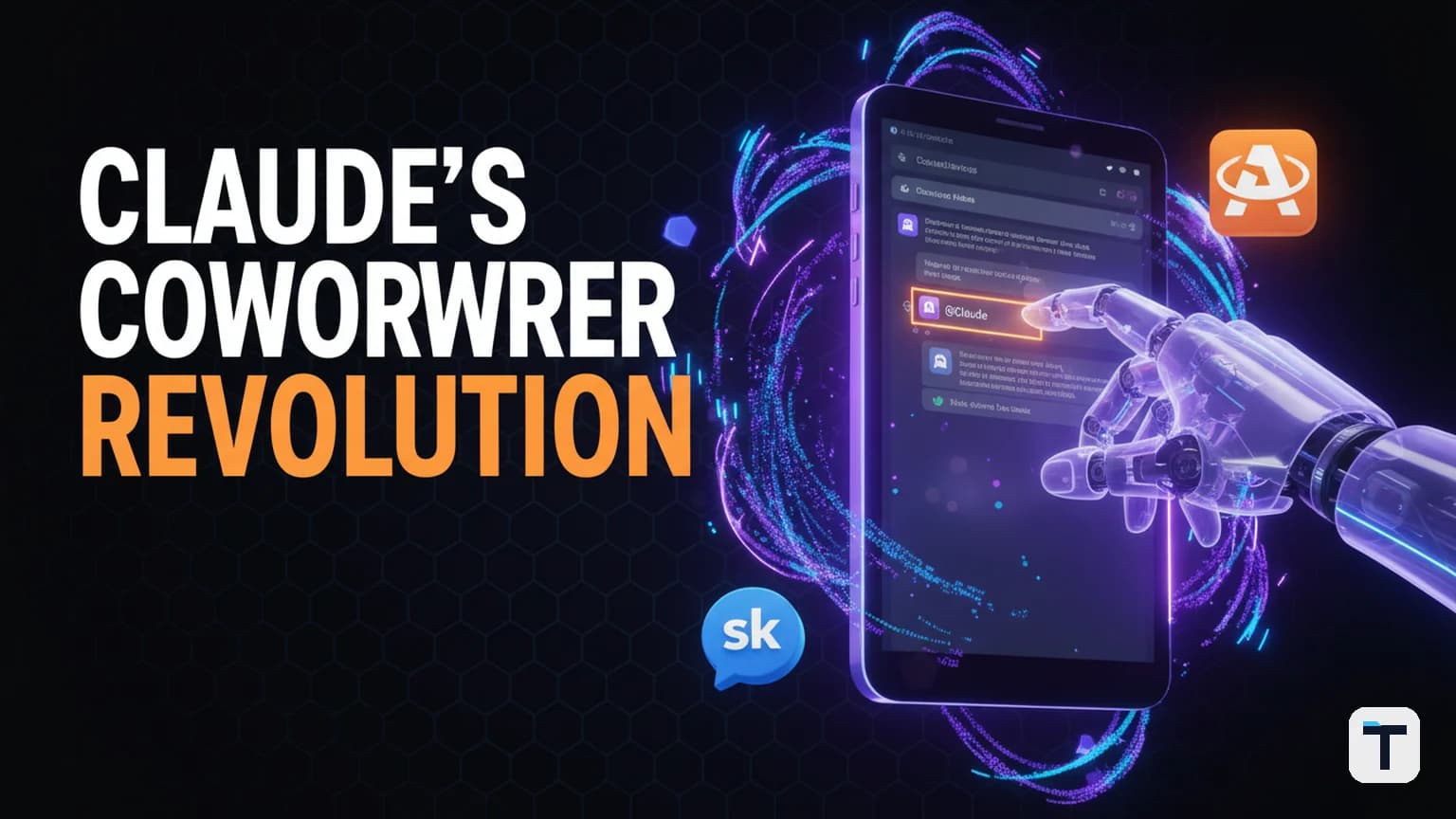

Verdict: The release of Claude Opus 4.8 and the "Claude Tag" Slack integration represents a fundamental shift in the AI landscape: the transition from passive assistants to proactive "AI Coworkers." By combining a 4x improvement in error-catching "honesty" with a new "Dynamic Workflows" engine that orchestrates hundreds of parallel subagents, Anthropic has built an AI that doesn't just answer questions—it joins the team to execute complex, multi-day projects autonomously.
Last verified: 2026-06-25 · Model: Claude Opus 4.8 · Availability: Beta (Enterprise/Team) · Key Metric: 69.2% SWE-bench Pro resolution. Note: Model versions and pricing ($5/$25 per Mtok) are current but subject to vendor updates.
What is the 'AI Coworker' Shift?
The "AI Coworker" era is defined by three shifts in how we interact with intelligence: persistence, proactivity, and multiplayer context. Unlike traditional chatbots that forget your business context the moment you close the tab, a coworker-class AI like Claude Tag lives inside your communication hubs (like Slack), remembers past project nuances, and works alongside your human team.
In this "Phase 3" of AI evolution, you stop "prompting" a model and start "delegating" to a teammate. Because Claude is now a persistent member of your Slack channels, it can follow along with discussions, learn your company's unique "vibe," and chime in via Ambient Mode to flag missed details or follow up on stalled threads without being asked.
Is Claude Opus 4.8 Really 4x More Honest?
For an AI to work as a coworker—especially on unattended tasks like code migrations or data audits—it must be trustworthy. Anthropic's flagship Claude Opus 4.8 model (released May 28, 2026) leads with "honesty" as its primary feature.
Internal benchmarks show Opus 4.8 is four times less likely than its predecessor (4.7) to let a flaw in its own work pass unremarked. Rather than "declaring victory" and leaving a bug for a human to find, 4.8 is trained to admit uncertainty and flag its own errors during the run. This reliability is what enables the high-stakes autonomous workflows businesses are now deploying.
How Do 'Dynamic Workflows' Orchestrate Complexity?
The most powerful technical unlock in Opus 4.8 is a feature called Dynamic Workflows. Instead of tackling a massive task sequentially, Claude can now "fan out" a project into a swarm of hundreds of parallel subagents.
Case Study: The 750,000-Line Bun Migration
Anthropic demonstrated this power by tasking a Claude swarm with porting the entire Bun codebase from Zig to Rust.
- Scale: ~750,000 lines of code.
- Speed: 11 days from first commit to merge.
- Accuracy: 99.8% test suite pass rate upon completion.
This orchestration allows Claude to manage specialized agents that inspect different parts of a codebase, hunt for bugs, and challenge each other’s conclusions before delivering a coordinated result.
Deploying Claude Tag: The 2026 Slack Blueprint
Claude Tag replaces the legacy Claude Slack app for Team and Enterprise customers. It transforms a channel into a multiplayer agentic workspace where anyone can tag @Claude to trigger a Dynamic Workflow.
| Feature | Capability | Benefit |
|---|---|---|
| Multiplayer | One Claude shared by the whole channel | Shared context; no siloed chats. |
| Async Tasking | Works over hours or days in the background | Frees humans for high-level strategy. |
| Ambient Mode | Proactively surfaces info and follows up | Prevents projects from falling through cracks. |
| Admin Controls | Scoped tool access and spend limits | Enterprise-grade security and governance. |
What this means for you
For business owners and managers, the takeaway is clear: the "prompt engineering" era is ending, and the "delegation" era has begun. To stay competitive, you shouldn't be asking how to talk to AI; you should be architecting Agent Operating Systems where AI coworkers can independently own results.
Anthropic's own data is the loudest signal here: 65% of their product team's code is now being generated by their internal version of Claude Tag.
FAQ
Q: Is Claude Opus 4.8 available for free users? A: No. Currently, Opus 4.8 and the Claude Tag beta are restricted to Claude Team and Enterprise plans.
Q: Can Claude Tag see my private Slack channels? A: Only if explicitly added by an administrator. Claude is scoped to specific channels and cannot access information it hasn't been granted permission to see.
Q: Does using Claude Tag cost extra? A: It uses your existing plan's token credits. However, admins can set per-channel spend limits to prevent budget overruns during long async tasks.
Q: How does this compare to GPT-5.5-Cyber? A: While GPT-5.5 leads in some specialized security benchmarks, Opus 4.8 currently leads on SWE-bench Pro (69.2% resolution) for general-purpose agentic coding and project execution.
Every claim here is traced to a primary source, dated, and listed under Sources. Research and drafting are AI-assisted; editing, verification and publication are human decisions, and a person is accountable for what appears on this page. How we work →
Discussion
0 comments