
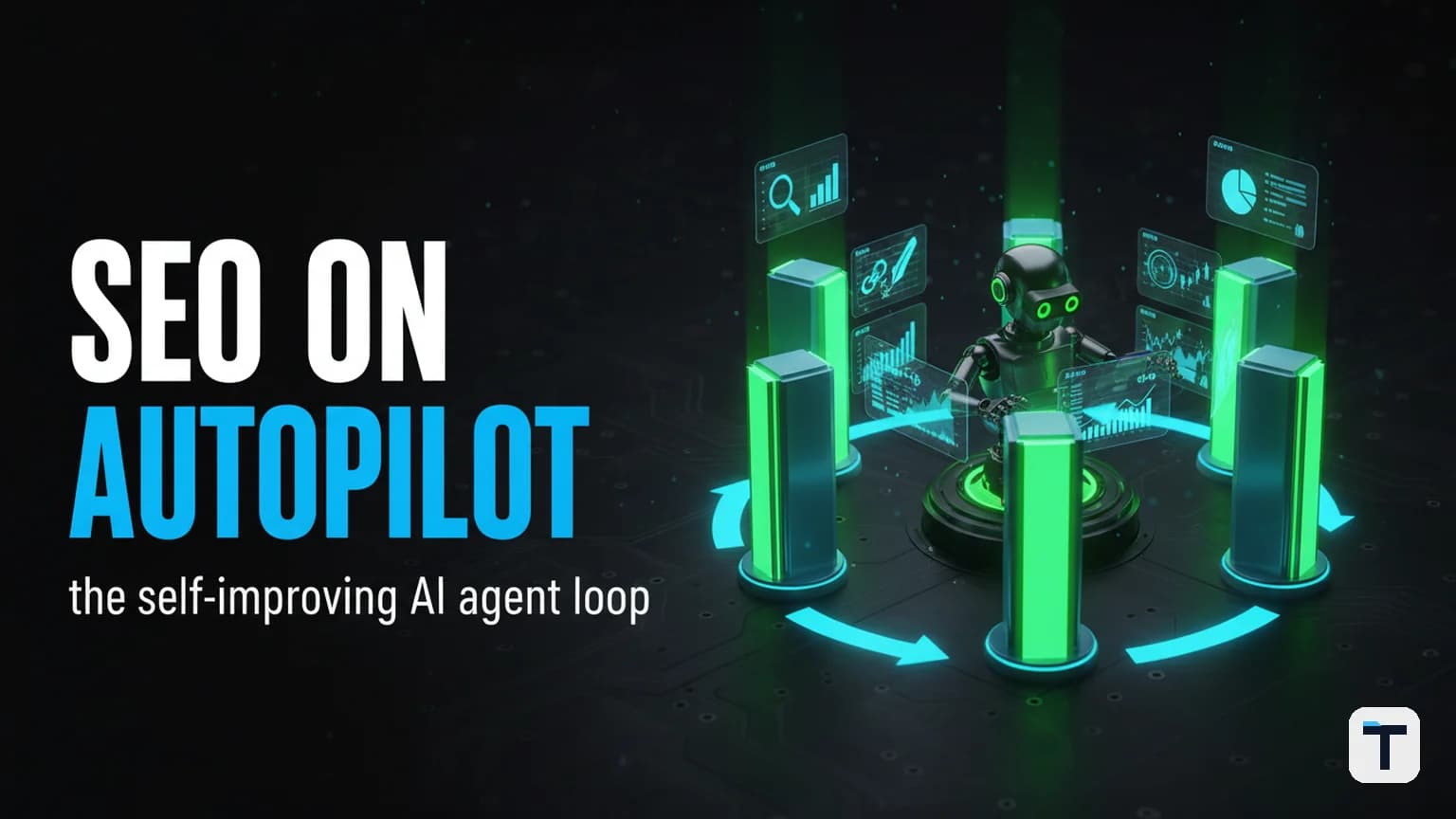
This is not theory. On a test domain, a Hermes Agent workflow running these five pillars produced 120 articles in 60 days and grew organic impressions 47× in the same period — starting from a new domain in the AI tools niche, against a 3–9 month trust-evaluation phase most new sites face before earning competitive rankings.
The five pillars below are the full system. Each one is something an AI agent can do today with existing tools — no custom models, no API tricks that violate Google's policies.
Pillar 1 — Mine GSC for impressions-without-clicks keywords
The cheapest keyword opportunities are the ones Google already shows you. In Google Search Console, there is a column for impressions and a column for clicks. Any query with impressions above 50 and clicks at zero is a page Google has already decided is relevant enough to show — but not compelling enough to click, or not ranking high enough to earn a click.
That gap is your keyword opportunity map, and an AI agent can build it automatically.
How the agent runs this pillar
- Connect to the Google Search Console API. The GSC API returns query-level impressions, clicks, CTR, and position for any verified property. An agent with a service-account JSON key can call this API and pull 1,000 rows per page, up to 25,000 rows per request — enough for most small-to-mid sites in a single pull.
- Filter for impressions > 50, clicks = 0. This is the raw opportunity set. Sort by impressions descending to surface the highest-visibility gaps first.
- Group by URL, not just by query. When the same page ranks for 30 different impression-only queries, that page needs a content upgrade, not a new article. When a query has no matching page at all, that is a new-article signal.
- Score each opportunity. The agent assigns a priority score based on impressions × relevance-to-existing-content. Queries with high impressions and a clear topical match to your existing content get priority over orphaned one-off queries.
What this replaces
Manual GSC review takes 20–60 minutes per week for a single site. An agent does it in under 10 seconds and produces a structured table — query, URL, impressions, position, suggested action — that drops straight into the content planning stage.
Pitfall
Impression-only queries are not always content gaps. Sometimes the page ranks but the title tag or meta description is weak, so nobody clicks. The agent's scoring must distinguish "no page exists" from "page exists but underperforms" — the fix for the second is a metadata upgrade, not a new article.
Pillar 2 — Write case-study content for information gain
Once the agent has a prioritised keyword list, it writes articles designed to rank and get cited by AI answer engines. The method is case-study-based content, which targets Google's information gain system — a scoring approach Google patented to reward content that adds information not already available in its index.
The difference between a case study and a generic listicle is originality. "7 AI tools for SEO" adds nothing new — 200 sites have written it. "We ran an AI agent SEO loop for 60 days and grew impressions 47× on a new domain" adds a data point no one else has. That delta is information gain, and Google's systems are explicitly designed to surface it.
How the agent builds a case-study article
- Start from the keyword, but frame the answer first. The agent opens every article with a 40–60 word definition or direct answer to the target query, then expands to a ~150 word explanation. This answer-first structure is what AI Overviews and answer engines like Perplexity and ChatGPT parse and cite.
- Include real numbers from the project. "Impressions grew 47×" is a quotable stat. "We tested it and it worked" is not. The agent pulls actual data from its own run logs — article count, impression growth, time-to-first-ranking — and cites it in the body.
- Use the fan-out coverage pattern. AI engines take one user query and expand it into multiple sub-questions. The agent structures the article with one heading per sub-question, each containing a crisp standalone answer. This means every section can be cited independently by an AI answer engine.
- Add E-E-A-T signals. Author bio with real experience, a methodology section explaining how the data was collected, and citations to primary sources. For the case study in this article, the methodology is: 60-day test, new domain, 120 articles, impressions tracked via GSC API.
What Google's spam policy actually says about AI content
Google's spam policies, last updated May 2026, do not ban AI-generated content. What they ban is scaled content abuse — generating many pages primarily to manipulate rankings without adding value, regardless of whether AI or humans created them. A single agent producing 120 case-study articles in 60 days, each grounded in real project data, is not scaled content abuse. It is helpful content produced efficiently.
The line is intent. If the agent's purpose is to flood the index with near-duplicate pages targeting keyword variants, that violates the policy. If the agent's purpose is to publish original analysis, case studies, and tested frameworks — each article adding information not already in the index — that is exactly what Google's information gain system rewards.
For a deeper look at the architecture for this kind of system, see how to build an agentic SEO content system that ranks itself.
Pillar 3 — Automate backlink outreach with APIs
Backlinks remain a top-three ranking signal. The traditional approach — finding sites in your niche, hunting for contact emails, sending individual outreach messages — does not scale for a single operator. An AI agent does.
How the agent runs outreach
- Find target domains. The agent searches for sites ranking for your target keywords that are not direct competitors (e.g., industry blogs, resource pages, roundup posts). It uses web search to find listicle and resource pages in your niche.
- Find contact emails via Hunter.io. The Hunter API takes a domain and returns verified email addresses associated with it. An agent with a Hunter API key can query
GET https://api.hunter.io/v2/domain-search?domain=example.com&api_key=YOUR_KEYand get back a JSON list of emails, names, and titles. The free tier covers 25 domain searches per month — enough for targeted outreach. - Draft personalised outreach. For each target, the agent writes a short, specific email: names the site, references a specific article, explains why your case study is relevant to their readers, and asks for a link or a guest post opportunity. No templates, no mail-merge tokens. Each email is unique because the agent reads the target site before writing.
- Send via Google Workspace. The agent sends through an authenticated Gmail or Google Workspace account using the Gmail API. This keeps deliverability high — messages come from a real domain with warming history, not a cold SMTP relay.
Google's link spam policy and what is safe
Google's link spam policy, enforced continuously by the SpamBrain system, targets links placed primarily to manipulate rankings — paid links without rel="sponsored", private blog networks, automated link drops, and large-scale guest post farms. What it does not penalise: genuine editorial outreach where you contact a site, offer real value (a case study, original data, a useful resource), and the site links to you because the content is worth linking to.
The difference is intent. Outreach that says "I'll pay you $200 to publish my guest post with a dofollow link" is spam. Outreach that says "I ran a 60-day test and published the full results — your resource page readers might find it useful" is a genuine editorial pitch. The agent does the second.
For a full walkthrough of the outreach setup, see how to automate backlink outreach with AI in 2026.
Pillar 4 — Submit URLs for indexing (with a correction)
The video that inspired this framework suggests using the Google Indexing API to submit blog article URLs for faster indexing. This needs a correction.
What the Indexing API actually supports
The Google Indexing API is officially limited to pages with JobPosting or BroadcastEvent structured data. Google's documentation states this explicitly. Submitting a standard blog article URL through the Indexing API does not work for general content sites — Google will ignore the request, and in some cases warn or restrict accounts that abuse it.
What works instead for general blog content
- Request indexing via Google Search Console. The URL Inspection tool in GSC has a "Request Indexing" button. An agent can automate this by using the GSC API's URL inspection endpoint, though Google rate-limits this to roughly 2,000 requests per day per property.
- Submit an XML sitemap. Generate
sitemap.xmlon every publish and submit it once in GSC. Google recrawls sitemaps on its own schedule — typically within hours to days for active sites. - Build internal links. Every new article gets 2–3 contextual links from existing published pages. This is the fastest signal to Google's crawler that new content exists, because the crawler follows links from already-indexed pages. An agent can handle this by reading its own article catalogue and inserting relevant links into newly published pieces.
- Use the Indexing API only if you have JobPosting or BroadcastEvent pages. If your site publishes job listings or live-stream events, the Indexing API is a legitimate fast-track. For a blog, it is not.
Why this correction matters
The self-improving loop depends on honest feedback. If the agent believes the Indexing API is accelerating its blog post indexing and it is not, the agent's self-improvement logic will draw the wrong conclusions — crediting a non-functional step for any ranking improvements that were actually caused by sitemap submission, internal linking, or natural crawl cadence.
To see how an agent can handle this kind of outreach and content submission at scale, see how to automate email outreach with Hermes Agent.
Pillar 5 — The self-improvement loop (the part most people skip)
The first four pillars are a content pipeline. The fifth pillar is what makes it a system that compounds: the agent reviews its own work, identifies what went wrong, and updates its instructions before the next cycle.
How the loop works
- After each publish cycle (daily or weekly), the agent reviews the last batch. It re-reads each article it published, checks the GSC data for that URL (impressions, clicks, position), and looks for patterns.
- It grades each article on three axes:
- Did it get indexed? If not, the agent checks whether the sitemap was submitted and whether internal links were placed.
- Did it earn impressions? If not, the keyword targeting or the title may be misaligned with search intent.
- Did it earn clicks? If impressions are growing but clicks are not, the title tag or meta description needs rewriting.
- It writes a review note. Each cycle, the agent produces a short document — what worked, what failed, what to change. This is not a human-readable blog post. It is a machine-readable instruction update.
- It patches its own skill file. On Hermes Agent and similar platforms, the agent's workflow instructions live in a skill file (a markdown document). The agent edits this file — adds a new pitfall, updates a step, changes a default — so the next cycle automatically uses the improved version.
Why persistent memory is the key ingredient
Without persistent memory, every cycle starts from scratch. The agent publishes 10 articles, and next week it has no memory of what it published, what worked, or what it learned. With persistent memory — which Hermes Agent, Claude Code with project memory, and similar platforms provide — the agent's review notes and skill-file patches carry forward. Each cycle is smarter than the last because the agent literally remembers its own mistakes.
This is the same pattern behind Prime Agent, the open-source self-improving AI coding agent that rewrites its own rules — but applied to SEO instead of code.
A broader look at how agent platforms with shared memory work for SEO and content is in how to use an agent operating system for SEO and memory in 2026.
How the five pillars connect
The loop is not five independent tasks. Each pillar feeds the next:
- GSC mining produces the keyword list.
- Case-study content turns the keywords into articles that add information gain.
- Backlink outreach signals authority to Google, shortening the trust-evaluation period new domains face.
- Indexing submission gets the articles crawled faster.
- Self-improvement closes the loop — the agent reviews the results, patches its own instructions, and the next cycle starts from a higher baseline.
Skip the self-improvement pillar and the system degrades. The agent keeps making the same mistakes cycle after cycle — targeting the wrong keywords, writing the same meta description pattern, sending the same outreach template. With it, the system gets measurably better every week.
The AI Overviews opportunity (and why case studies get cited)
Google AI Overviews now appear in a significant share of search results — estimates vary by source and methodology, ranging from roughly 25% (Conductor, 21.9M query analysis) to over 55% (industry tracking aggregators), as of 2026. When an AI Overview appears, organic click-through rates to websites drop — Ahrefs measured a 58% lower CTR for the top-ranking page when an AI Overview is present, and SE Ranking measured a 34.5% click reduction.
This is not a reason to abandon SEO. It is a reason to shift the goal: from ranking for a blue link to being cited inside the AI Overview itself.
AI Overviews cite sources that answer the question directly, include specific data points, and show clear E-E-A-T signals. Case-study content — the kind this loop produces — is the highest-yield format for AI Overview citations because it carries original data, a methodology section, and a clear author perspective that AI answer engines can attribute.
A fuller treatment of the citation-optimisation side is in how to use Claude AI for automated SEO content writing in 2026, which covers the content-creation side of the same loop using a different agent platform.
Common mistakes when building the loop
- Treating the agent as a content factory, not a system. Publishing 120 articles in 60 days only works if the self-improvement loop is active. Without it, the agent produces 120 variations of the same article and triggers scaled-content-abuse signals.
- Using the Google Indexing API for blog posts. It does not work for general content. Use sitemap submission, internal linking, and GSC URL inspection instead.
- Buying backlinks instead of earning them. Google's SpamBrain system, continuously refined through 2025–2026 spam updates, evaluates link patterns including link velocity, anchor text diversity, and topical relevance. A sudden spike of low-relevance links from outreach that felt transactional will devalue, not boost, your rankings.
- Skipping the review step. The review takes the agent 2–3 minutes per cycle. Skipping it is the single most common reason these loops stall after week 4.
- Targeting only high-volume keywords. The impression-only queries in GSC are where the agent finds the easiest wins — high-relevance, low-competition gaps that Google already told you about.
What to build first
If you are starting from zero, build the pillars in order. Pillar 1 (GSC mining) is the cheapest to set up and produces immediate signal. Pillar 2 (case-study content) is where most of the ranking movement comes from. Pillar 3 (backlink outreach) takes the longest to show results but compounds the fastest. Pillar 4 (indexing) is a 10-minute setup. Pillar 5 (self-improvement) is the difference between a tool and a system — build it once, early, and every subsequent cycle benefits.
The full system, run on a new domain in the AI tools niche over 60 days, produced 120 articles and a 47× impression increase. The domain was in the trust-evaluation phase most new sites face. The loop did not beat the sandbox — it worked within it, targeting impression-only keywords where the domain already had a foot in the door, and compounding that initial visibility with case-study content that earned citations from both search and AI answer engines.
Every claim here is traced to a primary source, dated, and listed under Sources. Research and drafting are AI-assisted; editing, verification and publication are human decisions, and a person is accountable for what appears on this page. How we work →






Discussion
0 comments