
Last verified: 2026-08-10
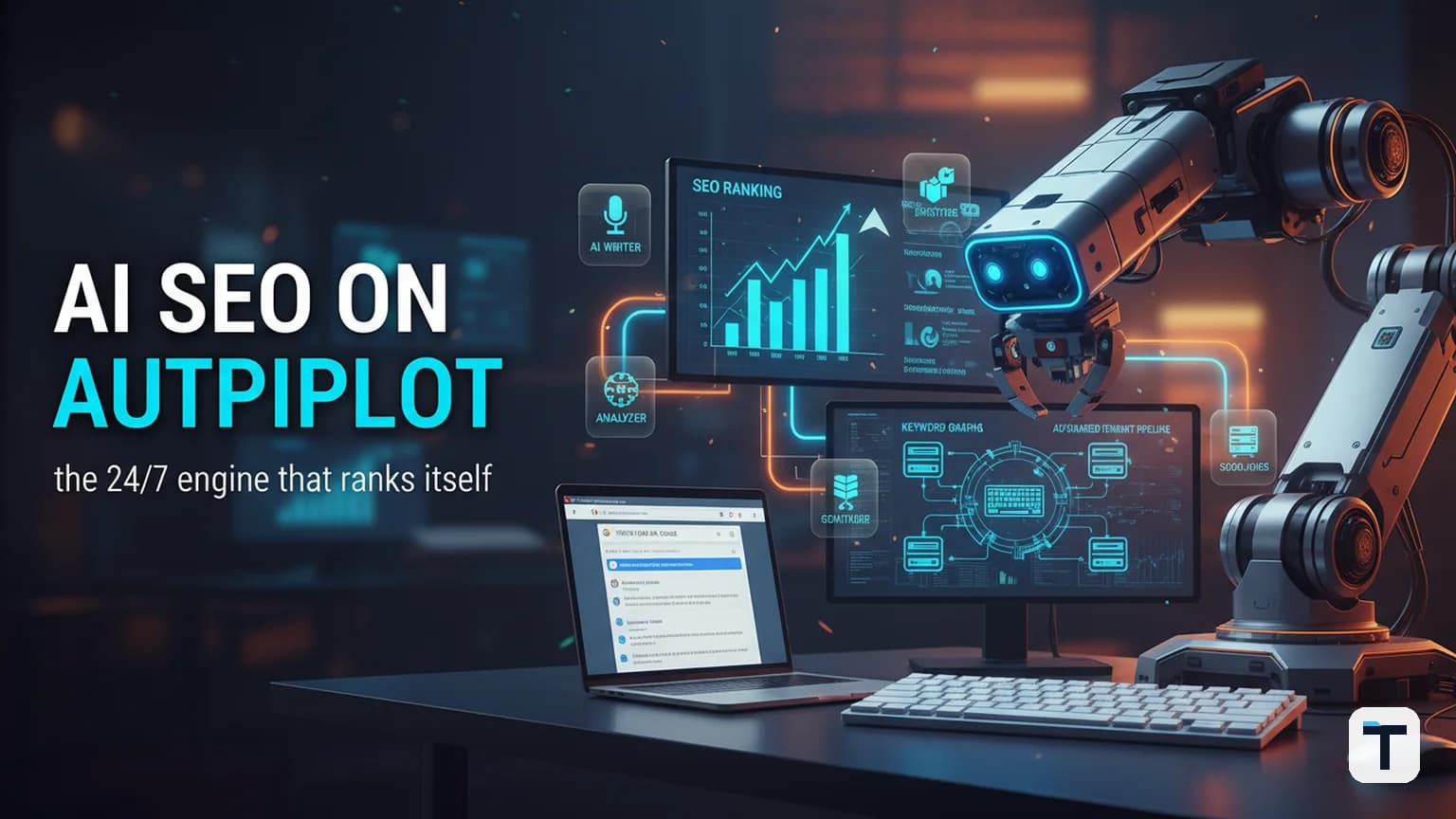
- AI agent SEO automation = keyword discovery + content + link building + self-improving loop
- Keyword stage uses Google Search Console API to find "impressions but no clicks" queries
- Content stage grounds every article in real case study data for Google's information gain signal
- Link stage automates outreach emails using Hunter API + Google Workspace
- Self-improving loop reviews batch results and proposes updates to its own instructions
- Realistic SEO timeline: 3–6 months for established domains, 4–6 months for new domains
- Pricing/limits change often — last checked 2026-08-10
What is an AI agent SEO engine?
An AI agent SEO engine is an autonomous system that handles the full SEO cycle — from keyword research through content creation, link building, and performance review — without step-by-step human prompting for each task. Unlike traditional SEO tools that act as dashboards (you look, you interpret, you act), an agent is goal-directed: you give it an objective like "rank my plumbing site for local keywords," and it chains together the steps to get there.
The key difference from a chatbot is multi-step execution. A chatbot generates text. An agent plans, uses tools, acts on live data, and remembers what worked. Hermes Agent, built by Nous Research, is one open-source option with persistent memory, 40+ built-in tools, a reusable skills system, and cron scheduling — the exact capabilities an SEO engine needs. It runs on a $5/month VPS and is MIT-licensed (Source: GitHub — NousResearch/hermes-agent).
How does AI agent SEO automation work?
AI agent SEO automation works by connecting an AI agent to your data sources (Google Search Console, your CMS, case study documents) and outreach tools (email APIs, lead finders), then letting it execute a repeatable workflow: find keyword gaps, write grounded content, pitch links, review results, and feed the learnings back into the next cycle. The agent's persistent memory ensures that every cycle's lessons compound — it remembers which outreach emails got replies and which keywords turned into clicks.
If this sounds like it overlaps with the concept of an agentic SEO content system, you're right — the difference is scope. An agentic content system focuses on the writing and ranking loop. A full SEO engine adds link building and the self-improving review layer, which is where the real compounding happens.
Part 1: How to find keywords an AI agent should target
The strongest keyword signal for an AI SEO engine is hiding in your own Google Search Console: queries where your site gets impressions but zero clicks.
Here's what that means in plain terms. Impressions tell you Google is already showing your website for that query — real people are seeing your site in search results. Zero clicks tell you the page ranking for that query isn't good enough to earn the click. That's Google telling you, in effect: "I'd rank you higher if you had a proper page for this."
Why this beats traditional keyword research
Traditional keyword research means spending an hour in Ahrefs or Semrush, guessing which keywords you might rank for, hoping the search volume is real, and hoping you picked the right intent. The Search Console method skips all of that — you're looking at actual queries Google already associates with your domain.
To automate this, connect the Google Search Console API to your agent. Query the searchanalytics.query endpoint, filter for clicks == 0 and impressions > 10, and you get a prioritized list of keyword opportunities Google already thinks you deserve to rank for. The API returns query, impressions, clicks, CTR, and position for each row (Source: Google Search Console API documentation).
Step-by-step: automated keyword discovery
- Authenticate with a Google Cloud service account that has access to your Search Console property.
- Query the API for the last 90 days, filtering by
clicks = 0andimpressions >= 10. These are your zero-click opportunities. - Group by intent — informational queries need articles; commercial queries need product or comparison pages.
- Score by opportunity — multiply impressions by (1 / average position) to find keywords where you're close to page 1 but not earning the click.
- Feed the top keywords to your content stage along with a real case study from your business.
Part 2: How to generate SEO content with an AI agent
The content stage is where most AI SEO fails — because most people generate generic text with no original data. Google's helpful content system (integrated into the core ranking algorithm as of 2026) rewards information gain: content that adds something new beyond what already exists in the search results. Commodity rehash gets demoted.
The case study method
The fix is to ground every article in a real case study from your business. Your agent takes a keyword (from Part 1) plus one real example — actual results, real numbers, genuine experience — and writes content that adds information the internet doesn't already have.
This works because the agent isn't making things up. It's pulling from your source of truth: your actual customer outcomes, your actual data, your actual experiments. Content built on real case studies is exactly the type of original, experience-driven material that Google's E-E-A-T framework rewards (E-E-A-T = Experience, Expertise, Authoritativeness, Trustworthiness).
If you're already exploring automated SEO content writing with Claude, the same principle applies — the agent is the executor, but the case study is the raw material that makes the content rankable.
Step-by-step: content generation loop
| Step | What happens | Why it matters |
|---|---|---|
| 1. Keyword input | Agent receives a zero-click query from Part 1 | Targets a proven gap, not a guess |
| 2. Case study attachment | You supply one real example from your business | Generates information gain, not rehash |
| 3. SERP analysis | Agent searches what currently ranks and matches the format | If top results are how-tos, write a how-to; if listicles, write a listicle |
| 4. Article draft | Agent writes with answer-first structure, FAQ, schema | Built for both ranking and AI Overview citation |
| 5. Indexing | Agent pings the Google Indexing API | New pages get crawled in hours, not weeks |
| 6. Verification | Agent checks the live URL returns 200 | Confirms the page is live and indexable |
The indexing shortcut
The Google Indexing API lets you tell Google to crawl a new URL immediately, rather than waiting days or weeks for organic discovery. Officially, Google says it's for JobPosting and BroadcastEvent structured data types — but in practice, many SEOs report it works for all content types (Source: Google Search Central documentation). Set up a service account in Google Cloud, add it as an owner in Search Console, and send URL_UPDATED notifications when you publish.
Important caveat: The Indexing API prompts Googlebot to crawl faster, but it does not guarantee ranking. You still need quality content, proper on-page SEO, and time. The daily quota is typically 200 URLs (Source: Google Indexing API documentation).
Part 3: How to automate backlink outreach with an AI agent
Backlinks remain one of Google's strongest ranking signals — especially editorial links, where a real person at another website adds your link inside their content because it genuinely fits. These are valuable precisely because they're hard: your competitors can't copy them without doing the same manual work.
Here's how to automate the tedious parts while keeping the links real.
Tools you need
| Tool | What it does | Cost |
|---|---|---|
| Hunter.io | Finds professional email addresses for any domain | Free plan: 25 searches/month; Starter: $34/mo; Growth: $104/mo (Source: Hunter.io) |
| Google Workspace (Gmail API) | Sends and manages outreach emails | $6/user/month (Business Starter) |
| Your AI agent | Writes personalized email drafts, manages replies | Free (self-hosted) or model API costs |
Step-by-step: automated link building
- Find prospects. Tell your agent what kind of sites you want links from (e.g., "blogs about home improvement with domain rating 20–40"). The agent uses the Hunter Domain Search API to find emails associated with each domain.
- Enrich leads. For each prospect, the agent pulls site info, notes what the site covers, and identifies where your content would naturally fit.
- Write the outreach email. The agent drafts a personalized email per prospect — first name, site name, the specific reason you're reaching out, the specific article that would fit their content. Not a template blast; a genuine pitch.
- Send and track. The agent sends via the Gmail API and monitors the inbox for replies. It handles follow-ups automatically after a set wait period.
- Report results. The agent logs which emails got replies, which led to links, and feeds that data back into the self-improving loop (Part 4).
What makes this different from spam
The links that actually move rankings are editorially placed — a real person decided your link belongs in their content. What the agent automates is the finding, drafting, and follow-up grind that normally eats your afternoons. The human at the other end still makes the decision to include your link. You're automating the outreach, not the placement.
This is also where AI search visibility compounds: when other sites mention your brand alongside your key terms, AI answer engines learn to associate you with those terms. Google's AI Overviews now appear on approximately 48% of search queries and have reduced organic CTR for the top-ranking result by 58% (Source: Ahrefs, December 2025 data). But pages cited inside the AI Overview earn more clicks than standard blue links — so authority signals from backlinks serve double duty.
Part 4: How to make the SEO engine improve itself
This is the part that separates a one-off automation from a compounding system. After each batch of keyword → content → outreach work, the agent reviews its own output and proposes updates to its own instructions.
How the self-improving loop works
- After each batch, the agent audits what it produced: which articles ranked, which didn't, which outreach emails got replies, which keywords generated clicks.
- It proposes changes to its own workflow: better subject lines, different keyword filters, new content angles, revised email templates.
- Because the agent has persistent memory, those updates survive across sessions. It remembers that "email subject line X got a 12% reply rate" and uses that pattern next time.
- The loop compounds. More content → more rankings → more impression data in Search Console → more keywords to feed back in. More links → more authority → each new article ranks faster than the last.
If you want to go deeper on the self-improving concept, we've written about building a self-improving AI agent SEO loop — this guide focuses on the full four-part engine, while that one focuses specifically on the loop mechanism.
Why persistent memory is the secret
Without persistent memory, every session starts from zero. The agent forgets which outreach templates worked, which keywords converted, which content angles ranked. It repeats mistakes.
With persistent memory — which Hermes Agent stores in MEMORY.md (agent notes, 2,200 chars) and USER.md (user profile, 1,375 chars), both injected into every session's system prompt — the agent accumulates knowledge. It learns your business, your voice, your link partners, and your winning patterns.
This is also why using an agent operating system with shared memory matters for SEO at scale: the same memory that powers one workflow powers all of them, meaning your keyword research informs your content informs your outreach.
How long does AI agent SEO take to show results?
SEO takes 3–6 months for measurable results on an established domain and 4–6 months on a brand-new domain, with competitive terms taking 6–12 months (Source: Ahrefs Keyword Rankings Study; Semrush SEO Timeline Research; Google Search Central documentation, aggregated by FactoryJet).
New domains often experience what SEOs call the "Google sandbox" effect — a period where Google suppresses rankings while building its trust profile for the domain, typically lasting 3–6 months. Most people quit during this window because they see no results after publishing 10 pages.
The advantage of an AI agent engine is not speed — it's that the waiting doesn't consume your time. The old way meant six months of waiting and six months of manually grinding out articles and outreach. The agent way means the engine publishes, pitches, and polishes in the background while you run your business. When the domain finally earns Google's trust, the traffic pops.
Does Google penalize AI-generated SEO content?
Google does not penalize AI-generated content simply for being AI-generated. Google's own documentation states: "Using AI to generate content with the primary purpose of manipulating ranking in search results is a violation of our spam policies." But AI content that is helpful, original, and grounded in real expertise is not penalized — it's rewarded when it satisfies the helpful content system's criteria (Source: Google Search Central — Helpful Content System).
The practical distinction: Google punishes content that adds nothing. Content built on real case studies, with verified facts, structured for both readers and search engines, follows every SEO rule more consistently than a human can across hundreds of articles. The agent doesn't forget rules by article 3 — it follows all of them every time.
What this means for you
If you're a small business owner, marketer, or builder:
- You don't need to be technical. The SEO expertise lives in the agent's skills. You supply two things only you can: your keywords (from your own data) and your case studies (from your real results).
- Start with one keyword. Find one zero-click query in Search Console, pair it with one real customer outcome, and let the agent write one article. Submit it via the Indexing API. Watch what happens.
- Link building is the moat. Content is table stakes; editorial links are the competitive advantage that compounds. Automate the outreach, keep the placement human.
- Be patient through the sandbox. If you're on a new domain, expect silence for 3–6 months. The engine keeps working while you wait.
- Track AI visibility, not just rankings. Google AI Overviews now appear on ~48% of queries (Source: Ahrefs/serp.systems, March 2026 data). Being cited in the AI answer matters as much as ranking in blue links.
Comparison: AI agent SEO engine vs. traditional SEO workflow
| Factor | Traditional manual SEO | AI agent SEO engine |
|---|---|---|
| Keyword research | 1 hour per keyword, guessing intent | Automated from Search Console data |
| Content per keyword | 1 article, 1 full day | 5 variations, before your coffee cools |
| Link building | Manual outreach, ~4 days per 200 prospects | Agent drafts, sends, follows up automatically |
| Consistency | Human forgets rules by article 3 | Agent follows every SEO rule every time |
| Cost | Writer ($200–500/article) + link agency ($1,000+/mo) | Agent self-hosted (free) + API costs (~$50–150/mo) |
| Timeline | 3–6 months of manual grinding | 3–6 months of the engine running in the background |
| Self-improvement | None — you repeat the same process | Loop reviews each batch and updates its own instructions |
FAQ
Q: What is an AI agent SEO engine?
A: An AI agent SEO engine is an autonomous system that handles the full SEO cycle — keyword discovery, content creation, link building, and performance review — without requiring a new prompt for every step. It runs continuously, uses real data from your Google Search Console, and improves its own workflow over time through a self-reviewing loop.
Q: How does AI agent SEO automation differ from using ChatGPT to write articles?
A: ChatGPT is a text generator — you prompt it, it responds, and you start over next time. An AI agent SEO engine is goal-directed: it chains multiple steps together (keyword research → SERP analysis → content drafting → indexing → outreach → review), uses live API data, and remembers what worked across sessions via persistent memory. You can read more about this distinction in our guide on using ChatGPT for SEO.
Q: Does the Google Indexing API work for all content types?
A: Officially, Google states the Indexing API is for JobPosting and BroadcastEvent structured data only (Source: Google Search Central). However, many SEOs report it triggers crawling for all content types. It speeds up crawling but does not guarantee indexing or ranking. The daily quota is approximately 200 URLs.
Q: How much does it cost to build an AI agent SEO engine?
A: If you self-host an open-source agent like Hermes Agent, the software is free (Source: GitHub — NousResearch/hermes-agent). You need a VPS ($5/month), Hunter.io for email finding (free tier: 25 searches/month; Starter: $34/month), Google Workspace for sending emails ($6/user/month), and model API costs if you use a hosted LLM (typically $50–150/month for moderate volume). Total: under $200/month for a small operation.
Q: How long until I see ranking results from automated SEO?
A: 3–6 months for established domains, 4–6 months for new domains, and 6–12 months for competitive keywords. New domains may experience a "sandbox" period of suppressed rankings lasting 3–6 months while Google builds trust (Source: Ahrefs/Semrush aggregated data). The AI engine doesn't make SEO faster — it makes the waiting hands-off.
Q: Will Google penalize my site for AI-generated SEO content?
A: No, as long as the content is helpful, original, and grounded in real expertise. Google's helpful content system penalizes content that adds no value, not content that was written by an AI. Content built on real case studies with verified facts follows the same quality standards as human-written content and can rank well. The key is information gain — adding something new that doesn't already exist in the search results (Source: Google Search Central documentation).
Q: Can I automate link building without it being spam?
A: Yes, if you automate the outreach (finding prospects, drafting personalized emails, sending follow-ups) while keeping the link placement human. A real person at the target site still decides whether to include your link. The agent automates the grind of finding email addresses and writing pitches — it does not auto-place links in directories or comments, which Google's spam policies specifically target.
Every claim here is traced to a primary source, dated, and listed under Sources. Research and drafting are AI-assisted; editing, verification and publication are human decisions, and a person is accountable for what appears on this page. How we work →




Discussion
0 comments