
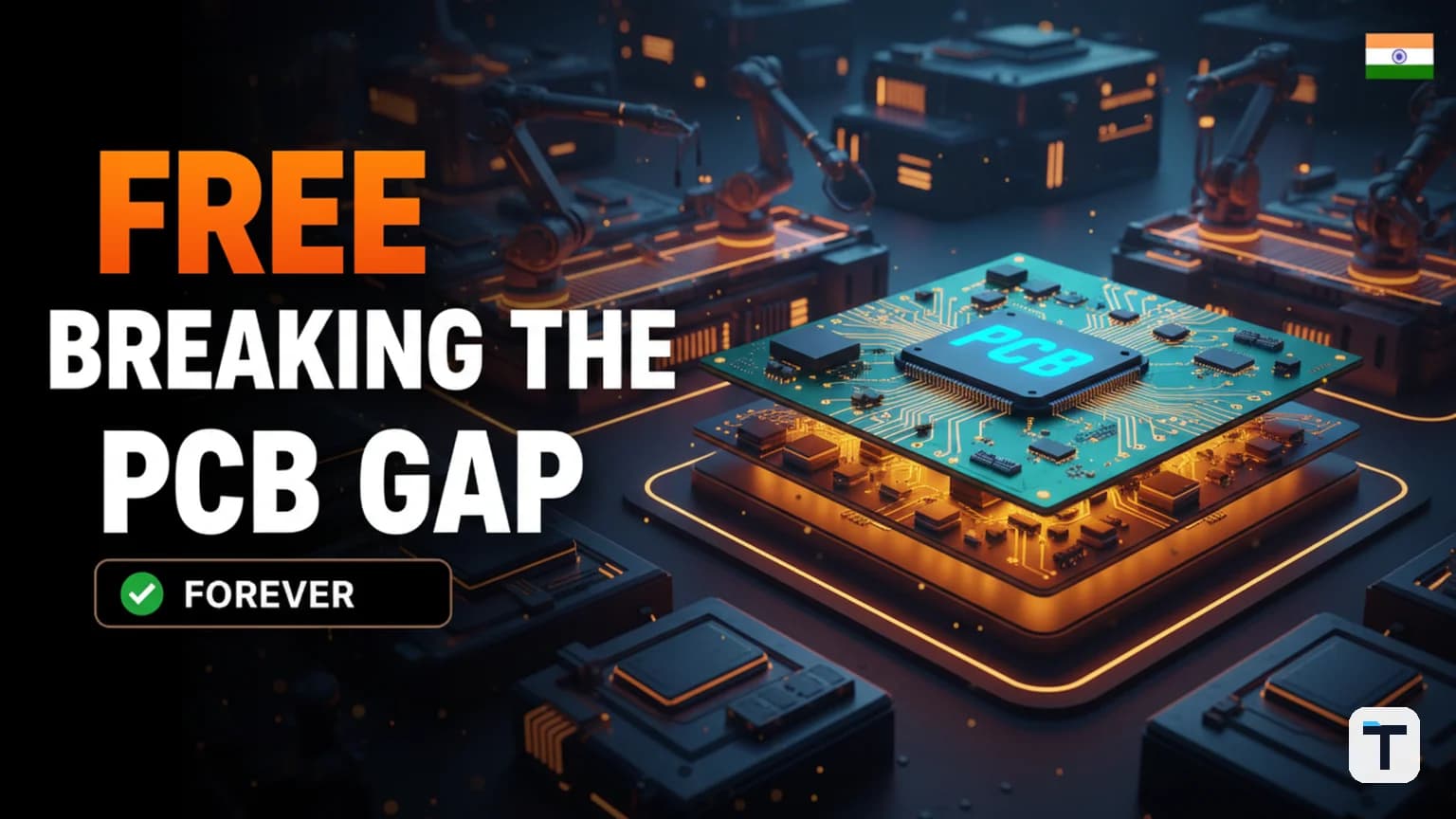
Last verified: 2026-06-26 · Dependency: ~70% (China/HK) · New Investment: ₹22,919 Cr (ECMS) · Focus: Multi-layer & HDI PCBs
Volatile facts: Subsidy allocations and manufacturing lead times are currently shifting as ECMS applications are processed.
Why are PCBs the new bottleneck for Indian tech?
While the world focuses on "chip wars," the Printed Circuit Board (PCB) is the physical foundation that connects every processor, memory module, and sensor. Without a domestic PCB supply chain, even the most advanced homegrown chips—like those planned under the India Semiconductor Mission (ISM)—remain a single shipment away from a total shutdown.
As of early 2026, India still imports approximately 60-75% of its electronic components from China and Hong Kong [Source: Communications Today, 2025]. For high-end applications like AI servers, which require 16-40+ layers of complexity, that dependency is near-total.
What is the ₹22,919 Crore ECMS Scheme?
Notified on April 8, 2025, the Electronic Component Manufacturing Scheme (ECMS) is a horizontal policy designed to subsidize deep component manufacturing. Unlike previous "assembly-focused" incentives, ECMS targets the "building blocks" of electronics.
| Target Segment | Incentive Type | Focus Area |
|---|---|---|
| Category B | Capex/Turnover | Multi-layer PCBs |
| Category C | Hybrid | HDI / MSAP / Flexible PCBs |
| Category D | Supply Chain | Capital equipment & materials |
[Source: Ministry of Electronics and Information Technology (MeitY), 2025]
Inside the Lion Circuits 100-Acre Mega Campus
The most visible sign of this pivot is the announcement by Lion Circuits, a Bengaluru-based PCB startup, of a 100-acre integrated mega campus in Vijayapura, North Karnataka.
This isn't just another factory; it is a blueprint for decentralized deep tech:
- Integrated Fab Units: Multiple units built incrementally to scale with demand.
- Automated Warehousing: AI-driven components warehouse for same-day dispatch.
- High-Layer Target: Aiming to close the "knowledge gap" by mastering 12-layer and advanced High-Density Interconnect (HDI) boards.
- R&D Hub: The campus includes a dedicated center for semiconductors and applied engineering through Terra Circuits.
The "Knowledge Gap": Why money isn't enough
Building advanced PCBs for AI servers is a "process knowledge" challenge, not just a funding one. High-end boards for NVIDIA-style GPU clusters can cost over $170,000 each due to extreme complexity [Source: KingBrother, 2025].
Technical hurdles include:
- Trace Precision: Copper traces under 75 microns (human hair width).
- Layer Density: AI servers often require 20-40 layers; most Indian fabs currently peak at 2-4 layers.
- Yield Management: Achieving 95%+ yield on complex HDI boards takes years of process mastery that China and Taiwan have perfected over decades.
What this means for you
For Indian hardware startups and small businesses building AI-connected devices, this shift promises:
- Reduced Lead Times: Moving from 8-week import cycles to domestic same-week dispatch.
- Lower Capital Risk: Avoiding the "30% cost increase" typically seen in small-batch imports due to tariffs and logistics [Source: PCBWay, 2024].
- Sovereign Reliability: Building on hardware that isn't subject to sudden geopolitical supply shocks.
If you are building in the AI agent space or sovereign computing, your "BOM" (Bill of Materials) is about to get a domestic upgrade.
FAQ
Q: Why is the PCB dependency on China a risk for India?
A: India currently imports roughly 70% of its PCBs from China/HK. Since PCBs are the physical foundation of every device, any supply chain disruption directly halts production for everything from EVs to indigenous supercomputers.
Q: How does the ECMS differ from the PLI scheme?
A: While the PLI focused on finished product assembly (like mobile phones), the ECMS (₹22,919 Cr) focuses "upstream" on the components and raw materials that go into those products, specifically targeting complex PCBs and lithium-ion cells.
Q: Is Lion Circuits the only player in this space?
A: No, but their Vijayapura campus is the largest integrated effort by a domestic startup. Larger groups like Tata Electronics are also investing heavily through the India Semiconductor Mission (ISM) for chip OSAT and fabrication.
Q: What are HDI PCBs, and why are they hard to make?
A: High-Density Interconnect (HDI) PCBs use laser-drilled microvias (<150 microns) to pack more circuitry into smaller spaces. They are essential for modern smartphones and AI servers but require high-precision lamination that most standard factories cannot achieve.
Every claim here is traced to a primary source, dated, and listed under Sources. Research and drafting are AI-assisted; editing, verification and publication are human decisions, and a person is accountable for what appears on this page. How we work →
Discussion
0 comments