
Last verified: 2026-06-26 · Key Stat: 100 Billion transistors on a fingernail · Efficiency: 70% less power at equal performance · Timeline: Research validated; commercial target ~2031.
What is IBM NanoStack and how does it work?
For decades, the semiconductor industry followed a "suburban" model: if you need more transistors, you clear more land (shrink the features). But as we approach the 1nm limit, we’ve run out of land—the atoms themselves are in the way.
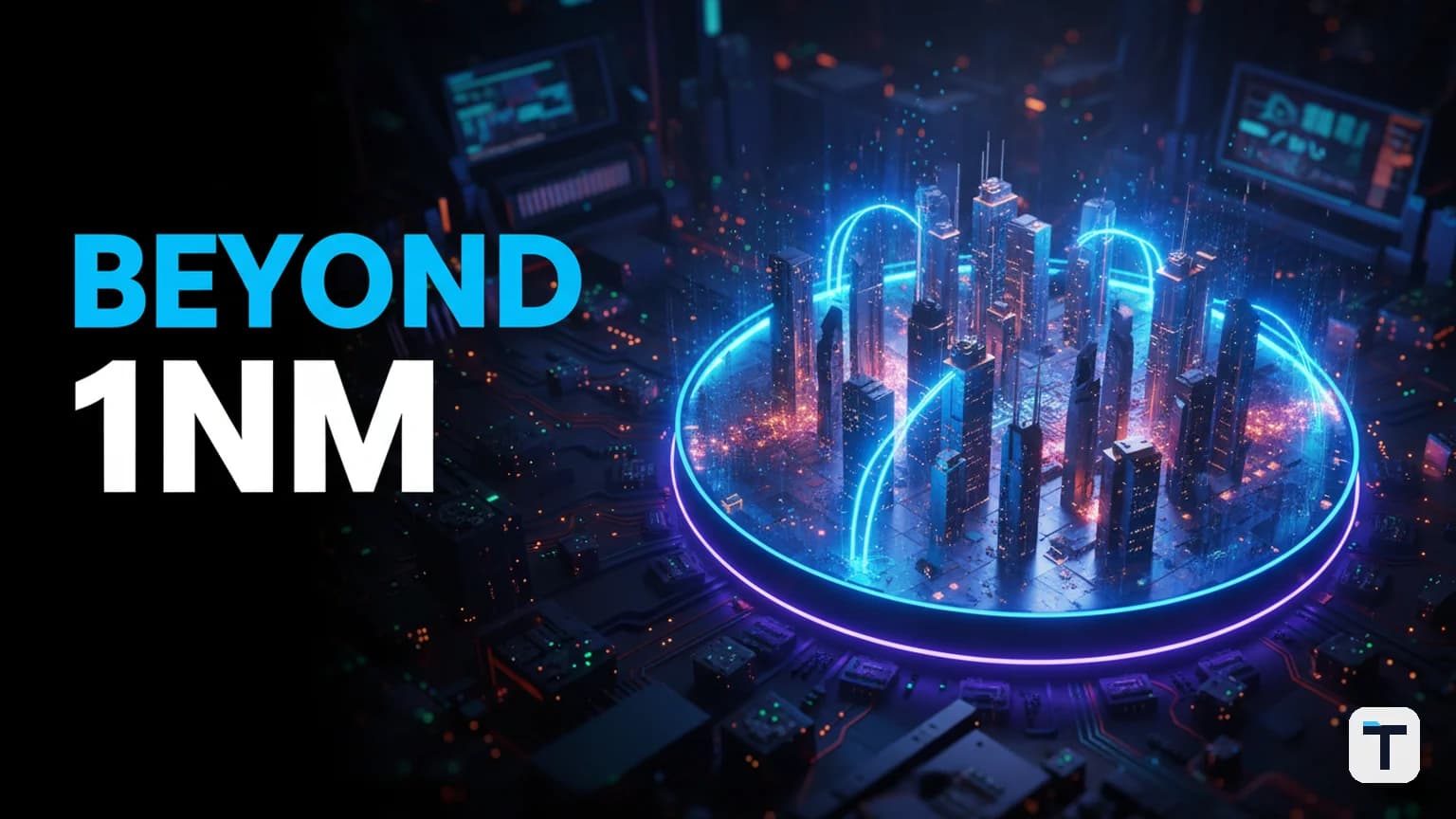
NanoStack is IBM's shift to a "metropolis" model. Instead of laying transistors side by side, IBM uses 3D sequential integration to stack and stagger them vertically.
- Verticality: Transistors are built upward like skyscrapers.
- Material Flexibility: Each layer can use different semiconductor materials (e.g., Silicon and Germanium) to optimize for speed or low power independently.
- Dual-Channel Engineering: This architecture allows for precise control over both n-type and p-type transistors within the same vertical footprint, which was previously a major manufacturing bottleneck [Source: IBM Newsroom, 2026].
Why is 0.7nm a "Physics-Defying" breakthrough?
The 0.7nm node (or 7 Angstroms) refers to a generation where features are roughly the size of three silicon atoms. At this scale, quantum tunneling—where electrons literally leak through solid walls—usually breaks the chip.
IBM solved this through two primary innovations:
- Ultra-thin Dielectric Bonding: This allows the "floors" of the transistor stack to be bonded together with almost zero vertical waste, keeping the overall chip thin.
- Thermally Stable Gate Stacks: Building the top layer of transistors usually requires heat that would melt the bottom layer. IBM’s new process uses a "low-thermal-budget" manufacturing flow developed at the Albany NanoTech Complex in partnership with Lam Research [Source: VLSI 2026 Proceedings].
The "SRAM Bottleneck" solved for AI
For AI developers, the most exciting part of this announcement isn't the CPU speed—it’s the SRAM scaling. Static RAM (SRAM) is the high-speed memory that sits directly on the chip to feed data to the processors. In recent years, SRAM scaling has stalled, meaning chips were getting faster but the "memory pipe" was staying the same size.
IBM’s NanoStack architecture delivers a 40% reduction in SRAM area. This means future AI processors (like successors to Nvidia's Blackwell or OpenAI’s Jalapeño chip) can carry significantly more on-chip memory, reducing the power-hungry need to fetch data from external HBM (High Bandwidth Memory), a key driver of the current AI memory shortage [Source: StorageReview].
What this means for your business
While 0.7nm chips won't be in your iPhone tomorrow, the ripples will change the economics of computing by the end of the decade:
- 70% Power Efficiency: For companies running massive AI models, this represents a near 3/4 reduction in electricity costs for the same compute—a major challenge for chips like Qualcomm’s Dragonfly C1000.
- Quantum Integration: IBM's concurrent launch of Anderon, a pure-play quantum foundry, suggests that these 0.7nm chips are being designed to act as the classical controllers for future quantum computers.
- Supply Chain Sovereignty: Much of this research is happening at the SUNY Poly Albany NanoTech facility in New York, positioning the U.S. as a leader in "Angstrom-era" manufacturing.
FAQ
Q: Is 0.7nm really the physical size of the transistor? A: No. In 2026, "0.7nm" (7A) is a node name representing a manufacturing generation. However, it signifies that transistor density has reached a point equivalent to what a 0.7nm 2D chip would offer, achieved here through 3D stacking.
Q: When will 0.7nm chips be commercially available? A: IBM typically unveils research breakthroughs 5–7 years ahead of commercialization. While Intel is targeting its 14A (1.4nm) node for 2027, IBM’s 0.7nm technology is expected to hit mass production around 2030–2031.
Q: How does this compare to TSMC and Intel? A: TSMC is currently ramping its A16 (1.6nm) process for 2026, and Intel is entering risk production for its 18A (1.8nm) node. IBM has "leapfrogged" these in a research capacity, demonstrating that scaling below 1nm is physically possible.
Q: Why does 3D stacking matter for AI? A: AI models require massive data movement. Stacking transistors vertically shortens the distance electrons travel and allows for more memory (SRAM) to be packed directly next to the logic, significantly reducing latency and heat.
Q: Does this mean Moore's Law is back? A: Moore’s Law (the doubling of transistors) never really stopped, but it became much more expensive. NanoStack provides a roadmap to continue doubling density for at least another decade by using the third dimension.
Every claim here is traced to a primary source, dated, and listed under Sources. Research and drafting are AI-assisted; editing, verification and publication are human decisions, and a person is accountable for what appears on this page. How we work →





Discussion
0 comments