
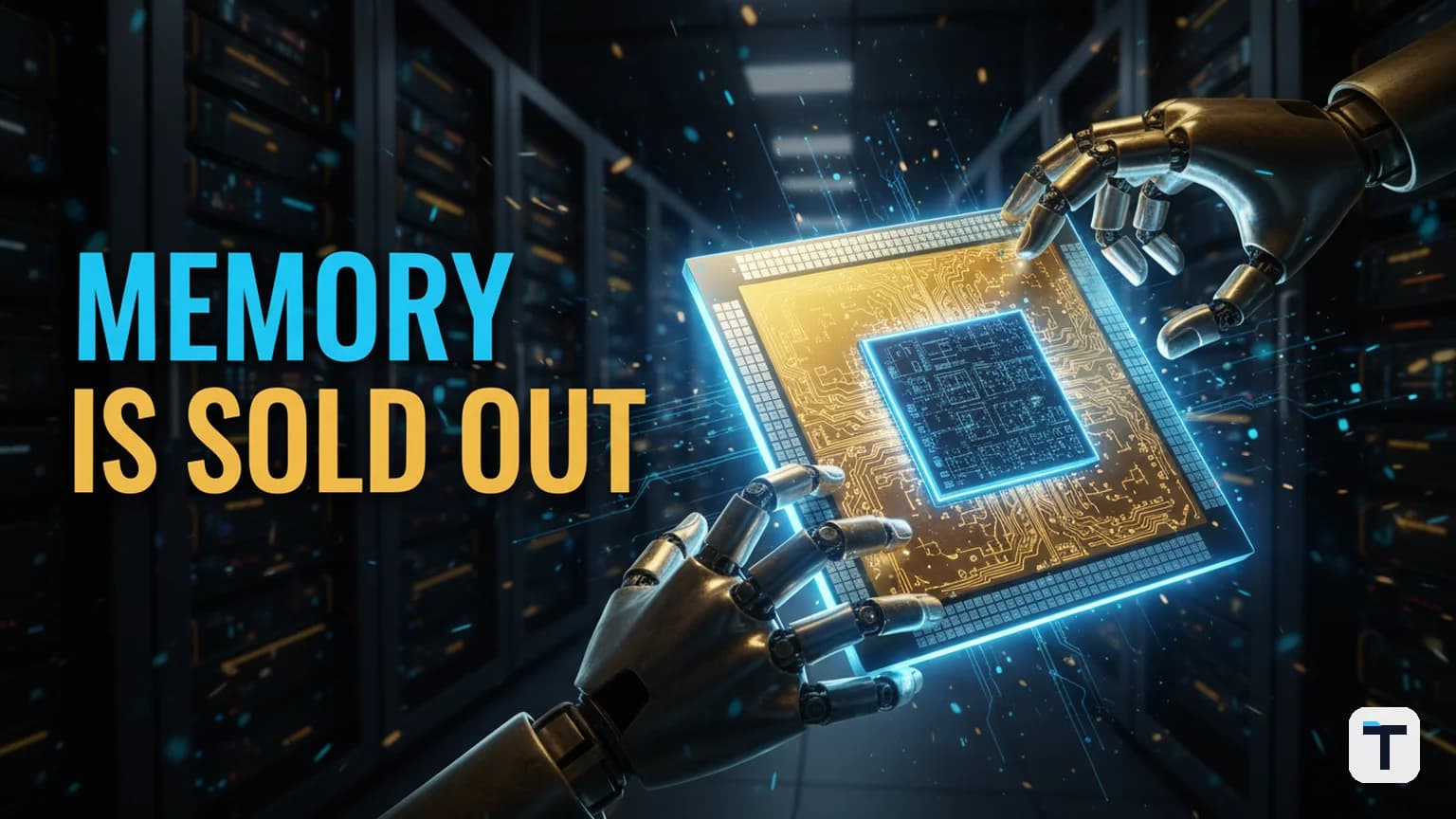
Last verified: June 25, 2026 · Status: Critical Shortage · Forecast: Price hikes for AI inference and consumer hardware through 2028.
Why the AI Revolution Ran Out of Memory
Artificial Intelligence doesn't just need chips that think; it needs chips that remember. High-Bandwidth Memory (HBM) is the high-speed transit system that feeds data to AI accelerators like Nvidia's Blackwell or OpenAI's Jalapeño chip.
The math of the shortage is brutal. While the industry needs to grow production by roughly 12% annually to keep pace with the AI buildout, current expansion plans by the "Big Three" (Samsung, SK Hynix, and Micron) sit at just 7.5%. The transition to HBM4 exacerbates this: these newer chips have larger die sizes, effectively reducing the number of chips that can be cut from a single silicon wafer. This "yield tax" means that even as factories run at 100% capacity, the net output of gigabytes is falling behind demand.
The "Chokepoint" Economics: Sold Out Through 2027
Micron’s June 2026 financial report marks the death of memory as a cheap commodity. The company has effectively flipped the script on tech giants, moving from "just-in-time" supply to "pay-to-play" dominance.
Key signals of this structural shift include:
- Binding Capacity: Micron's HBM3E and HBM4 capacity is fully booked through 2027, with demand already spilling into 2028.
- The $22 Billion Deposit: Tech giants, terrified of being locked out of the AI race, have handed Micron over $22 billion in upfront cash deposits to secure their place in line.
- Revenue Floors: Micron has signed 16 strategic "take-or-pay" customer agreements through 2030, with 14 of them creating a revenue floor of $100 billion.
This isn't just a cycle; it's a lock-in. While SK Hynix took an early lead in HBM, Micron’s aggressive ramp-up with HBM4—which is reportedly moving twice as fast as the previous generation—has made them the new chokepoint everyone depends on.
The Consumer Squeeze: Why Your Next Laptop Will Cost More
The AI memory hunger is "cannibalizing" the supply of standard DRAM used in PCs and smartphones. Because HBM production is more lucrative, manufacturers are reallocating wafer capacity away from consumer chips.
The projected impact for 2026-2027 includes:
- Rising Hardware Costs: PC and smartphone prices are expected to rise as manufacturers pass on the cost of scarce memory.
- Shipment Drops: IDC forecasts a 11.3% drop in PC shipments and a 12.9% drop for smartphones in 2026, primarily due to the inability of device makers to secure enough RAM at reasonable prices.
- Inference Inflation: As the hardware cost for data centers rises, expect the "free" tier of AI models to shrink and API pricing for high-end inference to remain high.
The Future of "Physical AI" and Humanoid Robots
If you think data centers are hungry, wait for the robots. Industry leaders like Tesla and TSMC are now flagging "Physical AI"—humanoid robots—as the next massive memory consumer.
A humanoid robot is projected to demand 10 times the memory of a self-driving car. As these robots move toward mass production toward the end of the decade, the demand curve for memory will likely decouple from data center cycles and enter a permanent growth phase. This long-term scarcity is what drove companies like Qualcomm to pivot toward the AI data center with more efficient architectures.
What This Means for You
For small businesses and developers, the memory shortage is a signal to optimize rather than just "upscale."
- Prioritize Efficiency: Focus on model quantization and smaller, efficient models (like Phi or Llama-3-8B) that require less memory footprint.
- Lock in Credits: If your business depends on heavy AI inference, consider locking in long-term API pricing or reserved instances now, as provider costs are likely to rise.
- Audit Your Hardware: If you need to upgrade company laptops or local servers, do it in 2026 before the full weight of the DRAM cannibalization hits retail prices.
Q: Why is there a memory shortage if AI chips are made by Nvidia? A: Nvidia makes the "processor" (the brain), but that brain needs memory (HBM) to hold the data it's working on. Companies like Micron, Samsung, and SK Hynix make that memory. Without the memory, the Nvidia chip can't function.
Q: Will memory prices ever go down? A: Not in the near term. With capacity sold out through 2027 and factory expansion lagging behind AI demand, prices are expected to remain elevated until at least 2028.
Q: How does this affect the Indian IT sector? A: Rising infrastructure costs are another headwind for traditional outsourcing firms already facing the death of labor arbitrage. Firms that don't own their own efficient hardware stacks will see their margins squeezed by rising AI tool costs.
Q: Is HBM4 better than HBM3E? A: Yes. HBM4 offers higher bandwidth and lower power consumption, which is critical for the next generation of AI models, but it is also much harder and more expensive to manufacture.
Every claim here is traced to a primary source, dated, and listed under Sources. Research and drafting are AI-assisted; editing, verification and publication are human decisions, and a person is accountable for what appears on this page. How we work →


Discussion
0 comments