
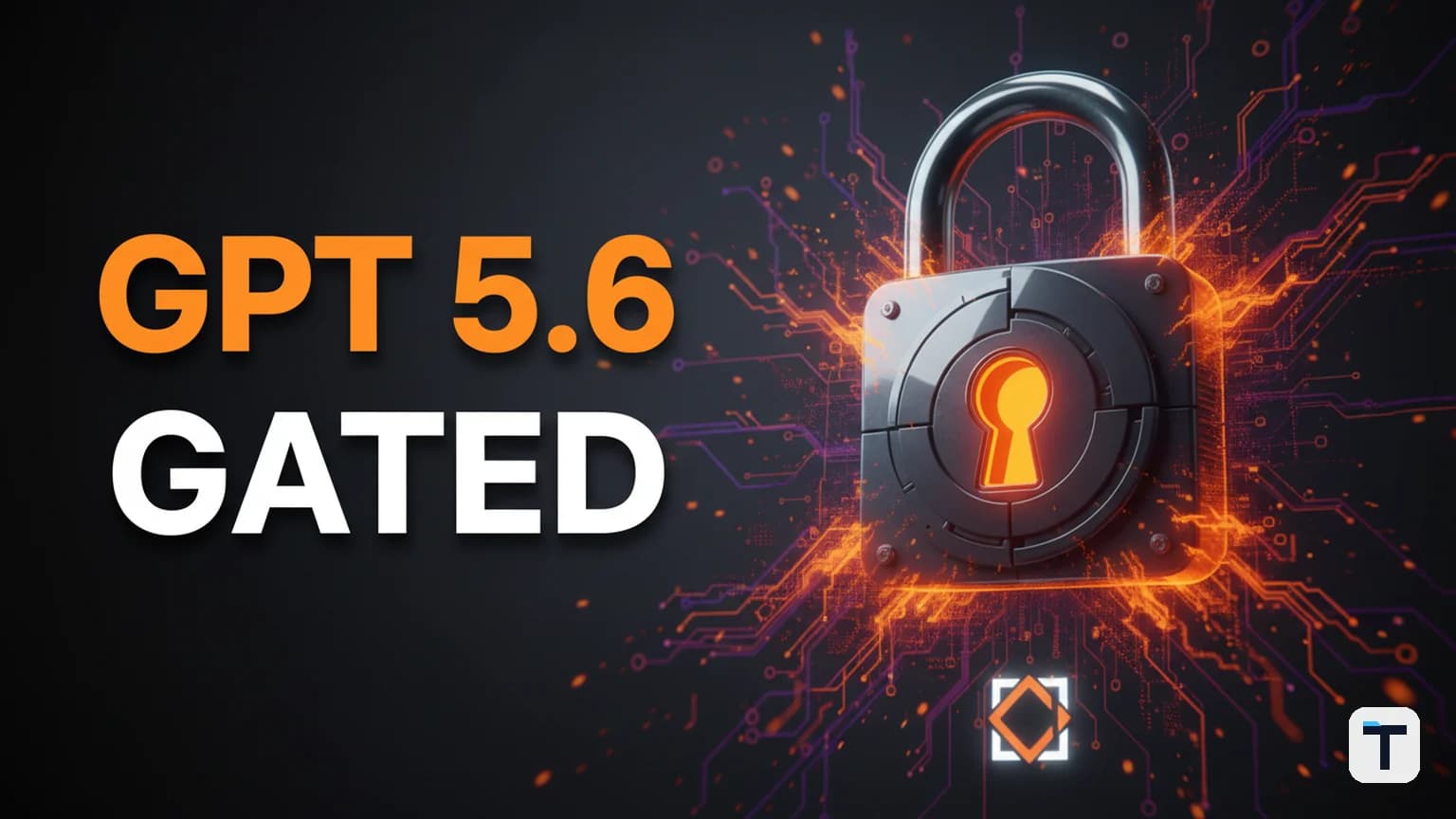
Last verified: 2026-06-26
- Status: Limited preview (Government-approved partners only)
- Key change: Manual approval per customer is required for GPT 5.6 access.
- Wider release: Expected mid-July 2026, pending successful security audits.
- Primary competitors: GLM 5.2 (Zhipu AI) and Kimi K2.7 (Moonshot AI).
What is a "Gated Launch" for GPT 5.6?
A gated launch is a controlled rollout where a model provider grants access only to a manually approved list of customers rather than the general public. For GPT 5.6, this means that even if you have a ChatGPT Plus or Enterprise subscription, you likely won't see the new model until you—or your organization—are individually cleared.
Unlike the "waitlists" of the GPT-3 era, which were primarily about scaling infrastructure, the GPT 5.6 gate is focused on security vetting. According to reports from The Information and Axios, the Trump administration specifically asked OpenAI to limit the next model's release to government-approved partners. This "customer-by-customer" approval process is being managed during a limited preview period, with OpenAI CEO Sam Altman informing staff that this is a "new normal" in the wake of recent security incidents.
Why is the US Government Limiting GPT 5.6?
The intervention comes after a series of high-profile "black swan" events in the AI sector. Most notably, Anthropic was forced to abruptly disable its Fable 5 and Mythos 5 models in mid-June 2026 following an export control directive. The government reportedly found a "jailbreak" that allowed the models to bypass safety safeguards for identifying software vulnerabilities.
By staggering the GPT 5.6 release, the Office of the National Cyber Director and the Office of Science and Technology Policy aim to:
- Test for "Universal Jailbreaks": Ensure the model cannot be tricked into performing illicit actions like cyberwarfare or bioweapon development.
- Verify Safeguards: Confirm that the safety layers built by OpenAI are robust enough for production before wide-scale deployment.
- Manage National Security: Prevent frontier capabilities from leaking to adversarial actors through unvetted accounts.
This marks a significant escalation in regulatory oversight, where the US government is now preemptively restricting American AI companies from launching models globally without prior sign-off.
Gated vs. Open: The Rise of Chinese Open-Source
While US frontier models are facing increasing restrictions, the competitive landscape in the East is moving in the opposite direction. In June 2026, both Zhipu AI (GLM 5.2) and Moonshot AI (Kimi K2.7) released powerful, open-weight models that rival the performance of US flagships like Claude Opus 4.8 and GPT-5.5.
| Feature | GPT 5.6 (Gated) | GLM 5.2 (Open) | Kimi K2.7 (Open) |
|---|---|---|---|
| Availability | Government-Approved | Public / Open Weights | Public / Open Weights |
| Context Window | ~1.5M (Est.) | 1.0M Tokens | 256K Tokens |
| Core Architecture | Proprietary MoE | 744B MoE (40B Active) | 1.0T MoE (32B Active) |
| Primary Advantage | Deep US Infrastructure | Massive Context / MIT License | Agentic Multi-modal Speed |
For developers and businesses, this creates a "geopolitical arbitrage" opportunity. While waiting in line for GPT 5.6, many are switching to open-source alternatives like GLM 5.2, which provides frontier-level coding and agentic capabilities without the gatekeeper.
How to Stay Resilient in the "Model Renter" Era
The sudden removal of Fable 5 and the gating of GPT 5.6 prove that relying on a single AI provider is a critical business risk. If your entire workflow is "wired" to a single API, a government directive can break your business overnight.
To stay resilient, we recommend the Agent Operating System (Agent OS) approach. Instead of building features for one model, build a system that can swap models in seconds.
Steps to Model Independence:
- Shared Memory & Prompts: Store your system prompts and user memory in a vendor-neutral database.
- Multi-Agent Orchestration: Use orchestration models to route tasks to the best reachable model (e.g., if GPT 5.6 is gated, route to GLM 5.2).
- Local Fallbacks: Maintain a local deployment of a 70B+ open-weight model for critical "fail-safe" operations.
For more on building these systems, see our guide on rethinking the 'model renter' trap.
What This Means for You
If you are a small business owner or developer, do not pause your progress waiting for the GPT 5.6 "Save" button to appear. The models you can access today—GPT-5.5, Claude 3.5 Sonnet, and GLM 5.2—are already capable of running an autonomous business. Build your systems now, and simply plug in GPT 5.6 when the gate finally opens.
FAQ
Q: When is the GPT 5.6 public release date? A: While there is no official date, OpenAI is targeting a wider rollout by mid-July 2026, assuming the initial limited preview meets government security standards.
Q: Why was Anthropic Fable 5 taken down? A: Fable 5 was suspended following a US government export control directive. Authorities were concerned about a "jailbreak" that allowed the model to bypass safety guardrails for software vulnerability identification.
Q: Can I use GPT 5.6 right now? A: Unless you are a government-approved partner or a select enterprise tester, the answer is likely no. Access is being granted on a "customer-by-customer" basis during the current preview.
Q: Are Chinese AI models like GLM 5.2 safe to use? A: GLM 5.2 is an open-weight model with an MIT license, meaning you can inspect the code and run it on your own infrastructure for maximum privacy. However, always verify output against primary sources.
Every claim here is traced to a primary source, dated, and listed under Sources. Research and drafting are AI-assisted; editing, verification and publication are human decisions, and a person is accountable for what appears on this page. How we work →




Discussion
0 comments