
Last verified: 2026-06-25
- Key Insight: Orchestration models hide multi-agent complexity behind a single OpenAI-compatible API endpoint.
- Performance Milestone: Sakana AI's Fugu Ultra recorded 73.7 on SWE-Bench Pro, validating autonomous coordination.
- Moat: Multi-vendor orchestration routes around localized export controls and single-point API failures.
- Note: Model pricing and pool availability shift frequently — facts verified against official June 2026 documentation.
What is an AI Orchestration Model?
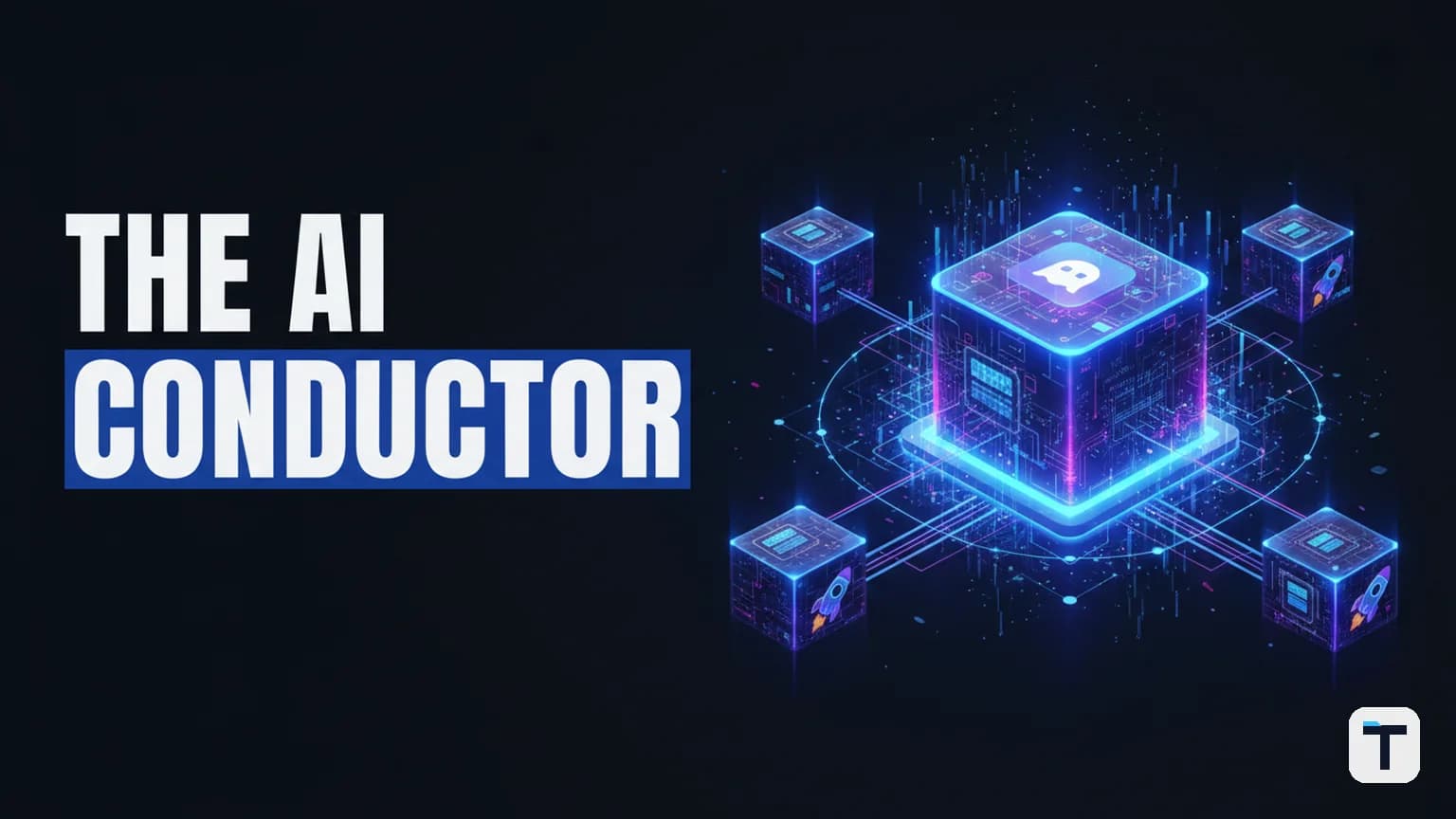
An AI orchestration model is a foundation model trained specifically to manage, distribute, and synthesize tasks across a collective pool of other language models rather than generating answers in isolation. Instead of chatting with a single monolithic "brain," the developer or operator interacts with a central conductor.
When a query enters the system, the orchestration model dynamically assesses the request, breaks it down into subtasks, and assigns distinct roles—such as Thinkers, Workers, and Verifiers—to the best-suited models in its underlying agent pool (which often contains instances like GPT-5.5, Claude Opus 4.8, and Gemini 3.1 Pro). This paradigm addresses critical single-agent limitations by isolating context windows, parallelizing execution streams, and containing the blast radius of localized model hallucinations. This architectural shift builds on the principles found in a production-grade AI Agent Operating System.
                  [ User Query ]
                        │
                        ▼
           ┌───────────────────────────┐
           │   AI Orchestrator Model   │ (e.g., Sakana Fugu)
           └────────────┬──────────────┘
                        │
         ┌──────────────┼──────────────┐
         ▼              ▼              ▼
  ┌─────────────┐┌─────────────┐┌─────────────┐
  │  Thinker    ││   Worker    ││  Verifier   │ (Dynamic Specialist Roles)
  │  (GPT-5.5)  ││ (Opus 4.8)  ││(Gemini 3.1) │
  └─────────────┘└─────────────┘└─────────────┘
How Does Autonomous Model Coordination Work?
The mechanics of cutting-edge orchestration systems rely on reinforcement learning and evolutionary optimization rather than rigid, human-coded conditional paths. The foundational architecture is heavily outlined in two landmark ICLR 2026 academic papers:
- The TRINITY Framework: An evolutionarily optimized coordinator system that dynamically assigns and balances the topology of the agent pool at runtime based on task complexity.
- The Conductor Paradigm: A method where coordination strategies are learned and executed natively via natural language, enabling the system to recursively scale its own effort on high-ambiguity problems.
When executing an operational workflow, such as an equity research sprint, the system spins up a closed "war room" environment. An analyst agent extracts raw disclosures, a valuation agent builds financial metrics, and opposing bull/bear agents debate the thesis. Finally, a judge model synthesizes the arguments into an interactive, real-time scenario dashboard. The entire pipeline mimics human institutional workflows, executing in minutes what typically requires several days of manual data collation. Similar automated validation structures can be observed in custom AI feedback loops.
Why is Sovereign AI Driving Orchestration Adoption in 2026?
The shift toward multi-agent orchestration is no longer just a technical optimization—it has become an operational and political necessity. On June 13, 2026, the US Commerce Department issued an emergency export control directive abruptly pulling leading frontier models (such as Claude Fable 5 and Mythos 5) offline for all foreign nationals globally.
This historic regulatory intervention exposed a massive systemic vulnerability for enterprise infrastructures built upon a single vendor's API. Because orchestration architectures are model-agnostic, they act as an abstract workflow layer. If a specific model variant becomes region-locked, restricted, or experiences a pricing surge, the orchestrator simply mutates the underlying pool composition and routes workflows through active alternatives without forcing engineering teams to rewrite local application code. This builds significantly upon global movements in independent sovereign intelligence.
How Does Fugu Ultra Compare to the Frontier?
Tokyo-based AI lab Sakana AI launched its commercial orchestration platform, Sakana Fugu, on June 22, 2026, offering a direct case study in this approach. It operates across two primary tiers through an OpenAI-compatible endpoint: Fugu (low-latency, optimized for daily tools like the OpenAI Codex app) and Fugu Ultra (deep multi-agent coordination).
According to Sakana AI's technical reports, Fugu Ultra operates "shoulder-to-shoulder" with premium standalone models, outscoring many individual engines on multi-step reasoning. However, technical analysis indicates that a compound system's performance remains strictly bounded by the raw capabilities of the accessible models in its pool.
| Benchmark Test | Fugu Ultra (Orchestrated System) | Standing Frontier Baseline | Benchmark Focus Area |
|---|---|---|---|
| SWE-Bench Pro | 73.7 | 80.3 | Autonomous Software Engineering |
| TerminalBench 2.1 | 82.1 | 88.0 | Local CLI Execution & Tool Use |
| LiveCodeBench v6 | 93.2 | 89.8 | Real-Time Code Generation |
| GPQA-D | 95.1 | 92.5 | Graduate-Level Scientific Reasoning |
Source: Sakana AI Published Technical Data, June 2026. Baselines represent historical standalone model performance prior to the June 2026 export suspensions.
While the orchestration system wins on raw data integration, live code generation, and complex hierarchical multi-agent delegation, it can experience marginal latency overhead due to the inner-loop validation calls between swappable expert models.
What This Means for You: Implementing a Resilient Stack
To protect your business operations or technical platforms from tool sprawl and regulatory disruption, adhere to an abstraction-first operating model:
- Decouple App Logic from Weights: Never hardcode specific vendor endpoints directly into your core features. Utilize unified orchestration layers or model routers.
- Package Workflows into Reusable Plugins: Mirror the architecture of the OpenAI Codex app updates by bundling skills, app integrations, and Model Context Protocol (MCP) server settings into swappable plugins rather than long static strings.
- Deploy Multi-Agent Sanbox Environments: For heavy analytical, testing, or code review pipelines, transition to path-based agent addressing (e.g.,
agents/research,agents/qa) to maintain clean boundaries and predictable token cost structures.
Related reading
FAQ
Q: What is the main difference between an AI model and an AI orchestrator? A: A standard AI model processes a prompt and generates a response using its own static weights. An AI orchestrator is a specialized system that analyzes the prompt, breaks it down, dispatches pieces of work to an underlying team of diverse AI models, runs automated cross-verification, and integrates the final output into a single unified response.
Q: Can I opt specific models out of an orchestration pool for privacy compliance? A: On standard orchestration tiers like Sakana Fugu, users can manually configure the agent pool to exclude specific proprietary models to meet geographic data privacy rules (such as GDPR). However, on maximum-depth tiers like Fugu Ultra, the underlying multi-agent composition is fixed to guarantee maximum reasoning accuracy.
Q: How much does it cost to run a multi-agent orchestration workflow? A: Pricing scales based on token consumption and subscription tiers. For example, commercial endpoints in late June 2026 price Fugu Ultra usage at approximately $5.00 per million input tokens and $30.00 per million output tokens, alongside standard subscription tiers starting at $20.00 per month for foundational access.
Q: Is Sakana Fugu open-source or fully self-hosted? A: No. Sakana Fugu and Fugu Ultra are managed, cloud-only commercial products accessed via an OpenAI-compatible API. For organizations requiring absolute local sovereignty that cannot be revoked or inspected, workflows must instead be routed to open-weight models deployed on completely private, self-hosted hardware infrastructure.
Every claim here is traced to a primary source, dated, and listed under Sources. Research and drafting are AI-assisted; editing, verification and publication are human decisions, and a person is accountable for what appears on this page. How we work →
Discussion
0 comments