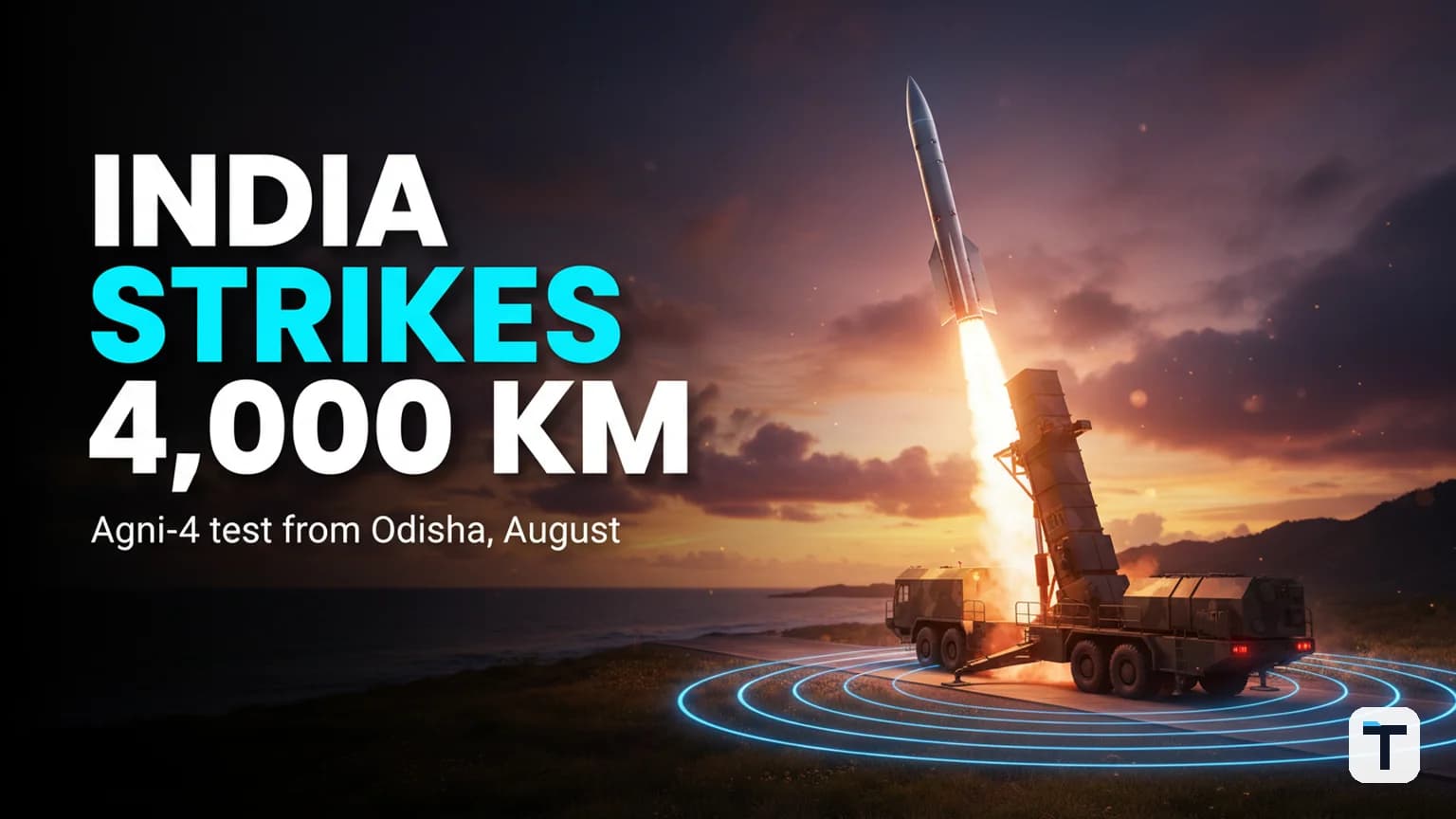

India successfully test-fired the Agni-4 medium-range ballistic missile from the Integrated Test Range at Chandipur, Odisha, on August 6, 2026. The launch, conducted under the Strategic Forces Command, validated all operational and technical parameters — making it the latest in a years-long cadence of user trials that confirm the missile's reliability under real conditions rather than a single attention-grabbing event. With a 4,000 km strike range, the Agni-4 covers targets across mainland China and reinforces India's policy of credible minimum deterrence.
Last verified: August 7, 2026
- Agni-4 test-fired on August 6, 2026, from ITR Chandipur, Odisha
- Range: 3,500–4,000 km; payload: 1,000 kg (nuclear or conventional)
- Two-stage solid-fuel, road-mobile, canisterised launch
- Defence Minister Rajnath Singh called it a "textbook mission launch"
- Developer: DRDO; operator: Strategic Forces Command (SFC)
- Volatile facts: missile test schedules and specifications may change with new launches
What is the Agni-4 missile and what was tested on August 6, 2026?
The Agni-4 is a two-stage, solid-fuel, surface-to-surface intermediate-range ballistic missile (IRBM) developed by India's Defence Research and Development Organisation (DRDO), with a strike range of 3,500 to 4,000 kilometres. It is approximately 20 metres long, weighs about 17,000 kg at launch, and carries a payload of up to 1,000 kg — which can include a nuclear warhead. The missile is road-mobile on an 8x8 transporter-erector-launcher (TEL), making it highly survivable against pre-emptive strikes (CSIS Missile Threat).
On August 6, 2026, the Strategic Forces Command (SFC) conducted a user trial of the Agni-4 from the Integrated Test Range (ITR) at Chandipur, off the Odisha coast. India's Ministry of Defence confirmed the launch in an official press release via the Press Information Bureau (PIB), stating: "Medium Range Ballistic Missile 'Agni-4' was successfully test-fired from the Integrated Test Range, Chandipur in Odisha on August 06, 2026. The launch validated all operational and technical parameters" (PIB, Government of India). The entire flight was monitored by an integrated network of radars, telemetry stations, and electro-optical tracking systems across the test range.
This was a user trial — meaning the SFC (the operational user, not DRDO's development team) fired the missile to confirm its combat readiness. User trials are a routine but essential part of maintaining a credible deterrent: they prove the production systems, not just the prototypes, work under operational conditions.
What are the Agni-4's key technical specifications?
The Agni-4 is one of the most technologically advanced missiles in India's strategic arsenal. Here are its confirmed specifications from primary sources:
| Specification | Value | Source |
|---|---|---|
| Classification | Intermediate-Range Ballistic Missile (IRBM) | CSIS Missile Threat |
| Range | 3,500–4,000 km | PIB, Government of India; Firstpost |
| Length | ~20 metres | GlobalMilitary.net |
| Launch weight | ~17,000 kg | CSIS Missile Threat |
| Payload capacity | 1,000 kg (nuclear or conventional) | CSIS Missile Threat |
| Propulsion | Two-stage solid propellant | Firstpost |
| Basing | Road-mobile (8x8 TEL) | GlobalMilitary.net |
| Guidance | Ring laser gyro-based inertial navigation system (RINS) | PIB, December 2014 |
| Max altitude | ~900 km (apogee in tests) | CSIS Missile Threat |
| Former designation | Agni-II Prime (rebranded to Agni-IV in 2011) | CSIS Missile Threat |
| Year of induction | 2014 | Anantam IAS |
The Agni-4 introduced several technological firsts for India's missile programme. It uses composite-material rocket motors, which reduce weight while maintaining structural integrity, and a fifth-generation ring laser gyro-based inertial navigation system (RINS) paired with a redundant micro navigation system (MINGS) for high accuracy. The re-entry heat shield can withstand temperatures exceeding 4,000 degrees Celsius, ensuring the avionics continue functioning during atmospheric re-entry at hypersonic speeds (PIB, December 2014).
How does the Agni-4 fit into India's Agni missile family?
The Agni missile series is the backbone of India's land-based nuclear deterrent, developed under the Integrated Guided Missile Development Programme (IGMDP) launched in 1983 under the leadership of Dr. A.P.J. Abdul Kalam. The series spans from short-range battlefield missiles to intercontinental-range systems:
| Missile | Range | Warhead payload | Status | Role |
|---|---|---|---|---|
| Agni-I | 700–1,250 km | 1,000 kg | In service (inducted 2007) | Short-range deterrence (Pakistan-centric) |
| Agni-II | 2,000–3,000 km | 1,000 kg | In service | Medium-range deterrence |
| Agni-III | 3,500+ km | 1,500 kg | In service (inducted 2011) | Intermediate-range (China-capable) |
| Agni-IV | 3,500–4,000 km | 1,000 kg | In service (inducted 2014) | Intermediate-range (bridges Agni-III and Agni-V) |
| Agni-V | 5,000+ km | 1,500 kg | In service (inducted 2018) | India's first ICBM (MIRV-capable since 2024) |
| Agni-P (Prime) | 1,000–2,000 km | Not disclosed | In service | Next-gen replacement for Agni-I/II |
Sources: CSIS Missile Threat; Wikipedia — Agni missile; Anantam IAS — Agni Missile Series.
The Agni-4 sits between the Agni-III (3,500 km) and Agni-V (5,000+ km) in India's deterrent ladder. It was formerly designated Agni-II Prime during its development phase, before DRDO reassigned the Agni-IV name to this upgraded variant of the Agni-II in 2011 (CSIS Missile Threat). The rebranding reflected that the missile was effectively a new design — with composite motors, updated guidance, and an extended range envelope — rather than a simple incremental upgrade.
Why does this test matter for India's strategic deterrence?
The August 2026 test matters not because it was a dramatic first — it was not — but because it demonstrated the repeatable cadence of successful launches across the Agni family. Credible deterrence is built on reliability, not novelty. A missile that works once is a science experiment; a missile that works every time it is tested is a weapon system.
The consistency pattern: 2024–2026
India's missile testing cadence over the past two years shows a deliberate, systematic validation programme:
| Date | System | Location | Outcome |
|---|---|---|---|
| April 2024 | Agni-Prime | Abdul Kalam Island, Odisha | Success (Hindustan Times, April 2024) |
| September 2024 | Agni-4 | ITR Chandipur, Odisha | Success (India Today, September 2024) |
| June 15, 2026 | LRLACM (cruise missile) | Dr. APJ Abdul Kalam Island, Odisha | Success (PIB, June 2026) |
| August 6, 2026 | Agni-4 | ITR Chandipur, Odisha | Success (PIB, August 2026) |
Each test validates the production line, the operator's proficiency (SFC, not just DRDO engineers), and the missile's performance under operational conditions. The latest Agni-4 launch fits this pattern exactly — a routine user trial that confirms the system remains combat-ready.
What "credible minimum deterrence" means in practice
India's nuclear doctrine, declared in 2003, rests on three pillars: no first use against non-nuclear states, credible minimum deterrence, and massive retaliation in response to a nuclear strike. The Agni-4 gives India the reach to hold targets across nearly all of mainland China at risk — including Beijing, Shanghai, and major military installations — when launched from eastern or north-eastern India (Indian Defence News). This is the "credible" part: the ability to inflict unacceptable damage on an adversary regardless of what they do first. The "minimum" part means India is not building an arsenal sized for a war-fighting doctrine, but one that is sufficient for deterrence.
The Agni-4's road-mobile, canisterised launch system is critical to this posture. Canisterised missiles are sealed in climate-controlled launch tubes at the factory, giving them years of shelf life without maintenance. When deployed, the TEL can move to an undisclosed launch point and fire within minutes — making it extremely difficult for an adversary to track and destroy before launch. This survivability is what makes second-strike capability credible.
What other missile tests has India conducted recently?
India's 2026 strategic weapons testing programme has been notably active, reflecting both technological maturation and heightened regional security dynamics:
Agni-Prime (April 2024): DRDO and SFC jointly test-fired the next-generation Agni-Prime missile from Abdul Kalam Island off the Odisha coast. The Agni-P is a canisterised, two-stage solid-fuel missile with a 1,000–2,000 km range, designed to replace the older Agni-I and Agni-II in service (Hindustan Times, April 2024).
Agni-4 (September 2024): The previous successful test of the Agni-4 occurred on September 6, 2024, also from ITR Chandipur (India Today, September 2024).
LRLACM (June 15, 2026): DRDO successfully flight-tested the indigenous Long Range Land Attack Cruise Missile (LRLACM) from Dr. APJ Abdul Kalam Island off the Odisha coast. The LRLACM is a separate programme from the Agni series — it is a cruise missile (not ballistic), with an indigenous turbofan engine, offering a complementary precision-strike capability. The Aeronautical Development Establishment, Bengaluru, is the nodal laboratory (PIB, June 2026).
INS Aridhaman commissioning (April 3, 2026): India commissioned its third nuclear-powered ballistic missile submarine (SSBN), INS Aridhaman (S4), strengthening its sea-based nuclear deterrence. The submarine can carry K-4 submarine-launched ballistic missiles with a range of approximately 3,500 km, adding the sea leg of the nuclear triad (Economic Times, April 2026).
Together, these developments show India building a layered, tri-service deterrent: land-based ballistic missiles (Agni series), submarine-launched ballistic missiles (K-series on SSBNs), and now long-range cruise missiles (LRLACM). Each system is tested repeatedly to confirm reliability under operational conditions.
Who manages and operates the Agni-4?
The Agni-4 programme involves a clear division of responsibilities between India's defence research and military organisations:
- Developer: Defence Research and Development Organisation (DRDO). DRDO designed and developed the Agni-4 at its Advanced Missile Laboratory in Hyderabad. Bharat Dynamics Limited (BDL) is the production agency (GlobalMilitary.net; Wikipedia).
- Operator: Strategic Forces Command (SFC). The SFC, established on January 4, 2003, is part of India's Nuclear Command Authority (NCA) and is responsible for the management and administration of the country's tactical and strategic nuclear weapons stockpile (Vajiram & Ravi).
- Oversight: Defence Secretary and DRDO Chairman Rajesh Kumar Singh monitored the August 2026 test. Senior DRDO scientists and representatives from the Indian Navy and Indian Air Force witnessed the launch (India Today, June 2026 LRLACM report).
- Political authority: Defence Minister Rajnath Singh congratulated the SFC and DRDO, calling the launch a "textbook mission" in a post on X (ANI / X, August 6, 2026).
What is the Agni-4's full flight test history?
The Agni-4 has a strong test record, with successful launches dating back to 2011. According to the CSIS Missile Threat database, eight flight tests have been conducted since the first attempt in 2010:
| Date | Range achieved | Outcome | Notes |
|---|---|---|---|
| December 10, 2010 | N/A | Failure | Trajectory deviation; crashed into sea |
| November 15, 2011 | 3,000 km | Success | First successful test from road-mobile launcher |
| September 19, 2012 | 4,000 km | Success | Carried explosive payload; under 100 m accuracy |
| January 20, 2014 | 4,000 km | Success | Carried mock nuclear warhead |
| December 2, 2014 | 3,500+ km | Success | First SFC user trial |
| November 9, 2015 | Not disclosed | Success | SFC user trial |
| January 2, 2017 | 3,100 km | Success | SFC user trial |
| December 3, 2018 | Not disclosed | Success | SFC user trial |
| September 6, 2024 | Not disclosed | Success | SFC user trial |
| August 6, 2026 | Not disclosed | Success | SFC user trial |
Source: CSIS Missile Threat and news reports of the 2024 and 2026 tests.
Nine successful launches out of ten attempts is a remarkable reliability rate for a ballistic missile programme. The single failure was the very first test in 2010, attributed to a Stage 1 control system issue. Every subsequent test — across iterative DRDO development trials and operational SFC user trials — has been successful.
What does this mean for India's technology and defence ecosystem?
The Agni-4 programme highlights several broader trends in India's defence technology ecosystem that matter beyond the missile itself:
Indigenous development is maturing. The Agni-4 was designed, developed, and manufactured entirely within India by DRDO and BDL. Its composite rocket motors, ring-laser-gyro navigation, and re-entry heat shield are all indigenous technologies. This builds on decades of investment in the IGMDP and demonstrates that India's defence research base can produce strategic-grade systems without foreign dependency. India's broader push towards technological self-reliance in critical infrastructure is visible in sectors ranging from semiconductor manufacturing to AI strategy — topics we've explored in our coverage of India's semiconductor strategy and India's approach to small AI and neurosymbolic models. DRDO's parallel development of India's indigenous expendable turbojet engine at GTRE shows this trend extending to propulsion systems.
Test infrastructure is world-class. All recent Agni tests have been conducted from the Integrated Test Range at Chandipur or Dr. APJ Abdul Kalam Island — both off the Odisha coast. These ranges provide the telemetry, radar tracking, and electro-optical systems needed to validate missile performance across the full flight envelope, from launch to impact in the Bay of Bengal or Indian Ocean.
Production is operational, not experimental. The shift from DRDO development trials (2010–2014) to SFC user trials (2014 onwards) marked the transition from prototype to production weapon. User trials test missiles from the production line, handled by military operators — not engineers. That the August 2026 test succeeded means the system that was inducted over a decade ago still works to specification today.
Strategic autonomy has commercial spillovers. India's push for defence-industrial self-reliance is part of a broader policy direction that includes tax incentives for foreign technology investment, as seen in India's 2026 tax amendment bill, and investments in AI infrastructure by Indian IT majors like TCS, HCLTech, and Infosys in AI data centre development. India's air defence modernization — including the indigenous Kusha air defence system as an S-400 alternative — further illustrates how the same domestic manufacturing ecosystem serves both strategic and commercial needs.
What this means for you
If you follow defence technology, geopolitical strategy, or India's growing role in the global tech ecosystem, the Agni-4 test is a data point in a larger story:
For defence analysts: The test is evidence that India's land-based nuclear deterrent remains operationally credible. The Agni-4 covers the crucial 3,500–4,000 km bracket — enough to reach deep into China from Indian launch sites — and has a near-perfect test record since 2011.
For tech industry watchers: The composite materials, precision navigation systems, and canisterised launch technology in the Agni-4 represent indigenous engineering capabilities that flow into the broader manufacturing and tech ecosystem. India's defence research base and its commercial tech sector share talent and increasingly share supply chains.
For investors: India's defence budget, which includes both indigenous R&D and procurement, is one of the fastest-growing in the world. The success of programmes like Agni signals that domestic defence manufacturing is reaching the reliability threshold needed for both self-use and export — as seen with Bharat Forge's heavy-lift airship programme for India's defence sector. India's AI talent landscape, while paradoxical in research output, continues to produce the engineering depth required for complex systems integration.
For small business and builders: While a ballistic missile test may seem far removed from your work, the broader lesson is about process reliability. India's defence establishment does not celebrate a single successful test — it demands a repeatable cadence of successes. That philosophy applies to any technology you ship: one good demo means nothing if the production system fails under real conditions.
FAQ
Q: What is the range of the Agni-4 missile? A: The Agni-4 has a strike range of 3,500 to 4,000 kilometres, according to India's Ministry of Defence and the CSIS Missile Threat database. This range allows it to reach targets across mainland China when launched from eastern or north-eastern India.
Q: When was the Agni-4 last tested before August 2026? A: The Agni-4 was previously test-fired successfully on September 6, 2024, from the Integrated Test Range at Chandipur, Odisha. That test was also an SFC user trial. The August 2026 test is the most recent one.
Q: Who develops and operates the Agni-4? A: The Agni-4 is developed by the Defence Research and Development Organisation (DRDO) and manufactured by Bharat Dynamics Limited (BDL). It is operated by the Strategic Forces Command (SFC), which is India's nuclear weapons management authority under the Nuclear Command Authority.
Q: Is the Agni-4 a nuclear missile? A: The Agni-4 is nuclear-capable — it can carry a nuclear warhead weighing up to 1,000 kg. It can also carry conventional warheads. India follows a policy of credible minimum deterrence with a no-first-use nuclear doctrine.
Q: What is the difference between the Agni-4 and the Agni-Prime? A: The Agni-4 is an intermediate-range ballistic missile with a 3,500–4,000 km range, in service since 2014. The Agni-Prime (Agni-P) is a newer, shorter-range missile (1,000–2,000 km) designed to replace the older Agni-I and Agni-II. They serve different deterrent roles — the Agni-4 targets China; the Agni-Prime primarily addresses Pakistan.
Q: How many times has the Agni-4 been tested? A: The Agni-4 has been flight-tested ten times since 2010 — once unsuccessfully (the first test in December 2010) and nine times successfully. The most recent successful test was on August 6, 2026, from ITR Chandipur, Odisha.
Every claim here is traced to a primary source, dated, and listed under Sources. Research and drafting are AI-assisted; editing, verification and publication are human decisions, and a person is accountable for what appears on this page. How we work →
Discussion
0 comments