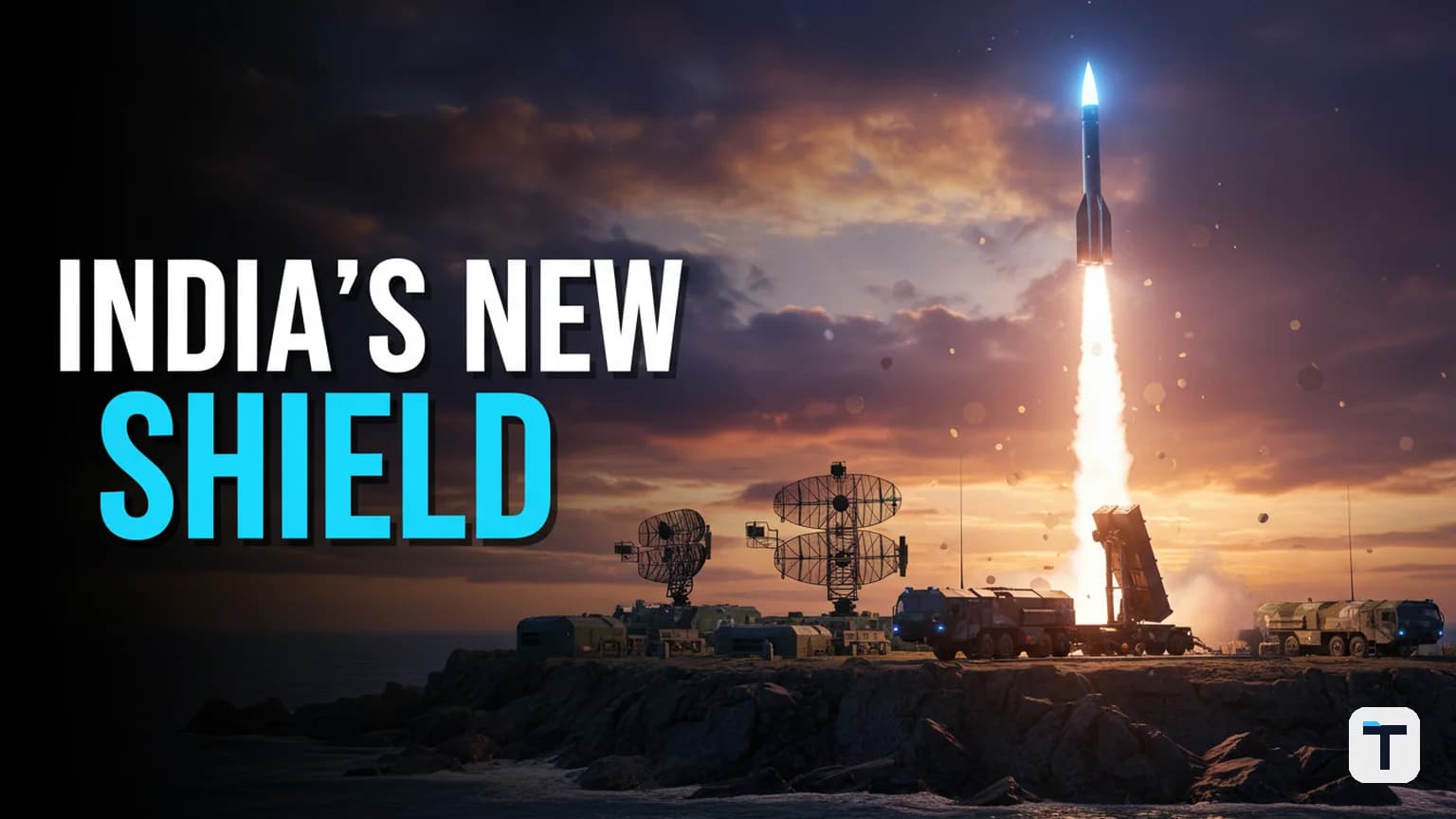

India's Defence Research and Development Organisation (DRDO) successfully conducted the maiden flight test of the Kusha long-range surface-to-air missile on July 23, 2026, from APJ Abdul Kalam Island off the Odisha coast. The test intercepted an electronic target simulating a high-speed, high-altitude aerial threat, marking the first proven flight of a system India hopes will eventually replace or supplement its imported Russian S-400 Triumf. With three interceptor variants planned for ranges of 150 km to 400 km, Kusha is designed to close a capability gap between India's existing 70-100 km MR-SAM and the fully imported S-400 — at roughly half the per-missile cost.
Last verified: July 29, 2026
- Maiden flight test passed: July 23, 2026, from APJ Abdul Kalam Island, Odisha
- Three interceptor variants: M1 (~150 km), M2 (~250 km), M3 (350–400 km)
- Project budget: ~₹21,700 crore for five squadrons
- Target deployment: early elements by 2028, full phased induction by 2030
- Cost per interceptor: ₹40–50 crore (vs ~₹100 crore for Russian S-400 missiles)
What is the Kusha long-range air defence missile?
The Kusha — formally designated the Extended Range Air Defence System (ERADS), earlier known as XRSAM — is DRDO's indigenous long-range surface-to-air missile (LR-SAM) programme, built to engage fighter jets, cruise missiles, unmanned aerial vehicles, and large enemy aircraft across a wide range and altitude envelope. Every component, including the missiles, radars, and command-and-control centre, was developed by DRDO laboratories and Indian industry partners, with Bharat Electronics Limited (BEL) as the principal production partner and Bharat Dynamics Limited (BDL) involved in missile manufacture (New Indian Express, July 23, 2026; PIB Press Release PRID 2288526).
The Cabinet Committee on Security cleared the project for development in May 2022, and the Ministry of Defence granted an acceptance of necessity (AoN) in September 2023 for five squadrons for the Indian Air Force, which is the lead service. The total project outlay is approximately ₹21,700 crore (The Print, July 23, 2026).
The Defence Research and Development Laboratory leads interceptor development, Research Centre Imarat is developing the seekers, and BEL is the principal production partner. Ground validation — including trials of the dual-pulse rocket motor that gives the interceptor its terminal energy — was completed before the July 23 launch.
How did the maiden flight test work?
The maiden flight test was launched from Launch Complex IV of the Integrated Test Range at APJ Abdul Kalam Island (formerly Wheeler Island) on July 23, 2026. The missile was fired against an electronic target simulating a high-speed, high-altitude aerial adversary. The system successfully intercepted the simulated threat, validating the integrated weapon system as a whole — not just the missile alone — including the radar, command-and-control chain, and launcher (New Indian Express, July 23, 2026).
This matters because a surface-to-air missile system is only as good as its sensor-to-shooter chain. A successful end-to-end intercept on the first flight means DRDO validated the full kill chain — detection, tracking, fire-control solution, launch, midcourse guidance, and terminal interception — in a single test event.
However, this test covered only the opening stretch. Flight evaluation of the first interceptor (M1) must be completed and repeated, after which the M2 and M3 will be trialled in sequence, each requiring validation of longer-burn propulsion, seeker performance at extended range, and radar tracking at greater distances.
How does Kusha compare to the S-400?
Kusha is being developed as an indigenous alternative to the Russian S-400 Triumf, offering comparable engagement envelopes but with decisive advantages in cost, supply-chain sovereignty, and lifecycle sustainability. India signed a $5.43 billion deal (approximately ₹40,000–45,000 crore) with Russia in October 2018 for five S-400 squadrons (The Defense Post, October 5, 2018). Kusha is projected to deliver a similar five-squadron capability for roughly ₹21,700 crore — a cost reduction of approximately 30–40% (IDRW, 2026).
| Parameter | Kusha (India) | S-400 Triumf (Russia) | MR-SAM / Barak 8 (India-Israel) |
|---|---|---|---|
| Developer | DRDO + BEL/BDL | Almaz-Antey | DRDO / IAI |
| Interceptor variants | M1 (150 km), M2 (250 km), M3 (350–400 km) | 40 km, 120 km, 250 km, 400 km | 70–100 km (Barak ER: 150 km) |
| Max speed | Mach 5.5 | Mach 6+ (~14,000 km/h for 40N6) | Mach 2 |
| Guidance | Hybrid RF/IR + datalink, hit-to-kill + fragmentation | Track-via-missile, active radar | Active radar seeker |
| Cost per interceptor | ₹40–50 crore | ~₹100 crore | Not publicly disclosed |
| System cost (5 squadrons) | ~₹21,700 crore | ~$5.43 billion (~₹40,000–45,000 crore) | ₹10,000 crore (9 squadrons, 2009 contract) |
| Supply chain | Fully indigenous | Single foreign supplier (Russia) | Indo-Israeli joint |
| Status | Maiden flight test passed (July 2026) | Operational (4 of 5 squadrons delivered) | Operational (since 2016) |
Sources: Wikipedia — Project Kusha; Wikipedia — Barak 8; The Week, April 2026; IDRW, 2026.
Why did India need to build Kusha?
India faced a specific capability gap. The Indian Air Force fields the 70–100 km MR-SAM (Barak 8) at one end of its long-range spectrum and the imported S-400 Triumf at the other. The intermediate band — roughly 100 km to 400 km — was held only by a system India does not build and cannot sustain independently (New Indian Express, July 23, 2026).
The strategic risk of that dependency became clear in two ways:
Delivery delays: Only four of the five contracted S-400 squadrons have been delivered since 2018. The fourth arrived in June 2026 after delays caused by the war in Ukraine, with the last expected by the end of 2026. Sustainment, spares, and replenishment remain dependent on a single foreign supplier.
CAATSA exposure: The S-400 purchase exposed India to potential US sanctions under the Countering America's Adversaries Through Sanctions Act (CAATSA). While India has so far received waivers, the geopolitical risk of relying on Russian defence imports has been a persistent concern.
Kusha is intended to deliver S-400-class capability with the supply chain held domestically, allowing squadrons to be raised on India's schedule rather than a partner's delivery calendar. Defence Minister Rajnath Singh stated that Kusha's success "will also eliminate the import dependency for such systems" (PIB, July 23, 2026).
What did the S-400 prove in combat that Kusha needs to replicate?
The combat value of the long-range outer band was demonstrated during Operation Sindoor in May 2025, when an IAF S-400 battery shot down a Pakistan Air Force Saab 2000 Erieye airborne early warning and control aircraft at approximately 314 km — the longest recorded surface-to-air missile kill in history. Air Chief Marshal AP Singh confirmed the engagement, and the IAF displayed recovered canister debris linked to the 40N6E interceptor used in the strike (New Indian Express, July 23, 2026; IDRW, 2025).
This engagement demonstrated that ultra-long-range surface-to-air missiles can deny enemy airborne command platforms — the most valuable non-fighter assets in any air force — the ability to operate safely even deep within their own airspace. Kusha's M3 variant, with its projected 350–400 km range, is designed to replicate this engagement envelope using an indigenous missile.
What is the deployment timeline for Kusha?
The programme follows a standard DRDO development-to-induction path with several distinct phases:
Developmental trials (2026–2027): The M1 interceptor's maiden flight was completed on July 23, 2026. Additional developmental flights will validate propulsion, seeker performance, and radar integration. The M2 and M3 interceptors will follow sequentially, each requiring its own developmental trial campaign.
User trials by the IAF (2027–2028): Developmental trials must give way to user trials by the Indian Air Force — a phase that typically runs one to three years and tests the system under service conditions rather than instrumented range conditions.
Phased induction (2028–2030): Early elements are expected to be operational around 2028, with phased induction of all three variants planned through 2030 (New Indian Express, July 23, 2026).
The M2 interceptor is expected to extend the engagement envelope to approximately 250 km, with developmental trials planned for 2027. The M3, targeting 350–400 km, has developmental trials planned for 2028 (Indian Defence News, March 2026).
How does Kusha fit into India's broader air defence architecture?
Kusha occupies the long-range interception tier within a multi-layered air defence architecture. Below it sits the Akash-NG for medium ranges; above it sits the two-tier ballistic missile defence network. All of them are meant to plug into the IAF's Integrated Air Command and Control System (IACCS), which fuses radar, AWACS, and fighter data into a single air picture.
The programme also sits inside Mission Sudarshan Chakra, announced by Prime Minister Narendra Modi on Independence Day 2025 as a decade-long effort to build an AI-enabled, multi-layered air and missile defence shield over strategic installations and civilian sites by 2035. Under this DRDO-led mission, the shield is built in tiers — beginning with space-based detection, coming down through mid-tier interception and ending in point defence handled by anti-drone systems and directed-energy weapons. The plan also folds in offensive reach, with the 500-km Pralay quasi-ballistic missile and extended-range BrahMos variants (New Indian Express, July 23, 2026).
| Layer | System | Range | Status |
|---|---|---|---|
| Point defence | Anti-drone systems, directed-energy weapons | <10 km | In development |
| Short-range | Akash / Akash-NG | 25–45 km | Operational |
| Medium-range | MR-SAM (Barak 8) | 70–100 km | Operational |
| Long-range | Kusha (ERADS) | 150–400 km | Maiden test passed; induction 2028–2030 |
| Ultra-long-range | S-400 Triumf (imported) | 40–400 km | Operational (4 of 5 squadrons) |
| Ballistic missile defence | PAD/AAD two-tier system | Exo-atmospheric + endo-atmospheric | Phase 2 completed |
What does Kusha mean for the global defence export market?
Nations across Africa, the Middle East, and Southeast Asia are reportedly watching the Kusha programme closely as a lower-cost alternative to premium Russian systems that also carry the risk of US CAATSA sanctions. Several factors make Kusha an attractive export candidate if it reaches operational maturity:
- Cost: At ₹40–50 crore per interceptor versus ~₹100 crore for Russian equivalents, the per-missile economics are roughly half. A five-squadron Kusha deployment costs approximately ₹21,700 crore, compared to the ~$5.43 billion India paid for five S-400 squadrons.
- No CAATSA risk: Buyers of Russian defence equipment face potential US sanctions; an Indian system carries no such exposure.
- Modular architecture: DRDO has designed the system with an open, modular command-and-control architecture that can integrate with existing air defence setups — a contrast to the more rigid, closed systems sold by some competitors.
- Single-shot kill probability: DRDO is reportedly targeting an 85% single-shot kill probability (SSKP), rising to 98.5% when the standard tactic of firing two missiles in rapid succession is employed (defence.in, 2026).
However, export viability depends on Kusha completing its full developmental and user trial cycle — a system that has passed one maiden flight test is not yet an export-ready product.
What this means for you
If you follow defence procurement, aerospace, or India's technology trajectory, Kusha's maiden test is significant for three reasons:
India is entering a capability tier held by very few nations. Only a handful of countries field indigenously developed ultra-long-range air defence interceptors (400 km class). A single successful test does not equal operational capability, but it moves India from paper architecture to demonstrated hardware.
The cost gap is structural, not incremental. At roughly half the per-missile cost of Russian interceptors and with the supply chain held domestically, Kusha could shift the economics of long-range air defence for India and for any export customer — assuming the programme stays on schedule.
The 2028–2030 timeline is ambitious but not unprecedented. DRDO's Akash and MR-SAM programmes each took 10–15 years from project sanction to operational induction. Kusha was sanctioned in 2022; if early elements deploy by 2028, that would be six years — fast by DRDO standards. The harder validation of the M2 (250 km) and M3 (350–400 km) variants, plus IAF user trials, will determine whether that timeline holds.
For those tracking India's defence-industrial base broadly, Kusha also intersects with other major programmes — from heavy-lift airship partnerships for defence logistics to the semiconductor manufacturing push under India's PLI scheme and the KWIN City semiconductor park in Karnataka. Each represents a different bet on building sovereign capability rather than buying it.
FAQ
Q: When was the Kusha missile's maiden flight test conducted? A: The DRDO conducted the maiden flight test of the Kusha long-range surface-to-air missile on July 23, 2026, from APJ Abdul Kalam Island off the Odisha coast. The missile successfully intercepted an electronic target simulating a high-speed, high-altitude aerial threat.
Q: What are the three Kusha interceptor variants and their ranges? A: Kusha is built around three interceptor variants sharing a common kill vehicle: the M1 with a range of approximately 150 km, the M2 at approximately 250 km, and the M3 at 350–400 km. All three use different boosters but share the same kill vehicle, launchers, and command-and-control infrastructure.
Q: How much does each Kusha interceptor missile cost? A: Each Kusha interceptor — across the M1, M2, and M3 variants — is estimated to cost between ₹40 and 50 crore per unit. Comparable Russian S-400 interceptors cost approximately ₹100 crore each, making Kusha roughly half the price per missile.
Q: When will the Kusha missile system be operational? A: Early elements of the Kusha system are expected to be operational around 2028, with phased induction of all three interceptor variants planned through 2030. The M1 developmental trials are underway; M2 trials are expected in 2027 and M3 trials in 2028, followed by IAF user trials.
Q: Is Kusha a replacement for the S-400? A: Kusha is designed to supplement and eventually reduce dependence on the S-400, not immediately replace it. India currently operates four of five contracted S-400 squadrons and faces delivery delays for the fifth due to the Russia-Ukraine war. Kusha provides the same engagement envelope with an indigenous supply chain, but will not reach full operational capability until 2028–2030.
Q: What is the total budget for Project Kusha? A: The Cabinet Committee on Security cleared the project in May 2022, and the Ministry of Defence granted an acceptance of necessity in September 2023 for five squadrons at approximately ₹21,700 crore. This is roughly 30–40% less than the ~$5.43 billion India paid for five S-400 squadrons.
Discussion
0 comments