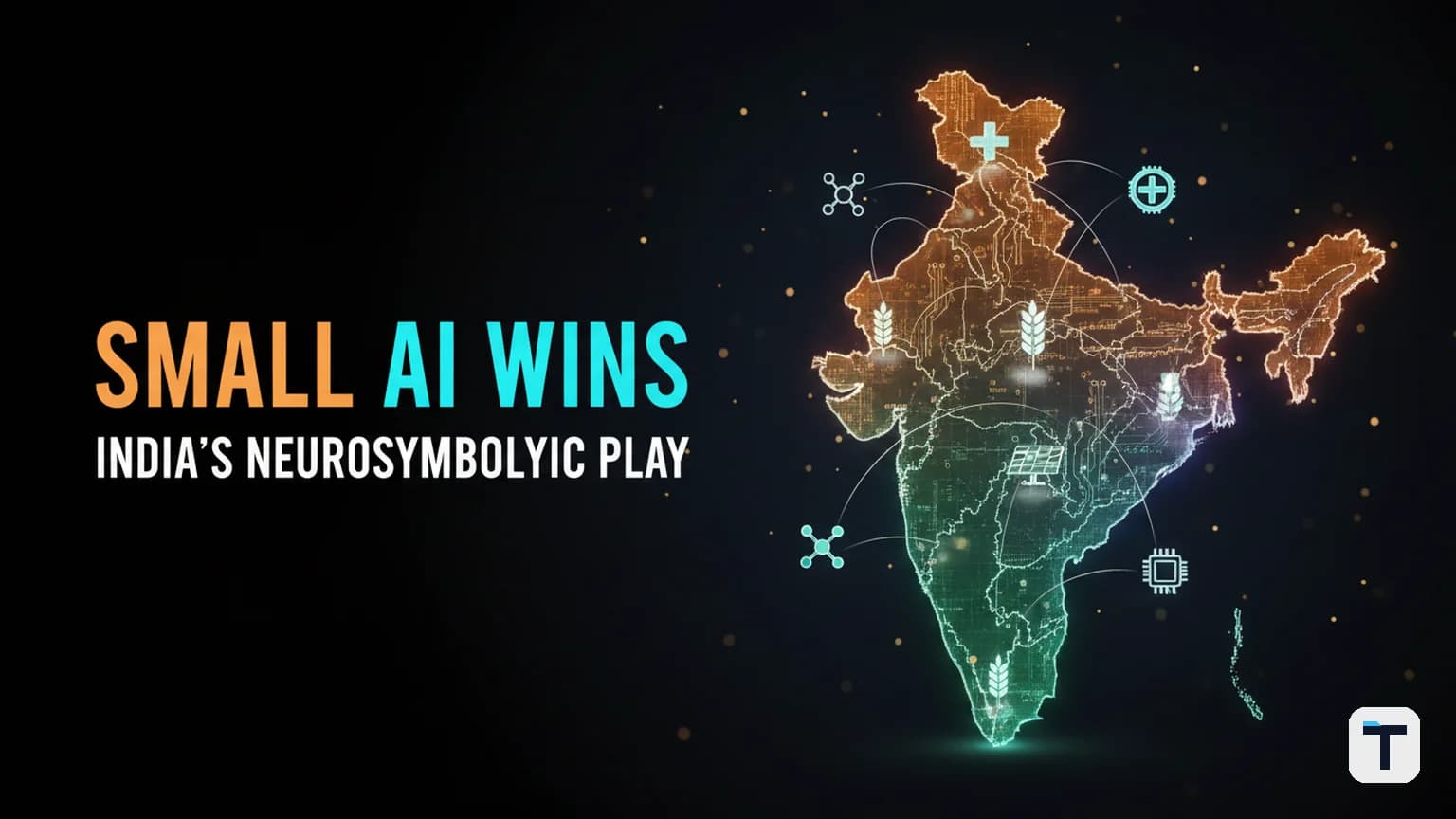

Verdict: India's most credible path to AI self-reliance isn't building a rival to GPT or DeepSeek — it's what Professor Amit Sheth calls "Small AI": compact, neurosymbolic models trained on indigenous enterprise data for specific domains like chronic disease management, drug discovery, smart-grid optimization, and semiconductor fabrication. Launched January 30, 2026, under MeitY as a Section 8 public-private partnership, IAIRO is building the platform, talent pipeline, and startup ecosystem to prove that frugal, purpose-built AI can capture economic value the big-model race can't.
Last verified: 2026-08-07
- IAIRO launched January 30, 2026, in New Delhi as a Section 8 PPP under MeitY, aligned with the IndiaAI Mission.
- "Small AI" = compact neurosymbolic models trained on enterprise-specific data, not the entire internet.
- IAIRO's SAMVID platform already has startups building domain models at a fraction of the $7M typical LLM cost.
- India ranks 2nd globally in AI paper volume but 4th in citation influence (behind UK, China, US).
- India's R&D spending reached 0.84% of GDP in FY24 — up from 0.66% in 2019-20, but still far below the 2% target.
What is India's "Small AI" strategy?
India's Small AI strategy is an approach to artificial intelligence that prioritizes compact, domain-specific, neurosymbolic models over large language models trained on the entire internet. Instead of competing with OpenAI, Anthropic, or DeepSeek on parameter count, Small AI trains models on the indigenous data of a specific enterprise or problem — a 500-megawatt solar plant, a semiconductor fab, a chronic disease management system — and combines neural networks with knowledge graphs so the model can reason, not just pattern-match.
Professor Amit Sheth, founding director of IAIRO, frames the distinction clearly: the large models coming from the US and China are "Big AI." India's initial investments in LLMs — Sarvam AI and Bhashini for multilingual coverage — were necessary and required. But the higher-impact opportunity for India's social and economic development comes from a different kind of AI entirely. You don't need a trillion-parameter model to monitor real-time quality data on a semiconductor fab line. You need a small, air-gapped model trained on that specific factory's data.
The strategy is built on three pillars:
- Indigenous data over internet-scale data. Models are trained on the enterprise's own operational data — not scraped from the web. This means the model is purposeful, frugal, and doesn't waste compute on irrelevant information.
- Neurosymbolic architecture over pure neural networks. By combining neural networks (pattern recognition) with knowledge graphs (structured domain rules), models become compact, explainable, and able to mix and match agents for different tasks.
- Co-development over in-house duplication. IAIRO's platform lets companies and startups co-develop models with researchers. The IP transfers to the company, which makes it far easier to attract investor backing.
What is IAIRO and what does it do?
The Indian AI Research Organization (IAIRO) is a Section 8 public-private partnership institution under the Ministry of Electronics and Information Technology (MeitY), aligned with the IndiaAI Mission. It was launched on January 30, 2026, in New Delhi, after Professor Sheth met Prime Minister Modi in December 2023.
IAIRO's day-to-day operations span four areas:
- Technology creation. IAIRO is building the SAMVID platform — a co-development environment where companies and startups can build Small AI models for their specific use cases. The platform already has its first startup onboard, developing a domain-specific model. A typical AI model startup costs $7 million and needs eight high-quality people; IAIRO aims to deliver models at a fraction of that cost, in less time, in a co-development mode where IP transfers to the company.
- Talent creation. IAIRO is running boot camps for elite undergraduate and master's students from IITs, BITS, and other top institutions. Students get two months of hands-on training in creating neurosymbolic models. About one-third of IAIRO's employees are returning from the US.
- Startup incubation. IAIRO has an in-house startup program led by Juhi Bhatnagar, an experienced investor. Startups incubated at IAIRO get access to the platform, the talent ecosystem, and a network of VCs — in a single day, IAIRO connected with 10 VCs, and in Singapore, seven top VCs investing in India came together to meet the team.
- National applications. IAIRO has chosen five initial focus areas: health, pharma, sustainability (weather and environment), education, and power.
What is neurosymbolic AI and why does it matter for India?
Neurosymbolic AI combines two things: neural networks (which excel at learning patterns from unstructured data) and symbolic reasoning systems like knowledge graphs, ontologies, and rules (which provide structure, context, constraints, and explainability). The neural side handles scale and unstructured data. The symbolic side adds domain rules and a traceable reasoning path — you can audit why the model made a decision.
For India, this matters for three reasons:
1. Compactness. A neurosymbolic model trained on a specific enterprise's data doesn't need to be trained on the entire internet. It's small, frugal, and cheap to create. Professor Sheth's team creates models that are "very compact, custom solving very specific problems, and not wasting compute on all the data of the world."
2. Explainability. Regulated industries — healthcare, finance, pharma — need AI that can explain its reasoning. A purely neural credit scoring model outputs a score. A neurosymbolic credit evaluator can output: "Loan denied because applicant's debt-to-income ratio (42%) exceeds the allowable threshold of 40% under rule XYZ." That audit trail is what regulators and boards require.
3. India's knowledge graph advantage. Professor Sheth's team has built a commercial-grade tool for creating knowledge graphs — a core technology for neurosymbolic AI. One of their professors published work on molecular discovery for cancer applications using knowledge graphs, covered in Indian newspapers. However, Sheth notes that China recognized the importance of knowledge graphs after his 2017 keynote in Chengdu and has since overtaken India in that area.
How does Small AI compare to Big AI for India's needs?
| Dimension | Big AI (Frontier LLMs) | Small AI (Neurosymbolic Domain Models) |
|---|---|---|
| Training data | Entire internet | Enterprise-specific indigenous data |
| Model size | Trillions of parameters | Compact, millions to low billions |
| Cost | $7M+ per model, massive GPU clusters | Fraction of cost, runs on air-gapped hardware |
| Use case | General chat, coding, content | Factory monitoring, drug discovery, grid optimization |
| Explainability | Black box | Traceable reasoning via knowledge graph |
| Deployment | Cloud API | On-site, air-gapped, real-time |
| IP ownership | Owned by US/Chinese company | Transferred to Indian company or startup |
The key insight: India doesn't need to match the US and China on Big AI. It needs to capture economic value in domains where Big AI doesn't work well — and there are many. A chronic health management system personalized to India's diabetes population, running on the country's digital health infrastructure. A real-time quality monitor on a semiconductor fab line that catches defects before they waste material. A weather model that gives farmers two days' advance notice of untimely rain so they can harvest before losing their crops.
None of these need a trillion parameters. They need the right data, the right architecture, and the right talent.
Why does India rank high in AI papers but low in citation influence?
India ranks second globally in AI research paper output, behind only China. But on citation influence — the measure of how much the rest of the world's science actually builds on your work — India drops to fourth, behind the United Kingdom, China, and the United States. Tech Mahindra's chief innovation officer Nikhil Malhotra made the same observation publicly: India is "measuring the wrong things," counting GPUs and models instead of counting original contributions.
Professor Sheth, who attends AAAI, NeurIPS, and EMNLP conferences regularly, offers a more granular view: for every one paper from India, there are more than 20 from China and six to seven from the US. He doesn't see the volume — and he doesn't see the quality.
The gap, he explains, comes down to talent depth. DeepSeek and Kimi (Moonshot AI), both founded in 2023, could draw on world-class trained PhDs and researchers because 88% of Chinese scholars in AI have returned to China. For India, that number is less than 20%. China's scholar program gave top professors million-dollar labs and competitive compensation. Tsinghua University's facilities, in Sheth's experience, exceeded any university he saw in the US.
India is starting to respond. The PM's Chair Professors program and new ANRF/DST initiatives are bringing talent back, but the investment is extremely small by comparison. IAIRO itself is hiring aggressively — its first employee after Sheth spent seven years in the US and got his master's from UT Austin; its fourth hire spent 13 years in the US at a top level in product management at Amazon. Several exceptional professors are in the pipeline for later in 2026.
What is the ANRF and how has it changed India's research funding?
The Anusandhan National Research Foundation (ANRF), launched under the ANRF Act 2023, is India's new research funding body. Its CEO is Shivkumar Kalyanaraman, who Professor Sheth knew from their shared time at Ohio State University.
Sheth co-chaired the AI for Science and AI for Engineering mission proposal panel and reports that ANRF has fundamentally transformed the funding process. The previous system was widely criticized: bureaucrats made decisions, proposals got two-line reviews, and faculty had little input from peers who could judge quality.
Under ANRF's new process (as described by Sheth):
- One mission received roughly 500 proposals.
- Every proposal got three detailed reviews (sometimes four or five).
- The panel shortlisted one-tenth for presentation — video presentation, Q&A, and deliberation.
- Each finalist got 40+ minutes of detailed committee review.
- No favoritism was sensed; everything went through merit.
- The process is "as good or even better than the National Science Foundation."
The problem: ANRF can only fund 1% of proposals. Sheth wants to see that reach 5-10%. India's GERD (gross expenditure on R&D) improved to 0.84% of GDP in FY24, up from 0.66% in 2019-20 — but still far below the 2% target and well behind China (2.69%), Brazil (1.19%), and Israel (4.5%).
What are the biggest challenges blocking India's AI strategy?
1. Corporate short-termism
Indian corporates, in Sheth's experience, are not interested in long-term research investment. They treat research like a contractor deliverable — wanting commercial value on a quarterly basis. Even for an organization like IAIRO with a national purpose, companies ask for short-term outcomes rather than investing in foundational work.
For high-value domains like drug discovery and drug repurposing, Sheth hasn't found the right companies willing to invest even the time to understand what IAIRO can offer — despite having a working prototype for molecular discovery in cancer applications.
2. Talent retention
While IAIRO has had more offers from top Indians worldwide (including people at DeepMind, and someone who worked on pre-training of some of the largest AI models) than it can currently absorb, the broader numbers are stark. In the US, approximately 150 people have experience with pre-training large models. In India, that number is very small. China reversed its brain drain by funding million-dollar labs; India's equivalent programs are extremely small by comparison.
3. Funding scale
India's R&D spending at 0.84% of GDP compares poorly with China's 2.69% and the world average of ~1.8%. Private sector contribution rose to 51.8% in FY24 (the first time it crossed 50%), but historically Indian capital has flowed toward companies with commercial traction, not unproven high-risk foundational research. DARPA-style funding — betting on research before it's proven elsewhere — barely exists.
4. Ecosystem depth
India needs more independent research organizations like IAIRO, not just universities. IAIRO can't be alone. Sheth advocates for research organizations associated with (but not part of) academic institutions, and for corporations to invest in corporate research labs — the way Mahindra has invested in automation. The time is right, he says, for companies to see high ROI from research investment the way Silicon Valley companies have.
Is Skyroot Aerospace proof that India's research-first approach works?
On July 18, Skyroot Aerospace's Vikram-1 rocket became the first privately built Indian rocket to reach orbit — launched from the Satish Dhawan Space Centre and reaching a 724-km orbit. Founded by engineers who came out of ISRO's deep research training, this was not a product-first startup playbook. It was a science-first playbook: invest in the underlying research, and the breakthroughs follow.
Professor Sheth's response to the Skyroot story captures the thesis in one line: "This is deep research. This is my domain." Skyroot is the proof point. When India invests in the underlying science first — not in copying someone else's proven product — the breakthroughs follow.
The parallel to AI is direct. India's semiconductor strategy (read our deep dive on India's semiconductor strategy) is another example: the ₹1.27 lakh crore bet is on building the foundational capability, not just importing it. The same logic applies to AI — and IAIRO's Small AI strategy is the AI version of that bet.
What does IAIRO mean for India's broader AI ecosystem?
IAIRO's model is a single integrated loop: talent creation, sovereign AI technology creation, startup incubation, and national applications — all in one place. The goal is not to be India's DeepMind. It's to prove a model that can be replicated.
India needs several competing research organizations, as the US and China both have. IAIRO is pioneering one approach; other permutations are needed — research organizations tied to universities, corporate-funded labs, philanthropic foundations stepping in where corporates won't.
The talent pipeline is improving. Indian undergrads who want PhDs are increasingly coming to researchers like Sheth. His US team produced 40-60 publications per year, and on more than half, there were Indian undergraduate or master's students as co-authors. Those students went on to top programs — University of Washington, USC, MIT Media Labs. The talent is there. The ecosystem is what was missing. IAIRO is building it.
For India's broader AI story, IAIRO fills a gap that India's AI talent paradox identified: the world's #1 AI skills leader hasn't produced a frontier model. Small AI reframes the goal. India doesn't need a frontier model. It needs a thousand domain-specific ones — and the startups to commercialize them.
This connects to what we've seen across Indian IT companies investing in AI data centers and IBM's FutureNow Centre in Vizag: the infrastructure is being built, the talent is returning, and the use cases are concrete. Small AI is the application layer that ties it all together.
What this means for you
For developers and startups: IAIRO's SAMVID platform is open for co-development. If you're building for a specific Indian domain — healthcare, agriculture, energy, manufacturing — and you have proprietary data, neurosymbolic models could give you a defensible product at a fraction of what an LLM-based approach would cost. The IP transfers to your company.
For investors: IAIRO is creating a pipeline of deep-tech AI startups with real IP, not just API wrappers. The startups coming out of this ecosystem have neurosymbolic models, knowledge graphs, and domain-specific training data as moats — not just speed-to-market.
For policy watchers: The ANRF funding reform is the most important structural change in Indian research funding in decades. But at 1% funding rate and 0.84% GERD, the scale is still too small. Watch for whether the PM's Chair Professors program and ANRF's budget expand — that's the leading indicator for whether India's Small AI strategy can reach the scale Skyroot reached in space.
FAQ
Q: What is Small AI? A: Small AI refers to compact, domain-specific AI models trained on an enterprise's own operational data rather than the entire internet. Unlike large language models (LLMs) that use trillions of parameters, Small AI models use neurosymbolic architecture — combining neural networks with knowledge graphs — to solve specific problems like factory quality monitoring, drug discovery, or personalized chronic disease management. They're cheap, explainable, and purpose-built.
Q: What is IAIRO? A: The Indian AI Research Organization (IAIRO) is a Section 8 public-private partnership institution under MeitY, launched January 30, 2026, in New Delhi. It builds the SAMVID platform for co-developing Small AI models with companies and startups, trains talent through boot camps, incubates startups, and works on national applications in health, pharma, sustainability, education, and power. Its founding director is Professor Amit Sheth.
Q: What is neurosymbolic AI? A: Neurosymbolic AI combines neural networks (which learn patterns from unstructured data) with symbolic reasoning systems like knowledge graphs and ontologies (which add structure, rules, and explainability). The result is a model that can both learn from data and explain its reasoning — critical for regulated industries like healthcare, finance, and pharma where auditability matters.
Q: How does India's AI research output compare to China and the US? A: India ranks 2nd globally in AI research paper volume, behind China. But on citation influence — how much other science builds on your work — India ranks 4th, behind the UK, China, and the US. At top AI conferences (AAAI, NeurIPS), for every paper from India, there are 20+ from China and 6-7 from the US. The gap is in quality and original contributions, not volume.
Q: Does India need its own large language model? A: India has already invested in large language models for its linguistic and cultural diversity — Sarvam AI and Bhashini cover 22 official Indian languages. But Professor Sheth argues the higher-impact opportunity is Small AI: domain-specific neurosymbolic models for health, pharma, energy, and agriculture. You don't need a trillion-parameter model to optimize a 500-megawatt solar plant or predict untimely rain for farmers.
Q: What is the ANRF and why does it matter for AI research? A: The Anusandhan National Research Foundation (ANRF), launched under the ANRF Act 2023, is India's new research funding body. Led by CEO Shivkumar Kalyanaraman, it has reformed the grant review process to match National Science Foundation standards — multi-reviewer detailed reviews, presentations, and merit-based decisions. The limitation: it can only fund 1% of proposals currently.
Every claim here is traced to a primary source, dated, and listed under Sources. Research and drafting are AI-assisted; editing, verification and publication are human decisions, and a person is accountable for what appears on this page. How we work →
Discussion
0 comments