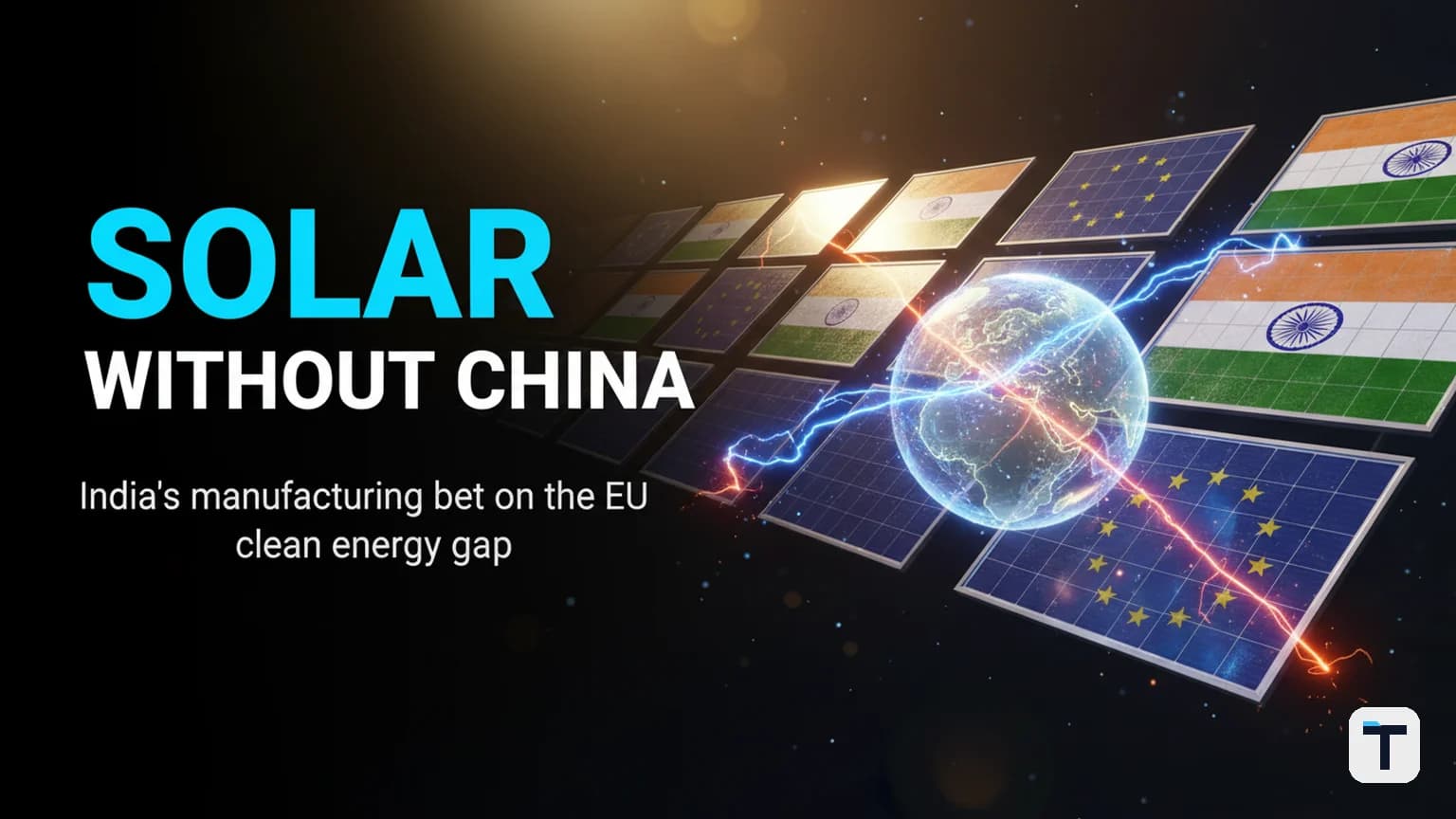

Tata Power is preparing to export solar cells and modules to Europe for the first time, targeting a 2-3 gigawatt opportunity in Italy as the European Union accelerates its push to break dependence on Chinese solar manufacturing. CEO Praveer Sinha confirmed the export plan on a post-earnings media call on July 27, 2026, framing India's largest integrated solar manufacturer as a credible alternative in a market where China currently supplies roughly 98% of all imported solar panels. Reuters, July 27, 2026
The move is significant for three reasons: it marks the first time a major Indian solar manufacturer has publicly targeted the EU market, it comes just months after the India-EU Free Trade Agreement slashed tariffs on bilateral trade, and it aligns with the EU's Net-Zero Industry Act, which is actively restructuring procurement rules to exclude Chinese-made equipment from portions of renewable energy projects. Whether Indian manufacturers can scale fast enough to fill the gap Europe is creating, however, is an open question — and the answer hinges on a fundamental capacity imbalance in India's solar supply chain.
TL;DR — Last verified: 2026-07-30
- Tata Power is targeting 2-3 GW of solar cell and module exports to Europe (initially Italy), confirmed by CEO Praveer Sinha on July 27, 2026.
- The company has 4.9 GW of integrated manufacturing capacity (4.3 GW in Tamil Nadu + facilities in Bengaluru) and is considering up to 10 GW of upstream ingot and wafer capacity.
- China supplied ~98% of EU solar panel imports in 2023 and 2024, per Eurostat; the EU's Net-Zero Industry Act requires member states to introduce non-price criteria favoring non-Chinese equipment in renewable auctions.
- India-EU FTA (concluded January 27, 2026) eliminates or reduces tariffs on over 90% of bilateral trade, making Indian exports more price-competitive.
- Risk: India has ~200 GW of module capacity but only ~30 GW of cell capacity, meaning much of the sector still imports upstream components — often from China.
Why Is Europe Looking Beyond China for Solar Panels?
Europe imports over 95% of the solar modules it installs, and China has supplied approximately 98% of all solar panel imports to the EU in both 2023 and 2024, according to official statistics from Eurostat, the EU's statistical office. Eurostat, October 2024; October 2025
That concentration became a strategic vulnerability. Chinese-made modules cost roughly two-thirds the price of European-manufactured equivalents, which fueled rapid deployment across the continent but hollowed out Europe's domestic manufacturing base. Factories closed, investment stalled, and the EU found itself importing a technology it had originally helped pioneer. Rystad Energy, 2023
The EU's response is the Net-Zero Industry Act (NZIA), agreed in February 2024. It designates solar photovoltaic as a "strategic net-zero technology" and sets an ambition for European manufacturing capacity to approach 40% of the bloc's annual deployment needs by 2030. Critically, it also introduces "non-price criteria" into renewable energy auctions: member states must allocate either 30% of auctioned volume or at least 6 GW per year to projects meeting supply-chain resilience, sustainability, and responsible-business-conduct criteria — criteria that effectively favor non-Chinese equipment. European Commission, Net-Zero Industry Act; Council of the EU
Italy moved first. In 2025, Italian authorities allowed solar projects to be built with non-Chinese equipment under the NZIA framework, creating an immediate opening for manufacturers outside China.
What Did Tata Power's CEO Actually Announce?
Praveer Sinha, CEO of Tata Power, told reporters on a post-earnings call on July 27, 2026, that the company sees a 2-3 gigawatt export opportunity in at least one European country. While Sinha did not formally name the market in his initial remarks, reporting and industry context indicate the opportunity centers on Italy, which opened its procurement door to non-Chinese solar under the NZIA in 2025. Reuters, July 27, 2026
This represents a notable shift. In late 2024, Sinha had said output from Tata Power's new Tamil Nadu factory was committed to the Indian market for the following 12-16 months. Since then, India's manufacturing base has expanded rapidly, creating new capacity pressure and the need to identify overseas customers. New Energy Weekly, July 28, 2026
The announcement is an expression of intent, not a signed contract. Reuters did not report signed customer deals, expected export revenue, or a delivery schedule.
How Much Solar Manufacturing Capacity Does Tata Power Have?
Tata Power's manufacturing operates through its subsidiary TP Solar (part of Tata Power Renewable Energy Ltd). The combined integrated capacity is 4.9 GW, split across two sites:
| Facility | Location | Cell Capacity | Module Capacity | Notes |
|---|---|---|---|---|
| TP Solar Tirunelveli | Tamil Nadu (near Tuticorin) | 4.3 GW (integrated) | 4.3 GW | India's largest single-location cell+module plant; built with ~₹4,300 crore investment; ~80% women workforce |
| Bengaluru | Karnataka | ~530 MW | ~682 MW | Older facility, serves Domestic Content Requirement market |
Both facilities produce mono PERC and n-type TOPCon technologies and comply with India's Domestic Content Requirement (DCR) norms. Tata Power Solar Manufacturing; Tata Power Solar Press Release
The company is also considering investing in up to 10 GW of upstream ingot and wafer manufacturing — the raw material stage needed to produce solar cells. This is the critical gap in India's solar value chain, and it matters because a 2-3 GW export target requires not just modules but the cells behind them.
Can India Actually Supply Europe at Scale?
India's solar manufacturing base is large on paper but structurally imbalanced. According to government estimates cited by Reuters, the country has close to 200 GW of annual module-making capacity but only about 30 GW of solar cell capacity. That means most Indian module makers still import cells — frequently from China — to assemble into finished panels. Reuters, July 27, 2026
| Supply Chain Stage | India's Capacity | Gap |
|---|---|---|
| Modules (assembly) | ~200 GW | Sufficient — large surplus |
| Cells (mid-stream) | ~30 GW | Severe bottleneck |
| Ingots & Wafers (upstream) | Minimal domestic capacity | Near-total import dependence |
This is the central tension in the story. If the EU's goal is to reduce dependence on China, and Indian manufacturers still import Chinese cells to assemble into modules for export to Europe, the supply-chain shift is partial at best. Tata Power's proposed 10 GW ingot and wafer investment is designed to close that gap — but it is not yet operational.
Tata Power is not alone in eyeing the European opportunity. Multiple Indian module makers are reportedly considering similar export strategies, according to Reuters. The timing aligns with a structural shift in global solar supply chains that goes well beyond any single company.
What Role Does the India-EU Free Trade Agreement Play?
The India-EU Free Trade Agreement, concluded on January 27, 2026, after nearly two decades of negotiations, eliminates or reduces tariffs on over 90% of goods traded between the two economies. This is the trade policy backdrop that makes solar exports commercially viable at a new price point. European Commission Press Release, January 27, 2026; Wikipedia — India-EU FTA
Key provisions relevant to solar manufacturing:
- Indian exports to the EU: About 93% of Indian shipments gain duty-free access to the EU market, phased over 7 years.
- Tariff reductions on industrial goods: Indian tariffs on machinery (up to 44%), chemicals (up to 22%), and related industrial inputs are being mostly eliminated — which lowers the cost of building solar manufacturing capacity in India using EU-sourced equipment.
- Strategic positioning: The FTA explicitly positions India as a hub for clean energy, semiconductors, and services exports, giving EU firms privileged access to India's fast-growing market.
Before the FTA, Indian solar equipment faced the EU's common external tariff, making it less price-competitive against Chinese modules. With tariff barriers lowered, Indian-made cells and modules become more cost-competitive in the EU market — though they still carry a price premium over Chinese equivalents.
How Does This Compare to the Broader India Manufacturing Story?
Tata Power's solar export push fits a wider pattern. India is aggressively building out manufacturing capacity across strategic technology sectors — from semiconductors to solar — as global supply chains fragment along geopolitical lines. This is not a one-company story; it is a structural realignment.
The semiconductor track is already visible: Micron's $2.75 billion Gujarat chip plant (which recently selected L&T for its Phase Two expansion) and Kaynes Semicon's wafer-fab ambitions under India's Semicon Scheme 2.0 (covered here) show the same template being applied to chips. Tata Power's solar export move is the renewable-energy equivalent — leveraging domestic capacity, trade deals, and Western supply-chain anxiety to position India as a credible alternative manufacturer.
Morgan Stanley has projected that India's manufacturing sector could reach $1.5 trillion by 2035, and the credibility of that bet depends on whether companies can deliver on export commitments like the one Tata Power is now making. (We analyzed the full $1.5 trillion thesis here.)
The underlying logic is the same across all three sectors: the West wants to de-risk from China, India has the labor force and policy tailwinds to build manufacturing at scale, and trade agreements are being structured to make the economics work. Solar is arguably the furthest along because India already has meaningful installed capacity — the gap is upstream, not midstream.
What Are the Real Risks to Tata Power's European Solar Export Plan?
Three structural challenges determine whether this export ambition becomes a meaningful revenue stream or stays at the "targeting" stage:
1. Price competitiveness. Chinese modules are still cheaper by roughly 30-50% compared to non-Chinese manufacturing, according to industry analysis of the NZIA's implementation. European buyers participating in NZIA-compliant auctions must accept a cost premium to use non-Chinese equipment; the EU allows authorities to presume cost differences above 20% as "disproportionate," which could limit the pool of qualifying projects. EU Parliament Briefing, 2025; SolarBEGlobal
2. Cell capacity bottleneck. India's 30 GW of cell capacity is a fraction of its 200 GW module capacity. Tata Power's 4.9 GW integrated capacity is real, but scaling to a 2-3 GW export commitment while also serving the domestic market (India is targeting 500 GW of non-fossil capacity by 2030) requires the upstream ingot and wafer investment to materialize.
3. EU certification and compliance. European buyers require CE certification, quality standards compliance, and adherence to sustainability sourcing criteria. Indian manufacturers entering the EU market for the first time must navigate certification timelines that can delay first shipments by months.
What This Means for You
If you build or operate in the clean-energy supply chain, three things to watch:
- The NZIA is creating a real, quantifiable market for non-Chinese solar. Member states must run at least 6 GW/year of NZIA-qualified auctions starting in late 2025. That is not a future possibility; it is happening now. India's manufacturers are the most credible near-term non-Chinese alternative.
- The capacity gap is the bottleneck. Module assembly is plentiful; cell manufacturing is scarce; wafer and ingot capacity is nearly absent outside China. If you are sourcing decisions on where solar supply chains are going, follow the upstream investment money.
- The India-EU FTA is a tailwind not just for solar but across technology hardware. The tariff reductions make Indian manufacturing a more competitive export base into the EU for a range of industrial goods — not just solar panels. Companies that move early into the India-to-EU manufacturing corridor will have a structural cost advantage as the phased tariff reductions roll out.
FAQ
Q: How much solar capacity is Tata Power targeting for European exports? A: CEO Praveer Sinha identified a 2-3 gigawatt export opportunity in at least one European country (reported to be Italy) on a post-earnings call on July 27, 2026. This represents potential demand, not signed contracts — Reuters noted no specific orders, revenue figures, or delivery schedules were disclosed. Reuters, July 27, 2026
Q: What is the EU's Net-Zero Industry Act and how does it affect solar procurement? A: The NZIA, agreed in February 2024, designates solar PV as a strategic net-zero technology and requires EU member states to include non-price criteria (supply-chain resilience, sustainability, responsible business conduct) in renewable energy auctions covering at least 30% of auctioned volume or 6 GW per year. The Act also sets an ambition for 40% of EU deployment needs to be met by domestic manufacturing by 2030. It effectively creates a carve-out market for non-Chinese solar equipment. European Commission
Q: What share of EU solar panels come from China? A: According to Eurostat, the EU's official statistics office, China accounted for 98% of all solar panel imports to the EU in 2023, and that share remained at 98% in 2024. By value, EU solar panel imports were €19.7 billion in 2023 (dropping to €10.9 billion in 2024 due to price declines, though import volume rose slightly). Eurostat
Q: Does the India-EU Free Trade Agreement lower tariffs on solar equipment? A: Yes. The India-EU FTA, concluded on January 27, 2026, eliminates or reduces tariffs on over 90% of bilateral trade, with about 93% of Indian exports gaining duty-free EU access phased over 7 years. This lowers the landed cost of Indian-made solar cells and modules in the EU market, though Chinese modules still carry a price advantage. European Commission, January 27, 2026
Q: What is the bottleneck in India's solar manufacturing supply chain? A: India has approximately 200 GW of module assembly capacity but only ~30 GW of cell manufacturing capacity, per government estimates. The upstream stages — solar ingots and wafers, from which cells are made — have minimal domestic production. Tata Power is considering a 10 GW ingot and wafer investment to close that gap, but it is not yet operational. Until it is, Indian module exports may still rely on imported upstream components. Reuters, July 27, 2026
Q: Is Tata Power's European solar export plan confirmed or just a target? A: It is a stated intent, not a confirmed deal. Reuters reported no signed customer contracts, no export revenue figures, and no delivery timeline. Sinha described the 2-3 GW figure as an "opportunity" the company identified. Investors and industry observers should treat it as an indicator of potential demand rather than committed sales. GuruFocus, July 27, 2026
Discussion
0 comments