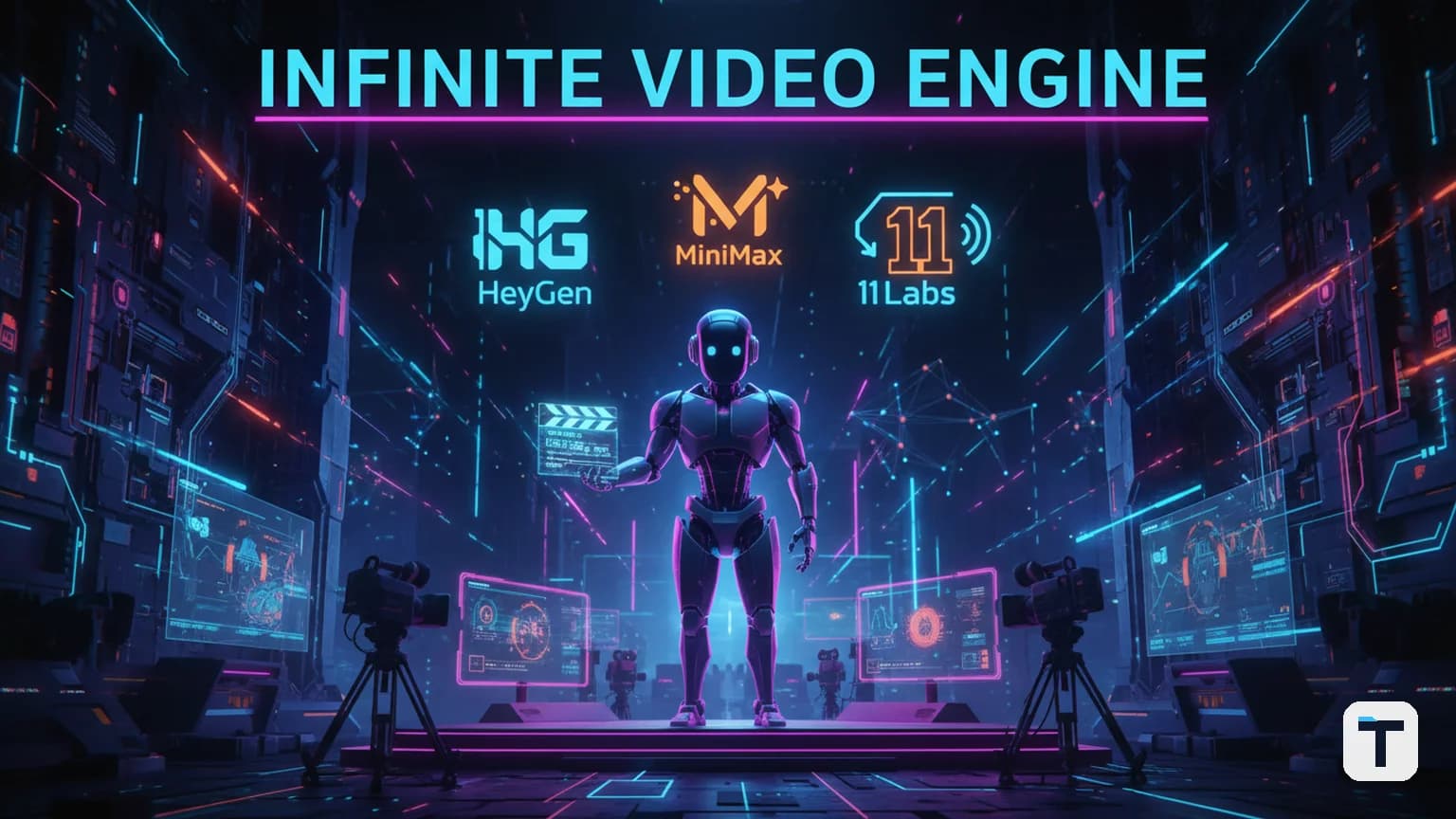

Verdict: In 2026, "autonomous video" has moved from simple text-to-video clips to fully agentic pipelines. By orchestrating HeyGen (avatars), MiniMax (B-roll), and OpenRouter Fusion (logic), a single person can now produce a 10-minute, high-fidelity video from a one-sentence brief for less than $10.
Last verified: 2026-06-19 · Best Avatar Tech: HeyGen Avatar IV · Best B-Roll Engine: MiniMax T2V · Economic Sweet Spot: ~$2 per finished minute.
What is an "Infinite Video Engine"?
An Infinite Video Engine is a self-sustaining pipeline where a central AI agent (the "Director") manages specialized sub-agents to handle every stage of production without manual intervention. Unlike early 2025 workflows that required manual stitching, the 2026 standard uses agentic operating systems to research, script, speak, render, and edit videos in a single loop.
For small businesses, this means the human role has shifted from creator to curator. You provide the prompt; the engine provides the final export.
The 2026 Autonomous Video Stack
To build a production-grade engine today, you need a modular stack that prioritizes consistency and cost.
| Stage | Tool / Model | Cost (API) | Role |
|---|---|---|---|
| Logic/Research | OpenRouter Fusion | ~$3/1M tokens | Aggregates research from 5+ models. |
| Voiceover | 11 Labs S2S | ~$0.30 / 1k chars | High-fidelity voice cloning with 700ms latency. |
| Video Avatar | HeyGen Avatar IV | $4.00 / min | Ultra-realistic 1080p presenter. |
| B-Roll Generation | MiniMax T2V / Grok 4.3 | $10/mo (unlimited) | Generates contextually relevant cinematic clips. |
| Orchestration | Hermes / Agent OS | Free (local) | The "Director" that calls the APIs in order. |
How the Pipeline Works: 5 Steps to Auto-Publishing
1. The Research-First Script
The engine begins by using a high-context model like MiniMax-M3 (1M token window) or Grok 4.3 to perform live research on your topic. This ensures the script isn't just a generic rehash but contains updated facts and verified entities.
2. High-Fidelity Voice Synthesis
Using 11 Labs Speech-to-Speech (S2S), the script is converted into a voiceover. By 2026, S2S has largely replaced text-to-speech for professional content, as it captures human inflection and pacing perfectly, making the AI avatar indistinguishable from a real presenter.
3. The "Subject Reference" Avatar
The engine calls the HeyGen Video Agent API ($2/min) to generate the visual presenter. For premium content, Avatar IV provides facial consistency and micro-expressions that pass the "uncanny valley" test for 1080p and 4K output.
4. Dynamic B-Roll and Editing
While the avatar renders, a sub-agent uses MiniMax or Grok Imagine 1.0 to generate 10-second B-roll clips based on the script's visual cues. The "Director" agent then uses cloud-based media flows to stitch these assets together, applying transitions and screen-recordings (via tools like Arcade or Claude Design) automatically.
5. HITL Quality Gate
Before publishing, the engine presents the video to a "Judge" agent (like GPT-5.4 or Claude 4 Mythos) to check for visual artifacts, pacing, and factual accuracy. See how this fits into a broader AI agent operating system.
What this means for your business
Autonomous video production is the end of the "production bottleneck." A single marketer can now run a daily video newsletter or a YouTube channel with zero filming days.
The Strategy: Focus on voice AI infrastructure and AI-first automation platforms to keep your unit costs low. If you can drive the cost of a 5-minute video below $10, you can scale horizontally across every topic in your niche.
FAQ
Q: How much does it cost to produce one video? A: Using standard 1080p avatars and MiniMax B-roll, a typical 5-minute video costs roughly $8.00–$12.00 in API credits.
Q: Is the quality good enough for YouTube? A: Yes. High-end engines using HeyGen Avatar IV and MiniMax's frame-consistent models are currently outperforming mid-tier human editors on pacing and visual consistency. See our AI YouTuber income breakdown for more on the business case.
Q: Can I run this locally? A: You can run the "Director" agent locally using Ollama or Hermes, but video and avatar rendering still require cloud-based GPUs via APIs (HeyGen/MiniMax) for speed.
Q: How do I handle branding? A: Most 2026 engines allow you to upload a "Brand Kit" (logo, fonts, hex codes) which the Director agent applies during the assembly phase.
Discussion
0 comments