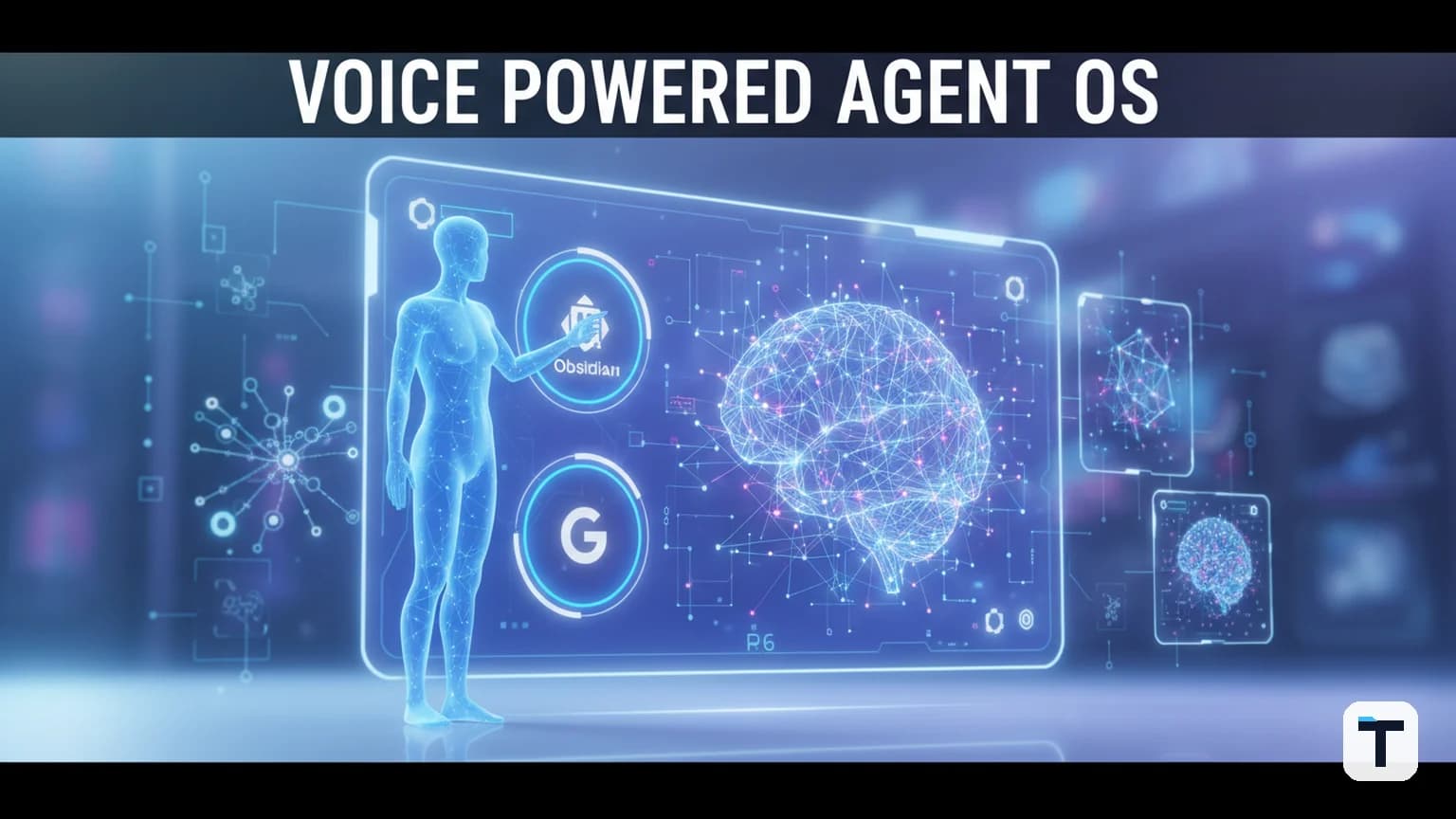

Verdict: The shift from "chatting with AI" to "controlling a computer with voice" is the defining shift of 2026. By unifying a low-latency voice layer (like Hermes Jarvis) with a persistent memory system (Obsidian), you can move from a simple assistant to a fully autonomous Agent Operating System that manages your business while you work hands-free.
Last verified: 2026-06-21
- Best for: Small business owners, developers, and power users.
- Core Tech: OpenAI Realtime API + Hermes Agent + Obsidian.
- Key Benefit: 700ms response time and full local computer control.
- Privacy: All logs and context are stored in your own local "Memory Galaxy."
Why a Voice-Controlled Agentic OS?
The traditional AI chatbot model is dying. Typing instructions into a window is slow, siloed, and reactive. A Voice-Controlled Agentic Operating System (OS) flips this model: it listens, reasons, and executes commands across your entire desktop in real-time.
In 2026, efficiency isn't just about the "smarts" of the model; it's about the speed of execution. A voice layer like Hermes Jarvis reduces the friction between thought and action, allowing you to open apps, build tools, and summarize data with a single spoken phrase.
The Tech Stack: How Hermes Jarvis Works
Building a "Butler-style" agent requires three distinct layers working in perfect sync:
- The Voice Layer (Intelligence): Using the OpenAI Realtime API, the system achieves sub-second latency, making the "Butler" vibe feel natural rather than robotic.
- The Execution Layer (Action): Hermes Agent acts as the engine, translating voice commands into shell scripts, file operations, and browser actions.
- The Memory Layer (Context): Obsidian serves as the "Memory Galaxy." Every conversation, task, and personal preference is logged locally, ensuring the agent gets smarter with every interaction.
| Feature | Technology Used | Why it matters |
|---|---|---|
| Voice Interaction | OpenAI Realtime / ElevenLabs | Fast, human-like response speeds. |
| Computer Use | Hermes Agent / OpenClaw | Opens apps, writes code, and browses. |
| Persistent Memory | Obsidian / MCP | Keeps history and business context safe. |
| Orchestration | Agentic OS Dashboard | Unified UI for multi-agent coordination. |
The "Memory Galaxy": Why Local Context is Your Moat
One of the biggest issues with standard AI assistants is that they "forget" who you are between sessions. An Agentic OS solves this by plugging into your local Obsidian vault.
By logging every protein target, SEO keyword, and project update into a "Memory Galaxy," your agent develops a "Company Brain." This allows the agent to give you a Daily Briefing that isn't just a weather report, but a deep dive into your specific action items, recently touched notes, and market trends relevant to your business.
"Wall Mode": The Always-On Business Assistant
The most powerful implementation of this system is Wall Mode. Instead of a tab you close, the Agentic OS sits on a dedicated monitor (or "Wall"), listening for its wake word.
- Background Operation: While you work on your main tasks, your agent listens for specific commands.
- Proactive Briefings: It can interrupt to give you a weekly recap or a heads-up on a high-priority SEO task.
- Hands-Free Building: You can say, "Jarvis, build me a quick landing page for our new product," and watch the code appear and run in the preview window while you finish an email.
What this means for small business owners
For the one-person business or small team, an Agentic OS acts as a force multiplier. You aren't just using AI to "write an email"; you are using it to:
- Automate SEO: Pull case studies from your memory and publish them to your site.
- Real-time Coding: Build internal tools, calculators, or games by simply describing them.
- Unify Fragments: Stop switching between 10 SaaS tools; the Agentic OS connects them all via a single voice interface.
As noted in the June 2026 WordPress VIP Report, 60% of consumers are increasingly turned off by "AI-washed" brand messaging. The solution isn't to stop using AI, but to use it internally to build a more authentic, efficient, and "human" business.
Related reading
FAQ
Q: Does it cost money to run a voice-controlled Agent OS? A: If you use local models (like GLM-5.2 or North Mini Code) and a local gateway, the cost is nearly zero. Paid APIs like OpenAI Realtime or ElevenLabs offer higher quality and lower latency for a fee.
Q: Is it hard to set up Hermes Jarvis? A: Within a unified Agent OS dashboard, it’s often as simple as pasting a command and configuring your API keys. Most systems are designed to be "plug-and-play" with your local terminal.
Q: Can a voice agent really control my computer safely? A: Yes, by using tool guardrails and "Agent Mode" toggles, you can control exactly what the agent can and cannot do. Running in a sandbox (like Docker or Modal) adds an extra layer of security.
Q: Why use Obsidian instead of a standard database? A: Obsidian uses local markdown files, meaning you own your data. It’s human-readable, portable, and integrates easily with AI tools through the Model Context Protocol (MCP).
Discussion
0 comments