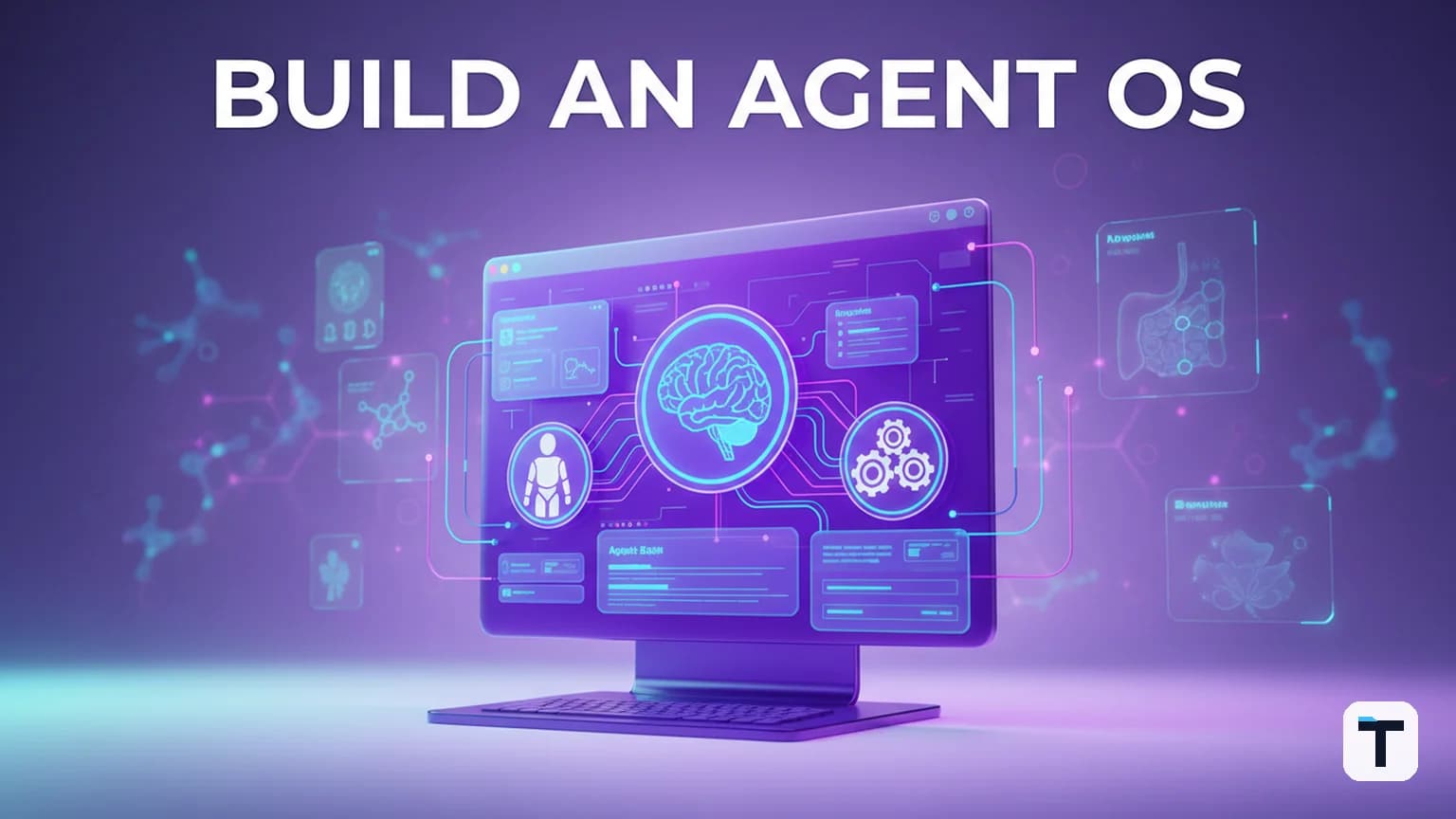

Verdict: In 2026, the competitive edge has shifted from using AI assistants to orchestrating AI Agent Operating Systems (AOS). An AOS is a unified control layer that manages multiple autonomous agents, shared memory, and tool access, transforming fragmented "chat" sessions into a persistent, 24/7 digital workforce capable of finishing complex, multi-step projects without human supervision.
| Feature | Details |
|---|---|
| Core Concept | A coordination layer for multi-agent orchestration (Resource, Process, Memory, I/O) |
| Primary Standard | Model Context Protocol (MCP) for agent-to-tool communication |
| Top Frameworks | CrewAI, LangGraph, AutoGen, Anthropic Agent SDK |
| Memory Titans | Letta (OS-style), Mem0 (Personalization), Zep (Temporal Knowledge Graphs) |
| Last Verified | 2026-06-19 |
Q: What is an AI Agent Operating System (AOS)?
A: An AI Agent Operating System (AOS) is the software architecture that sits between Large Language Models (LLMs) and your business systems. Just as a traditional OS (like Windows or Linux) manages hardware resources for applications, an AOS manages LLM resources, tool permissions, and shared memory for autonomous AI agents. It enables agents to plan, communicate (Agent-to-Agent or A2A), and execute actions across your stack in a coordinated, stateful manner.
Q: Why is a "Chat" interface no longer enough in 2026?
A: Single-session chat interfaces are ephemeral and stateless. They are "buttons" that wait for a user prompt. In contrast, an AOS is an always-on environment. According to MIT research, 95% of 2025 AI pilots failed due to integration gaps, not model quality. An AOS solves this by providing "process scheduling" (triggering agents on webhooks or schedules) and "long-term memory" (retaining context across weeks of work).
Q: What are the 4 essential layers of a modern AOS?
A: To build a resilient AOS in 2026, you must implement these four functional layers:
- Orchestration & Logic (The CPU): Frameworks like CrewAI or LangGraph that define how agents decompose goals into tasks.
- Memory & State (The RAM/Disk): Systems like Letta or Zep that handle "hot" context (working memory) and "cold" archival knowledge.
- Tool & API Access (The I/O): Standardized protocols like MCP that allow any agent to securely read and write to your CRM, database, or local files.
- Governance & Permissions (The Security): Fine-grained controls that ensure an agent can search your knowledge base but cannot delete your production database.
The Evolution: From AI Assistants to "Agentic Masterminds"
The most significant shift in 2026 is the move from reactive assistants to proactive "Masterminds." In a traditional workflow, you ask a chatbot to write an email. In an AOS workflow, a Lead Agent identifies a drop in customer engagement, a Research Agent analyzes recent ticket trends, and a Content Agent drafts and queues personalized re-engagement emails—all while you sleep.
This level of autonomy requires a robust infrastructure for voice AI and text-based agents alike. It effectively creates a "virtual company" where the agents collaborate, critique each other's work, and optimize for specific outcomes.
Choosing Your Stack: Frameworks vs. Primitives
When building your AOS, you face a choice between high-level frameworks and low-level primitives.
- High-Level Frameworks (e.g., CrewAI, AutoGen): Best for rapid deployment of role-based agent teams. They come with built-in patterns for collaboration and task handoffs.
- Primitive-First SDKs (e.g., OpenAI Agents SDK, Anthropic Agent SDK): Best for developers who want deep control over token handling and lifecycle hooks.
For small businesses, we recommend a hybrid approach: Use best-in-class automation platforms for simple tasks, but reserve the AOS for complex, logic-heavy workflows that require brand-aware memory and code synchronization.
Implementation Guide: The 5 Steps to Your First AOS
- Define the Workspace: Set up a persistent environment where your agents can read and write files (e.g., a secure Docker container or a dedicated VPS).
- Standardize Tooling with MCP: Install an MCP server to bridge your local tools (like Google Drive or Slack) to your LLM.
- Implement Tiered Memory: Use Letta to give your agents "Core Memory" (facts they must always remember) and "Archival Memory" (searchable history).
- Assign Roles & Goals: Use a framework like CrewAI to define specific agents (e.g., "Market Analyst," "Technical Writer") with clear backstories and objectives.
- Connect Triggers: Don't wait for a prompt. Connect your AOS to a webhook (e.g., from your CRM) or a cron job to make it truly autonomous.
What this means for you
Building an AOS isn't just about technical complexity; it's about Information Gain. By orchestrating specialized agents, you can synthesize insights and execute actions that no single human or LLM could manage alone. For small businesses, this is the path to scaling operations without a linear increase in headcount. The AOS becomes your most valuable employee—one that never forgets, never sleeps, and constantly learns from your data.
FAQ
Q: Is an Agent OS more expensive than a regular chatbot? A: While token usage is higher due to agent-to-agent communication and memory retrieval, the ROI is significantly higher. An AOS can finish multi-step projects (like a full SEO audit and content refresh) that would otherwise cost hundreds of dollars in human labor.
Q: Do I need to be a coder to build an AOS? A: In early 2026, low-code builders like Make and Zapier have introduced "agentic" layers, making basic AOS features accessible to non-coders. However, full customization still benefits from basic Python or JavaScript knowledge.
Q: Which LLM is best for an AOS? A: We recommend a "Dynamic Duo" approach: Use high-reasoning models like Claude 3.5 Sonnet or OpenAI o1/o3 for the Planner Agent, and faster, cheaper models like DeepSeek-V3 or Llama 3.3 for the Worker Agents.
Q: How do I handle agent errors in a 24/7 system? A: Implement "Resilience Patterns" like retries with exponential backoff and "Circuit Breakers." If an agent hits a specific failure threshold, the AOS should pause and notify a human supervisor.
Q: Is my data safe in an AOS? A: Data safety depends on your deployment. For maximum privacy, use local LLMs (via Ollama) and a self-hosted memory system like Mem0 or Cognee. Always use role-based access controls (RBAC) for your agent tools.
Discussion
0 comments