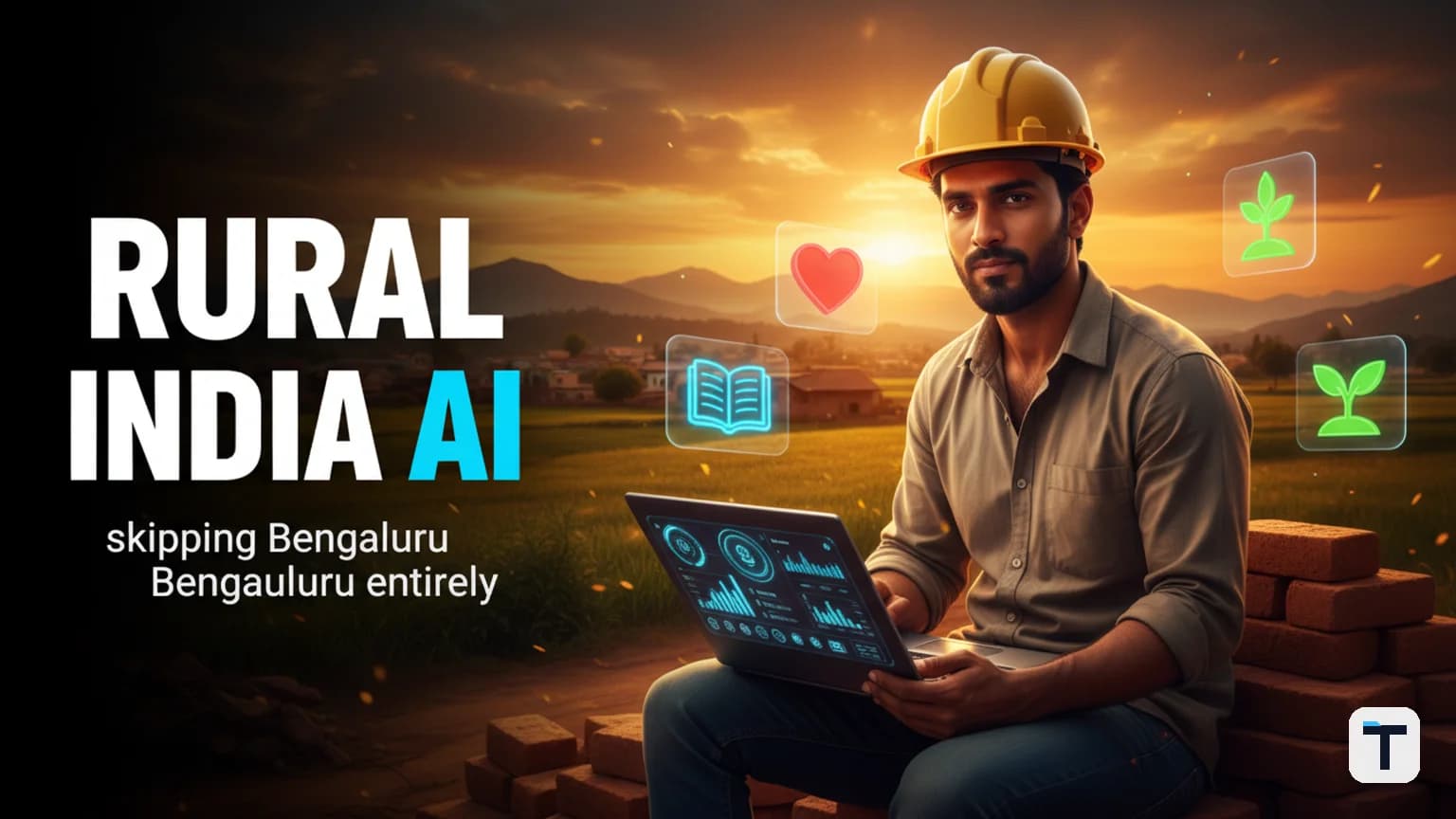

India's most consequential AI revolution is not happening in Bengaluru's tech parks or in the frontier-model labs chasing GPT benchmarks. It is happening in rural districts, where young people with no formal engineering background are building working AI tools for NGOs, schools, and community organizations — rehabilitation trackers for mobility clinics, malnutrition monitoring systems, autism care platforms. The revolution is bottom-up, problem-first, and skipping the cities entirely.
This is not a prediction. It is already happening. And it reframes what "AI for India" actually means: not competing with OpenAI on benchmarks, but deploying AI to solve 10,000 local problems district by district.
Last verified: August 4, 2026
- Grassroots AI programs train rural youth (not engineers) to build real deployed tools for NGOs and schools.
- AI collapses build cycles from years to weeks, making applied, problem-specific development viable for under-resourced communities.
- IndiaAI Mission (₹10,372 crore, approved March 2024) and Bhashini (350+ language models, 22 scheduled languages) provide national scaffolding — but the real leverage is local.
- The model is apprenticeship-style applied learning, not theory-first credential programs.
- Best for social-impact founders, NGOs, and educators: start from a problem on the ground, not a model in the cloud.
What Is the Grassroots AI Revolution in India?
The grassroots AI revolution is a bottom-up movement where people without formal computer science degrees — rural youth, NGO workers, school teachers, dentists — use AI tools to build deployable software for their communities' specific problems. Instead of a tech hub like Bengaluru building solutions for rural India, the people closest to the problems are building solutions themselves, with AI handling the parts that used to require years of engineering training.
The key shift: AI compresses the build cycle from years to weeks. A rehabilitation tracker that used to take 18 months to spec, design, and engineer can now be built in 2–3 weeks by someone who understands the problem on the ground. The bottleneck is no longer technical skill — it is domain knowledge, proximity to the real problem, and the habit of building.
This is a meaningful departure from the standard "tech hub → rural delivery" pipeline. In that model, urban engineers build software for communities they have never visited, then are surprised when it does not fit. The grassroots model inverts this: the community member is the builder.
Why Is the Grassroots AI Movement Skipping Bengaluru?
Bengaluru's tech ecosystem is optimized for scale, venture capital, and global enterprise productivity tools. The grassroots AI movement is optimized for specific local problems — cattle artificial insemination tracking, autism progress monitoring, malnutrition screening — that are invisible to the incentives of the startup tech hub.
Bengaluru engineers are usually insulated from the problem. They write code for clients they never meet. When one tech-turned-social-impact practitioner visited a US healthcare company, the first thing the company did was take him to the hospital floor and introduce him to the patients his code would affect. That is not standard in Indian software firms. The grassroots model forces the opposite: you visit the cow before you build the cattle insemination tracker. You meet the autistic child before you build the autism care app.
The result is that the people who understand rural problems — the nurse, the Anganwadi worker, the cattle insemination technician — are better positioned to direct AI-assisted builds than a remote engineering team. AI gives them the building capability they previously lacked.
How Does AI Change the Build Cycle for Real-World Problems?
Before AI, building a working software tool for a rural NGO required: a full software development team, 1–5 years of development time, and a budget most NGOs could not afford. By the time the tool was built, the original need had often changed or disappeared.
AI changes this in three concrete ways:
| Factor | Before AI | With AI (2026) |
|---|---|---|
| Build time for a domain-specific app | 1–5 years | 2–3 weeks |
| Required technical background | Computer science degree + years of experience | Domain knowledge + basic AI prompting |
| Iteration cycle | Months per revision | Days; rebuild and redeploy quickly |
| Cost barrier | Full engineering team salary | Free or low-cost AI tools (Gemini, ChatGPT, open-weight models) |
| Proximity to problem | Engineers remote from end users | Builder IS the end-user community member |
This is not an abstract productivity gain. It is the difference between an NGO that never gets a tool and one that gets a working app in the same month the need is identified.
The mindset shift matters as much as the speed: previously, tech workers were like cab drivers — "tell me where you want to go, I'll drive." With AI, they are like autonomous car operators — the AI asks them, "where do you want to go?" That reversal takes getting used to. Not everyone uses the freed-up time well yet. But for people who already know the problem deeply, the capability unlock is enormous.
What Does a Grassroots AI Build Actually Look Like?
Consider a concrete example from the field. An NGO working on autism care in schools had a recurring problem: when a teacher moves on or 3–4 months pass, the school loses continuity on what works for each child. They write reports in diaries, but no one tracks patterns over time.
A grassroots team built an AI-powered tracking system that monitors each child weekly and generates insights — for example, "this child responds well to music; introducing a music activity could improve engagement." That insight is invisible in the standard classroom structure. The tool surfaces it.
The team that built this was not a Bengaluru engineering firm. It was young people trained in a 3-month applied program — not in a 2-year theoretical curriculum. In that program, they learned exactly enough to build the thing, then they built it. If you had put them through two years of classroom theory first, they would have learned nothing usable.
A 4-Step Applied AI Build Process
- Visit the problem. Before writing any code, go to the site — the clinic, the school, the village. Understand the workflow from the person who does it daily. Example: for a cattle insemination tracker, visit the village, watch the procedure, learn that semen must not be out of the nitrogen cold bottle for more than 15 minutes or it becomes useless. That constraint shapes the software.
- Scope the build to the narrowest useful version. Do not build a platform. Build the one thing that solves the immediate pain. The autism tracker does not try to be an LMS — it tracks weekly progress and surfaces patterns.
- Learn just enough to build it. Teach the specific tools needed for this build — not a full CS curriculum. If the app needs Python and MongoDB, teach enough Python and MongoDB to build this app, not the language's entire ecosystem.
- Iterate in production, not in theory. Deploy to the real users within weeks. Watch what breaks. Rebuild. This is where habits (version control, agile iteration) matter more than exam scores — and you cannot build habits in a classroom.
How Is AI Education Shifting From Consumption to Creation?
Most "AI in education" conversations are about teaching students to consume AI — prompting ChatGPT, using Gemini for homework, generating summaries. The grassroots model teaches students to build with AI.
The difference is fundamental. A consumer of AI asks the tool for an answer. A creator uses the tool to build a system that serves a community. The consumer's ceiling is whatever the model outputs. The creator's ceiling is the size of the real problem they can address.
There is a legitimate concern: when students who have not learned to think critically use AI, the AI amplifies whatever they feed it. If you were producing poor-quality thinking before, AI helps you produce it 10x faster. The guardrail is not to ban AI — it is to build the habit of asking the right question first, then using AI to answer and build.
The education system India has built is excellent at producing literacy — memorizing multiplication tables, reciting formulas, reproducing known answers. It is historically weaker at producing question-askers. Ask a room of Indian students "A for ___?" and they say "apple." Ask students abroad the same question, and some say "noun or verb? person, place, or thing?" They ask clarifying questions. The grassroots AI build model forces question-asking: what problem? for whom? what is the narrowest useful version? That is the skill AI cannot replace, because the AI needs someone to aim it.
What National Infrastructure Supports Grassroots AI?
The grassroots movement does not exist in a policy vacuum. Several national-level initiatives provide scaffolding — and understanding them helps you see where the leverage points are.
IndiaAI Mission (Approved March 7, 2024)
The Union Cabinet approved the IndiaAI Mission with a budget of ₹10,372 crore ($1.25 billion) to build a comprehensive AI ecosystem. It rests on seven pillars:
- IndiaAI Compute — GPU compute access for startups and researchers
- IndiaAI FutureSkills — AI skilling and capacity building
- IndiaAI Startup Financing — risk capital for AI startups
- IndiaAI Innovation Centre — indigenous foundation models trained on Indian datasets
- IndiaAI Datasets Platform — non-personal data for AI development
- IndiaAI Applications Development Initiative — sector-specific AI apps
- Safe & Trusted AI — responsible AI governance
As of February 2025, the IndiaAI Innovation Centre received 67 proposals for foundation models — 22 for LLMs/LMMs, 45 for domain-specific small language models (SLMs) targeting healthcare, education, and financial services. The domain-specific SLMs are where grassroots builders will find their tools.
Bhashini — India's Language AI Platform
Bhashini is the government's AI-driven language technology platform, covering all 22 scheduled Indian languages. It hosts over 350 AI-based language models — Automatic Speech Recognition, Machine Translation, Text-to-Speech, OCR, transliteration — across 17+ language services. It was built in collaboration with over 70 research institutes.
For grassroots builders, Bhashini is the difference between an app that works in English (useless for most rural users) and one that works in Marathi, Kannada, or Bhojpuri. A malnutrition tracker that Anganwadi workers can operate via voice in their own language is a fundamentally different tool from one that requires English literacy.
Atal Tinkering Labs (AIM, NITI Aayog)
The Atal Innovation Mission under NITI Aayog has established over 10,000 Atal Tinkering Labs across 722 districts in 35 states and union territories, with 6,200+ "Mentors of Change." The program — continued with an enhanced budget of ₹2,750 crore till March 2028 — follows exactly the model grassroots AI needs: train teachers first, then students; provide equipment and mentorship; let students build.
Crucially, Atal Tinkering Labs started with a teacher training module before the student module — the same sequence the grassroots model recommends. You change a teacher, you change a whole generation of students.
The Nilekani Exam Reform Task Force (July 2026)
In July 2026, the Prime Minister announced a high-powered task force on examination reforms under Nandan Nilekani (co-founder of Infosys, former UIDAI/Aadhaar chairman). It builds on the Public Examinations (Prevention of Unfair Means) Act, 2024, and targets the National Testing Agency's exam integrity and design.
The grassroots argument here is that India does not just need better exams — it needs a different way of preparing young people for an AI-native world. The apprenticeship model, applied education, and "learn-a-bit, build-a-bit" iteration are structural alternatives to the exam-first system. The task force's DPI-style approach (digital public infrastructure for exams) may create tools, but the pedagogical shift has to happen at the community level.
What Does "Applied Education" Mean in an AI-Native World?
Applied education is learning-by-doing with immediate application. You learn something, you apply it in the next 3–4 months, or you forget it. The current system teaches a lot that students forget. Ask anyone with a degree: do you remember your integration and differentiation formulas? The people doing advanced physics use them — everyone else forgot.
The apprenticeship model is not new. It is how lawyers learn (by working with another lawyer), how chartered accountants learn (by training under one), how cricketers improve (by sharing a dressing room with a senior player). The IPL changed Indian cricket by exposing young players from small towns to international stars in the same dressing room. Applied AI learning works the same way: you learn by building alongside someone who has built before.
| Traditional Education | Applied AI Education |
|---|---|
| 2–4 year curriculum, theory-first | 3-month build cycles, problem-first |
| Exam at the end | Working deployable artifact at the end |
| Teacher knows one subject; student learns many | Student builds one thing deeply, learns adjacent skills as needed |
| Grades as the signal | A working tool that serves real users as the signal |
| Knowledge decays if unused | Habits (version control, iteration) stick through practice |
| "A for apple" — memorized answers | "A for ___? noun or verb?" — clarifying questions |
The argument is not to abolish breadth — you need some sprinkling of everything so people can navigate the world. But the model of "learn all subjects for years, then apply none of it" does not survive contact with AI, because AI makes building so fast that the theory-first approach is strictly slower than the build-first approach.
What Are the Risks of Democratized AI at the Grassroots?
Democratizing AI build capability is not unambiguously good. Three risks are real:
AI slop at scale. AI amplifies whatever you do. If you were producing quality work, you produce 10x quality. If you were producing garbage, you produce 10x garbage. The Feb-2026 Google core update specifically demotes commodity rehash content. Grassroots builders need quality guardrails, not just access to tools.
Attention span erosion. When tools make everything easy, people may switch off their brains. There was a real case of kids driving at night using a mapping tool that directed them over an unfinished bridge — ignoring posted warning signs — and they died. Easy tools do not replace situational awareness. The builder must still think about whether the tool's output is right for the context.
The domain-knowledge trap. An urban engineer building an autism care app without ever meeting an autistic child will build the wrong thing. AI makes it faster to build the wrong thing. The grassroots model mitigates this by insisting on proximity — visit the cow before building the cattle tracker — but that discipline has to be enforced culturally, not technically.
The guardrail is sandboxing: when a student in a learning platform asks the AI an off-topic question, the system keeps them within the topic. If you are learning Newton's laws, it does not answer geography questions. If you have used GPT enough today, it tells you to come back tomorrow. That kind of friction — designed in — is what keeps democratized tools from becoming democratized slop.
What Is the Innovation Center Model for Districts?
The vision for scaling grassroots AI is not one giant organization. It is 100 organizations of 100 people each, spread across districts — inspired by E.F. Schumacher's Small Is Beautiful (1973). Each district would have a locally owned, locally run innovation center that:
- Knows the pulse of the district (language, culture, economic base, festivals)
- Gets ideas from the world (what AI tools exist, what has been built elsewhere)
- Implements for the district (adapts, not copies)
- Is staffed by people from the district
This is the "follow Saraswati, Lakshmi follows" model — build something of genuine value and impact, and funding will come. Khan Academy raises a billion dollars a year. Not-forprofits can generate real revenue if the impact is real. The VC and social-impact funding will follow demonstrated impact, not PowerPoints about future impact.
The alternative — standardizing everything to one national template — loses India's diversity. You walk into any Walmart in the US and find milk in the same left-side back corner. India has never worked that way and should not try. The district-level innovation center model embraces the bouquet instead of forcing one gray shade.
What Does This Mean for You?
For social-impact founders and NGO technologists: Stop trying to hire a Bengaluru firm to build your tool. Find someone in the community who understands the problem, give them an AI build cycle (2–3 weeks), and let them build the narrowest useful version. The free AI API providers available in 2026 make the cost barrier close to zero.
For educators and skilling programs: The apprenticeship model (learn-by-building under a practitioner) outperforms theory-first curricula for AI-native work. The AI startup strategy framework of "stop competing with frontier labs, start solving local problems" applies directly: your students should build for real users, not for grades.
For one-person businesses and small teams in India: The grassroots AI build model — narrow scope, fast iteration, domain-first — is exactly how a one-person AI consulting business should operate. You do not need a team of engineers. You need deep proximity to one problem and the discipline to ship in weeks, not years. A no-code AI agent setup can serve as the build layer.
For people watching AI's impact on Indian tech jobs: The structural argument that India's IT hiring freeze is not cyclical but structural — AI is replacing the entry-level coding work that India's IT services model depends on — makes grassroots, problem-specific building more relevant, not less. The people who can combine domain knowledge with AI build capability will not be the ones displaced.
FAQ
Q: Do you need a computer science degree to build AI tools for rural problems? A: No. The grassroots model trains people with no engineering background to build working apps in 3 months by teaching only what is needed for the specific build. AI handles the parts that used to require years of coding experience. Domain knowledge and proximity to the problem matter more than credentials.
Q: What is the IndiaAI Mission and how does it support grassroots AI? A: The IndiaAI Mission, approved by the Union Cabinet on March 7, 2024, with a ₹10,372 crore budget, has seven pillars including compute access, future skills, startup financing, and an innovation centre for indigenous foundation models. Its Application Development Initiative and FutureSkills pillars are most directly relevant to grassroots builders.
Q: How does Bhashini help rural AI applications? A: Bhashini is the government's AI language technology platform covering 22 scheduled Indian languages with 350+ AI models for speech recognition, translation, text-to-speech, and OCR. It lets grassroots builders create apps that rural users can operate in their own language by voice, removing the English-literacy barrier.
Q: Is the grassroots AI movement anti-Bengaluru or anti-tech-hub? A: No. It is a complement, not a replacement. Bengaluru's ecosystem excels at scale, enterprise productivity, and frontier-model competition. The grassroots movement addresses hyper-local problems that the urban tech-hub model is structurally poorly suited for — because the builders do not have proximity to those problems.
Q: What is applied education and how does it differ from traditional education? A: Applied education is learn-and-immediately-build: you learn a skill and apply it within 3–4 months, or you forget it. Traditional education teaches theory for years before any application. In an AI-native world, where build cycles are weeks not years, the applied model is strictly faster for producing people who can ship working tools.
Q: Can democratized AI at the grassroots scale without producing low-quality output? A: Only with deliberate guardrails. AI amplifies whatever it is given — quality in, 10x quality out; garbage in, 10x garbage out. The mitigation is sandboxing (keeping AI within the topic domain), enforcing domain proximity (visit the problem before building), and building habits like version control and iteration rather than relying on AI output unchecked.
Discussion
0 comments