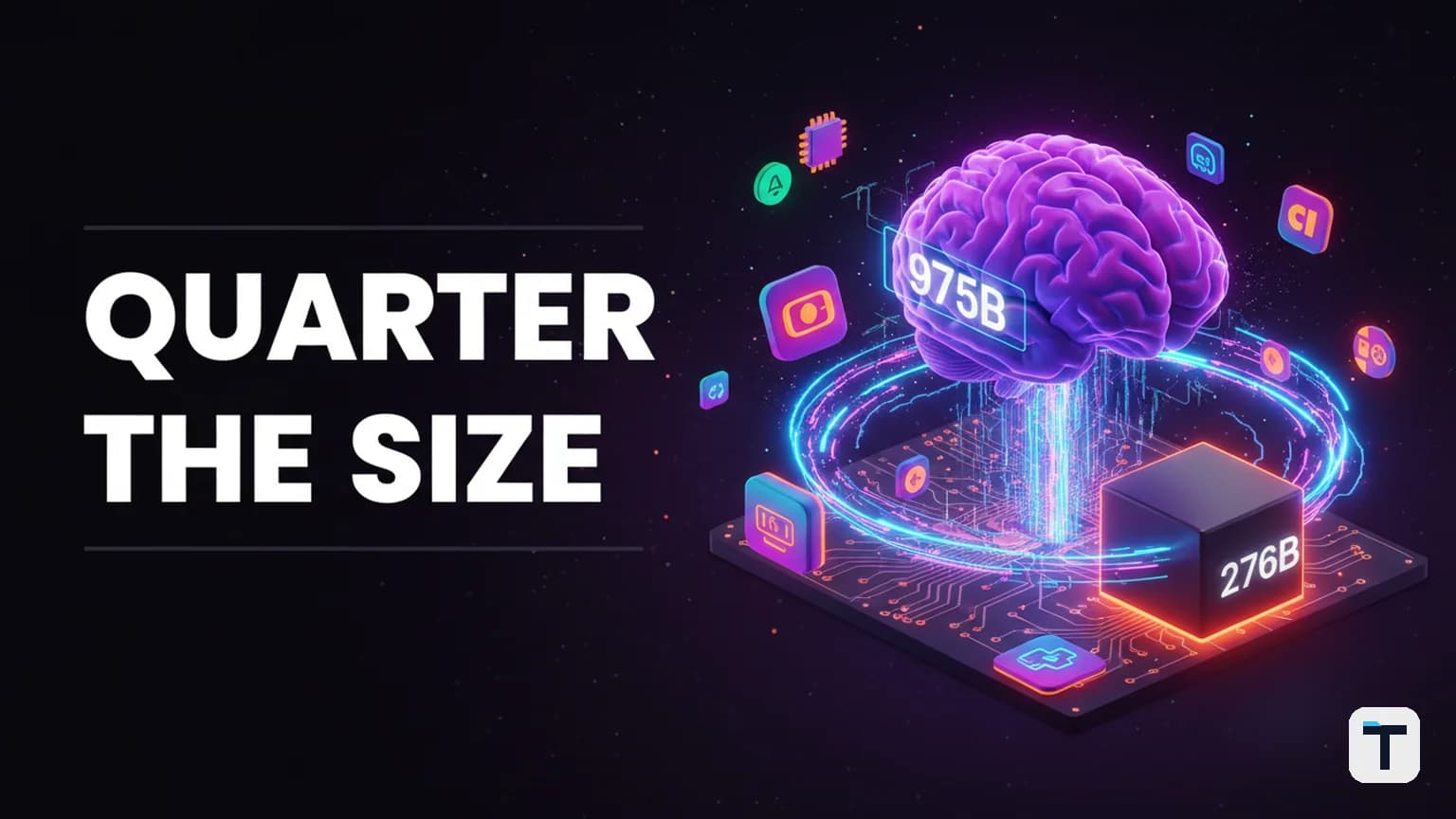

Verdict: Inkling-Small is the most efficient open-weights model Thinking Machines Lab has shipped — a 276-billion-parameter Mixture-of-Experts model that activates only 12 billion per token, yet matches or beats its 975-billion-parameter sibling Inkling on reasoning and agentic coding benchmarks while costing roughly a quarter as much to run. Released on July 30, 2026 under the Apache 2.0 license with full weights on Hugging Face, it is the first credible proof that the "train a giant, then distill a smaller version fast" approach scales as a repeatable playbook — not a one-off. For most builders and businesses that don't need a walking encyclopedia, Inkling-Small is the better default; Inkling retains the edge only on broad factual recall.
Last verified: 2026-08-04 · Best for: coding, agentic tool use, reasoning · Best alternative: Inkling (for facts) · License: Apache 2.0 · Context: 1M tokens · Access: Tinker, Hugging Face, API providers
What is Inkling-Small?
Inkling-Small is an open-weights multimodal reasoning model released by Thinking Machines Lab on July 30, 2026. It uses a Mixture-of-Experts (MoE) architecture with 276 billion total parameters but only 12 billion active parameters per token — meaning each query only "lights up" a small fraction of the model, which is what makes it fast and cheap to run despite its large total size.
The model is the smaller sibling of Inkling, a 975-billion-parameter MoE model (41 billion active) that Thinking Machines released just two weeks earlier on July 15, 2026. Both models are part of the same family: both process text, images, and audio natively, both support up to a 1-million-token context window, and both ship with full downloadable weights under Apache 2.0.
The headline number: Inkling-Small is roughly a quarter the active-parameter size of Inkling (12B vs 41B) and under 30% of its total size (276B vs 975B), yet on several benchmarks the smaller model actually wins.
How does a model a quarter the size stay as good?
Inkling-Small's performance parity comes from a documented technique called on-policy distillation, followed by targeted reinforcement learning.
- Distillation (the teacher–student approach). Inkling — the larger model — acted as a teacher. The smaller Inkling-Small was trained by learning from Inkling's behavior on problems, absorbing the larger model's "good habits" without needing the same number of parameters to store them. Thinking Machines' official announcement describes this as "on-policy distillation with Inkling as teacher" applied to an earlier Inkling-Small preview checkpoint (Thinking Machines — Inkling-Small announcement).
- Agentic coding reinforcement learning. After distillation, the team ran two additional weeks of reinforcement learning focused on coding and tool-use tasks — graded practice that rewards correct answers and penalizes bad ones. This narrowed the gap further on coding benchmarks specifically.
- Better data, applied faster. Because Inkling-Small started training after Inkling, the team had already learned the recipe. They refined the pre-training data mix and the ML post-training recipe before starting, then ran the playbook again.
The result, per Thinking Machines: Inkling-Small surpassed Inkling on reasoning and agentic coding benchmarks, while Inkling retains the advantage on knowledge coverage and factual accuracy. In other words, the smaller model traded breadth of knowledge for sharper reasoning and coding.
This "big model first, smaller distilled version two weeks later" pattern is becoming the standard AI-lab playbook, and this is one of the cleanest public examples of it. If you're new to how base-model training itself shifted in 2026, see our explainer on the LLM base-model training paradigm shift.
Inkling-Small vs Inkling: how do they actually compare?
Inkling-Small matches or beats Inkling on reasoning and coding, but trails on factuality and general knowledge. Here's the side-by-side based on the official Thinking Machines benchmark table.
Reasoning and agentic coding
| Benchmark | Inkling-Small | Inkling | Notes |
|---|---|---|---|
| Humanity's Last Exam (text-only, no tools) | 31.6% | 29.7% | Smaller model wins |
| GPQA Diamond | 89.5% | 87.2% | Small edge for Inkling-Small |
| SWE-Bench Verified | 80.2% | 77.6% | Bash-only harness; smaller model wins |
| Terminal-Bench 2.1 | 64.7% | 63.8% | Small edge for Inkling-Small |
| SciCode | 48.7% | 46.1% | Small edge for Inkling-Small |
| GDPval-AA v2 Elo (agentic work tasks) | 1269 | 1238 | Small edge for Inkling-Small |
Where Inkling still wins
| Capability | Inkling-Small | Inkling | Verdict |
|---|---|---|---|
| General knowledge / factuality | Lower (vendor-reported) | Higher | Inkling wins — Thinking Machines states this explicitly |
| FORTRESS adversarial safety | 71.6% | 78.0% | Inkling is safer against adversarial prompts |
| VoiceBench (audio) | 90.1% | 91.4% | Inkling edges ahead on audio tasks |
| MMMU Pro (vision) | 74.0% | 73.5% | Roughly tied |
A useful framing: Inkling-Small is the specialist (reasoning, coding, tool use), Inkling is the encyclopedia (facts, knowledge breadth). The broad-spectrum user who needs trivia or careful factual recall still gets the edge from the bigger model.
How much does Inkling-Small cost to run?
Inkling-Small is moderately priced for its intelligence tier and is notably cheaper than its larger sibling, because fewer active parameters means less compute per token.
- Input price (via Thinking Machines' API): approximately $0.30 per 1 million tokens, with cache-hit pricing as low as $0.06 per 1M tokens — (Artificial Analysis — Inkling Small analysis).
- Output price: approximately $1.20 per 1M tokens.
- Speed: ~104 output tokens per second measured by Artificial Analysis — faster than the median model in its class.
- Self-hosting: the model requires ~180 GB of GPU memory at full precision to host yourself, so running it locally requires multiple high-end GPUs or heavy quantization.
If you're deciding between this and other recent open-weights releases on cost grounds, it's worth comparing to DeepSeek V4 Flash 0731 for free agentic use and Qwen 3.8 Max for raw scale.
Who built Inkling-Small — and what's the company's status?
Thinking Machines Lab is the AI startup founded by Mira Murati, former CTO of OpenAI, in September 2024. The company raised $2 billion at a $12 billion valuation in July 2025, with investors including Nvidia, AMD, Andreessen Horowitz, and Jane Street (mlq.ai summary; Wikipedia — Thinking Machines Lab).
The company has had a notable spate of departures alongside this model release window:
- January 2026: two co-founders left — Barret Zoph (former CTO) and Luke Metz — both returned to OpenAI. Soumith Chintala (PyTorch co-creator) took over as CTO (TechCrunch, Jan 14 2026).
- July 27, 2026: co-founder Lilian Weng left citing health reasons, then rejoined OpenAI to lead a recursive self-improvement team (TechCrunch, Jul 29 2026).
What's striking is that despite losing multiple co-founders within the span of seven months, Thinking Machines still shipped a flagship model and a distilled derivative within two weeks of each other. That's the clearest signal yet that the "small team, fast cycle, distillation playbook" approach is repeatable — not a fluke depending on a single researcher.
How can you access Inkling-Small?
There are three practical paths, from easiest to most technical:
- Tinker Playground — Thinking Machines' official web playground at tinker.thinkingmachines.ai/playground. You can chat with Inkling-Small or fine-tune it on your own data without any infrastructure. This is the path for non-technical users and small businesses.
- A hosted API provider — third-party inference providers including Baseten and others have already listed Inkling-Small for programmatic API access. This is the path for builders adding it to an existing app.
- Self-host — download the full weights from Hugging Face under the Apache 2.0 license and run it locally on sufficiently large GPU hardware. This is the path for teams with strict data-residency needs and the infrastructure to support it.
For builders thinking about which open-weights model to wire into an agent framework, the broader pattern matters more than any single model — see our framework on building a model-agnostic AI agent OS that survives model churn.
What this means for you
For builders (technical). Inkling-Small is the cheapest model in its weight class on reasoning-per-dollar, and the distilled-from-a-frontier-model approach means its quality will only improve as Thinking Machines ships bigger teachers. Wire it in as an inference-only option first — the OpenAI-compatible API drop-in means a base-URL swap gets you going.
For small businesses (non-technical). You do not need to self-host. The Tinker Playground lets you experiment with Inkling-Small and even fine-tune it on your customer FAQs, onboarding docs, or call transcripts without writing code. The real edge here isn't "install the model" — it's "find the use case where a sharper, cheaper coding/reasoning model beats what you currently use." Good first tasks: search across your saved documents and chat history at the 1M-token context window, draft coding help, or generate structured summaries from long inputs.
For investors watching the space. The two-week flagship-to-derivative cycle is the leading indicator. The implication for the moat of any frontier-lab valuation is straightforward: shipping a frontier model and then distilling a smaller version becomes a routine process, not a heroic effort. Companies whose valuation depends on being the only ones who can ship at the frontier will see that premium erode as the playbook is copied.
For the model-agnostic pragmatist. If you've read this far and your real question is "what should I actually run today," the honest answer is: it depends on whether you need facts. Need rare-fact recall with low hallucination? Stay on Inkling or a closed model with strong abstention. Need reasoning, coding, or agentic tool use at low cost? Inkling-Small wins on price-to-performance in this class right now.
FAQ
Q: Is Inkling-Small free to use commercially? A: Yes. Inkling-Small is released under the Apache 2.0 license, which permits commercial use, modification, and redistribution with minimal restrictions. You can download the weights from Hugging Face and use them in commercial products.
Q: How is Inkling-Small different from Inkling? A: Inkling-Small is much smaller — 276B total / 12B active parameters versus Inkling's 975B total / 41B active — and was trained partly by distilling from Inkling. Inkling-Small matches or beats Inkling on reasoning and coding benchmarks but trails on factual recall and general knowledge, per Thinking Machines.
Q: Can Inkling-Small process images and audio like GPT-5 or Gemini? A: Yes. Inkling-Small accepts text, image, and audio inputs natively. Images are divided into 40×40-pixel patches and encoded with a four-layer hMLP; audio is represented as dMel spectrograms. It also supports programmatic image inspection — cropping, zooming, and analyzing images with Python code while reasoning.
Q: Is Inkling-Small the best open-weights model available today? A: No — it's the best on reasoning and agentic coding at its size and price point, per independent scoring from Artificial Analysis (Intelligence Index: 40, rank #15 of 101). On the broader Artificial Analysis Intelligence Index it trails several larger and closed models including GPT-5.6 Luna and Gemini 3.1 Pro. The honest positioning: best open-weights reasoning model in its weight class, not the smartest model overall.
Q: What hardware do I need to run Inkling-Small locally? A: Approximately 180 GB of GPU memory at full precision, so you need multi-GPU setups or heavy quantization. For most users, accessing the model through Tinker Playground or a hosted API is more practical than self-hosting. Self-hosting is for teams with strict data residency or cost-volume requirements.
Q: When was Inkling-Small released and by whom? A: July 30, 2026, by Thinking Machines Lab — the AI startup founded by former OpenAI CTO Mira Murati. The larger sibling Inkling was released July 15, 2026. Two weeks apart, both Apache 2.0, both multimodal.
Discussion
0 comments