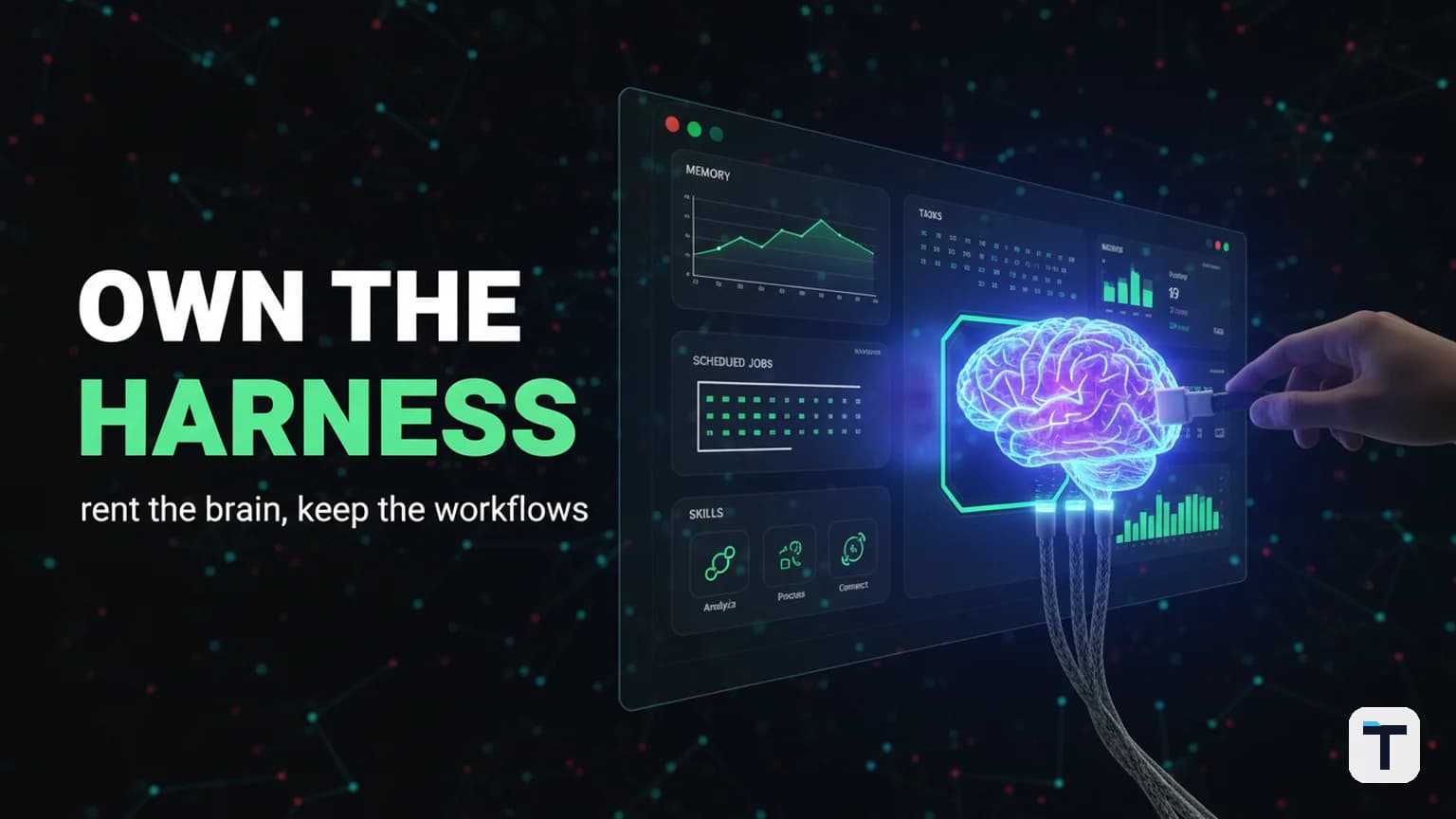

Verdict: In 2026 the smartest move is not picking the best model — it is owning an agent operating system that treats every model, including today's leader, as a swappable part. Moonshot AI's 2.8-trillion-parameter Kimi K3 went open-weight on July 27, 2026, and Alibaba previewed a 2.4-trillion-parameter Qwen3.8 two days earlier. Frontier-class models are now arriving weeks apart, not years. The teams still hard-coupled to one provider rebuild everything every release. The teams on a model-agnostic harness flip one key and keep running. If you build on a model-agnostic agent harness instead of a single API, the model stops being your platform and starts being a monthly upgrade.
Last verified: 2026-07-31 · Model swaps are now monthly: Kimi K3 (2.8T params, open weights July 27), Qwen3.8 (2.4T, previewed July 19), Hermes v0.19 (80% faster cold start, July 20) · Pricing/limits/versions change often — re-check before relying on exact numbers.
What Is a Model-Agnostic AI Agent OS?
A model-agnostic AI agent OS is an agent harness where the language model is a swappable backend, not the platform. The harness owns memory, skills, scheduled workflows, and a tool layer; the model only provides the reasoning tokens. Open-source frameworks like Hermes Agent (by Nous Research) make this the architecture instead of a feature — you point a config at a name and a key, and when a better model ships next month, you switch in one command [^1] [^2]. The whole point is that your agent's brain is rented and its hands are owned.
This matters right now because the open-weights frontier caught up with the closed frontier in July 2026. Kimi K3 — a 2.8-trillion-parameter sparse Mixture-of-Experts model from Moonshot AI with a 1-million-token context window and native image and video understanding — is openly downloadable under a Modified MIT license [^3] [^4]. That is the largest open-weight release ever, and it is general-purpose frontier intelligence. Building around a single closed API in this environment is committing to rewrite your stack every time a competitor ships.
Why Models Are Now a Monthly Resource, Not a Platform
Two years ago open models trailed the closed ones by roughly a year. Now they are shipping the same month. The evidence:
- Moonshot AI Kimi K3 — 2.8 trillion total parameters, 16 of 896 experts activated per token, 1,048,576-token context, full weights + technical report published July 27, 2026 [^3] [^5]. Independently ranked #1 on LMArena's Frontend Code Arena across six of seven frontend domains [^6], and #3 of 99 models on Artificial Analysis's Intelligence Index with a composite score of 57.1 [^7].
- Alibaba Qwen3.8 — 2.4 trillion parameters, previewed July 19, 2026, open weights promised soon [^8] [^9]. Alibaba's own account positions it as "second only to Fable 5" — the numbers come from a tweet, with no model card or independent benchmarks yet.
- Existing article: we have a full breakdown of what Kimi K3's architecture and pricing mean for builders at Kimi K3 Explained: How Moonshot's 2.8T Open-Weight Model Changes the AI Compute Math (2026).
The takeaway is not which model wins this week. The takeaway is that whichever wins, you can replace the previous one without touching your workflows. The agent OS is what makes that true.
What Actually Goes In an Agent OS (and What Stays Out)
A model-agnostic agent OS has five layers, each deliberately independent of the model. This is the same separation Hermes Agent ships with: routing in, state out.
- Memory layer — persistent, cross-session, model-independent. The bones are a full-text-search store (Hermes uses SQLite + FTS5) holding conversations, decisions, and working context. Switching models must not lose a single byte of memory, because the agent's continuity lives here, not in the model [^1] [^10]. Our existing guide on Hermes Agent OS in 2026: What an AI Agent Operating System Actually Is and How to Set One Up walks through the full architecture.
- Skill layer — reusable procedural files (skills) that capture how a task is done well. When an agent solves a hard problem, it writes what worked as a skill; that skill is loaded next time the same problem class arrives. Across sessions, the agent gets measurably faster on tasks it has done before [^1] [^11]. See our skill-centric AI agent harness guide for how this layer builds itself.
- Workflow layer — scheduled jobs, goal-mode tasks, and multi-agent task boards. A cron schedule runs every morning whether you are awake; goal mode keeps running a task until a completion contract tests passed; the Kanban-style task board tracks multi-agent handoffs and catches agents that died mid-task [^1] [^12].
- Tool layer — file system, browser, code execution, messaging (Telegram/Discord/Slack), and MCP integrations. All tools resolve through the harness, never the model — the model says "call fetch_url"; the harness executes it. This is why Kimi K3's terminal-bench scores translate into shipped work only when an agent OS is doing the actual operating [^5].
- Routing layer — one provider config per job. Cost-sensitive work goes to a cheap model; reasoning-heavy work goes to a frontier model; switching is a single config change. On Hermes, you can also run a cheap "side model" for image reading, page summarization, and long-chats compression while the main model handles the real reasoning — if you never configure the side model, those features silently stop working [^1].
| Layer | What it owns | What it does NOT depend on |
|---|---|---|
| Memory | Conversations, decisions, working context | The model |
| Skills | How-to files, generated after hard tasks | The model |
| Workflows | Schedules, goals, task board | The model |
| Tools | File, browser, messaging, code | The model |
| Routing | Provider keys, model name | Everything else |
How Kimi K3 Actually Performs (Independently Verified)
The "Kimi K3 is absolutely insane" framing from launch headlines oversimplifies the independent evidence. Here is what we verified against primary sources on July 31, 2026:
Architecture (Confirmed). Kimi K3 is a 2.8-trillion-parameter sparse Mixture-of-Experts transformer with native vision, 16 active experts per token (out of 896), and a 1,048,576-token context window. It uses Kimi Delta Attention (KDA) for faster long-context decoding and Attention Residuals (AttnRes) for stability. Training was MXFP4 weights with MXFP8 activations [^3] [^5] [^13].
Frontend Code Arena (Confirmed, with caveat). K3 ranks #1 on LMArena's Frontend Code Arena with 1,679 points across six of seven judged frontend domains (Brand & Marketing, Reference-Based Design, Data & Analytics, Consumer Product, Simulations, Content Creation Tools); second in Gaming to Claude Fable 5 [^6]. LMArena uses human preference voting in a blind test — preference is not the same as correctness. A polished dashboard can still have broken logic.
Intelligence Index (Confirmed, not a clean sweep). Artificial Analysis independently scored K3 at 57.1 on the Intelligence Index, third of 99 models — behind Claude Fable 5 (59.9) and GPT-5.6 Sol (58.9) [^7]. It leads on the AA Coding Index (76.24) and on AutomationBench-AA. It trails the closed frontier on the Intelligence Index itself. Honest summary: near-frontier, not the new #1 on every axis.
Speed (Confirmed: it is slow). Independent measurement puts Kimi K3's first-party API output at 34 tokens per second and time to first token at 4.18 seconds [^7]. Both sit in the slow vintage across comparable open-weights models. K3 is always in "thinking mode" — Moonshot's docs confirm reasoning_effort=max is the only supported effort setting today [^14]. The thinking tokens add up: Artificial Analysis measured K3 emitting 130 million output tokens to complete the Intelligence Index evaluation versus a 100-million-token field median [^7]. That verbosity directly hits real cost.
Hallucination (Confirmed: a real regression). Artificial Analysis's AA-Omniscience benchmark logged K3's hallucination rate climbing from 39% (K2.6) to 51% (K3) on the same evaluation, even as accuracy rose from 33% to 46% [^15] [^16]. The model gets more questions right and confidently wrong at the same time. This is exactly why agent OS design includes a completion-contract gate and a hallucination check — model output that is good enough to test is not good enough to ship.
What Does Kimi K3 Cost?
Kimi K3 API pricing, as published by Moonshot on platform.kimi.ai and confirmed by OpenRouter, Artificial Analysis, and BenchLM in late July 2026 [^17] [^7] [^18]:
| Token type | Rate (USD per 1M tokens) |
|---|---|
| Input (cache miss) | $3.00 |
| Input (cache hit) | $0.30 |
| Output | $15.00 |
| Context window | 1,048,576 tokens |
That is roughly half the cost of GPT-5.6 Sol per task and around one-third the cost of Claude Opus 4.8 [^7]. K3's catch is verbosity — the $15/M output bill scales not with tokens you ask for but with the thinking tokens the model emits first. If you want all the value for less, there is also the Ling 3.0 Flash free MoE agent model for routine work.
Why "Open Weights" Does Not Mean "Run It at Home"
A 2.8-trillion-parameter model is not a laptop workload. The Kimi K3 download is approximately 1.56 TB across 118 files on Hugging Face [^5]. At 4-bit precision, the weights alone need roughly 1.2 TB of storage [^9]; serving it in production is a datacenter project, often requiring 8× H100 or H200 accelerators even with aggressive quantization [^13].
So "open weights" here really means "anyone can host it" — not everyone should. Together AI, Fireworks, Modal, Databricks, Nebius, and Makora already serve K3 through their inference endpoints with widely varying latency [^19]. The reason the agent OS strategy matters more than the model: it does not care who hosts it. You point your routing layer at a provider name and a key. If a faster K3 host appears tomorrow, you switch with one config edit. Your memories, your skills, your schedules, your Kanban board — none of them move.
How to Build a Model-Agnostic Agent OS in 5 Steps
This is the actual setup, derived from the model-agnostic architecture Hermes ships with and the patterns we have used in production [^1] [^12]:
- Install a model-agnostic harness. Hermes Agent is open-source MIT-licensed, runs on Linux/macOS/WSL2, and installs with one command [^1]. Its routing layer supports 15+ providers — Nous Portal, OpenRouter (200+ models), NVIDIA NIM, and direct provider keys — so model swaps are config edits, not rewrites [^10].
- Wire memory once. Hermes ships three memory tiers — short-term session context, long-term searchable conversations, and procedural skill memory [^1] [^10]. Whatever model you plug in reads the same memory store. The continuity is in the harness, so a model swap cannot erase it.
- Generate your first skill. Use the harness's
learncommand on an existing guide you wrote — onboarding docs, a playbook, a runbook. The agent digests the page and saves it as a reusable skill file on your disk. That skill survives every model swap [^1]. See our portable AI skill file guide for the full pattern. - Set one scheduled job you care about. Trending watcher, competitor monitor, daily digest — anything that runs on cron and writes its output somewhere you will actually read. Goal-mode variants let a task keep iterating until a completion contract asserts it passed [^1] [^12]. Start with the autonomous AI agent task board guide if you want agents that hand work to each other.
- Configure the side model. This is the most-skipped step. Hermes uses a small side model to read images, summarize pages, and compress long chats. If you never point that side model at a real provider in your config, those features silently stop working — nothing tells you [^1]. The fix is one line of config: point the side-model at your main provider.
The Quicksilver release of Hermes (v0.19.0, July 20, 2026) materially improved reliability for the agent OS pattern: cold-start time-to-first-token dropped from ~4.3 seconds to ~0.9 seconds across CLI, gateway, TUI, desktop app, and cron — an 80% cut applied everywhere Hermes runs [^20]. v0.19 also shipped crash-proof delivery (finished work survives gateway crashes and is delivered on next start), live subagent transcripts, and smart approvals where an independent LLM reviewer checks flagged commands before they execute [^20] [^21]. The migration path from prior OpenClaw setups is one command that pulls over 30 categories of old config automatically [^1].
What This Means for You
If you have never touched an agent, do the five steps above this week and stop. One harness, one model, one skill, one schedule. You will understand the pattern. If you already have it running, the next milestone is a goal-mode task with a completion contract that runs overnight — let the agent OS test its own work and report in the morning. If you manage people, find one job that eats an hour a day and point this at it. Not the hardest job — one. Boring, repeated work is what AI agents are best at right now.
The unglamorous rule across all three cases: own the harness, rent the brain. Swap K3 for Qwen3.8 next month, swap Qwen3.8 for whatever Alibaba ships the month after. Your memory, skills, schedules, tools, and task board stay exactly where they are because they never lived in the model in the first place.
FAQ
Q: What is a model-agnostic AI agent OS? A: An agent harness where the language model is a swappable config, not the platform. The harness owns memory, skills, workflows, and tools; the model only provides reasoning tokens. Open-source examples like Hermes Agent ship this as the default architecture — one config edit changes the model and nothing else moves [^1] [^10].
Q: Is Kimi K3 really "the best" open model in 2026? A: It is the largest open-weight release ever (2.8 trillion parameters) and ranks #1 on LMArena's Frontend Code Arena, but it is not a clean sweep. Artificial Analysis independently scored it 57.1 on the Intelligence Index, third of 99 models, behind Claude Fable 5 and GPT-5.6 Sol [^7]. It also has a 51% hallucination rate on the AA-Omniscience test [^16]. Honest summary: near-frontier under an open license, leading in some axes, trailing in others, with a real reliability regression.
Q: Can I run Kimi K3 on my own laptop? A: No. The Kimi K3 open-weight download is roughly 1.56 TB on Hugging Face, and serving 2.8 trillion parameters even at 4-bit quantization requires datacenter-class GPU capacity (typically 8× H100/H200) [^3] [^5] [^9] [^13]. "Open weights" here means anyone can host it and any provider can offer inference, not that you can run it personally. Kimi K3 is already served by Kimi, Fireworks, Modal, Databricks, Makora, Nebius, and Together AI [^19].
Q: Why does the model not matter as much as the agent OS? A: Models are arriving monthly: Kimi K3 (2.8T), Qwen3.8 (2.4T), and Hermes v0.19 all shipped in the second half of July 2026 [^3] [^9] [^20]. Any agent coupled to one model rebuilds its workflows every release. A model-agnostic harness keeps memory, skills, schedules, and tools inside itself; the model is a swap-in backend. Your workflows keep running when the brain changes.
Q: Why is Hermes Agent "self-improving" and what does that actually mean? A: Hermes writes reusable skill files after solving hard tasks, then loads those skills on the next similar task; it also nudges itself to persist what it learned in memory. Independent reporting notes that agents with 20+ self-generated skills are about 40% faster on repeated tasks in the same domain [^10] [^11]. The "self-improving" is real improvement over time on tasks you actually use the agent for — not a model that retrains itself.
Q: How does Kimi K3's hallucination rate compare? A: On Artificial Analysis's AA-Omniscience benchmark, K3's hallucination rate climbed from 39% (K2.6) to 51% (K3), while accuracy rose from 33% to 46% [^15] [^16]. The model gets more questions right and confidently wrong at the same time. This is the concrete reason the agent OS pattern ships with a completion-contract gate and a hallucination check — production work needs a pass/fail test on the model output, not a hope.
Discussion
0 comments