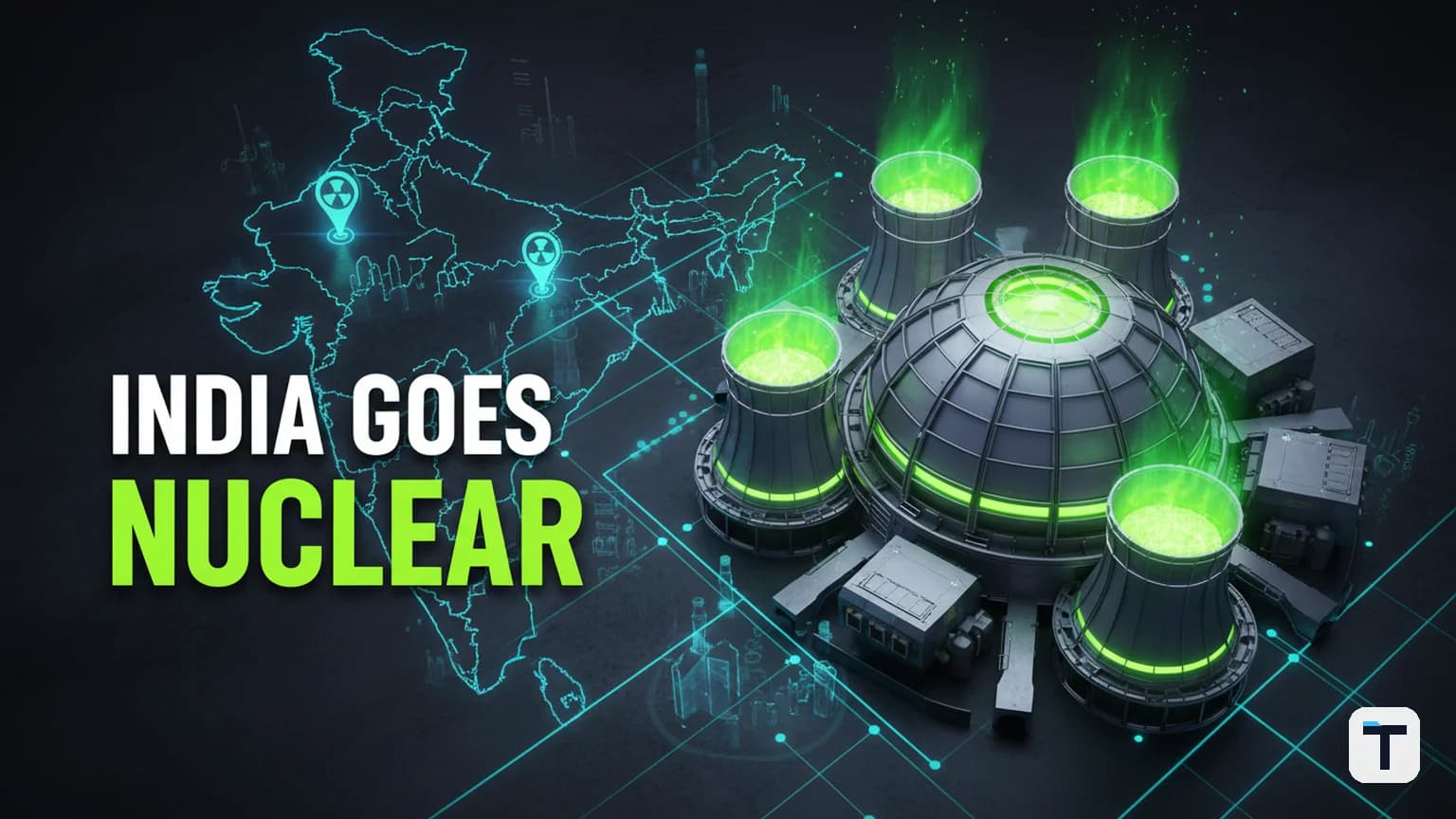

India aims to bring at least five indigenous small modular reactors (SMRs) into operation by 2033, backed by a ₹20,000 crore (~USD 2.5 billion) budgetary allocation under the Nuclear Energy Mission announced in the Union Budget 2025–26. The Bhabha Atomic Research Centre (BARC) is developing three distinct designs — a 220 MWe Bharat Small Modular Reactor (BSMR-200), a 55 MWe reactor (SMR-55), and a high-temperature gas-cooled reactor (HTGR) for hydrogen production — with lead units planned at Tarapur, the site of India's very first nuclear power station. The SHANTI Act 2025 now opens the sector to private participation for the first time in the nation's history.
Last verified: 2026-07-30 · 5 SMRs targeted by 2033 · ₹20,000 crore budget · 3 indigenous designs at BARC · 100 GW nuclear target by 2047 (up from 8.78 GW today)
Pricing, timelines, and reactor specifications are volatile — last checked July 2026.
What are India's three indigenous SMR designs?
India is betting on three different reactor designs, each serving a distinct purpose. All three are being developed by the Bhabha Atomic Research Centre (BARC) with support from the Nuclear Power Corporation of India Limited (NPCIL), and all fall under the IAEA's definition of SMRs as "advanced nuclear reactors that have a power capacity of up to 300 MW(e) per unit" — about one-third the capacity of a traditional nuclear reactor.
| Design | Capacity | Technology | Primary Use | Budget Allocated |
|---|---|---|---|---|
| BSMR-200 (Bharat Small Modular Reactor) | 220 MWe | Pressurised Heavy Water Reactor (PHWR) — slightly enriched uranium | Captive power for steel, aluminium, cement; repurposing retiring thermal plants | ₹5,960 crore |
| SMR-55 | 55 MWe | PWR-based, block-type, highly modular | Remote locations without grid connectivity | ₹7,000 crore (for two units) |
| HTGR (High-Temperature Gas-Cooled Reactor) | ~5 MWth | Gas-cooled (helium) | Hydrogen production and industrial process heat | ₹320 crore |
Sources: Press Information Bureau (PIB), Government of India; World Nuclear News; Business Standard.
The BSMR-200 is the flagship design. It builds on India's decades of experience with 220 MWe PHWRs — reactors the country has been building and operating since the 1980s, now scaling up to the indigenously designed 700 MWe fleet. This makes India a natural player in the emerging global SMR race, since the core pressurised heavy water reactor technology is already proven domestically — part of the same indigenous design-build-scale pattern that has driven India's defence and aerospace manufacturing push.
The SMR-55 is designed for what the Department of Atomic Energy calls "isolated mode" — operating without grid connection in remote areas. Its smaller exclusion zone (which does not extend beyond the plant boundary) is what makes this possible, enabling deployment in regions where a traditional plant could never be sited.
The HTGR, though smallest at approximately 5 MWth, is strategically significant: it is specifically designed to produce hydrogen through thermochemical water splitting, positioning India's nuclear programme as a contributor to the hydrogen economy, not just electricity generation.
Why is India building small reactors instead of scaling up large ones?
Small modular reactors produce up to 300 MWe per module and are factory-built rather than constructed entirely on-site, which means faster deployment, lower upfront capital costs, and the flexibility to place them in locations where a massive traditional plant could not be economically justified. This directly addresses three structural challenges of large nuclear projects in India.
1. Capital intensity. Traditional nuclear plants require enormous upfront investment and years of construction. The BSMR-200, by contrast, is estimated to take just 60 to 72 months of construction after project sanction. A factory-built modular approach means components are standardised and manufactured in series, spreading capital cost across multiple units.
2. Siting flexibility. Large nuclear plants need coastal sites with abundant cooling water and large exclusion zones. SMRs can serve energy-intensive industries (steel, aluminium, cement) directly as captive power, can repurpose retiring coal-fired thermal plants (brownfield sites, grid already connected), and can power remote regions without grid infrastructure.
3. Private-sector entry point. This is the real structural shift. India's nuclear sector has been under government control since the Atomic Energy Act of 1962. SMRs — smaller, modular, cheaper per unit — are explicitly positioned as the entry vehicle for private and state government participation. Their lower individual cost and factory-standardised safety case make private investment structurally feasible in ways a 1,600 MWe plant is not.
The International Atomic Energy Agency frames the same advantages globally: SMRs are "suitable for cogeneration and non-electric applications" and offer "options for remote regions with less developed infrastructures." India's distinct contribution is applying PHWR technology — a domain where it has decades of operational and manufacturing experience — to the SMR format.
How much funding has India committed, and where does it go?
The Union Budget 2025–26 allocated ₹20,000 crore (approximately USD 2.5 billion) specifically for the design, development, and deployment of small modular reactors under the Nuclear Energy Mission for Viksit Bharat. This is the single largest government commitment to SMR technology by any non-Western country to date.
The allocation breaks down as follows, based on statements made by Minister of State Dr. Jitendra Singh in Parliament and reported by Business Standard and the Indian Chemical News:
| Component | Allocation (₹ crore) |
|---|---|
| BSMR-200 development and construction | 5,960 |
| SMR-55 (two units) development and construction | 7,000 |
| HTGR design and construction | 320 |
| Design, engineering, and development of new reactors | 800 |
| Civil and general infrastructure at reactor complex | 452 |
| Total SMR allocation | ~14,532 |
The remaining ~₹5,468 crore of the ₹20,000 crore envelope covers broader Nuclear Energy Mission activities beyond the three named designs.
The Mondaq analysis of the Union Budget 2025–26 confirms the overall allocation figure, and the Press Information Bureau's official release (PRID 2099244, dated 3 February 2025) confirms the government's stated objective to "develop at least five indigenously designed and operational SMRs by 2033" through this funding.
What is the roadmap from 8.78 GW to 100 GW by 2047?
India currently operates 24 nuclear reactors with a combined capacity of 8.78 gigawatts. The government's roadmap, as laid out by Dr. Jitendra Singh in Parliament and confirmed by the Press Information Bureau, projects capacity reaching approximately 22 GW by 2031–32 as projects already under construction are progressively completed. Nuclear Power Corporation of India Limited (NPCIL) is expected to add another 32 GW beyond 2032 through indigenous PHWR and Light Water Reactor (LWR) projects, bringing capacity to approximately 54 GW by 2047.
The remaining 46 GW — the gap between ~54 GW (public sector) and the 100 GW target — is expected to come from other public sector enterprises, state governments, the private sector, and joint ventures using multiple business models and technologies.
| Milestone | Target Capacity | Date | Source |
|---|---|---|---|
| Current operational | 8.78 GW | 2025 (baseline) | PIB / Parliament statement |
| Mid-term goal | ~22 GW | 2031–32 | PIB / Parliament statement |
| NPCIL expansion (PHWR + LWR) | ~54 GW total | by 2047 | PIB / IBEF |
| Full 2047 target | 100 GW | 2047 | Nuclear Energy Mission |
| Gap to be filled by private/JV/state | 46 GW | by 2047 | PIB / Parliament statement |
This means the five SMRs targeted for 2033 are not expected to single-handedly close the capacity gap. They are the proof-of-concept and market-creation step: the first demonstration that private and non-central actors can build and operate nuclear reactors in India. The five units by 2033 test the regulatory, supply chain, and financing framework that the remaining 46 GW by 2047 depends on.
What does the SHANTI Act 2025 change about private participation?
The SHANTI Act — officially the Sustainable Harnessing and Advancement of Nuclear Energy for Transforming India Act, 2025 — is the most sweeping reform of India's nuclear legal framework since the 1960s. It repeals two landmark statutes: the Atomic Energy Act of 1962 (which established the central government's monopoly over nuclear power) and the Civil Liability for Nuclear Damage Act of 2010 (CLND Act).
Key changes, as analysed by Norton Rose Fulbright and KS&K legal commentary:
Private companies can now build and operate civilian nuclear power plants under licence. Previously, only government-owned entities (NPCIL and its joint ventures) could own and operate reactors. The SHANTI Act allows licensed private companies — including joint ventures with foreign suppliers — to apply to build, own, and operate civilian nuclear power plants, subject to regulatory review by the Atomic Energy Regulatory Board (AERB), which the Act converts from an executive body into a statutory regulator. This is a structural shift comparable to how Bharat Forge's partnership with Flying Whales demonstrated that private Indian manufacturers can enter domains once reserved for state-controlled enterprises.
Supplier liability is capped and defined. The CLND Act of 2010 placed unlimited liability on equipment suppliers — a provision that deterred foreign technology providers like Westinghouse and GE for over a decade. The SHANTI Act caps and clarifies this exposure, aligning India's liability framework closer to international standards like the IAEA-backed Convention on Supplementary Compensation. This removes the single biggest structural barrier to foreign reactor technology entering India.
Fuel-cycle activities remain a state monopoly. The Act carves out a hard boundary: power generation, reactor construction, and operation are opened to private operators, but uranium enrichment, plutonium reprocessing, and weapons-adjacent fuel-cycle activities remain exclusively under the Department of Atomic Energy. This split preserves national security control while liberalising the commercial layer.
The proposed foreign direct investment cap is up to 49% FDI in the nuclear sector, according to Vaid ICS analysis — enough to attract global technology providers and capital while keeping majority Indian control.
Where will India's first SMRs be built?
The lead units of the BSMR-200 and SMR-55 are proposed for the Tarapur Atomic Power Station site in Maharashtra, with in-principle approval for engineering and construction already received according to Dr. Jitendra Singh's written reply to the Lok Sabha. The HTGR is planned for BARC's Vizag campus in Andhra Pradesh.
Tarapur is a storied site. The Tarapur Atomic Power Station (TAPS) was commissioned on 28 October 1969 — making it the first commercial nuclear power station in India and among the first in Asia. Originally built by Bechtel and GE under the 1963 123 Agreement (an Indo-US civilian nuclear cooperation pact), TAPS initially housed two 160 MW boiling water reactors (BWRs).
Today the site has four reactors: the original two BWRs and two indigenous 540 MW PHWRs. The site is owned and operated by NPCIL and is the fourth-largest nuclear power plant in India. Beginning India's SMR programme at the same site that launched the country's nuclear journey five and a half decades ago is symbolically deliberate — it signals continuity of India's nuclear independence narrative.
The Atomic Energy Commission has approved Tarapur as the site for the BSMR-200. The BSMR-200's proposal for administrative and financial sanction has been cleared by the AEC and is now headed to the Union Cabinet for final approval, per Indian Defence News reporting.
What this means for you (India's clean-energy and tech stakeholders)
If you run an energy-intensive business in India — steel, aluminium, cement, or any operation with large captive power needs — SMRs represent a future pathway to reliable, carbon-free baseload power without depending on the grid. Tata Power and the Naveen Jindal Group have already expressed interest in setting up Bharat Small Reactors, per World Nuclear News. NPCIL has issued a Request for Proposals from "visionary Indian industries" to finance and build a fleet of 220 MW Bharat Small Reactors. The window is opening, though commercial deployment remains years away.
If you are in the hydrogen economy, the HTGR at BARC Vizag is a signal that India's nuclear programme explicitly intends to produce hydrogen — not just electrons — from reactor heat. This is the first-time India is coupling nuclear capacity to industrial hydrogen production.
If you invest in Indian infrastructure, the SHANTI Act's 49% FDI cap and the private-entry pathway through SMRs create a new sector. The projected $200+ billion needed to hit the 100 GW 2047 target cannot come from the public sector alone — private capital and efficiency are explicitly mandatory in the government's own framing.
If you benchmark India's indigenous manufacturing push, the SMR programme fits the same pattern that worked across rail (India's first in-house hydrogen train), defence (DRDO's Kusha air defence missile), and aerospace (the GTRE indigenous turbojet engine): design it domestically, build it domestically, scale it domestically — a model that has also powered the success of India's PLI manufacturing incentive scheme. The BSMR-200 is specifically designed so that "the majority of equipment are within the capability of Indian industries" — with private Indian vendors already delivering critical components like low-alloy steel forgings for the reactor pressure vessel.
FAQ
Q: What are India's three small modular reactor designs? A: India is developing: (1) the BSMR-200 (220 MWe Bharat Small Modular Reactor, based on PHWR technology, for industrial captive power and thermal-plant repurposing); (2) the SMR-55 (55 MWe, for remote off-grid locations); and (3) a High-Temperature Gas-Cooled Reactor (~5 MWth, for hydrogen production and industrial process heat). All three are designed by BARC at the Department of Atomic Energy.
Q: How much money has India allocated for SMRs? A: The Union Budget 2025–26 allocated ₹20,000 crore (approximately USD 2.5 billion) for the design, development, and deployment of SMRs under the Nuclear Energy Mission. Within that, ₹5,960 crore is for the BSMR-200, ₹7,000 crore for two SMR-55 units, and ₹320 crore for the HTGR. The rest covers broader mission infrastructure.
Q: Where will the first Indian SMRs be built? A: Lead units for both the BSMR-200 and SMR-55 are proposed at the Tarapur Atomic Power Station in Maharashtra — the site of India's first commercial nuclear plant, commissioned in October 1969. The HTGR is planned at BARC's Vizag campus in Andhra Pradesh. The Atomic Energy Commission has approved Tarapur for the BSMR-200.
Q: Can private companies build nuclear power plants in India now? A: Yes. The SHANTI Act 2025 repeals the Atomic Energy Act of 1962 and the Civil Liability for Nuclear Damage Act of 2010, opening the civil nuclear sector to licensed private companies — including joint ventures with foreign suppliers — under regulatory oversight by the statutory Atomic Energy Regulatory Board. Fuel-cycle activities like enrichment and reprocessing remain a state monopoly.
Q: How realistic is the 2033 timeline for five working SMRs? A: The BSMR-200 is estimated to take 60 to 72 months of construction after project sanction. In-principle approval is in hand and the concept design phase is complete. The proposal for administrative and financial sanction for the BSMR-200 has been cleared by the Atomic Energy Commission and is now at the Union Cabinet stage. The five-by-2033 target is tight but workable if cabinet approval arrives in 2025–26 — though India's nuclear timelines have historically slipped.
Q: How does India's 8.78 GW nuclear capacity today compare to the 2047 target? A: India currently operates 24 reactors producing 8.78 GW. The roadmap projects ~22 GW by 2031–32 (from projects already under construction), ~54 GW by 2047 (from NPCIL PHWR and LWR projects), and the remaining 46 GW gap to be filled by other public sector enterprises, state governments, private players, and joint ventures. The 100 GW by 2047 target represents roughly a 12-fold increase from today.
Discussion
0 comments