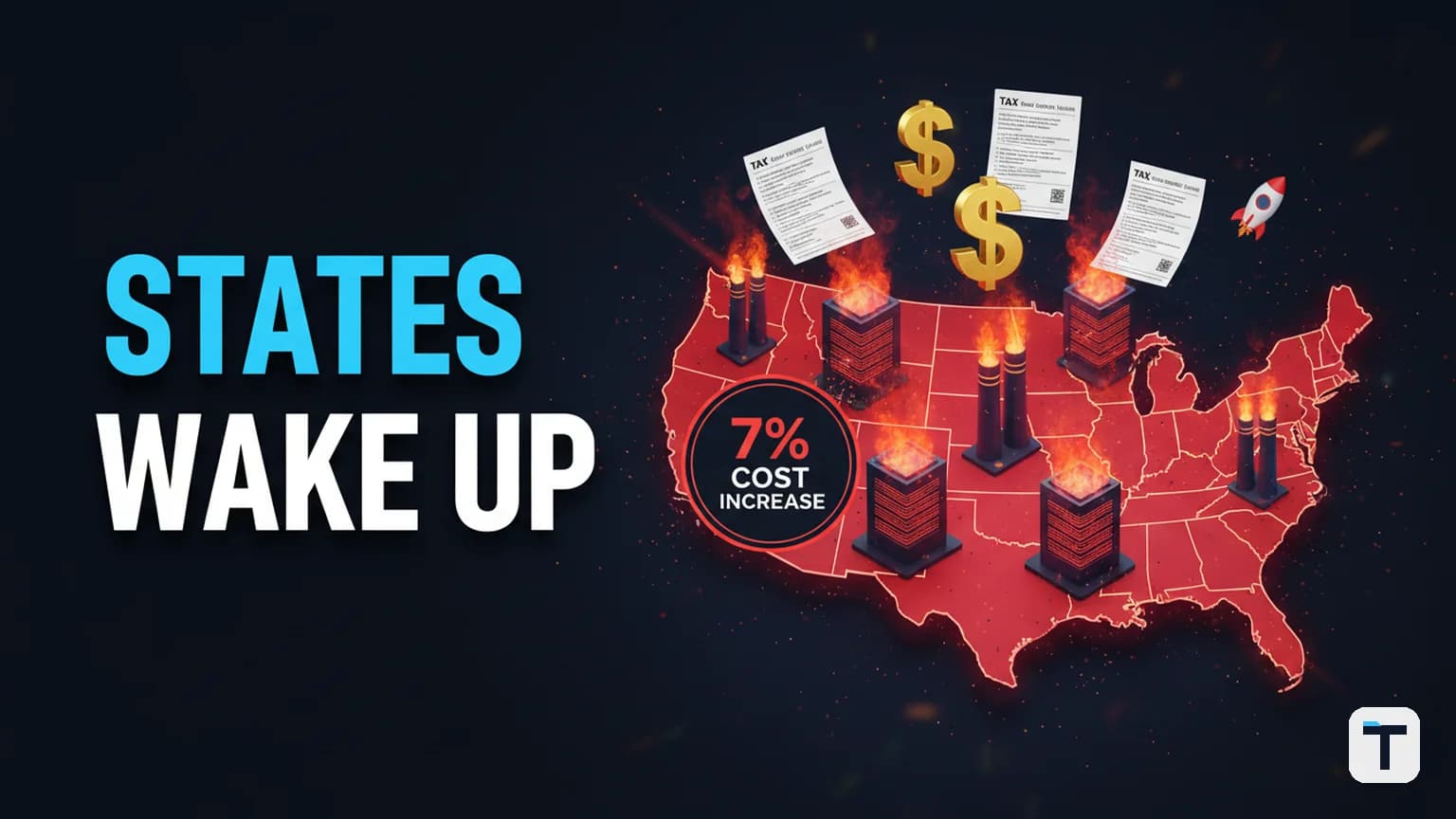

Four US states have paused, capped or curtailed their data center tax breaks in 2026, and at least nine more are considering outright repeal. Removing the sales tax exemption on servers, networking gear and cooling equipment would add roughly 7% to the equipment bill for a new build. For operators planning multi-billion-dollar AI capacity, that is a change to the underlying cost model rather than a rounding error.
TL;DR
- Ohio, Illinois, Arizona and Oklahoma have all acted in 2026 to pause, cap or wind down data center incentives.
- At least nine states are weighing full repeal; roughly two dozen have introduced bills to scale programmes back.
- Losing the sales tax exemption is estimated to add about 7% to equipment costs for new construction.
- Ohio is the trigger case: an exemption projected at $136 million cost close to $1.6 billion in fiscal 2025.
- Around 38 states currently offer some form of data center incentive, so the map is fragmenting rather than closing.
- Expect more conditional deals: ratepayer protection clauses, impact fees and clawbacks attached to the exemption.
What exactly changed in 2026?
The specifics differ by state, but the pattern is consistent. Ohio suspended new exemptions in spring 2026 after Governor Mike DeWine's administration published the actual fiscal cost. Illinois stopped processing new applications to its data center incentive programme on 1 July 2026, with the Department of Commerce and Economic Opportunity instructed to hold the queue. Arizona enacted a three-year moratorium on its data center sales tax exemption running from 1 July 2026 to 30 June 2029, after Governor Katie Hobbs initially pushed to eliminate the exemption altogether. Oklahoma's Data Center Consumer Ratepayer Protection Act took effect on 1 July 2026 and also ends incentive eligibility for facilities not operating by January 2027.
Other states are further back but moving in the same direction. New Jersey froze a $250 million programme (a CoreWeave deal was grandfathered). North Carolina proposed full repeal by end of 2032; Charlotte passed a 150-day local moratorium. In Virginia, where the exemption costs an estimated $1.6 billion a year, the Senate floated an impact fee while the House proposed a study. Pennsylvania's legislature passed a repeal of five-year-old breaks, with the sponsor citing a half-billion-dollar gain. Texas took a different route: Governor Abbott directed regulators to ensure data centers cover their own grid costs and pledged to revisit the sales tax exemption in 2027.
Why did states reverse a decade-long policy?
Cost visibility. For most of the 2010s, these programmes were sold on modest revenue-forgone estimates and large construction headlines. The estimates were wrong by an order of magnitude in at least one case. Ohio's exemption was projected to cost around $136 million; the actual figure for fiscal 2025 came in at nearly $1.6 billion. Once one governor put a number that large on the record, legislative research offices in other states went looking for their own.
The second driver is electricity. Data center load growth has landed on the same distribution systems that residential customers pay for. Oklahoma's law is named for ratepayer protection for a reason. President Trump has publicly argued that companies building data centers should pay their own way, pointing to household electricity bills. A Gallup survey found roughly seven in ten Americans oppose data centers in their communities. Incentives that were uncontroversial when they attracted a warehouse to a rural county now sit inside a live argument about grid costs, water use and land.
For the market consequences of AI infrastructure spending running into resistance, see our analysis of why tech stocks are falling in 2026.
How does a 7% equipment cost increase actually work?
The mechanism is narrow. Most programmes exempt qualifying equipment — servers, GPUs, switches, racks, cooling — from state and sometimes local sales tax. Rates in the relevant jurisdictions sit in the 5% to 7% band, with local add-ons on top, so the exemption is worth broadly that share of the equipment invoice.
Two points follow. First, the 7% applies to the equipment line, not total project cost. Land, construction and labour are treated separately. Second, the effect compounds against refresh cycles. GPU fleets are replaced far more often than buildings, so the tax hit recurs at every hardware generation.
If accelerator supply stays tight and unit prices stay high, a percentage-based tax lands on a larger base. Our piece on the chip bottleneck shaping the next model generation covers that supply side.
Are data center tax breaks disappearing everywhere?
No. Roughly 38 states still offer some form of data center incentive. Nine have taken concrete action — pauses, moratoriums or phase-outs — and around two dozen have introduced proposals to curtail or repeal. The through-line is modification rather than wholesale abolition.
The practical result is a wider spread between jurisdictions. States that keep clean exemptions become relatively more attractive. States that attach conditions — ratepayer protection, minimum job counts, dedicated generation, impact fees, operational deadlines like Oklahoma's January 2027 cut-off — change the shape of the negotiation. Grandfathering clauses advantage incumbents with signed deals over new entrants siting their first facility.
What should teams planning capacity do now?
Re-run the site model without the exemption and see whether the project still clears its hurdle rate. If it only works with the tax break, treat that as a finding, because a three-year moratorium of the Arizona type is long enough to cover an entire build-and-commission cycle.
A few things are worth putting in writing before committing:
- Confirm whether your agreement is grandfathered, and what triggers would void it.
- Model the tax on refresh purchases, not just initial fit-out.
- Check operational deadlines — Oklahoma's January 2027 requirement means a slipped commissioning date can cost the incentive outright.
- Price grid cost allocation separately — Texas-style directives can outweigh the sales tax question.
- Track the local layer — Charlotte's 150-day moratorium shows a city can stall a project regardless of state policy.
Teams doing comparative research repeatedly may find a structured workspace helpful; our guide to Perplexity projects for teams covers one approach, and the ChatGPT voice desktop guide is useful for automating data gathering.
FAQ
Q: Which states have actually rolled back data center tax breaks? A: Ohio suspended new exemptions in spring 2026, Illinois paused from 1 July 2026, Arizona imposed a three-year moratorium through June 2029, and Oklahoma's ratepayer protection law took effect 1 July 2026. Pennsylvania's legislature passed a repeal, and New Jersey froze a $250 million programme.
Q: Why is 7% the number being cited? A: It reflects the combined state and local sales tax on qualifying equipment without the exemption. Rates vary by jurisdiction, so treat 7% as a working midpoint.
Q: Does repeal affect existing data centers? A: In most cases, no. States have generally grandfathered signed agreements. New facilities and expansions are where the exposure sits.
Q: What made Ohio the turning point? A: The exemption was projected at $136 million but reached nearly $1.6 billion in fiscal 2025. That gap gave legislators in other states a reason to audit their own programmes.
Q: Will this slow AI data center construction? A: Unlikely to stop it, more likely to redistribute it. With 38 states still offering incentives, the effect is to shift siting toward jurisdictions with intact exemptions and added conditions elsewhere.
Q: Where can I check current state policy? A: State revenue departments and legislatures are authoritative for statutory text. The NCSL maintains a comparative overview of state data center incentive programmes.
Discussion
0 comments