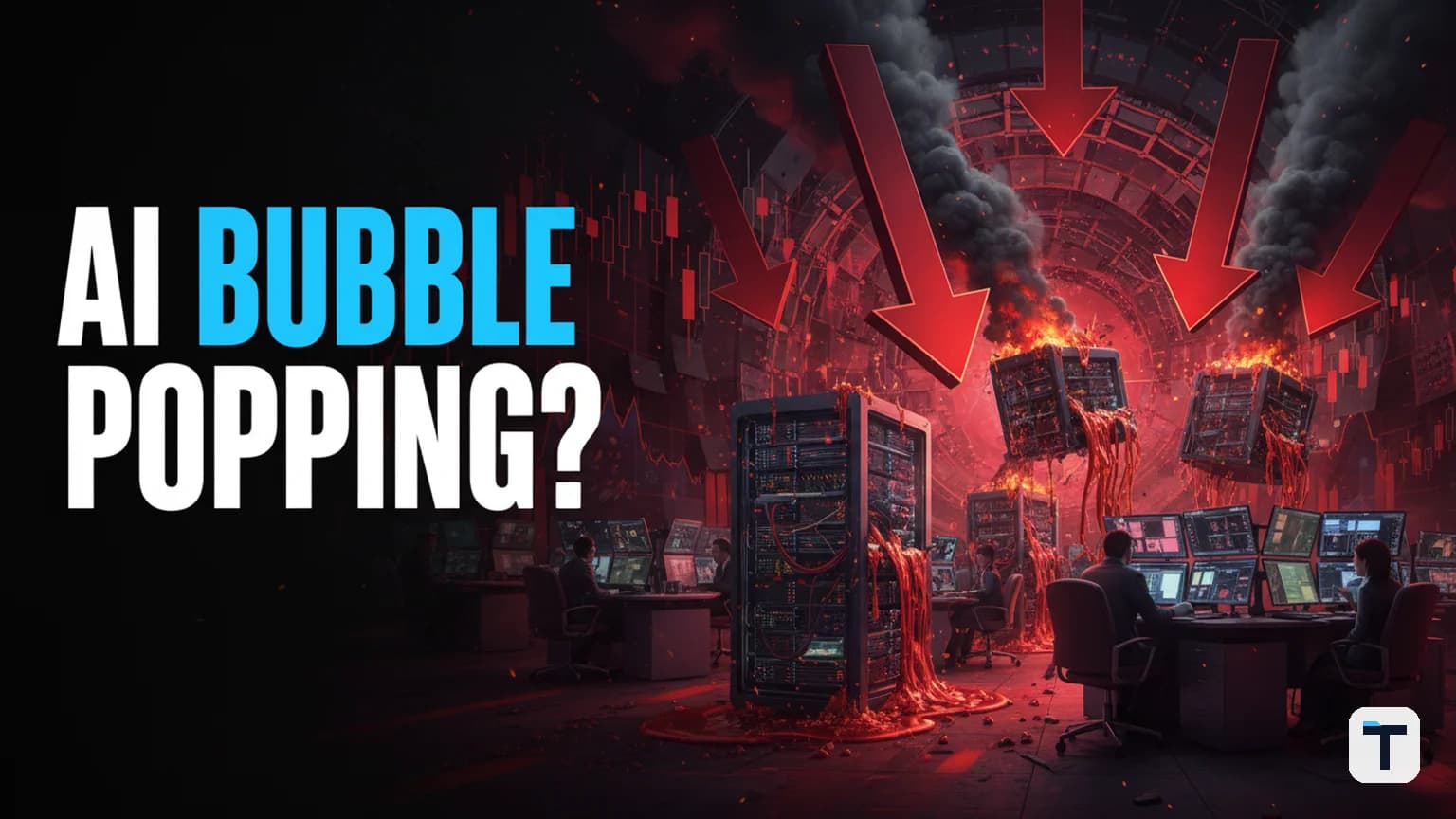

On July 23, 2026, the Magnificent Seven technology stocks lost $767 billion in market value in a single trading session — the group's worst one-day drop since April 2025 (Bloomberg). The crash came not after a quarterly loss or a guidance cut, but immediately after some of the most profitable companies in history posted record earnings. Alphabet (Google's parent) reported its highest quarterly profit ever: $12 billion in net income and $39.1 billion in operating cash flow, up 41% year-on-year (Quartr, Yahoo Finance).
This is the most confusing crash in recent market memory. Stocks fell precisely because the companies were doing too well — spending at a scale that markets suddenly decided may never pay off.
TL;DR: Why Tech Stocks Crashed in July 2026
Last verified: August 3, 2026 — Volatile facts (stock prices, market caps, ARR figures) change frequently. Re-check before acting on anything here.
- The trigger: Alphabet's Q2 2026 free cash flow turned negative ($-5.9 billion) for the first time since its 2004 IPO, because AI infrastructure spending ($44.9 billion) exceeded operating cash flow ($39.1 billion).
- The scale: Big Tech collectively carries approximately $1.65 trillion in AI-related off-balance-sheet debt — 122% of their on-balance-sheet debt load (Tom's Hardware).
- The revenue gap: J.P. Morgan calculates that AI must generate $650 billion in annual revenue industry-wide to deliver a 10% return on invested capital — but the largest AI companies combined currently produce under $100 billion (Tom's Hardware).
- The circular money: Nvidia is simultaneously supplier, investor, and debt guarantor for its own largest customers, creating a "circular financing loop" that concentrates risk if any link breaks (New York Times).
- The bottom line: This is a valuation crisis, not a revenue crisis. Companies are making more money than ever, but Wall Street is repricing the risk that the spending behind those numbers may be unsustainable.
What Caused the July 2026 Tech Stock Crash?
The sell-off was triggered by a structural realization, not a single news event. When Alphabet reported that it spent $44.9 billion on capital expenditures in a single quarter — exceeding the $39.1 billion in cash its operations generated — investors were forced to ask a question they had been avoiding: what if the AI infrastructure bonanza is building capacity for revenue that does not yet exist?
Google's free cash flow went negative by $5.9 billion in Q2 2026, the first time this has happened since the company went public in 2004 (Quartr, Substack/BluBird Capital). And this is not an isolated quarter. Alphabet has disclosed $811 billion in total signed future purchase commitments and contractual obligations for AI infrastructure (Digitimes). To put that in perspective: that figure is larger than the GDP of Saudi Arabia.
On the day Alphabet reported — July 23, 2026 — its stock fell 7% and Amazon fell 4%, even though Amazon and Nvidia had not even reported earnings yet. Alphabet alone shed roughly $300 billion in market capitalization. Nvidia lost approximately $80 billion, and Amazon lost about $120 billion — despite both companies being silent that day (Bloomberg, Fox Business).
For years, every time a tech giant increased AI spending, the stock went up. More spending meant more confidence. But on July 23, the same signal produced the opposite reaction. The narrative flipped.
The Four Risks Driving the AI Sell-Off
Risk 1: Can AI Companies Actually Turn a Profit?
The most fundamental question is whether the companies spending hundreds of billions on AI infrastructure can ever earn it back in revenue. J.P. Morgan's November 2025 analysis concluded that the AI industry needs to generate $650 billion in annual revenue to deliver a 10% return on invested capital — the minimum threshold for justifying risky investments (Tom's Hardware).
The current reality is far from that target:
| Company | Annualized Revenue (ARR) | Estimated Annual Loss | Source |
|---|---|---|---|
| OpenAI | ~$25 billion | ~$20.9 billion (2025 operating loss) | Reuters, ValueAdd VC |
| Anthropic | ~$14–47 billion (varies by reporting date) | Not publicly disclosed | SaaStr, LATKA |
Even adding Google's Gemini revenue (estimated ~$25 billion), the combined annual AI revenue across the three largest players is roughly $97 billion — against a $650 billion annual threshold. The gap is more than $550 billion per year.
Adding to the concern, OpenAI has signed approximately $1.4 trillion in total infrastructure commitments, while its annualized revenue run rate is $25 billion (ValueAdd VC, HyperAI). Sam Altman himself has publicly acknowledged that OpenAI loses money on $200-per-month Pro subscriptions.
Risk 2: The Depreciation Accounting Problem — Michael Burry's Warning
Legendary investor Michael Burry (of The Big Short fame) flagged what may be the most subtle risk: big tech companies are extending the "useful life" of their AI servers and chips to make their profits look better on paper (Motley Fool, Solurana).
Here is the accounting in plain English:
- A company buys $30 billion in AI servers and chips.
- If it estimates those servers last 3 years, it books $10 billion per year in depreciation costs.
- If it simply changes the estimate to 6 years, the annual cost drops to $5 billion per year.
- Same hardware, same money spent — but $5 billion in extra profit appears on the income statement.
Burry posted a table showing how useful life estimates have been extended over time:
| Company | Old Useful Life | New Useful Life | Period of Change |
|---|---|---|---|
| Meta | 3 years | 5.5 years | 2020 → 2025 |
| Alphabet/Google | 3 years | 6 years | (per Burry's post) |
| Oracle | Extended | Extended | (per Burry's post) |
| Microsoft | Extended | Extended | (per Burry's post) |
Sources: Motley Fool, Solurana
The beauty of this accounting question — and Burry's point — is that time will settle it. If the servers genuinely last six years, big tech's reported profits are real. If they last three, then reported profits are overstated by tens of billions per year. We will know the answer by approximately 2028, when the first wave of servers purchased during the AI boom ages out.
Risk 3: Shell Companies and $1.65 Trillion in Hidden AI Debt
Nobody has $5 trillion in cash to build AI data centers. So the money is being borrowed — but not always on the companies' own balance sheets.
The most striking example: Meta is building a $29 billion data center, but Meta did not borrow $29 billion. Instead, a newly formed entity called Beignet Investor LLC borrowed $27.3 billion from bond investors (debt due in 2049). S&P Global assigned the entity an "A+" preliminary rating (S&P Global Ratings). The Financial Times confirmed Beignet Investor is a joint venture between Meta and Blue Owl, a private capital firm (Financial Times).
Meta owns only 20% of the venture. The shell company owns the data center, and Meta is essentially a tenant paying rent. The arrangement keeps $27 billion in debt off Meta's own balance sheet — which means shareholders and analysts see a lighter liability picture.
This is not an isolated case. According to analysis reported by Tom's Hardware, five major tech companies collectively carry approximately $1.65 trillion in AI-related commitments that sit off their balance sheets — an amount equivalent to 122% of their reported on-balance-sheet debt (Tom's Hardware, Foreign Policy Journal).
Risk 4: The Circular Financing Loop — Nvidia as Supplier, Investor, and Guarantor
The most complex risk is the circular flow of money between Nvidia and its largest customers, particularly OpenAI.
Nvidia is in talks to provide a $250 billion financing guarantee for OpenAI to lease a data center (developed by a SoftBank subsidiary, with total investment expected to exceed $500 billion). Separately, Nvidia is negotiating a chip procurement financing deal with OpenAI worth up to $350 billion. Nvidia's potential exposure to OpenAI alone could reach $600 billion — nearly three times its own annual revenue of approximately $216 billion (New York Times).
Here is how the money moves in a circle:
- Nvidia provides financing guarantees to OpenAI.
- SoftBank builds the data center using that-backed arrangement.
- OpenAI leases computing capacity from the facility.
- OpenAI uses Nvidia-backed financing to purchase Nvidia chips.
- Nvidia recognizes revenue and orders, then provides more guarantees for even larger future projects.
Nvidia is simultaneously the supplier (selling chips), the investor (backing deals), and the debt guarantor (insuring repayment). If OpenAI's revenue fails to grow fast enough to service this massive infrastructure commitment, Nvidia faces a triple loss: lost chip sales, lost equity value, and defaulted loan guarantees.
The bond market noticed. On July 27, 2026 — the day news of the Nvidia-OpenAI deal broke — the price of insurance on Nvidia's debt (credit default swaps, or CDS) recorded its biggest intraday jump, signaling that bond investors are growing wary of the circular financing structure (TMGM). As the old market saying goes: the stock market tells you what people hope for; the insurance market tells you what they fear.
How Does This Compare to the Dot-Com Bubble?
This is the question every investor and analyst is asking. The comparison is imperfect but instructive:
| Factor | Dot-Com Bubble (1999–2001) | AI Buildout (2024–2026) |
|---|---|---|
| Revenue of key companies | Near zero (many pre-revenue) | Record profits, tens of billions in real revenue |
| Infrastructure investment | Fiber optic cable overbuild | Data centers, GPUs, power plants |
| Hidden leverage | Limited SPV use | $1.65T in off-balance-sheet commitments |
| Accounting concerns | Revenue recognition fraud | Useful-life depreciation extensions |
| Time to clarify | ~3 years (crash 2000–2002) | Unknown — 2028 earliest (server lifespan test) |
| Key difference | Companies had no cash flow | Companies generate massive cash flow, but spend more than they earn |
The critical difference: in the dot-com era, companies had no revenue. Today's tech giants are more profitable than any companies in history. The risk is not that they cannot make money — it is that they may be spending money faster than they can ever earn it back, and using accounting structures that make that gap harder to see.
What This Means for You
If you use AI tools for your work or business: The AI infrastructure arms race means competition among providers (OpenAI, Anthropic, Google, Meta, Amazon) is intensifying — which is good for you. Token costs have been dropping dramatically and will likely continue to fall as companies fight for market share. The pressure to prove ROI on multi-trillion-dollar investments means affordable AI is coming, fast. Understanding how to position your work in an AI-first world matters more than tracking daily stock prices.
If you are building a business on AI: Diversify your dependency. If your entire stack runs on one provider's API, a pricing change or a provider failure hits you directly. The market turbulence is a reminder that even the largest AI companies face existential financial questions. Consider common AI tool problems and how to fix them before scaling your dependency on any single platform.
If you are an AI researcher or evaluator: The spending pressure creates incentives for shortcuts. Labs are motivated to overstate benchmarks and capabilities to justify valuations. Understanding why AI benchmarks are gaming the system helps you separate genuine progress from hype-driven reporting.
If you are an investor: Watch three indicators: (1) token cost trends — if they keep falling, enterprise AI adoption will justify the spending; (2) the Nvidia CDS spread — if insurance costs keep climbing, bond markets are pricing real default risk; and (3) the 2028 server depreciation cliff — that is when Burry's accounting bet gets settled by reality.
Frequently Asked Questions
Q: Why did tech stocks fall in July 2026? A: Tech stocks fell because Alphabet's Q2 2026 earnings revealed negative free cash flow ($-5.9 billion) for the first time since 2004, caused by AI infrastructure spending ($44.9 billion) exceeding operating cash flow ($39.1 billion). This triggered a repricing of the risk that the trillion-dollar AI buildout may not generate sufficient returns, leading the Magnificent 7 to lose $767 billion in market value on July 23, 2026 (Bloomberg).
Q: Is the AI bubble bursting in 2026? A: It is too early to call it a burst. Unlike the dot-com era, today's tech giants generate record revenue and profits — the issue is that their spending exceeds their cash generation, and $1.65 trillion in AI commitments sits off their balance sheets (Tom's Hardware). The market is repricing the risk, not necessarily predicting collapse. The answer will depend on whether AI revenue can close the gap from ~$97 billion today toward J.P. Morgan's $650 billion annual threshold.
Q: How much are big tech companies spending on AI infrastructure? A: Alphabet alone spent $44.9 billion in capital expenditures in Q2 2026 and has $811 billion in total future purchase commitments (Digitimes). Across the five largest tech companies, AI-related spending and commitments are estimated at over $1.65 trillion in total debt and obligations — 122% of their reported balance-sheet debt.
Q: What is the Nvidia circular financing loop? A: Nvidia is simultaneously supplying chips to OpenAI, financing OpenAI's data center leases ($250 billion guarantee), and underwriting OpenAI's chip purchases ($350 billion in financing) — making Nvidia its own largest customer's supplier, investor, and debt guarantor. Nvidia's potential exposure to OpenAI alone could reach $600 billion against its own annual revenue of ~$216 billion (New York Times).
Q: What did Michael Burry say about AI depreciation? A: Burry flagged that big tech companies are extending the estimated useful life of AI servers from ~3 years to 5.5–6 years, which reduces annual depreciation costs and inflates reported profits by billions. The truth will be revealed around 2028, when the first wave of AI-boom servers ages out and their actual lifespan can be compared to the accounting estimates (Motley Fool).
Q: Should I stop using AI tools because of the market crash? A: No. The market sell-off is a financial valuation issue, not a technology quality issue. AI capabilities are improving rapidly, and token costs are falling. The competitive pressure to prove ROI means AI tools are getting cheaper and better for end users. The companies may face financial turbulence, but the technology itself is maturing into real productivity.
Discussion
0 comments