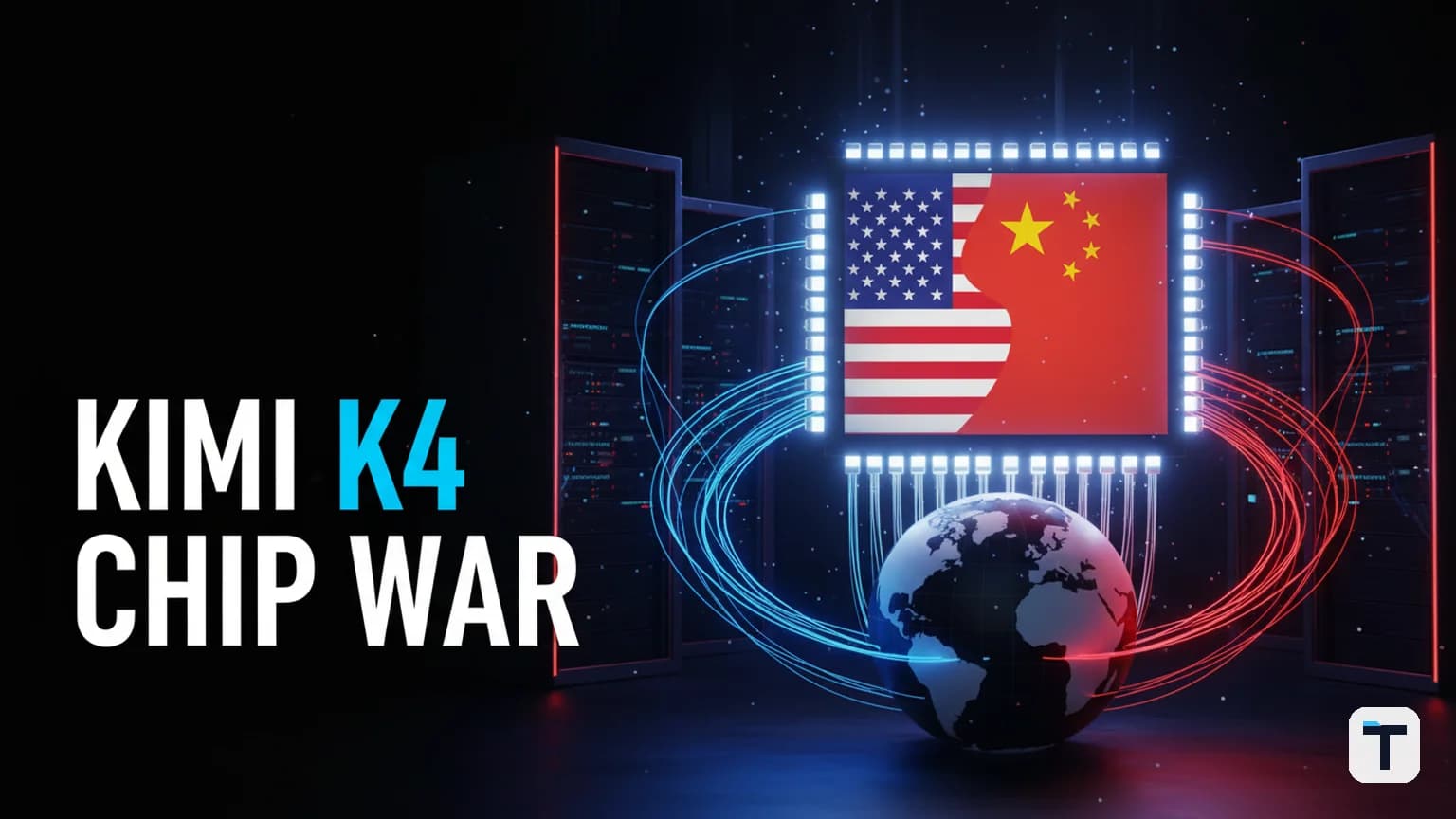

Verdict: Kimi K4 — Moonshot AI's successor to the 2.8-trillion-parameter Kimi K3 — is already in early development, and sources familiar with the plan say it will be significantly larger than K3. But the real story isn't parameter counts. It's whether Moonshot can get enough Nvidia Blackwell chips to train it, given US export controls, the company's existing workaround through Southeast Asia, and a Chinese domestic chip industry that isn't ready yet. Based on Moonshot's ~52-day release cadence and the Manifold prediction market's 48% odds for a 2026 release, K4 could land before year-end — if the hardware arrives.
Last verified: 2026-08-02
- Kimi K3 launched July 16, 2026: 2.8T parameters, 1M-token context, open weights dropped July 26.
- Moonshot is actively seeking more Blackwell chips for K4 training (Bloomberg, TechInAsia, July 2026).
- K3 was trained on ~20,000 Nvidia chips accessed via an Alibaba cloud-computing deal, plus Blackwell chips via Southeast Asia.
- The White House accused Moonshot of distilling Anthropic's Fable model to build K3; Nvidia's Jensen Huang pushed back on restrictions.
- Pricing/limits are volatile — everything here was last checked August 2, 2026.
What Is Kimi K4 and Why Does It Matter?
Kimi K4 is the next-generation large language model from Moonshot AI, the Beijing startup behind the Kimi model family. It has not been officially announced, but multiple sources told Bloomberg and TechInAsia that Moonshot is already seeking additional Nvidia Blackwell chips specifically to train it. K4 is expected to be meaningfully larger than K3, which at 2.8 trillion parameters is already the largest open-weight AI model in the world.
This matters for three reasons. First, the Kimi K3 model — released July 16, 2026 — ranks fifth among 215 models on the public benchmark tracker BenchLM, and holds the top published Arena Elo score for coding (1679) among all tracked models. A significantly bigger follow-up could push further into territory dominated by Anthropic's Claude Fable 5 and OpenAI's GPT-5.6 Sol. Second, K3's open-weight release on July 26, 2026 — a day ahead of Moonshot's stated July 27 target — means K4 will likely follow the same open-weight pattern, putting frontier-class capabilities in anyone's hands for free. Third, the hardware story behind K4 is a real-time test of whether US export controls can slow Chinese AI development, or whether the workaround infrastructure that built K3 will scale.
How Was Kimi K3 Built? (This Tells You What K4 Needs)
K3's training setup reveals the compute challenge K4 faces. According to Bloomberg reporting on July 31, 2026, Moonshot trained K3 on a cluster of approximately 20,000 Nvidia chips accessed through a cloud-computing agreement with Alibaba, which is both Moonshot's compute provider and one of its largest investors. Sources said the chips were H200s (Nvidia's Hopper generation); an Alibaba spokesperson denied the specific chip model but did not deny the broader arrangement.
On top of that, a person familiar with Moonshot's procurement confirmed the startup has a separate channel for accessing Nvidia's newer Blackwell-generation chips through data centers in Southeast Asia — specifically Thailand. Whether that access runs through legal remote rental agreements or direct purchases (the latter would breach US export rules) was not specified.
The White House escalated the story on July 22, 2026, when Michael Kratsios, director of the White House Office of Science and Technology Policy, posted on X that Moonshot "developed a sophisticated internal platform to conduct large-scale distillation against US models," specifically accusing the company of distilling Anthropic's Fable model to build K3. Kratsios also said Moonshot used GB300 servers acquired either through Thailand or by other means. No evidence was provided, and Moonshot did not respond publicly.
The compute stack behind K3, at a glance
| Component | Detail | Source |
|---|---|---|
| Primary training cluster | ~20,000 Nvidia chips via Alibaba cloud deal | Bloomberg, July 31, 2026 |
| Chip generation (reported) | H200 (Hopper); Alibaba denied the specific model | Reuters |
| Secondary Blackwell access | Blackwell chips via Thailand / Southeast Asia | Tom's Hardware, July 2026 |
| Distillation accusation | White House claims K3 distilled from Anthropic Fable | CyberScoop, July 22, 2026 |
| Inference hardware | Moonshot recommends ≥64 H20 chips for self-hosted K3 | Moonshot platform docs |
When Will Kimi K4 Be Released?
Based on Moonshot's historical release cadence, a K4 release in 2026 is plausible but not guaranteed. AI Release Tracker, which logs 12 Moonshot models from October 2023 through Kimi K3, calculates an average of 52 days between releases and projects the next model around September 6, 2026. However, that average includes smaller incremental releases (K2.5, K2.6, K2.7 Code), and a full generation jump (K3 to K4) would likely require more time.
The Manifold prediction market — which resolves YES if Moonshot officially releases any model explicitly branded "Kimi K4" before December 31, 2026 — sits at 48% as of late July 2026. That uncertainty reflects the tension between Moonshot's demonstrated speed (K3 went from API launch to open weights in ~10 days) and the hardware constraints that could delay a larger training run.
The informed estimate: if Moonshot can secure Blackwell access in the next 2–3 months and training proceeds on a similar timeline to K3, a late-Q4 2026 release is possible. If chip access stalls or the US tightens enforcement, a 2027 release is more likely.
Why Doesn't Moonshot Just Use Chinese Chips?
This is the core tension behind K4. China has poured enormous resources into building its own chip industry, and for inference — actually running a model once it's trained — domestic chips like Huawei's Ascend 910C are being adopted quickly. But training a frontier-class model (2.8T+ parameters) requires hundreds of chips connected with high-speed networking, and the domestic hardware racks built for that scale simply aren't widely available yet, with delivery times stretching up to 6 months.
Moonshot itself relies heavily on the Nvidia H20 — the one chip Chinese companies are currently allowed to access under US rules — to serve K3 on its own platform. For training the next model, H20 chips alone may not be sufficient, which is why Moonshot is reportedly seeking Blackwell specifically.
The pattern isn't unique to Moonshot. Three of China's most prominent AI labs have now been linked to Blackwell chips:
| Lab | Model | Blackwell allegation | Source |
|---|---|---|---|
| Moonshot AI | Kimi K3 (2.8T) | Trained on Blackwell via Thailand | Bloomberg, White House, July 2026 |
| DeepSeek | V4 (1.6T) | Trained on smuggled Blackwell in Inner Mongolia | CNBC, December 2025 |
| Alibaba | Qwen3.8-Max-Preview (2.4T) | Sources say also trained on Nvidia chips including Blackwell | Bloomberg sources, July 2026 |
DeepSeek's case is the most dramatic: a senior Trump administration official told reporters in April 2026 that DeepSeek V4 was trained on "several thousand" smuggled Blackwell GPUs hidden in an Inner Mongolia data center. Nvidia called the smuggling claims "far-fetched," and DeepSeek denied using Blackwell, claiming it trained on H800s and Huawei Ascend 910C processors. No seizures or arrests followed the disclosure.
What Did Nvidia's CEO Say About Chinese Open-Weight Models?
Nvidia CEO Jensen Huang made his first-ever post on X on July 24, 2026 — and used it to argue that the world needs both closed and open frontier models. He shared a letter titled "Open Weights and American AI Leadership," signed by Nvidia, Microsoft, Meta, IBM, Dell, Palantir, Mistral, Hugging Face, Perplexity, CrowdStrike, Andreessen Horowitz, Y Combinator, and 13 other companies (25 signatories total).
Huang's argument: open models "strengthen safety and cybersecurity, accelerate innovation and diffusion, and enable sovereignty." The letter's notable absentees — OpenAI, Anthropic, Google, and xAI — are the four labs currently racing hardest on closed frontier models. Anthropic and OpenAI have actively called for more restrictions on Chinese open-weight models, citing national security and cybersecurity concerns. The position of the 25-company coalition is the opposite: restricting open models pushes development to other countries (China) and creates a few single points of failure that nobody outside those companies can test.
For anyone building on AI, this split matters because it determines which models you'll legally be able to use. If Washington restricts Chinese open-weight models like Kimi, US companies that currently use them — including through platforms like Hermes Agent and OpenCode — would lose access to some of the cheapest frontier-class models available.
How Did Kimi K3's Launch Reveal the Inference Problem?
Within 48 hours of K3's launch on July 16, 2026, Moonshot had to stop accepting new subscriptions entirely. The official Kimi account posted on July 19: "Kimi K3 has received far more love than we expected, and our GPUs are feeling it. Over the past 48 hours, demand has pushed close to the limits of our current capacity."
The company temporarily paused new sign-ups to protect existing subscribers and announced plans to restructure its subscription model into split tiers to distribute compute more evenly. This is the inference bottleneck: as AI models take on longer, agentic workloads — not one-off question answering but continuous multi-step tasks — they consume far more tokens and GPU time per user. Training a 2.8T model is hard; serving it to tens of thousands of simultaneous users running agent loops is arguably harder.
This has direct implications for K4. A significantly larger model means higher inference cost per request (more active parameters per token, or at minimum more total memory required). If Moonshot struggled to serve K3's demand within 48 hours, K4's launch could face the same wall — unless infrastructure scales ahead of the model.
For a deeper look at pairing K3 with an agent framework, see our Kimi K3 AI agent setup guide.
What Does the Kimi Model Lineage Tell Us About K4?
Moonshot's release history shows a clear pattern: each major version roughly doubles total parameters, while the cadence compresses.
| Release | Date | Total parameters | Key advance |
|---|---|---|---|
| Kimi K2 | Jul 2025 | 1T | First open-weight debut; 32B active MoE |
| Kimi K2.5 | Jan 2026 | ~1T | Multimodal (vision + text) |
| Kimi K2.6 | Apr 2026 | 1T | 300-agent swarms; beat GPT-5.4 on SWE-Bench Pro |
| Kimi K3 | Jul 16, 2026 | 2.8T | 1M context, multimodal, always-on reasoning |
| Kimi K4 | Expected | >2.8T (reported) | Unknown — likely larger context, deeper agent integration |
Source: AI Release Tracker, Presenc AI lineage research
The jump from 1T (K2 series) to 2.8T (K3) was nearly 3x. If K4 follows the same pattern, it could land in the 4–5T range — though this is speculation based on historical scaling, not a confirmed figure. What is confirmed is that Moonshot is seeking more Blackwell chips for K4, which implies a training run that exceeds K3's compute budget.
For context on how the broader training landscape is shifting — from web text to reasoning priors and synthetic data — see our analysis of the LLM training paradigm shift in 2026.
What This Means for You
If you're a developer or startup building on open-weight models: Start planning for a K4 evaluation now, even though it hasn't shipped. When K3's open weights dropped, Together AI and Modal had day-0 hosted access ready. K4 will likely have similar partner-hosted options, so you won't need to self-host a multi-trillion-parameter model. But you should pin commit hashes from Moonshot's Hugging Face org when integrating anything K-related, and read the LICENSE directly rather than assuming terms carry over from K3.
If you're a builder using AI agents: The inference bottleneck that shut down K3 subscriptions within 48 hours is a warning. If you're routing mission-critical work through any single hosted model — Chinese or American — you need a fallback. Our system-over-model framework for plugging new LLMs into agent workflows shows how to swap models without rebuilding your agent stack, and our budget AI model decision guide comparing DeepSeek V4 Flash vs GPT-5.6 Luna helps you hedge across price tiers.
If you're watching the US-China AI race: The K4 story is the export-control story. Moonshot built K3 by stitching together 8-chip Blackwell servers from at least two separate cloud providers, redesigning the cross-data-center networking themselves. If US enforcement tightens and that supply dries up, K4's timeline stretches. If it doesn't — or if domestic Chinese chips close the training gap faster than expected — K4 arrives sooner. Either way, Chinese open-weight models are not going away. The question is whether you'll be allowed to use them.
Related reading
FAQ
Q: What is Kimi K4? A: Kimi K4 is Moonshot AI's planned successor to the 2.8-trillion-parameter Kimi K3 model. It has not been officially announced, but sources told Bloomberg and TechInAsia that Moonshot is already seeking additional Nvidia Blackwell chips to train it. K4 is expected to be significantly larger than K3.
Q: When will Kimi K4 be released? A: No official date exists. Moonshot's average release cadence is ~52 days, but a full generation jump (K3 to K4) typically takes longer. The Manifold prediction market puts the odds of a 2026 release at 48% as of late July 2026. A late Q4 2026 release is plausible if chip access holds; 2027 is more likely if it doesn't.
Q: How many parameters will Kimi K4 have? A: No confirmed figure. Based on Moonshot's scaling pattern (K2 series at 1T, K3 at 2.8T), a K4 in the 4–5 trillion range is plausible speculation, but this is not a verified number. What is confirmed is that Moonshot is seeking more compute than K3 required.
Q: What chips does Moonshot need to train K4? A: Moonshot is reportedly seeking Nvidia Blackwell-generation chips (GB200/GB300 class). K3 was trained on ~20,000 Nvidia chips via an Alibaba cloud deal (reported as H200s) plus additional Blackwell units accessed through Southeast Asia. US export controls restrict direct Blackwell sales to China.
Q: Is Kimi K4 open source? A: If it follows the K3 pattern, K4 will likely be released as open-weight. K3's full weights were published on July 26, 2026 — free to download, with Together AI and Modal offering day-0 hosted access. Moonshot has consistently shipped open weights since the K2 series in July 2025.
Q: Why did Moonshot pause Kimi K3 subscriptions? A: Within 48 hours of K3's July 16, 2026 launch, demand exceeded Moonshot's GPU capacity. The company paused new subscriptions on July 19 to protect existing users and announced plans to split subscription tiers. This is an inference-capacity problem, not a training problem — and it's a warning sign for K4's launch.
Discussion
0 comments