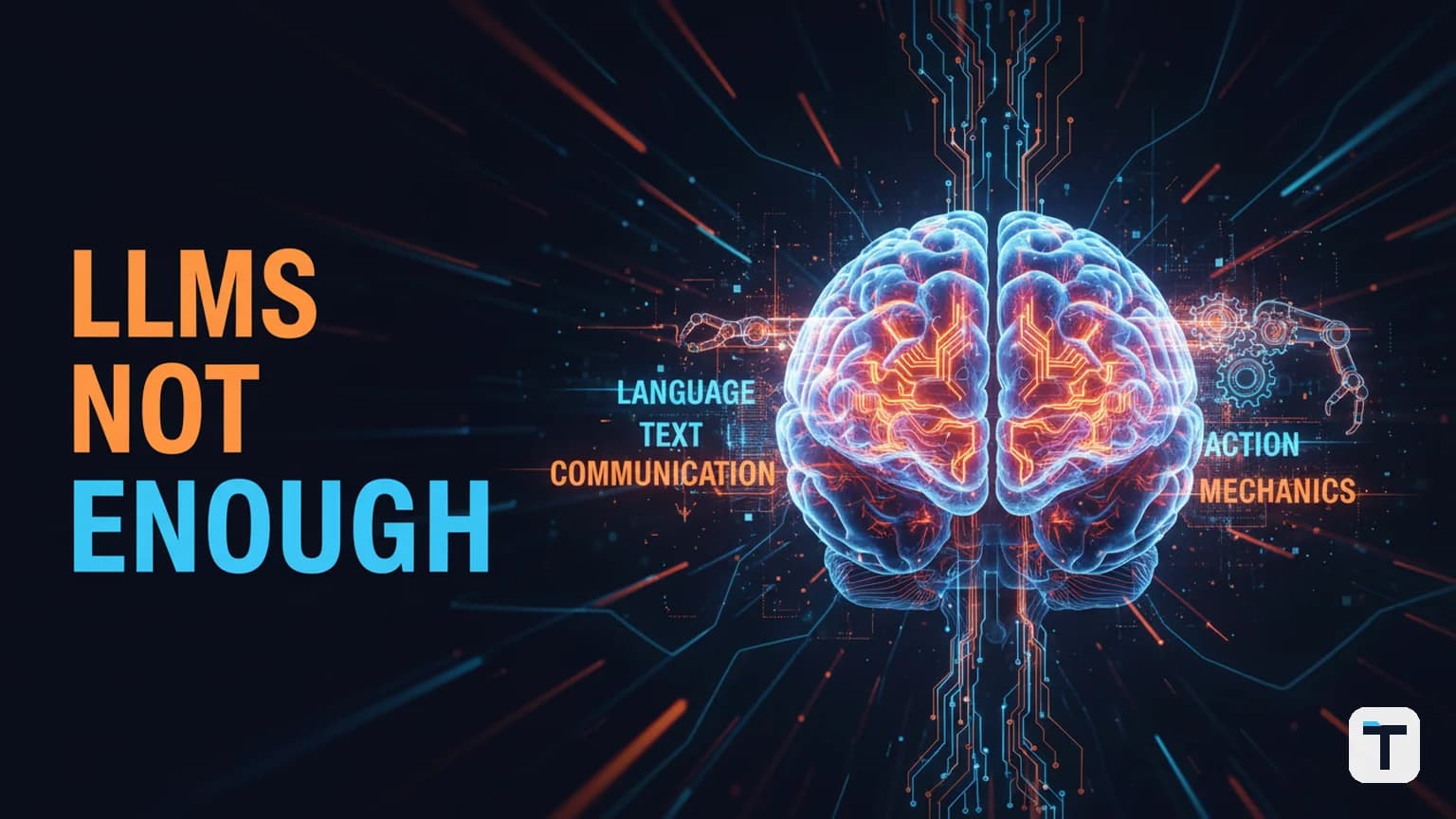

Large Language Models (LLMs) are not obsolete in 2026 — but they are no longer the finishing layer. For real AI agents that close support tickets, run network operations, or execute business workflows, the work is increasingly moving to Large Action Models (LAMs): models trained to pick the next action, hand it to the right tool, and decide whether to keep going or stop. Pair that with Domain-Specific Language Models (DSLMs) — models tuned for one industry's vocabulary and failure modes — and you get the architecture most enterprise teams are quietly building toward this year. This piece breaks down where the LLM ends and the action layer begins, why "agent sprawl" is the new technical debt, and what a practical 2026 stack looks like for a team that ships.
Last verified: 2026-08-02 TL;DR:
- LLMs answer; LAMs act. The action capability is increasingly trained into the model, not just bolted on by a wrapper.
- DSLMs (domain-specific language models) are a Gartner top 2026 strategic trend — a 7B-parameter specialist often beats a 400B generalist on its home turf, at a fraction of the inference cost.
- "Agent sprawl" is the new shadow IT: 94% of enterprises worry it is multiplying complexity and risk; the average enterprise already runs ~12 agents.
- Anthropic's July 2026 "J-space" research shows LLMs quietly develop an internal reasoning workspace — a signal that the language layer still has real runway, even as the action layer grows up.
- The winning 2026 stack isn't one model; it's a portfolio: a general LLM for reasoning, DSLMs for each domain, small task models for routing, and a LAM to execute. Pricing/limits/model versions change often — re-check before committing budget.
What is a Large Action Model (LAM)?
A Large Action Model is a model trained primarily to generate the next action — not the next word. Instead of predicting text continuation from a prompt, a LAM predicts which tool to call, with which parameters, and what to do with the response that comes back. The key distinction: the action capability is trained into the model using trajectory data (real sequences of state → action → result), rather than bolted onto a chat model by an external harness.
That last point matters more than it sounds. Strip the tool-calling scaffolding off an agentic LLM and you get a chatbot. Strip the scaffolding off a true LAM and you still have an action model — the behavior lives in the weights.
This is why the production pattern in 2026 is often both: an agentic LLM handles open-ended reasoning and interpretation, then routes high-stakes, well-bounded actions (a payment, a database write, an API call) through a guarded LAM that does the same thing reliably every time (Analytics Vidhya, July 2026).
LLM vs LAM vs agentic LLM: what's actually different?
The three terms get used interchangeably in vendor decks, but the architecture is distinct. Here is the honest comparison.
| Dimension | LLM (e.g. GPT-5.4, Claude Opus 4.7) | Agentic LLM | Large Action Model (LAM) |
|---|---|---|---|
| Primary output | Text / code completion | Text + tool calls via a wrapper | The next action + its parameters |
| Where action lives | Nowhere (language only) | In the surrounding harness | Trained into the model weights |
| Remove the wrapper | Same chatbot | Just a chatbot | Still an action model |
| Best at | Reasoning, synthesis, drafting | Flexible, exploratory tasks | Reliable, bounded execution |
| Failure mode | Confident prose, no follow-through | Clicks the wrong button 3× | Over-fits to trained trajectories |
| Cost at scale | Highest (frontier tokens) | Frontier tokens × orchestration | Lower — often a smaller specialist |
The practical takeaway: for "answer this question" you want an LLM; for "figure out what to do and try a few things" you want an agentic LLM; for "do exactly this, every time, and tell me when you're done" you want a LAM. The honest truth in 2026 is that most teams still ship with an agentic LLM because the tooling is mature and iteration is fast — and they bring in a LAM only when reliability, latency, or cost forces the issue.
Are LLMs actually "done"? (The J-space surprise)
No — and the evidence is recent. In July 2026, Anthropic published research on a hidden internal structure inside Claude it called "J-space", uncovered with a new interpretability tool called the Jacobian lens (J-lens) (MIT Technology Review, July 9, 2026).
J-space is a small, emergent "workspace" where the model holds concepts it can report on, control, and reuse — without writing them into the output. It behaves like a scratchpad for deliberate reasoning, operating amid a sea of more automatic processing. Anthropic found it accounts for less than 10% of Claude's activity yet carries most of the work that matters for higher-order reasoning and safety-relevant decisions. The full paper and an open-source J-lens implementation are at transformer-circuits.pub.
What this means for enterprises: the language layer is not a "done and dusted" commodity. The path from word prediction to genuine deliberation is still being mapped — which refutes the lazy framing that "LLMs are obsolete." The accurate framing is: language modeling is no longer the bottleneck, but it is no longer the whole product either. Reasoning + action + domain context is the 2026 stack.
What is a Domain-Specific Language Model (DSLM)?
A DSLM is a generative model trained or refined on a specialized corpus — legal filings, clinical records, telecom OSS/BSS logs, financial 10-Ks — rather than the open web. The argument for them is sharp and economic: a 7B-parameter DSLM routinely outperforms a 400B general-purpose model on domain tasks, at 10–50× lower inference cost, with better governance properties (Gartner, March 2026; Open Empower, April 2026).
There are three ways to get one, in order of effort:
- RAG on a general model — inject domain knowledge at inference time. Fastest to ship, least precise. Start here.
- Fine-tune an open base model (Llama, Mistral, Qwen) on your domain data. Best balance of cost and specialization. Where most enterprises should land.
- Pre-train from scratch — the Bloomberg GPT / Med-PaLM route. Only worth it if you have a proprietary data moat nobody else can match.
A useful 2026 framing: DSLMs are the neurosurgeon where the general LLM is the general practitioner. For a contract review, a legal DSLM understands that "yield" means a legal obligation, not a harvest — and it understands it without a paragraph of prompt-engineered disambiguation.
How do you wire the action layer to the model layer?
Once you have a reasoning model (LLM) and a domain-tuned model (DSLM), the action layer is what closes the loop. A clean mental model, drawn from how production telecom and NOC (network operations center) teams build this today:
- An alarm comes in from the network — say, a packet-loss spike on an IPX link. A general LLM can triage the symptoms.
- The DSLM recognizes the domain pattern — it has seen OSS/BSS alarm topologies a thousand times, the "bulbous onion" of layers where a top-level alarm has six hidden root causes. It routes the ticket to the right sub-domain.
- The LAM decides the next action: which engineer tool to call, with which parameters, and whether to escalate or auto-remediate. Critically, it also decides whether to stop — a common failure of pure agentic loops is that they never park the ticket.
- The agent (the hands and legs) executes the tool call the LAM specified and returns the response. The LAM reads the response and decides: another tool, another agent, or done.
The phrase worth holding onto: agents are the hands and legs of a nervous system run by the model. Take away the model's reasoning and the agent has no judgment; take away the agent and the model has no reach. Both matter; neither is the product on its own.
This is also where the memory layer earns its keep. A common complaint about LLMs through 2025 was that the moment you closed a session, you lost everything. Modern production stacks solve this with a persistent memory tier — and we've written separately about the three layers every AI agent OS needs, and why the memory layer matters most.
What is "agent sprawl" and why is it the new technical debt?
Agent sprawl is the uncontrolled proliferation of AI agents across an enterprise without coordinated governance, a shared context layer, or lifecycle management. It is the AI equivalent of the SaaS sprawl of the early 2010s — except the blast radius is bigger, because agents take actions, not just store data.
The numbers are stark. Per an OutSystems 2026 survey of 1,900 enterprises, 94% report concern that agent sprawl is increasing complexity, technical debt, and security risk. The average enterprise already runs about 12 AI agents, projected to grow 67% by 2027 (Atlan, 2026).
A second, subtler dimension is context sprawl: your sales agent knows one thing, your customer-success agent knows another, and they don't talk. One prioritizes high-velocity outreach on a contact; the other flags the same contact as GDPR-restricted. Without a shared context layer they don't coordinate — they collide. Tools like Databricks' Unity AI Gateway and Okta's non-human-identity lifecycle management attack the identity dimension of sprawl (who agents are); the context dimension (what agents know) is still mostly unsolved.
If you're building a small set of agents for your own work or small business, the lesson is to architect for a shared event bus and an agent registry from day one — adding them later means rewriting integrations. If you want a concrete remote-access pattern for your agent dashboard, see our Tailscale remote-access guide.
What does the GPT-5 era "harness" signal tell us?
A subtle but important shift happened between GPT-4 and GPT-5: the model started searching. When you send a question to a GPT-5-family model today, it often doesn't just emit text — it triggers a web search, reasons over the results, and then answers. That is a harness — an action the model takes before the answer, not just a word it predicts (OpenAI, GPT-5 launch, Aug 2025; Perplexity AI Magazine, April 2026).
The signal for builders: the line between "the model" and "the agent around the model" is blurring. Frontier models are absorbing the first tier of agentic behavior (search, tool use, memory) directly. That is good for users and bad for anyone whose product was just "an LLM with a search wrapper." The defensible layer is moving up — into domain context (DSLMs) and reliable execution (LAMs) — and down — into memory and the agent OS. The wrapper in the middle is increasingly a commodity.
When does quantum AI actually matter? (A realistic timeline)
Quantum computing's role in AI is the topic most likely to be over-hyped or under-delivered in a single sentence. The honest, primary-source picture:
- Quantum security is real and here now. NIST released its first three finalized post-quantum encryption standards on August 13, 2024, and added HQC as a fifth backup algorithm on March 11, 2025. These are production-ready — the migration is a when, not an if. Some experts estimate a quantum computer capable of breaking current encryption could appear within a decade.
- Quantum machine learning is not commercial yet. Academic work on quantum ML for drug discovery and molecular property prediction is active and serious (Nature, 2025; ACS Chemical Reviews, 2024) — but the algorithms are still hybrid (quantum + classical) and run on noisy, small-qubit hardware. A realistic expectation is commercial quantum-ML applications in healthcare and materials starting around 2028–2029, with the broad payoff further out.
- Room-temperature quantum is the unlock to watch. Today's quantum computers operate at near-Kelvin temperatures. The practical move most researchers want is an API-scale classical interface so students and innovators can at least simulate quantum approaches — even if a simulation will not solve a real problem, it trains the next generation. Watch for indigenous, room-temperature machines; until they exist, quantum AI stays in the lab.
For most readers: budget for post-quantum cryptography migration in 2026, keep quantum ML on the watchlist with a 3–5 year horizon, and ignore anyone selling "quantum AI" as a 2026 product.
What does a practical 2026 AI stack look like?
Synthesizing everything above, here is the portfolio architecture enterprises are converging on — and a small team can run a downsized version of the same shape:
| Layer | What it does | Example in 2026 |
|---|---|---|
| General LLM | Reasoning, synthesis, drafting, open-ended interpretation | GPT-5.4 / Claude Opus 4.7 / Gemini 3.1 Pro |
| Domain DSLM(s) | Industry-specific accuracy at low cost | Legal/telecom/finance fine-tune on a 7B base |
| Task-specific small models | Fast, cheap classification, routing, extraction | Sub-1B classifiers, routers |
| LAM / action layer | Reliable, bounded execution of well-known workflows | A trained action model for your top 20 tickets |
| Memory layer | Persistent state across sessions | Vector store + structured memory (see our memory blueprint) |
| Agent registry + event bus | Cures agent sprawl before it starts | Agent inventory + shared pub/sub for context |
| Model router | Sends each request to the right model by task/cost | A small policy model or rule-based router |
The winner isn't the biggest model. It's the right model for each task — and the connective tissue between them. If you're starting from zero, begin with a free agent team stack and a decision framework for picking an agent OS; add the DSLM and LAM layers only when the general stack surfaces a concrete reliability or cost gap.
What this means for you
- If you're a small team / solo builder: You don't need a LAM yet. Start with an agentic LLM (cheap, mature tooling), add a RAG-backed domain knowledge layer, and budget for a memory tier. The decision to build a LAM should be evidence-driven: wait until you have a specific workflow that fails three times out of five with the agentic loop.
- If you're in enterprise IT: Treat agent sprawl as the new shadow IT. Stand up an agent registry and a shared context layer now — adding them after you have 30 agents is an order of magnitude harder than doing it at agent #3.
- If you're a hiring manager: The scarce role in 2026 isn't "prompt engineer." It's the person who can design the portfolio — model router, DSLM fine-tuning pipeline, action-layer guardrails, and the memory/MIME schema that keeps the full stack coherent.
- If you're tracking the frontier: Watch the DSLM + LAM axis more than the next GPT point release. The frontier general models are converging in capability; the defensible moat is domain data and reliable execution.
Related reading
FAQ
Q: Is a Large Action Model just a fine-tuned LLM? A: No. A LAM is trained primarily for action generation using trajectory data — sequences of state, action, and result — with different objectives and optimization targets than a language model. You can fine-tune an LLM toward action behavior, but a true LAM's action capability lives in the weights, not in a surrounding harness.
Q: Do LAMs make agentic LLMs obsolete? A: No. The strongest production systems in 2026 use both: an agentic LLM for reasoning and open-ended interpretation, and a LAM for reliable, bounded execution of high-stakes actions like payments, data changes, or API calls. They solve different problems.
Q: Are LLMs actually "done" in 2026? A: Language modeling as a standalone product is commoditized, but research like Anthropic's July 2026 J-space discovery shows the language layer still has real runway for internal reasoning. The accurate framing is that LLMs are no longer the whole product — they are one layer in a reasoning + action + domain stack.
Q: Should a team new to agents start with a LAM or an agentic LLM? A: Start with an agentic LLM. The tooling is mature, iteration is faster, and the agent-building patterns you learn still apply when you later add a LAM. Bring in a LAM only when reliability, latency, or cost on a specific bounded workflow demands it.
Q: What is the difference between agent sprawl and shadow AI? A: Shadow AI is AI use that bypasses IT approval — typically a human using a tool without disclosure. Agent sprawl is the uncontrolled proliferation of autonomous AI agents across an enterprise without coordinated governance, shared context, or lifecycle management. Sprawl is riskier because agents take actions autonomously, not just generate text.
Q: Is quantum AI something I should invest in for 2026? A: Invest in post-quantum cryptography migration in 2026 — NIST's finalized PQC standards have been ready since August 2024. Treat quantum machine learning as a 2028–2029 watchlist item; it is still in hybrid quantum-classical academic research, not commercial production.
Discussion
0 comments