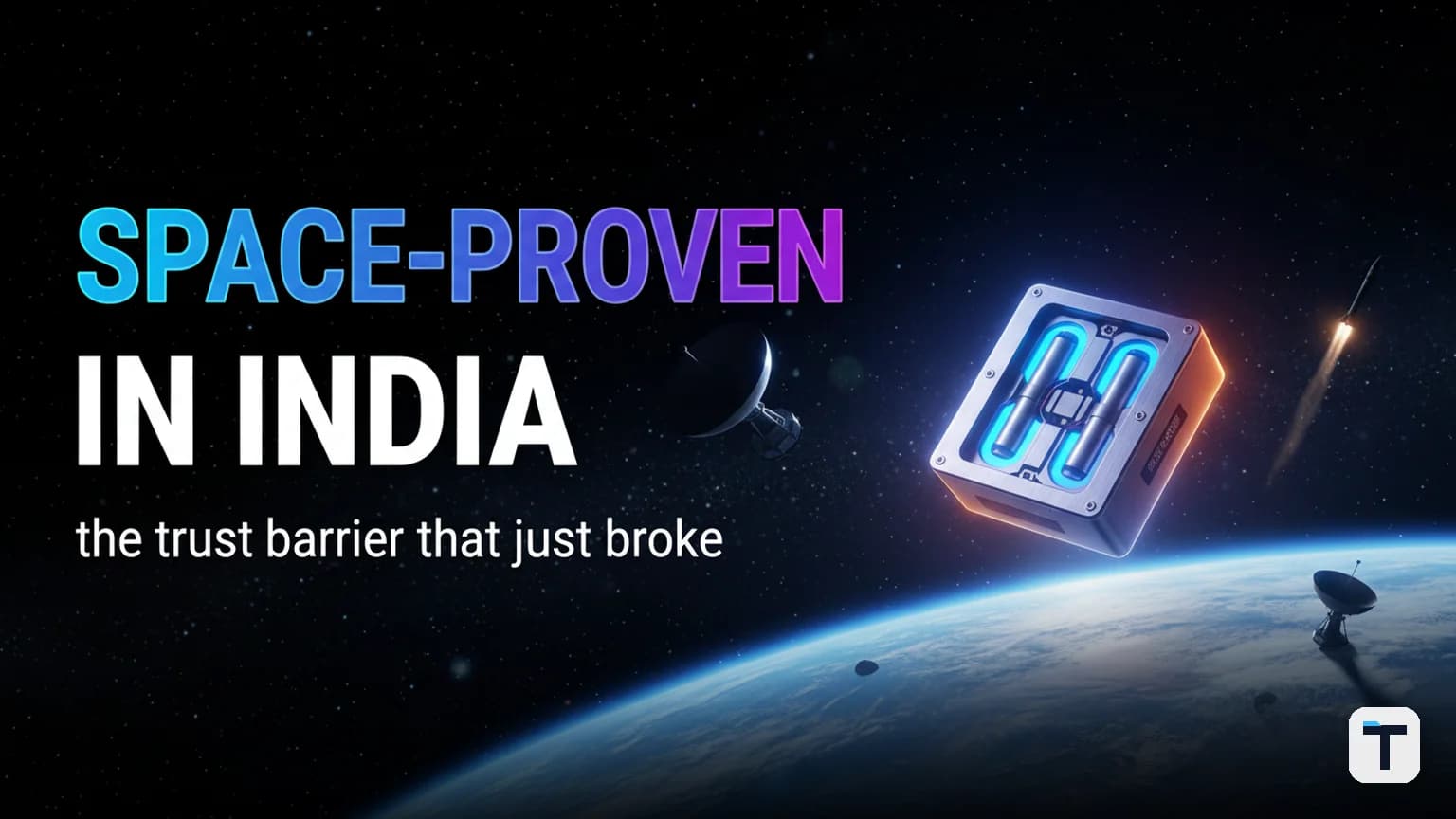

On July 18, 2026, a single 380-gram lithium-ion battery pack called PowerBank-50 rode Skyroot Aerospace's Vikram-1 rocket to a 450 km low Earth orbit — and in doing so became the first commercially available, made-in-India satellite battery to earn flight heritage. It is a small object with a sharp lesson: the hardest barrier in the space industry is not physical. It is trust.
What flight heritage actually means
Flight heritage is proof that a piece of hardware has survived a real orbital mission and operated as designed in the space environment. Nothing else — not ground testing, not simulation, not qualification campaigns — substitutes for it. NASA formalises this with its Technology Readiness Level scale: TRL 8 means a technology is "flight qualified," but only TRL 9 — "flight proven during a successful mission" — clears the gate. That last step, from qualified on the ground to proven in orbit, is the one that breaks most new entrants.
The reason is structural. A satellite mission can cost anywhere from a few hundred thousand to several hundred million dollars. A single subsystem that fails in orbit ends the mission, the revenue, and the insurance claim. So satellite builders, launch providers, and insurers all ask the same first question: has this part flown before? If the answer is no, the battery, attitude-control board, or solar-array drive becomes a mission risk nobody wants to underwrite.
That produces a trap that the industry calls the flight-heritage loop: you cannot get heritage without flying, and you cannot fly without heritage. Every component supplier starts inside it. The way out is to convince a launch provider or a payload host to give you a ride on something already flying — which is exactly what TakeMe2Space pulled off.
Why batteries face the highest scrutiny of any subsystem
Not every component faces the same bar. Batteries get the most scrutiny because they sit on both sides of the failure modes that destroy satellites.
They must survive launch. A rocket ascending to orbit is not a smooth ride. It is a controlled explosion that subjects every bolt and cell to intense vibration and acoustic shock. A battery with loose cell welds or a cracked enclosure becomes a short circuit waiting to happen — and short circuits in a pressurised enclosed volume are a launch-vehicle operator's nightmare.
Then they must run in vacuum, forever. Once in orbit, the environment does not let up. LEO satellites pass through Earth's shadow every orbit, which means their solar panels go dark part of each ~97-minute pass. In those minutes, the battery alone keeps the satellite alive. If the battery fails, the satellite dies — there is no service call in space.
The thermal cycling is brutal. On the sun-lit side of an orbit, a satellite's skin can spike past +120°C. On the shadow side, it can plunge to −150°C. Every 97 minutes, the battery inside that enclosure goes through that swing. Lithium-ion cells do not like thermal cycling. Their internal resistance, their capacity, and their safety margin all erode with each hot-cold iteration.
Radiation does not help. Cosmic rays and trapped particles in the Van Allen belts can flip bits in the battery management system's microcontroller, degrade the electrolyte chemistry over time, and age the cells faster than they age on Earth. A radiation-tolerant or radiation-hardened design is one answer; the COTS approach is another — and that is where the economics get interesting.
The COTS revolution: why mass manufacturing is winning
For decades, satellites flew radiation-hardened components — "rad-hard" parts screened, qualified, and burned in for years by a small handful of specialised manufacturers. The price tag reflected that. A space-qualified part can cost 10 to 100 times more than a commercial-grade equivalent of the same function. That math worked when the satellite market was small, mission lifetimes were measured in decades, and launch rates were measured in ones.
The New Space movement inverted that logic. If you are flying a small satellite in low Earth orbit for 3 to 5 years, the radiation environment is harsh but not the same as a 15-year geostationary mission. You can trade heritage-grade radiation tolerance for commercial-grade price, design around the remaining risk, and replace the satellite when it dies. The premium shifts from "one perfect part" to "many affordable parts at scale."
That is the path PowerBank-50 takes. Its core is not a custom rad-hard cell — it is four commodity 18650 lithium-ion cells, the form factor inside everything from laptop battery packs to electric scooters, arranged in a 4S1P configuration. What makes it space-worthy is not exotic chemistry. It is the engineering around it: a battery management system that balances and reports cell health to ground operators, a self-warming thermal control that holds the cells inside their safe operating window through orbital cold, and an aluminium flight enclosure that takes the vibration of a rocket and keeps the cells contained.
This COTS approach is why the satellite COTS components market has been one of the fastest-growing segments in the space industry — it lets armies of small satellite startups buy flight-worthy subsystems at commodity prices, with short lead times, instead of waiting in a multi-year radiation-qualification queue. The same logic that drove the personal computer revolution into commodity hardware now drives the satellite component market: build in volume, sell at affordable unit economics, let the platform layer innovate on top.
How PowerBank-50 broke the loop — and what it changed
Here is the sequence that matters.
Skyroot's Vikram-1 launched from the Satish Dhawan Space Centre in Sriharikota on July 18, 2026, on its maiden flight, mission "Aagaman." Vikram-1 became the first privately developed Indian rocket to reach orbit, making India only the third country in the world — after the United States and China — where a private company has achieved orbital launch capability. The vehicle carried an Orbital Adjustment Module (OAM) at a 450 km orbit, and aboard that OAM rode Cosmoserve Space's experimental payload, including the "Embrace" robotic arm.
Powering that payload was a single PowerBank-50 unit.
By the time the payload deployed, the battery had validated its entire chain in the real environment — its high-energy-density lithium-ion cells, its intelligent battery management system, its cell heaters, and its aluminium flight enclosure had all done their jobs in actual orbital conditions. In TRL terms, PowerBank-50 had just jumped from TRL 8 (flight qualified) to TRL 9 (flight proven).
The strategic upshot, per Ronak Kumar Samantray, TakeMe2Space's founder and CEO: "Every satellite mission lives or dies by its power system, which is why nobody wants to be the first to fly a new battery. We are grateful that Cosmoserve trusted PowerBank-50 on a mission of this significance. Flying on the first private Indian rocket to reach orbit, and performing flawlessly at 450 km, is the strongest validation a product can earn."
For India's fast-growing small-satellite ecosystem, that one flight removes a chronic bottleneck. Satellite builders no longer have to import this critical component at high cost and long lead times. A flight-proven power system is now designed, built, and available off-the-shelf in India — at ₹1,04,900 (around $1,260), a fraction of comparable imported packs. A 5-year mission life rating means it is not just a demo unit; it is a product that can fly real missions.
The access economics: why $1,260 matters
To understand what changed, look at the supply chain it replaces. Imported flight-qualified satellite battery packs from established Western or Israeli vendors typically cost several times more and carry lead times measured in quarters, not weeks. A university CubeSat team trying to fly a 6U platform might wait 9 to 12 months for a battery pack — longer than the entire satellite bus takes to build. Add to that import paperwork, customs, and the risk of a long-distance shipping cell damage incident, and the battery pack becomes the long-pole item on the critical path.
PowerBank-50 collapses that. At ₹1,04,900 for an off-the-shelf flight-proven unit with stackable configurations (a single 4S1P pack will serve a CubeSat; multiple packs stack into a single battery for a microsatellite), a builder can spec the power subsystem in a week and focus engineering time on the mission that matters. PC104 mounting means it bolts into the standard CubeSat bus structure most small satellite buses already use — no custom mechanical interfaces required.
That is the multiplier effect flight heritage creates. It is not about the first flight; it is about the hundreds of flights that become possible once the first one is done. Every university team, every startup, every research lab that had deferred a mission because they could not source a power system now has one they can buy.
The bigger story: India building the space supply chain
The PowerBank-50 milestone lands inside a larger arc. India's space economy currently sits at approximately $9 billion (ISpA, late 2025), with the government targeting $44 billion by 2033 — roughly an 8% share of a global space market the FICCI-EY report projects to exceed $1.8 trillion by 2035. The strategy hinges on the private sector: by late 2025 India had over 300 active space startups, the FDI regime had been liberalised, and IN-SPACe was running a single-window authorisation framework to route private missions through the regulator.
The TakeMe2Space company is one node in that graph. It raised a Series A round (TechCrunch reported $5 million led by Chiratae Ventures; company statements put cumulative fundraising at $5.64 million) to build what it calls orbital data centres — satellites that process, store, and serve data in orbit rather than just beaming raw imagery to the ground. The next mission is a 6U CubeSat designated MOI-1A, launching in October 2026 aboard a SpaceX Falcon 9 rideshare, equipped with an Nvidia Jetson module for on-orbit AI inferencing. The business case stacks toward a 4-satellite constellation in 2027 (target: $15 million in annual revenue with 5 kW of compute in orbit) and eventually a 50 kW orbital data centre by 2029–2030.
The bet is that doing computation in space — instead of bouncing every byte through Ka-band downlinks to a ground station — will be cheaper for Earth observation, defence analytics, and autonomous spacecraft. NVIDIA's March 2026 launch of its Space platform (Jetson Orin for edge inference, IGX Thor for on-orbit servers, the Vera Rubin Space-1 module for orbital compute) is a signal that the same big-tech stack that made ground AI cheap for AI agents that run their own loops is being rebuilt for orbit.
In that context, the battery is not just a battery. It is the power subsystem of an orbital compute platform. Flight heritage on a satellite battery today is the credential that opens the door to flying an orbital GPU tomorrow.
What this means for you, even if you never touch a satellite
You will not personally buy a PowerBank-50. But the chain of consequences reaches down to the ground.
More satellites in orbit means more data for everyday decisions. The weather forecast before a farmer sows a crop, the cyclone warning on the coast, the GPS on a delivery rider's app, the high-resolution imagery that powers agricultural insurance and disaster relief — all of those depend on satellites working. Cheaper, more available satellite subsystems mean more satellites launched by more players, which means more frequent and more granular data feeding those everyday services.
It also means a different kind of startup economy. The same logic that lets a HSR Layout startup export India's physical AI data to the world now lets an Indian startup export the satellite power subsystem to the world. TakeMe2Space has already shipped PowerBank units to customers in Spain, Italy, the UK, Singapore, and Korea — the company's list of export markets. The unit economics that work for India as a $1.5 trillion manufacturing bet by 2035 increasingly work for high-reliability, low-volume space hardware too. The same country that makes your phone can now make the battery that powers a satellite looking down at your phone.
It quietly redraws the global chip-and-component map. If a Hyderabad startup can build a flight-proven satellite battery at a fraction of imported cost, the next question is what else. Solar cells (where the company is working on moving from GaAs at $300–400 per watt to silicon under $10 per watt, with conglomerate partners). Onboard computers. Reaction wheels. The whole long tail of satellite subsystems — each one currently dominated by a handful of Western primes at heritage-grade pricing — is now contestable.
Flight heritage, in plain terms
Flight heritage is the credential in the satellite industry that separates "promising engineering" from "something you would actually fly." It is earned in one way: by going to orbit and working there. A 380-gram battery from Hyderabad did that on July 18, 2026, aboard the first privately built Indian rocket to reach orbit. By finishing the mission at 450 km — surviving the vibration of launch, the vacuum, the radiation, and the thermal cycling — PowerBank-50 became the first commercially available, made-in-India satellite battery to clear the bar.
The technology that did it is not exotic. It is four commodity lithium-ion cells, a battery management system, a self-warming thermal control, and an aluminium flight enclosure. The engineering discipline that did it is. Building flight hardware that works is a different game from building ground hardware that works, and the loop that locks new entrants out — you cannot get flight heritage without flying; you cannot fly without it — is why so few suppliers clear it. India just did, on a power subsystem, on a private launch, at a price point the small-satellite market can actually afford.
The next decade in space will be partly about rockets, partly about satellites, and mostly about who can manufacture reliable space-grade subsystems cheaply enough to keep up with the launch rate. On July 18, 2026, one supplier proved they could.
Frequently Asked Questions
What is flight heritage for a satellite component? Flight heritage is proof that a piece of hardware has survived a real orbital mission and operated as designed in space. It is the highest level of trust in the satellite industry — distinct from ground qualification, which only proves a component can survive the launch and environment in simulation. NASA encodes this distinction in its Technology Readiness Level scale: TRL 8 means a component is "flight qualified," but only TRL 9 — "flight proven during a successful mission" — clears the procurement gate.
Why is flight heritage so hard to earn for a satellite battery? Batteries face scrutiny on both sides of the failure modes that end satellite missions. They must survive launch vibration and acoustic shock without a cell weld or enclosure crack that could cause a short circuit. Then they must operate reliably in vacuum through extreme thermal cycling (satellite skin temperatures can swing from −150°C to +120°C every orbit) and radiation exposure. Because every satellite's solar panels go dark during Earth-shadow passes and the battery alone keeps the spacecraft alive during those minutes, a battery failure equals a lost mission.
How does the COTS approach change the economics of space components? Commercial Off-The-Shelf (COTS) components cost approximately 10 to 100 times less than radiation-hardened equivalents for the same function, because they leverage mass-manufactured commodity parts (standard lithium-ion cells, commercial-grade processors) rather than low-volume, purpose-screened space grades. The trade-off is radiation tolerance — COTS parts are more vulnerable to single-event upsets and long-term degradation. For short-duration LEO missions (3 to 5 year lifetimes), that trade is increasingly acceptable, which is why the satellite COTS components market has grown alongside the small-satellite and mega-constellation boom.
What did TakeMe2Space's PowerBank-50 actually prove on the Vikram-1 mission? On July 18, 2026, a single PowerBank-50 unit powered Cosmoserve Space's experimental payload aboard Skyroot's Vikram-1 rocket at a 450 km low Earth orbit. By completing that mission without fault, it validated its entire engineering chain in the real space environment: high-energy-density lithium-ion cells, an intelligent battery management system that reports cell health to ground operators, self-warming thermal controls, and an aluminium flight enclosure. The flight moved PowerBank-50 from TRL 8 (ground-qualified) to TRL 9 (flight-proven), making it the first commercially available, made-in-India satellite battery to clear that bar.
What does this milestone mean for Indian satellite builders? It eliminates a chronic import dependency. Indian small-satellite teams previously had to source flight-qualified battery packs from foreign suppliers at several times the cost and with lead times measured in quarters. PowerBank-50 is available off-the-shelf at ₹1,04,900 (~$1,260), with PC104-standard mounting and stackable configurations that cover CubeSat to microsatellite applications. That collapses the critical-path bottleneck on satellite builds and lowers the entry barrier for Indian universities, startups, and research labs to put satellites in orbit.
How big is India's space economy and where does it go from here? India's space economy is currently valued at approximately $9 billion (late 2025 figures from ISpA). The government targets $44 billion by 2033 — a roughly five-fold expansion that would lift India's share of the global space market from under 2% to ~8%. The expansion is driven primarily by the private sector, supported by liberalised FDI norms, the Indian Space Policy 2023, and IN-SPACe's single-window authorisation framework. Over 300 active space startups were operating in India by end of 2025.
Discussion
0 comments