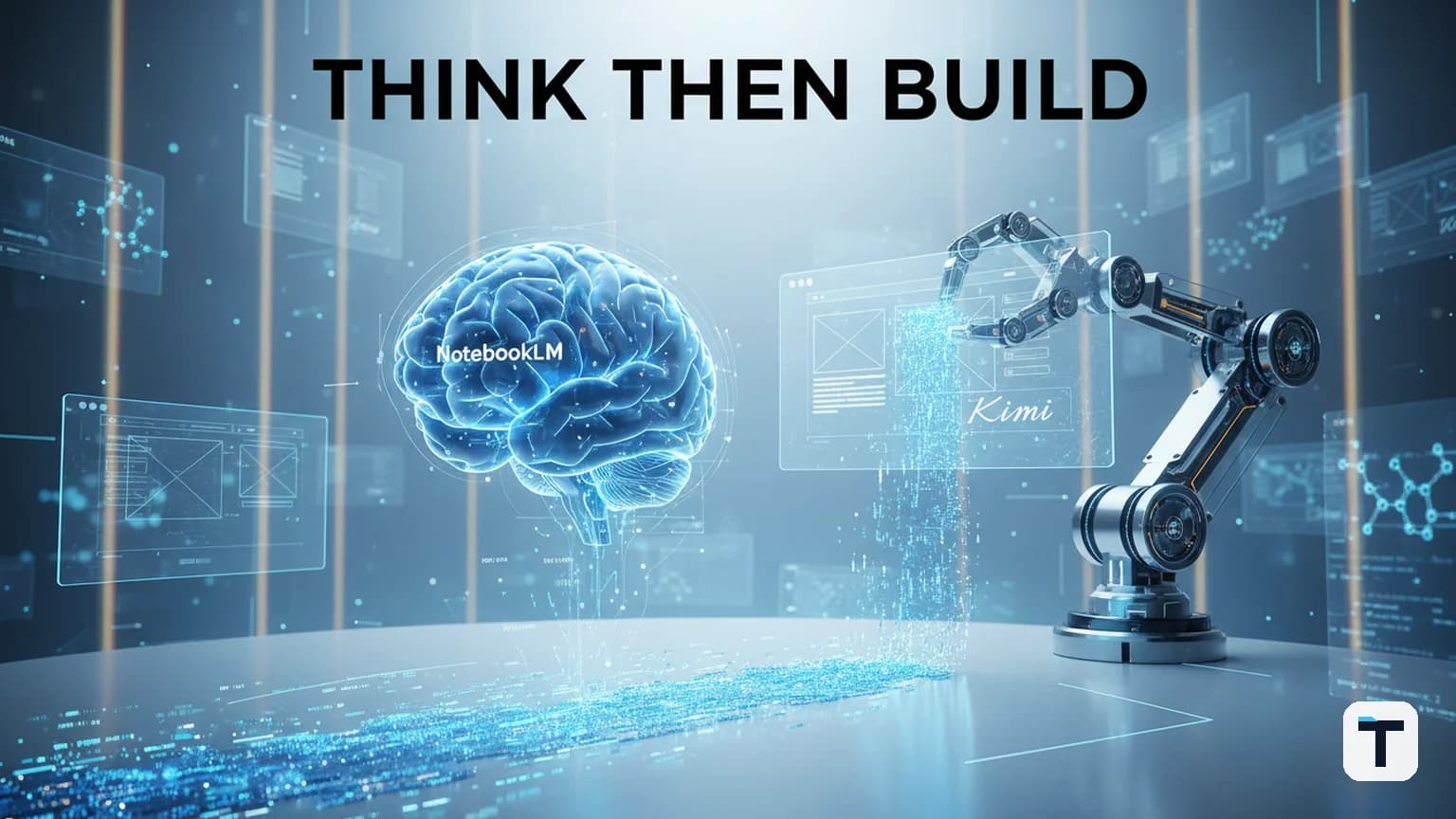

Verdict: The most efficient AI production workflow in 2026 is the "Think then Build" loop: using Google NotebookLM to synthesize messy research into clean blueprints, then passing those blueprints to Kimi K2.7 Code for execution. By separating the research phase from the building phase, teams can reduce hallucinations by up to 40% and cut the time-to-publish for landing pages, emails, and codebases from hours to minutes.
Last verified: 2026-06-21 · Best for: Small business owners, solo builders, and content teams · Featured Tools: Google NotebookLM (Gemini 3.5), Kimi K2.7 Code (Moonshot AI). Note: Pricing and model versions for Kimi and Google AI Ultra change frequently — last checked June 2026.
What is the 'Think then Build' Workflow?
In the early days of AI, users tried to do everything in one prompt. In 2026, the industry has moved toward "separation of concerns." The "Think then Build" workflow acknowledges that models optimized for research and grounding (like NotebookLM) are often different from models optimized for high-logic execution and coding (like Kimi K2.7 Code).
By using NotebookLM to "think" (organize, summarize, and map) and Kimi to "build" (write code, design layouts, and execute tasks), you avoid the "overwhelmed model" problem where an AI loses track of complex instructions. This approach is a core pillar of modern AI Agent Operating Systems.
NotebookLM 2026: The Ultimate Research Agent
Google's NotebookLM received two massive upgrades in early 2026 that transformed it from a simple PDF reader into an active research agent.
- The 'Better Research' Update (June 2026): Upgraded to Gemini 3.5, NotebookLM now integrates the Antigravity coding framework, allowing it to execute code and autonomously discover primary sources from the web without any pre-uploaded files.
- Visual Synthesis: The March 2026 update added 10 new Infographic styles (powered by Nano Banana Pro) and Cinematic Video Overviews (via Veo 3), letting you turn a pile of documents into a visual presentation or mind map in seconds.
For builders, NotebookLM acts as the "Source of Truth." You upload your messy feedback, raw notes, and market data, and it outputs a structured Blueprint that is 100% grounded in your facts.
Kimi K2.7 Code: The 1T-Parameter Execution Engine
Released on June 12, 2026, Moonshot AI's Kimi K2.7 Code is a 1-trillion parameter Mixture-of-Experts (MoE) model that has become the gold standard for open-weight execution.
- Token Efficiency: K2.7 reduces "thinking token" usage by 30% compared to K2.6, making it faster and cheaper to run.
- 256K Context Window: It can hold a medium-sized codebase or a full marketing plan in its "active memory" while it works.
- Benchmarking: It scored 62.0 on Kimi Code Bench v2, outperforming many proprietary models in real-world software engineering tasks.
Unlike general chatbots, Kimi K2.7 Code is built for agentic programming. It doesn't just talk; it plans, executes, and debugs.
Step-by-Step: How to Run the Loop
To master this workflow, follow these three steps to turn raw ideas into finished products.
1. The Synthesis (NotebookLM)
Upload your sources (PDFs, YouTube transcripts, Google Docs) into a NotebookLM workspace. Use the Studio Panel to generate a "Drafting Guide" or "Technical Specification."
- Tip: Upload your brand guidelines as a source to ensure the blueprint matches your company's voice.
2. The Bridge (The Copy-Paste)
Copy the structured blueprint from NotebookLM. Do not give Kimi your raw, messy files. Kimi works best when given a clean, logic-heavy instruction set. This "distillation" step is what prevents AI agent hallucinations.
3. The Build (Kimi K2.7 Code)
Paste the blueprint into the Kimi Code CLI or a hosted API. Use a prompt like: "Using this blueprint as the strict technical guide, build a production-grade React landing page with Tailwind CSS. Follow the 'Think then Build' logic: plan the component tree first, then write the code."
What This Means for You
For small business owners, this workflow is the "great equalizer." You no longer need a dedicated research team and a developer to launch a new product or campaign. You can go from a "messy folder of ideas" to a "finished, working asset" in under 15 minutes.
If you are already using tools like Claude Code, adding NotebookLM as your "upstream" research partner will significantly improve the quality of your output.
FAQ
Q: Is Kimi K2.7 Code free to use? A: The model weights are open-source and free to download on Hugging Face under a Modified MIT License. However, using it through Moonshot AI's hosted API is a paid service (roughly $0.95 per 1M input tokens as of June 2026).
Q: Does NotebookLM train on my private data? A: No. Google states that NotebookLM does not use your uploaded personal data or conversations to train its global models. It is a private, grounded workspace.
Q: Can I run Kimi K2.7 Code locally? A: Yes, but due to its 1T parameter size (even with MoE), it requires significant hardware (typically multiple H100s or specialized inference engines like SGLang). Most small businesses prefer the API or local sparse MoE alternatives.
Q: What is the benefit of Cinematic Video Overviews? A: Available for Google AI Ultra subscribers, these use the Veo 3 model to turn your research into an immersive visual narrative, perfect for explaining complex projects to stakeholders without manual video editing.
Discussion
0 comments