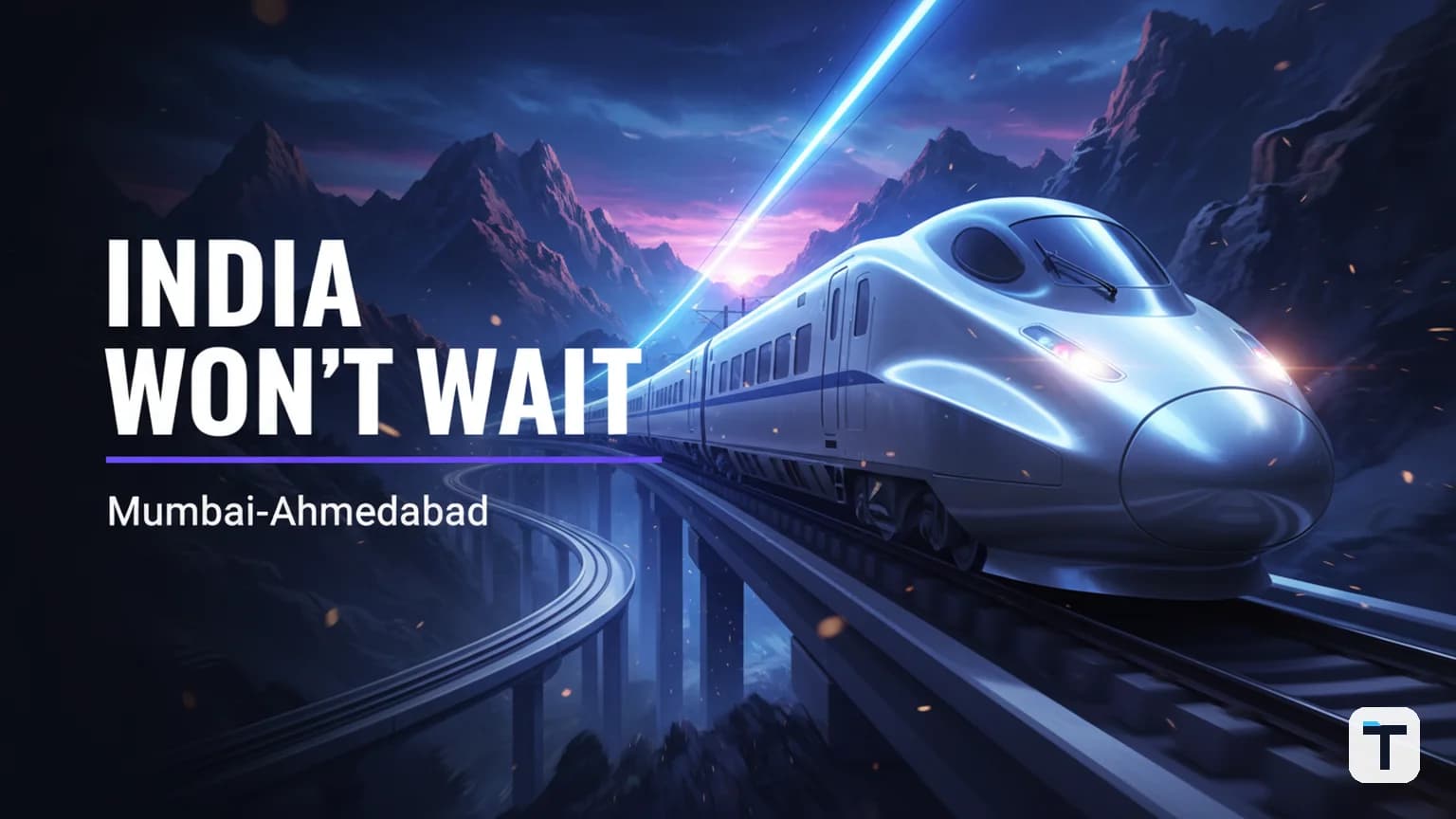

India's first bullet train will not be Japanese. The Mumbai-Ahmedabad High-Speed Rail corridor — a 508 km project born from a 2015 India-Japan agreement to deploy Shinkansen technology — will open with an Indian-built train called the B28, running at 250 km/h on a 97 km priority section between Surat and Vapi by August 2027. Japan's next-generation E10 Shinkansen, originally meant to be the corridor's flagship rolling stock, will not arrive before the early 2030s. India chose to build its own train rather than wait.
This is not a breakup. Both governments have framed it as "sequencing" — Indian trains first, Japanese trains later. But the technical decisions underneath that framing — an indigenous trainset, an open-standard European signalling system instead of Japan's proprietary one, and a domestic manufacturing base that did not exist when the agreement was signed — add up to a structural shift in how India builds high-speed rail. The B28 is the first chapter. A faster successor, the B35 (350 km/h design speed), is already in design.
Last verified: 2026-07-21 · B28 design speed: 280 km/h (operational: 250 km/h) · First section: Surat–Vapi, August 2027 · E10 Shinkansen: early 2030s · Signalling: ETCS Level 2 (Siemens–DRA JV, ₹4,140 crore) · Project cost: ~₹1.98 lakh crore (up from ₹1.08 lakh crore) · JICA funds 81% Volatile facts: Timelines, costs, and delivery dates are subject to revision. Re-check before relying on them.
What is the B28 bullet train?
The B28 (Bharat-made bullet trainset) is India's first indigenously designed and manufactured high-speed train, built by BEML Limited in partnership with the Integral Coach Factory (ICF) in Chennai. It is an 8-car trainset with distributed traction, designed for a top speed of 280 km/h and an operational speed of 250 km/h on the Mumbai-Ahmedabad corridor. Each trainset carries approximately 580 passengers and features reclining and rotatable seats, pressurized cabins for tunnel travel, and onboard infotainment systems.
BEML was awarded the contract in October 2024 by ICF, valued at ₹866.87 crore for two trainsets — roughly ₹27.86 crore per coach. For comparison, Japan had quoted approximately ₹46 crore per coach for Shinkansen rolling stock, making the indigenous option roughly 40% cheaper per coach.
Manufacturing is underway at BEML's dedicated "Aditya" facility in Bengaluru, inaugurated by Railway Minister Ashwini Vaishnaw in April 2026. The first prototype is expected by the first quarter of 2027, after which it will be moved to the Surat depot for testing and trial runs on the corridor.
Why did India stop waiting for Japan's Shinkansen?
Japan could not deliver the E10 Shinkansen before 2034. India's first corridor section was ready to open in 2027. That seven-year gap is the core reason.
The original 2015 agreement envisioned Japanese Shinkansen trains running on an Indian-built corridor. Japan would supply three systems: the train, the signalling system (DS-ATC), and the Operation Control Centre (OCC). India would handle civil construction. But the Japanese side "has still not been able to share the offers for E10 trains, signalling system, and Operation Control Centre (OCC) systems because the train is still under design," a senior Railway Ministry official told The Indian Express in July 2026.
The real reason for the delay, the official added, was the phasing out of the E5 series in Japan. India had originally been offered the E5 Shinkansen (320 km/h), but negotiations stalled over cost and modifications for Indian conditions. Japan then proposed the next-generation E10, but that train is still under development by East Japan Railway Company (JR East) and will not be ready until the early 2030s — with some reports indicating 2034.
Project studies and the experience of Taiwan and South Korea showed that the first section could be commercially operational by August 2027. Waiting until 2034 was not acceptable to India. Both sides agreed to start operations with Indian-designed trains and an open-standard signalling system.
How does the B28 compare to Japan's Shinkansen?
| Parameter | B28 (India) | E10 Shinkansen (Japan) |
|---|---|---|
| Manufacturer | BEML + ICF (India) | JR East (Japan) |
| Design speed | 280 km/h | ~320 km/h (estimated) |
| Operational speed | 250 km/h | ~320 km/h |
| Cars per trainset | 8 | 10–12 (TBD) |
| Cost per coach | ~₹27.86 crore | ~₹46 crore (E5 quote) |
| Ready for India | Q1 2027 (prototype) | Early 2030s (2034 per reports) |
| Signalling | ETCS Level 2 (open standard) | DS-ATC (proprietary) |
| Status | Under development at Aditya plant, Bengaluru | Under design at JR East, Japan |
The B28 is slower (250 km/h operational vs. 320 km/h for the E10) and smaller (8 cars vs. 10–12). But it will be ready years earlier and costs roughly 40% less per coach. The signalling decision — ETCS Level 2 instead of DS-ATC — is arguably more significant than the train itself, because it determines who can build, maintain, and upgrade the system for decades to come.
Why did India choose ETCS Level 2 over Japan's DS-ATC?
India chose the European Train Control System (ETCS) Level 2 because it is an open international standard used in over 50 countries, including South Korea, Taiwan, China, and across Europe. Japan's DS-ATC is proprietary — it works on Shinkansen lines in Japan and nowhere else.
This matters for three reasons:
- No vendor lock-in. Any rolling stock manufacturer can design trains for ETCS. With DS-ATC, India would have been dependent on Japanese vendors for all future upgrades, repairs, and expansion.
- Interoperability. India's Delhi–Meerut Regional Rapid Transit System (RRTS) already uses ETCS. Future high-speed corridors can share signalling infrastructure, training, and maintenance expertise.
- Cost. The Siemens–DRA Infracon consortium won the signalling and telecom contract for ₹4,140 crore. The rival L&T–Alstom bid was nearly three times higher at approximately ₹12,686 crore. A proprietary Japanese system would have carried its own premium.
Japanese railway engineer Hideki Makihara, a former justice minister who previously worked on the project, publicly criticized the decision, calling India's approach "sheer recklessness" and arguing that "Shinkansen trains and our signalling are inseparable." JR East's vice president Atsuko Itoh separately stated that Japanese safety standards could not be guaranteed with European signalling. India's position is that ETCS is a proven, internationally certified system — and that operational sovereignty matters more than fidelity to the original Japanese model.
What is the B35 and why does it matter?
The B35 is India's planned next-generation indigenous bullet train, targeting a design speed of 350 km/h and an operational speed of 320 km/h. Railway Minister Ashwini Vaishnaw confirmed in June 2026 that design work will begin within six months.
The B35 is not just a faster train — it is the platform intended for all future high-speed corridors in India. The National High Speed Rail Corporation Limited (NHSRCL) has already begun capability assessments with global rolling stock manufacturers, evaluating their ability to design propulsion systems, vehicle electronics (TCMS), and mechanical systems for 350 km/h operation under Indian climatic conditions.
| Parameter | B28 | B35 |
|---|---|---|
| Design speed | 280 km/h | 350 km/h |
| Operational speed | 250 km/h | 320 km/h |
| Role | First corridor launch | Standard platform for all future HSR |
| Design status | In manufacturing | Design phase starting |
| Corridor | Mumbai–Ahmedabad | All future corridors |
The B35 signals that India is not merely filling a gap — it is building a domestic high-speed rail industry. The Vadodara training institute, the Aditya manufacturing plant, the ETCS signalling choice, and the B35 design program together form an ecosystem that will persist regardless of when (or whether) the E10 Shinkansen eventually arrives.
How much does the Mumbai-Ahmedabad bullet train cost?
The project's cost has nearly doubled. The original estimate was approximately ₹1.08 lakh crore (~$10.1 billion). As of January 2026, Railway Board Chairman Satish Kumar confirmed the revised estimate is approximately ₹1.98 lakh crore, pending Cabinet approval.
Japan's JICA is financing about 81% of the original cost (~₹88,000 crore) through low-interest concessional loans. The Indian government will bear the cost overrun, as JICA is not providing additional funds.
The corridor spans 508 km with 12 stations: Mumbai (BKC), Thane, Virar, Boisar, Vapi, Billimora, Surat, Bharuch, Vadodara, Anand, Ahmedabad, and Sabarmati. It includes India's first undersea rail tunnel — 7 km beneath Thane Creek, part of a 21 km tunnel section. The corridor is designed for an operational speed of 320 km/h, which would reduce travel time between Mumbai and Ahmedabad from approximately eight hours to roughly two hours.
What is the timeline for the Mumbai-Ahmedabad corridor?
| Milestone | Target date | Source |
|---|---|---|
| India-Japan agreement signed | December 2015 | PIB / JICA |
| BEML contract awarded | October 2024 | ICF / BEML exchange filing |
| Siemens–DRA signalling contract awarded | June 2025 | NHSRCL |
| Aditya plant inaugurated | April 2026 | Ministry of Railways |
| B28 prototype ready | Q1 2027 (March) | Ministry of Railways |
| First commercial run (Surat–Vapi) | August 15, 2027 | Railway Minister |
| Full corridor operational | End of 2029 (phased) | NHSRCL |
| E10 Shinkansen delivery | Early 2030s (2034 per reports) | MEA / Railway official |
| B35 design work begins | Within 6 months of June 2026 | Railway Minister |
The corridor will open in phases: Surat–Bilimora first, then Vapi–Surat, then Vapi–Ahmedabad, and finally the Thane–Ahmedabad section including the undersea tunnel. The Mumbai-side segment is the most complex due to the tunnel and dense urban construction.
What does this mean for India's broader manufacturing strategy?
The B28 is not an isolated project. It fits a pattern visible across Indian manufacturing in 2026:
- Rail: India launched its first indigenous hydrogen train, designed and integrated entirely in-house. The pattern extends to launch capability too — India's private space race has already produced a private orbital rocket.
- Aerospace: Tata Advanced Systems completed the maiden flight of the first made-in-India C-295 military transport aircraft at its Vadodara facility — the first private-sector military aircraft manufacturing in India's history. See: how Tata's C-295 broke India's state-only monopoly on military aircraft.
- Semiconductors: C-DAC is designing India's indigenous AI inference chip to reduce dependence on Nvidia. See: can C-DAC break Nvidia's grip by 2030?.
- Power equipment: BHEL manufactured India's first indigenous 1,200 kV transformer for the national supergrid. See: inside India's first indigenous 1,200 kV transformer.
The bullet train program follows the same logic: when timelines slip or costs escalate on foreign-supplied technology, India builds a domestic alternative rather than extending the deadline. The B28 at 280 km/h, the B35 at 350 km/h, the Vadodara training institute, and the ETCS signalling choice are all deliberate investments in domestic capability — capability that does not disappear when the E10 Shinkansen eventually arrives.
Seven new high-speed rail corridors have been sanctioned in the Union Budget 2026–27, spanning approximately 4,000 km: Mumbai–Pune, Pune–Hyderabad, Hyderabad–Bengaluru, Hyderabad–Chennai, Chennai–Bengaluru, Delhi–Varanasi, and Varanasi–Siliguri. All are expected to use Indian-manufactured rolling stock.
What this means for you
If you are a business tracking Indian infrastructure, manufacturing, or supply chain opportunities, the bullet train pivot signals three things. This mirrors the broader pattern of India's private space race, where domestic capability is built rather than imported:
- India will not wait. When foreign suppliers miss timelines, India builds indigenous alternatives. This pattern is now consistent across rail, aerospace, semiconductors, and defense. If you supply technology to India, expect timeline pressure and local-manufacturing requirements.
- Open standards win. The ETCS choice over DS-ATC shows India will favor interoperability and vendor independence over fidelity to any single supplier's ecosystem. If your product locks customers in, India will look for alternatives.
- The supply chain opportunity is real. The B28, B35, seven new corridors, and the 4,000 km HSR network create demand for steel, precision components, electrical systems, signaling equipment, and skilled labor. Companies that can manufacture in India — or partner with Indian firms — are positioned to capture this.
For travelers, the immediate benefit is clear: a journey that currently takes eight hours by road or conventional rail will drop to under two hours on the full corridor, with the first section opening in 2027.
FAQ
Q: When will India's first bullet train run? A: India's first bullet train, the indigenous B28, is targeted to begin commercial operations on the Surat–Vapi section of the Mumbai-Ahmedabad corridor on August 15, 2027. The B28 prototype is expected to be ready by the first quarter of 2027, followed by testing and trials.
Q: Will Japan's Shinkansen still run on the Mumbai-Ahmedabad corridor? A: Yes. Japan will supply the E10 series Shinkansen in the early 2030s (with some reports indicating 2034). Both countries have agreed to start operations with Indian trains and transition to Japanese trains when the E10 is ready. The MEA has framed this as sequencing, not a break.
Q: How fast is India's indigenous bullet train? A: The B28 has a design speed of 280 km/h and an operational speed of 250 km/h. The planned successor, the B35, targets a design speed of 350 km/h and an operational speed of 320 km/h. The corridor itself is designed for 320 km/h operations.
Q: Why did India choose ETCS signalling instead of Japan's DS-ATC? A: ETCS Level 2 is an open international standard used in over 50 countries, which avoids vendor lock-in and allows any manufacturer to build compatible trains. Japan's DS-ATC is proprietary and only used on Shinkansen lines in Japan. The Siemens–DRA Infracon consortium won the ₹4,140 crore signalling contract, roughly one-third of the rival L&T–Alstom bid.
Q: How much does the Mumbai-Ahmedabad bullet train project cost? A: The project cost has nearly doubled from the original estimate of ₹1.08 lakh crore to approximately ₹1.98 lakh crore as of January 2026, pending Cabinet approval. Japan's JICA finances about 81% of the original cost through low-interest loans; the Indian government bears the cost overrun.
Q: What is the B35 bullet train? A: The B35 is India's planned next-generation indigenous bullet train with a design speed of 350 km/h and operational speed of 320 km/h. Design work is expected to begin within six months of June 2026. It is intended as the standard platform for all future high-speed rail corridors in India.
Discussion
0 comments