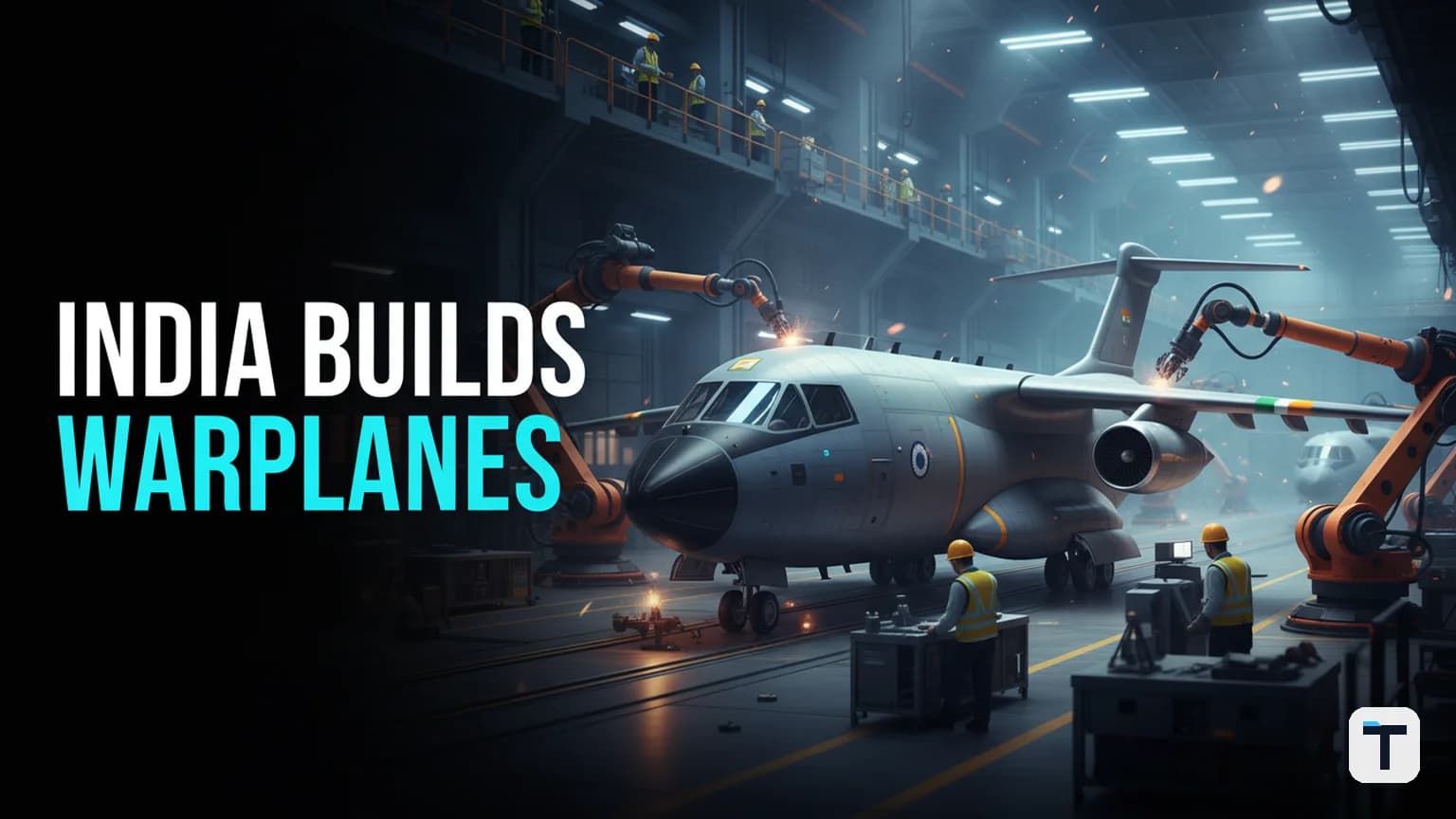

Tata Advanced Systems Limited (TASL) has become the first private Indian company to build and fly a complete military aircraft, ending a seven-decade monopoly held by state-owned Hindustan Aeronautics Limited (HAL) — and following the same private-sector breakthrough pattern seen when Skyroot's Vikram-1 made India the third nation with private orbital launch capability. The first India-assembled Airbus C-295 tactical transport completed its maiden test flight from Vadodara on June 10, 2026 — months ahead of the original September 2026 deadline — replacing the Indian Air Force's ageing Avro-748 fleet and seeding a domestic aerospace supply chain of over 15,000 jobs. But "made in India" here means something more nuanced than it sounds: the first aircraft is largely assembled from imported engines and avionics, and true indigenization climbs to 98% only by the 32nd aircraft on a labour-hour basis.
What is the Tata C-295 programme and why is it a first for India?
The C-295 programme is the first instance of a complete military aircraft being manufactured in India by a private-sector company, rather than a state-owned enterprise. Under a ₹21,935 crore ($2.6 billion) contract signed on September 24, 2021, the Ministry of Defence agreed to acquire 56 Airbus C-295 transport aircraft for the Indian Air Force (Airbus press release, September 2021). The first 16 were delivered in "fly-away" condition from Airbus's final assembly line in Seville, Spain, with the final Spanish-built aircraft handed over in August 2025 (Airforce Technology, June 2026). The remaining 40 are being assembled at the Tata-Airbus Final Assembly Line (FAL) in Vadodara, Gujarat — a facility inaugurated on October 28, 2024 by Prime Minister Narendra Modi and Spanish Prime Minister Pedro Sánchez (Press Information Bureau, October 2024).
Until this programme, every military aircraft built in India came from HAL or another state entity. The C-295 changes that. As Defence Minister Rajnath Singh stated at the FAL inauguration: "The C-295 project is a huge accomplishment for the Indian private industry as it is the first project of its kind in which a complete military aircraft will be manufactured in India by a private company" (PIB, October 2024).
How does the C-295 compare to the Avro-748 it replaces?
The C-295 replaces the Hawker Siddeley HS-748 "Avro," a twin-turboprop transport first flown in 1961 and inducted into the IAF over six decades ago. HAL assembled 89 Avros for the IAF and Indian Airlines collectively, but the type has been technologically obsolete for years — critically, it lacks a rear ramp for cargo loading, limiting it to troop and VVIP transport (Defstrat, November 2023).
| Specification | Avro HS-748 | Airbus C-295 |
|---|---|---|
| Payload | ~5,400 kg | 9,250 kg (Airbus) |
| Troops | ~48 | 71 troops / 50 paratroopers (GlobalSecurity) |
| Rear ramp | No (side doors only) | Yes |
| Engines | Rolls-Royce Dart (legacy turboprop) | 2 × Pratt & Whitney Canada PW127G (Airbus) |
| Max cruise speed | ~451 km/h | 480 km/h (260 knots) (Airbus) |
| Range (full load) | ~1,500 km | 1,333 km with max payload; ferry range 5,400 km (GlobalSecurity) |
| STOL capability | Limited | Takeoff 670 m / landing 320 m (Indian Defence News, May 2026) |
| First flown | 1961 | 1997 (original C-295); India-assembled: June 10, 2026 |
The C-295's rear ramp, short-takeoff-and-landing (STOL) capability, and ability to operate from unpaved airstrips make it suited for Himalayan Advanced Landing Grounds like Daulat Beg Oldi, Nyoma, and Chushul — environments where the Avro could never serve as a logistics aircraft (Indian Defence News, May 2026).
How indigenous is the "made in India" C-295 really?
Indigenization on the C-295 programme is measured in labour hours, not component value — and it ramps up aircraft by aircraft. Airbus's C-295 India programme head, Jorge Tamarit, has publicly stated: "We measure indigenisation by labour hours and by the 32nd aircraft it will reach 98%" (The Hindu, 2026; Outlook India, June 2026).
Here is what that indigenization ladder looks like in practice:
- Aircraft #1 (first India-built, rolled out May 2026, flew June 10, 2026): Fuselage and tail manufactured by TASL in Hyderabad since 2023. Engines (Pratt & Whitney Canada PW127G) and avionics (Collins Aerospace) imported from the United States and fitted at Vadodara. Structural work is domestic; propulsion and electronics are not. (Outlook India; The Better India, June 2026)
- Aircraft #2–31: Progressive transfer of component manufacturing to Indian suppliers. The C-295 airframe contains over 14,000 components, of which roughly 3,500 parts are slated to be domestically produced annually by Tata (Outlook India).
- Aircraft #32–40 (scheduled delivery Q1 2029 onward): Maximum indigenous content — the last eight aircraft carry the highest level of domestic manufacturing on a labour-hour basis. The scheduled delivery of the 32nd aircraft is in the first quarter of 2029 (The Hindu, 2026).
Key Indian public-sector contributions already include: Bharat Electronics Limited (BEL) developing indigenous radar warning receivers and missile approach warning systems, and Bharat Dynamics Limited (BDL) manufacturing the countermeasure dispensing system (Outlook India). More than 13,400 detail parts, 4,600 sub-assemblies, and all seven major component assemblies are being manufactured in India (Outlook India).
What remains imported through the programme: the Pratt & Whitney Canada PW127G engines, the Collins Aerospace avionics suite, and select specialized systems. These are not trivial — engine and avionics represent the highest-value, highest-technology components on any aircraft. India does not yet domestically manufacture turbo-prop engines of this class. This import dependency mirrors the broader pattern seen in India's electronics component manufacturing pivot, where the country moved from assembly to component-level capability only after sustained policy and investment commitment.
Why does this matter beyond one military contract?
The C-295 programme is not just about 40 transport aircraft. It is building an aerospace manufacturing ecosystem that did not previously exist in India's private sector. Airbus committed to the programme creating "15,000 skilled direct jobs and 10,000 indirect positions over the coming 10 years" at the 2021 contract signing (Airbus press release, September 2021). The Vadodara FAL has a production capacity of approximately 12 aircraft per year (idrw.org).
Three downstream implications follow:
1. Maritime surveillance variants. The Indian Navy and Indian Coast Guard have received Acceptance of Necessity for 15 maritime patrol aircraft based on the C-295 platform — nine Medium Range Maritime Reconnaissance (MRMR) aircraft for the Navy and six Multi-Mission Maritime Aircraft (MMMA) for the Coast Guard, valued at approximately $3.5 billion (Naval News, February 2024). DRDO's Centre for Airborne Systems (CABS) is co-developing the indigenous sensor suite, including an AESA maritime patrol radar and EO/IR payload (defence.in). The bulk of these aircraft will also be assembled in India.
2. MRO infrastructure at Dholera. Gujarat's upcoming Dholera International Airport — 80% complete as of July 2026 — will house dedicated Maintenance, Repair, and Overhaul (MRO) hangars specifically built to support the entire C-295 fleet. Civil Aviation Minister Rammohan Naidu Kinjarapu confirmed this in a press briefing: "Tata's upcoming semiconductor facility and Airbus's defence partnerships will benefit directly from our specialised Maintenance, Repair, and Overhaul (MRO) hangars on-site. These hangars will support the MRO operations of India's first indigenous military transport aircraft, the C-295" (Press Information Bureau, July 2026).
3. A launchpad for civil aircraft assembly. On July 19, 2026, Naidu visited the TASL Vadodara facility and publicly framed the C-295 programme as a stepping stone: "As India strengthens its aerospace manufacturing capabilities, we are steadily moving towards a future where Indians will proudly fly in Made in India civil aircraft" (LiveMint, July 2026). The same PIB briefing announced an MOU between Brazilian aerospace major Embraer and Adani Aviation Systems to establish a Final Assembly Line for India's first civilian "Make in India" aircraft at Dholera, targeting the first rollout by 2028 (PIB, July 2026).
Can the Vadodara facility scale to genuine civil aircraft manufacturing?
This is the hardest question, and the honest answer is: not yet, and not without a fundamentally different scale of investment.
Assembling a military transport under licence from Airbus — even with 98% indigenous labour hours — is a different proposition from designing, certifying, and manufacturing a commercial passenger aircraft. Civil aviation involves a vastly more demanding certification regime (DGCA and EASA/FAA compliance), a deeper supply chain (every part needs traceability and airworthiness approval), and a market that punishes any reliability gap with instant grounding. India does not currently possess an OEM-level civil aircraft industry.
What Vadodara does provide is the foundation: a trained workforce, quality control systems, an MSME supplier base, and the institutional knowledge of assembling and testing a pressurized, multi-role aircraft. Tata and Airbus began collaborating in 2012 and it took approximately 14 years to reach the point where aircraft are being assembled in India (idrw.org). The C-295 is a data point — a promising one — but not yet a trend. India has a history of defence manufacturing announcements that did not seed broader industrial ecosystems, a caution that also applies to BHEL's indigenous 1,200 kV transformer breakthrough and other state-led manufacturing milestones. The real test is whether the supplier base, MRO infrastructure, and engineering talent built around this programme outlast the 40-aircraft order.
The early signs are more encouraging than past programmes. The C-295 has accumulated over 335 orders from 39 operators worldwide, making Vadodara only the second assembly line for the type globally (after Seville). If even a modest share of future international orders is allocated to India, the line could remain active beyond the IAF contract — and that sustained production volume is what converts a one-off programme into a permanent industry (idrw.org).
What this means for you
If you build, invest, or work in India's advanced manufacturing ecosystem — defence, aerospace, semiconductors, or precision engineering — the C-295 programme is your reference point for how private-sector aerospace manufacturing actually takes root in India. It took 14 years from the first Tata-Airbus collaboration to a flying aircraft. It required a government contract as anchor, a global OEM as technology partner, and a phased indigenization plan measured in labour hours, not headlines. The MSMEs that won Tata's Tier-II and Tier-III supplier contracts are now part of a global aerospace supply chain — and that supply chain will outlast the 40th aircraft. For anyone evaluating India's manufacturing trajectory, the signal is not the first flight; it is whether the supplier base and MRO infrastructure at Dholera convert into civil aircraft capability by 2028 — the same question being asked of Taiwan's high-tech manufacturing pivot into Tamil Nadu, where design-to-manufacturing depth is the real metric, not assembly alone.
Related reading
FAQ
Q: What is the Tata C-295 programme?
A: The Tata C-295 programme is a ₹21,935 crore contract under which Tata Advanced Systems Limited (TASL) assembles 40 Airbus C-295 military transport aircraft at a Final Assembly Line in Vadodara, Gujarat, for the Indian Air Force. A further 16 were delivered from Spain. It is the first time a private Indian company has manufactured a complete military aircraft.
Q: When did the first made-in-India C-295 fly?
A: The first India-assembled C-295 completed its maiden test flight on June 10, 2026, from the Tata-Airbus Final Assembly Line in Vadodara, ahead of the original September 2026 deadline. The aircraft had rolled out from the assembly line in May 2026.
Q: How much of the C-295 is actually made in India?
A: Indigenization is measured in labour hours and ramps up by aircraft. The first aircraft uses imported Pratt & Whitney engines and Collins Aerospace avionics, but the fuselage and tail are manufactured in India. By the 32nd aircraft (scheduled for Q1 2029), indigenous content reaches 98% on a labour-hour basis. Over 13,400 detail parts are manufactured in India.
Q: What aircraft does the C-295 replace?
A: The C-295 replaces the Indian Air Force's ageing Hawker Siddeley HS-748 "Avro" fleet, first flown in 1961. The Avro lacks a rear cargo ramp and has limited payload (~5,400 kg) compared to the C-295's 9,250 kg payload, 71-troop capacity, and STOL capability from airstrips as short as 670 metres.
Q: Will the Indian Navy and Coast Guard use the C-295?
A: Yes. The Defence Acquisition Council approved 15 maritime patrol variants — nine MRMR aircraft for the Navy and six MMMA aircraft for the Coast Guard, valued at approximately $3.5 billion. DRDO is developing the indigenous sensor suite, including an AESA maritime patrol radar. The bulk will be assembled in India.
Q: Can Tata's Vadodara facility build civilian passenger aircraft?
A: Not yet. The C-295 programme builds assembly capability and a supplier ecosystem, but civil aircraft manufacturing requires a different certification regime, deeper supply chain, and OEM-level design capability. However, an Embraer-Adani MOU targets civil aircraft assembly at Dholera by 2028, and Dholera's MRO hangars will service the C-295 fleet — both are steps toward that goal.
Discussion
0 comments