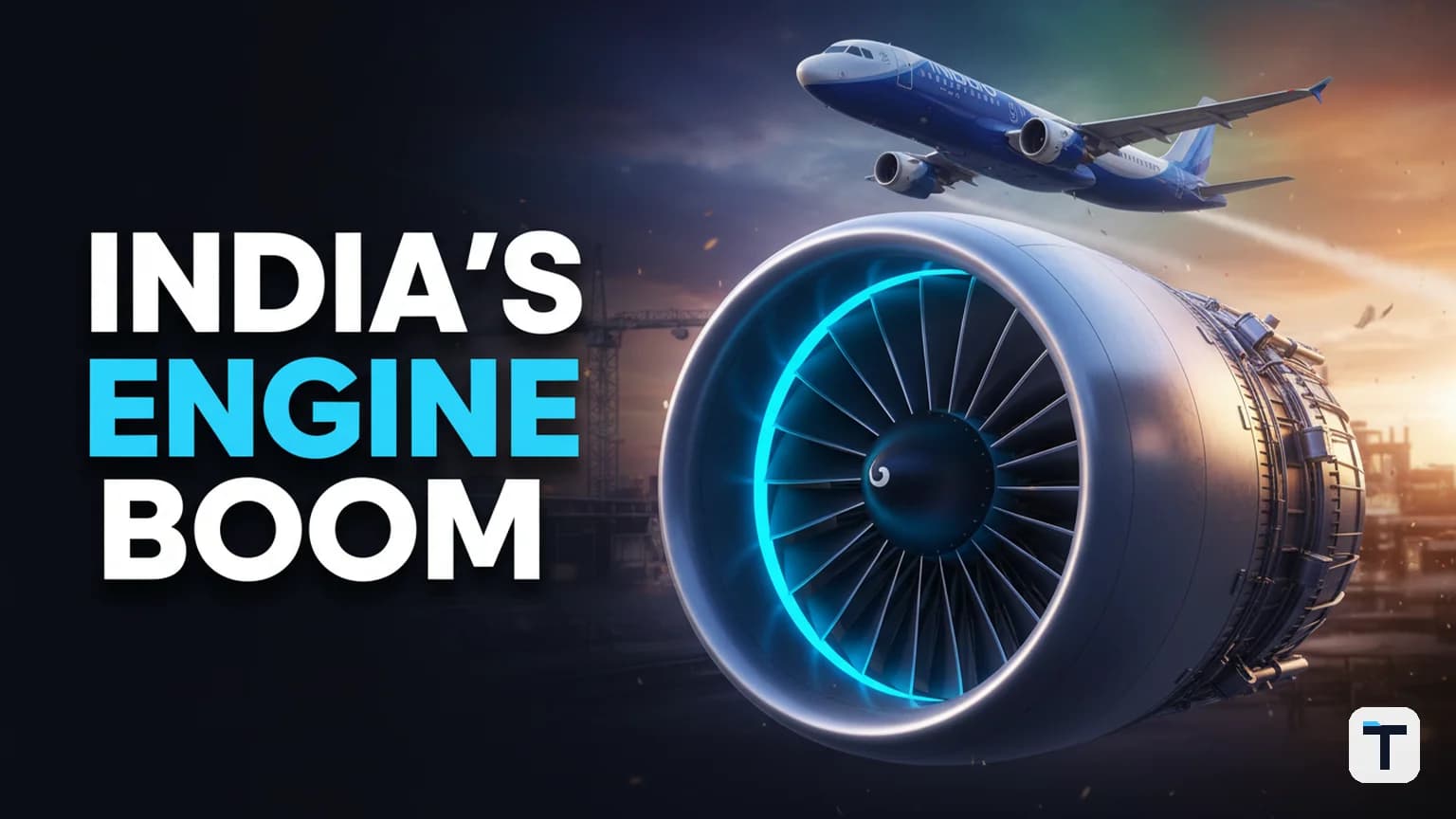

India is now CFM International's third-largest engine market worldwide, a milestone cemented by IndiGo's record-breaking memorandum of understanding for over 1,000 LEAP-1A turbofan engines signed at the Farnborough International Airshow on July 20, 2026. The deal — the single largest LEAP engine order in CFM's 50-year history — will power 510 Airbus A320neo-family aircraft and commits CFM to helping IndiGo build its own engine maintenance, repair, and overhaul (MRO) facility in India. Five Indian carriers already operate more than 400 LEAP-powered narrowbody jets with roughly 2,000 engines on order in the country, making India a decisive force in the global commercial propulsion market.
Last verified: July 21, 2026
- IndiGo signed a record MoU for 1,000+ LEAP-1A engines (July 20, 2026, Farnborough)
- India is now CFM's third-largest market: 5 carriers, 400+ LEAP-powered aircraft, 2,000 engines on order
- The deal includes a dedicated IndiGo engine MRO facility and long-term material services
- IndiGo carried 123.4 million passengers in FY2026 and holds a 64.3% domestic market share
- Pricing/engine values were not disclosed; this is an MoU, not yet a firm contract
Why Is India Now CFM's Third-Largest Engine Market?
India overtook established aviation markets to become CFM International's third-largest country market because of a combination of explosive passenger growth, massive aircraft order backlogs, and a deliberate push to localize engine maintenance and manufacturing. CFM International — the 50/50 joint venture between GE Aerospace and Safran Aircraft Engines — confirmed that five Indian carriers now operate more than 400 LEAP-powered aircraft with approximately 2,000 engines on order in the country before the IndiGo deal was even announced (Economic Times).
This is not a one-off surge. India's aviation market has been compounding at rates that dwarf mature markets. IATA projects passenger traffic to, from, and within India will grow at an average annual rate of 5.6% over the next two decades, adding 425 million annual passenger journeys by 2044 — nearly tripling 2024 levels (IATA). India accounts for 17.8% of the global population but only 4.2% of global air passengers, which means the runway for growth is enormous.
The engine market follows the aircraft market, and India's order book is staggering. IndiGo alone has over 900 Airbus aircraft on order (Economic Times). Air India has placed multi-hundred-aircraft orders of its own. Every one of those narrowbody jets needs two engines plus spares, which is how the math compounds into thousands of turbofans.
What Did the IndiGo-CFM Deal Actually Include?
The memorandum of understanding signed at Farnborough on July 20, 2026, covers three components that go well beyond a simple purchase agreement:
1,000+ LEAP-1A engines to power 510 Airbus A320neo-family aircraft (A320neos, A321neos, and A321XLRs). Each aircraft requires two engines, and the total includes spares — which is how the number exceeds 1,000 for 510 airframes (FlightGlobal).
A dedicated IndiGo engine MRO facility in India, with CFM providing "extensive support" for its establishment. The facility will be located in Bengaluru (Economic Times). This is a strategic move — India currently sends an estimated $1.5 billion of engine maintenance work overseas annually (TechTimes).
A long-term material services agreement covering spare parts supply, aimed at keeping dispatch reliability high and costs predictable as the fleet grows.
Financial terms were not disclosed. The MoU is a commitment to negotiate a firm order with specific delivery slots, and engine deliveries are expected to extend through the 2030s (FlightGlobal).
The signing ceremony was attended by GE Aerospace CEO H. Lawrence Culp Jr., Safran CEO Olivier Andriès, IndiGo Managing Director Rahul Bhatia, and incoming IndiGo CEO Willie Walsh — reportedly his first major industry appearance since being named to the role (FlightGlobal).
Who Is Willie Walsh and Why Does His Arrival at IndiGo Matter?
Willie Walsh is one of the most experienced executives in global aviation. He led Aer Lingus, then British Airways, then formed International Airlines Group (IAG) — the parent company of British Airways, Iberia, and Aer Lingus. He then served as Director General of the International Air Transport Association (IATA), the global airline trade body, before being named IndiGo's CEO on March 31, 2026 (Reuters; India Today).
Walsh succeeds Pieter Elbers, who resigned on March 10, 2026, following a severe operational crisis that led to thousands of cancelled flights and regulatory intervention. Walsh is expected to formally join IndiGo by August 3, 2026, and the LEAP engine deal will be among the first major commercial decisions on his desk as he negotiates the conversion from MoU to firm order (Skift).
Walsh's appointment signals IndiGo's shift from a pure low-cost domestic carrier to a global network airline. The airline has ordered 60 Airbus A350-900 widebody aircraft (30 initially in April 2024, doubled in 2025) with deliveries beginning in 2027, aimed squarely at long-haul international expansion (Airbus; ETTravelWorld). Walsh's experience managing complex international airline operations at IAG is directly relevant to executing that transition.
How Big Is the LEAP Engine Program?
The CFM LEAP (Leading Edge Aviation Propulsion) engine family powers three of the world's most important narrowbody aircraft programs: the Airbus A320neo family (LEAP-1A), the Boeing 737 MAX (LEAP-1B), and the COMAC C919 (LEAP-1C). Key facts:
| Specification | LEAP-1A (Airbus A320neo) | LEAP-1B (Boeing 737 MAX) | LEAP-1C (COMAC C919) |
|---|---|---|---|
| Max take-off thrust | 33,000 lbf | 28,000 lbf | 31,000 lbf |
| Fan diameter | 78 in | 69 in | 78 in |
| Entered service | August 2016 | May 2017 | — |
| Fuel savings vs. CFM56 | 15% | 15% | 15% |
Source: CFM International; GE Aerospace
The LEAP has dominated the A320neo engine market. By 2024, it was selected for 75% of A320neo orders, winning decisively over the competing Pratt & Whitney PW1100G geared turbofan, which suffered well-documented reliability issues in its early years (Wikipedia/CFM International LEAP). CFM delivered 1,570 LEAP engines in 2023, up 38% from 2022, and has an order backlog exceeding 10,000 engines.
The LEAP-1A that IndiGo ordered is the highest-thrust variant, designed for the A320neo family's full range from the A319neo to the A321XLR. It incorporates ceramic matrix composites (CMCs), 3D-woven carbon fiber fan blades, and additive-manufactured components — technologies that reduce weight and improve fuel efficiency by 15% over the previous-generation CFM56.
Why Does the MRO Facility Matter So Much?
The MRO component of the IndiGo deal may matter more long-term than the engine purchase itself. Here is why:
India's maintenance gap is expensive. An estimated $1.5 billion in engine maintenance work is sent overseas annually because India lacks sufficient domestic MRO capacity for modern turbofans (TechTimes). Every engine shipped to a foreign shop means aircraft on the ground, forex outflow, and dependency on overseas schedules.
The MRO backlog is global. Engine availability and maintenance backlogs have plagued airlines worldwide in recent years. By building its own LEAP MRO facility — with CFM's technical support — IndiGo is insulating itself from that global bottleneck. This is a supply chain resilience play, not just a cost play.
Safran is already investing. In November 2025, Safran announced a €200 million ($220M) LEAP engine MRO facility in Hyderabad, operational in 2026, with a capacity of 300 LEAP shop visits per year and 1,100 employees at full capacity (Rediff/Safran press release). India's broader aircraft MRO market is projected to reach $7 billion by 2034, growing at roughly 6% CAGR (IMARC Group).
Manufacturing is localizing too. Safran Aircraft Engines signed a contract with India's Titan Engineering and Automation Limited in February 2025 to manufacture low-pressure turbine components for the LEAP engine, with production starting in 2026. A separate agreement covers turbine forged parts with Hindustan Aeronautics Limited (HAL) (Wikipedia/CFM International LEAP). GE Aerospace has manufacturing in Pune and engineering in Bengaluru.
The pattern is clear: India is moving from buyer to builder. Engine manufacturing, MRO, and component supply are all localizing — and the IndiGo deal accelerates that trend.
How Does This Fit Into India's Broader Aerospace Ambitions?
The IndiGo-CFM deal is one data point in a much larger trend: India is systematically building domestic aerospace capability across military and civilian sectors. Consider the parallel developments:
Tata's C-295 military aircraft assembly line broke the state-only monopoly on Indian military aircraft manufacturing, showing that private-sector Indian companies can produce complete aircraft domestically.
India's private space sector produced Vikram-1, making India the third nation with private orbital launch capability — a signal that India's private sector can compete in the most demanding aerospace domains.
The Mumbai-Ahmedabad bullet train project is pushing toward indigenous high-speed rail, reflecting the same "build in India" logic now driving the engine MRO push.
What ties these together is a national strategy: reduce dependence on foreign suppliers, localize high-value manufacturing and maintenance, and position India as a global aerospace player — not just a buyer. The LEAP engine MRO facility fits the same template as the C-295 assembly line: get the OEM to transfer capability to India, build domestic expertise, and capture more of the value chain domestically.
What Are the Risks and Open Questions?
The deal is a memorandum of understanding, not a firm contract. Several risks remain:
Demand risk. IndiGo carried 123.4 million passengers in FY2026 (year ended March 31, 2026), up only 4% year-on-year — a notable deceleration from prior years' double-digit growth. Load factor fell to 84.4%, down 1.6 percentage points. The airline reported a net loss of INR 23.9 billion for FY2026 due to sharp rupee depreciation and operational challenges, despite an underlying operational profit (IndiGo official results). India's domestic air traffic grew just 1.44% in H1 2026 (BusinessWorld). The growth is still positive, but the pace has cooled — which raises the question of whether 510 additional aircraft will all find profitable deployment.
Delivery timeline uncertainty. The MoU must be converted to a firm order with specific delivery slots aligned to IndiGo's Airbus order book. Given global engine production constraints — CFM has a backlog of over 10,000 LEAP engines — securing early delivery positions is not guaranteed. Engine deliveries are expected to extend through the 2030s (FlightGlobal).
Operational execution. IndiGo's recent operational meltdown in December 2025, which led to thousands of cancelled flights and the eventual resignation of CEO Pieter Elbers, exposed weaknesses in the airline's operational resilience (Skift). Adding 510 aircraft and 1,000+ engines to an operation that recently struggled with its existing fleet is a scaling challenge that Walsh must solve.
Competition from Pratt & Whitney. IndiGo currently operates a mixed A320neo fleet with both LEAP-1A and Pratt & Whitney PW1100G engines (FlightGlobal). Standardizing on CFM for future deliveries simplifies maintenance and training, but it also concentrates supplier risk. The Pratt & Whitney GTF has matured significantly since its troubled introduction, and competing engine programs are in development.
What Does This Mean for You?
For aviation industry professionals: India is no longer an emerging market — it is a primary market. Engine OEMs, MRO providers, component manufacturers, and suppliers that do not have an India strategy are already behind. The localization of LEAP component manufacturing (Titan Engineering, HAL) and MRO (Safran Hyderabad, IndiGo Bengaluru) creates a domestic supply chain that will pull more work into India over time.
For investors: The India aircraft MRO market is projected to reach $7 billion by 2034 (IMARC Group), and the LEAP engine installed base in India will be one of the largest in the world. Companies positioned in India's engine MRO and component manufacturing value chain — from Safran and GE Aerospace down to Indian suppliers like Titan Engineering and HAL — are the direct beneficiaries.
For India's startup and manufacturing ecosystem: The CFM deal creates demand for skilled aerospace engineers, technicians, and MRO specialists. Safran's Hyderabad MRO alone will train over 100 Indian technicians and engineers per year and employ up to 1,100 at full capacity (Rediff/Safran). This is a talent and capability flywheel that benefits the entire Indian aerospace sector.
For anyone watching India's economic trajectory: The pattern across space launch, military aircraft manufacturing, semiconductor manufacturing, and now commercial engine MRO is the same: India is methodically climbing the manufacturing value chain in the hardest, most capital-intensive industries. The CFM deal is another brick in that wall.
FAQ
Q: How many LEAP engines did IndiGo order from CFM?
A: IndiGo signed a memorandum of understanding for over 1,000 LEAP-1A engines to power 510 Airbus A320neo-family aircraft. Each aircraft needs two engines plus spares, which is how the total exceeds 1,000. It is the single largest LEAP engine order in CFM International's history. Financial terms were not disclosed, and the MoU must still be converted to a firm contract with specific delivery slots.
Q: Why is India CFM's third-largest market?
A: Five Indian carriers operate more than 400 LEAP-powered aircraft with approximately 2,000 engines on order in the country. India's aviation market is one of the fastest-growing in the world, with IATA projecting 5.6% annual passenger growth over the next 20 years. The large aircraft order backlogs at IndiGo, Air India, and other carriers translate directly into engine demand.
Q: What is the LEAP engine and why does it matter?
A: The CFM LEAP (Leading Edge Aviation Propulsion) is a turbofan engine family produced by CFM International, a 50/50 joint venture between GE Aerospace and Safran Aircraft Engines. It powers the Airbus A320neo (LEAP-1A), Boeing 737 MAX (LEAP-1B), and COMAC C919 (LEAP-1C). It delivers 15% better fuel efficiency than the previous-generation CFM56 engine and was selected for 75% of A320neo orders by 2024.
Q: Will the IndiGo MRO facility reduce India's reliance on foreign engine maintenance?
A: Yes, that is the intent. India currently sends an estimated $1.5 billion in engine maintenance work overseas annually. IndiGo's new LEAP MRO facility in Bengaluru, supported by CFM, plus Safran's separate €200 million LEAP MRO facility in Hyderabad (operational 2026, capacity 300 shop visits/year), will significantly increase domestic MRO capacity. However, with over 1,000 LEAP-powered aircraft on order across Indian carriers, no single facility can handle all demand — multiple MRO shops will be needed.
Q: Who is Willie Walsh and what is his role at IndiGo?
A: Willie Walsh is the incoming CEO of IndiGo, expected to formally assume the role by August 3, 2026. He previously led Aer Lingus, British Airways, and International Airlines Group (IAG), and most recently served as Director General of IATA. He succeeds Pieter Elbers, who resigned in March 2026 after a major operational crisis. The LEAP engine deal is one of the first major commercial decisions on Walsh's agenda as he negotiates the MoU-to-firm-order conversion.
Q: Is the IndiGo-CFM deal a firm order or just an agreement to negotiate?
A: It is a memorandum of understanding (MoU), not a firm contract. The MoU commits both parties to negotiate a binding agreement with specific delivery timelines and quantities. Converting it to a firm order with confirmed delivery slots aligned to IndiGo's Airbus order book is the next step. Engine deliveries are expected to extend through the 2030s.
Discussion
0 comments