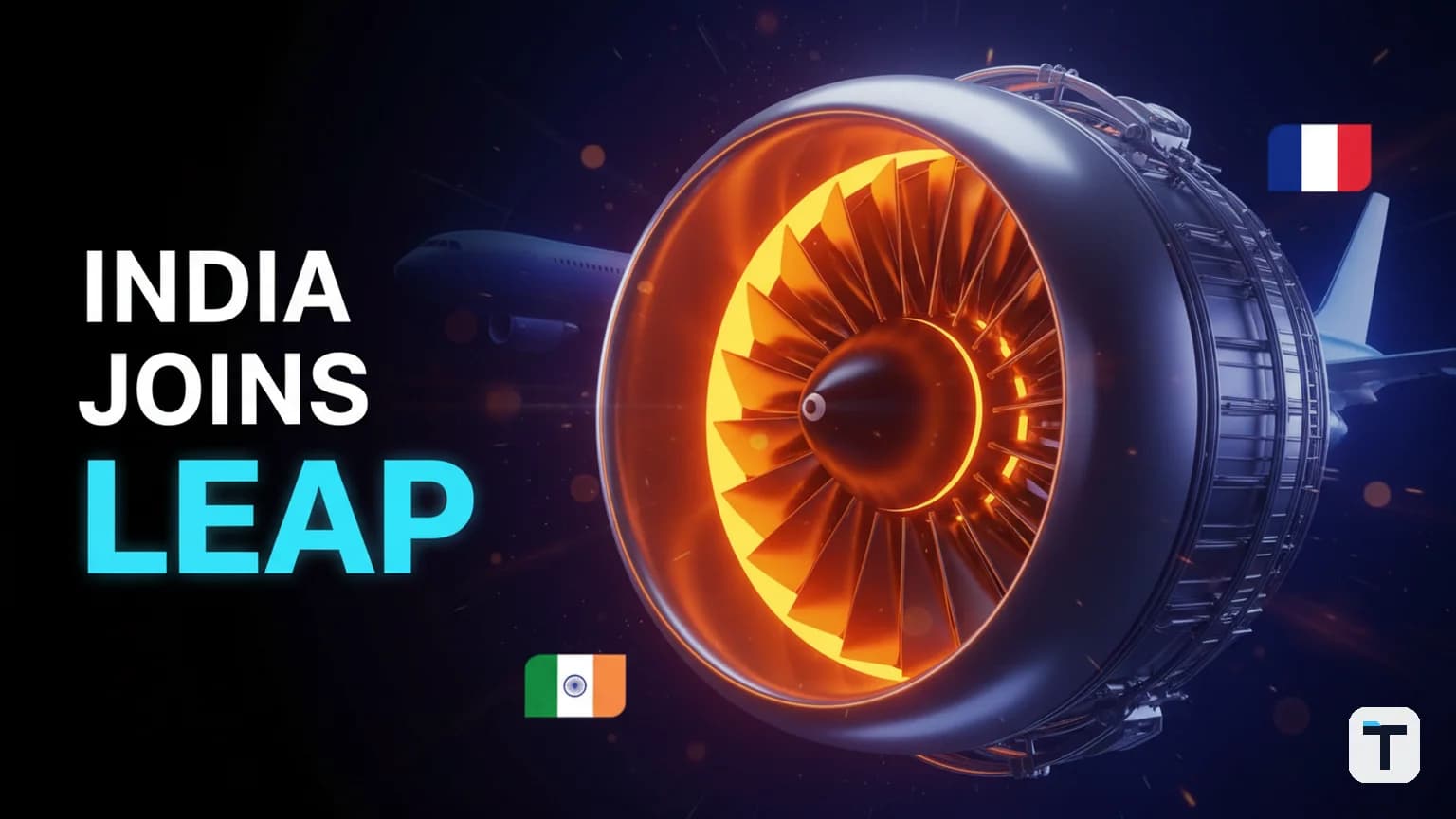

Verdict: Hindustan Aeronautics Limited (HAL) and Safran Aircraft Engines signed a multi-year agreement on July 22, 2026, at the Farnborough International Airshow for HAL to manufacture superalloy turbine ring forgings for the CFM LEAP engine — the powerplant behind the Airbus A320neo, Boeing 737 MAX, and COMAC C919. The deal is genuinely significant but easy to over read: it does not mean India is building a complete indigenous civil jet engine. It means a state-owned Indian firm has now been locked in as a long-term Tier-1 forgings supplier inside the world's most capacity-constrained engine supply chain, at exactly the moment LEAP production is the bottleneck holding back global narrowbody deliveries.
Last verified: 2026-07-23
- HAL will produce near-net-shape superalloy turbine ring forgings at its Foundry & Forge Division (Ring Rolling facility) in Bengaluru.
- The parts go into the rotating, high-temperature section of the CFM LEAP engine — critical for performance and reliability.
- Signed July 22, 2026, at the Farnborough International Airshow by Praveen B (GM, HAL Foundry & Forge) and Dominique Dupuy (SVP Purchasing, Safran Aircraft Engines), in the presence of HAL CMD Ravi K and Bengaluru Complex CEO Jayakrishnan S.
- It formalizes a relationship that ran through a 2022 joint venture, an October 2023 MoU, a February 2025 forging contract, and a June 2025 Paris Air Show rotating-parts agreement — this is the long-term production commitment.
- India is already CFM's third-largest market by engines in service; over 2,000 LEAP engines are on order for Indian airlines.
What is the HAL-Safran LEAP engine deal?
The HAL-Safran LEAP engine deal is a long-term supply agreement under which Hindustan Aeronautics Limited will manufacture and supply critical turbine ring forgings — made from advanced superalloys — for the CFM LEAP engine program. The agreement was signed on the sidelines of the Farnborough International Airshow on July 22, 2026, and HAL will carry out the work at its state-of-the-art Ring Rolling facility inside the Foundry & Forge Division in Bengaluru. Safran Aircraft Engines, the French engine-maker half of the CFM International joint venture, counts these components among the most demanding parts in the engine: they sit in the rotating section where temperatures and mechanical loads are extreme, and any defect directly threatens engine performance and reliability.
In plain terms: HAL is now one of the companies Safran relies on to forge the heat-resistant metal rings that hold the turbine section of a LEAP engine together. That is a small share of an entire engine, but it is a share very few companies in the world are qualified to produce.
Why does the LEAP engine matter to global aviation?
The LEAP (Leading Edge Aviation Propulsion) engine matters because it is the single most important narrowbody jet engine in commercial aviation right now. It is the product of CFM International, a 50/50 joint venture between GE Aerospace and Safran Aircraft Engines, and it is the sole engine offered on the Boeing 737 MAX and one of two options on the Airbus A320neo family (the other being Pratt & Whitney's GTF). It also powers China's COMAC C919. CFM says it has delivered more than 10,000 LEAP engines and calls it the fastest production ramp in commercial aviation history; the engine burns up to 15 percent less fuel than its CFM56 predecessor.
The reason this deal has outsized weight is that LEAP supply is currently the bottleneck for the whole narrowbody market. A persistent CFM LEAP engine shortfall — driven partly by upstream forging and casting constraints — was a leading cause of Airbus's 16 percent year-over-year drop in Q1 2026 deliveries, and Airbus CEO Guillaume Faury publicly said 2026 "comes with little hope" for a meaningful engine-volume increase. A key piece of Safran's own capacity expansion, a roughly $175 million hydraulic forging press, has been pushed back to 2029. Against that backdrop, any new qualified forgingscapacity added anywhere in the world is strategically valuable — which is the lens through which to read HAL's participation.
What will HAL actually manufacture for the LEAP engine?
HAL will manufacture near-net-shape turbine ring forgings from advanced superalloys (the earlier confirmation pointed to Inconel-type nickel alloys) at its Ring Rolling facility in the Foundry & Forge Division, Bengaluru. "Near-net-shape" means the forged ring is produced as close as possible to its final geometry, minimizing expensive machining of high-temperature alloys that are difficult to cut. These rings form structural elements in the rotating turbine section of the LEAP engine, where they must retain strength at extreme operating temperatures and withstand sustained centrifugal load. That is why the component is described as critical to engine performance and reliability: a turbine ring that relaxes, warps, or develops a defect under load can force an engine removal long before its scheduled shop visit.
This is not HAL's first aero-engine work, but it is the first time a multi-year production commitment has placed HAL inside the civil LEAP supply chain at forgings-tier depth. Safran's stated rationale, from Dupuy, is explicit: building a locally integrated supply chain in India is "crucial as we ramp up LEAP engine production to meet rising global demand." In other words, India is being added not as charity but as capacity Safran genuinely needs.
How did the HAL-Safran relationship get to this point?
The 2026 contract is thecap on a multi-year sequence, not a sudden breakthrough. The two firms' partnership spans roughly five decades — starting with Safran (then Turbomeca) Artouste engines on HAL's Cheetah and Chetak helicopters — and the recent LEAP-specific arc looks like this:
| Date | Milestone | What it did |
|---|---|---|
| July 2022 | Safran-HAL MoU on a new helicopter engine JV | Set up the SAFHAL Helicopter Engines joint venture for the IMRH/DBMRH (the "Aravalli" engine). |
| October 2023 | MoU on industrial cooperation for LEAP parts | Opened the track for HAL to manufacture LEAP rotating parts. |
| November 2023 | SAFHAL Helicopter Engines Pvt. Ltd. incorporated | Formalized the helicopter-engine JV in India. |
| February 2025 (Aero India) | Contract to produce forged parts for LEAP | HAL's first concrete LEAP forging work, building on the 2023 MoU. |
| June 2025 (Paris Air Show) | Agreement for industrialization and production of rotating parts for LEAP | Extended scope from forgings into Inconel rotating parts. |
| July 2026 (Farnborough) | Long-term agreement for superalloy turbine ring forgings | The deal covered here — turns prior agreements into a full long-term production commitment. |
Notice the gradient: each step widens HAL's role from exploratory cooperation to qualified componentry to a locked-in multi-year production seat. The 2026 deal is best understood as the point at which the relationship converts from "we are building capability" to "we are now a long-term link in your supply chain."
How does this fit Safran's wider India footprint?
Safran is not new to India, and the HAL deal rides on top of a much larger base. On Safran's own India page the group reports about 3,500 employees and 18 sites across the country, with a 70-plus year presence dating to the 1950s. For Safran Aircraft Engines specifically, the company already runs five production sites in Hyderabad, Bengaluru, and Goa, and in 2025 it inaugurated its largest LEAP engine MRO (maintenance, repair, overhaul) facility in the world in Hyderabad. The Safran-HAL Aircraft Engines joint venture in Bengaluru, set up in 2022, already manufactures components for both the LEAP and the M88 engine that powers the Rafale fighter.
The HAL ring-forging deal therefore slots into a cluster: a forgings supplier (HAL), a component JV (Safran-HAL Aircraft Engines), a LEAP MRO (Hyderabad), plus other Indian partners such as Titan Engineering and Automation Limited (TEAL), which signed a low-pressure-turbine parts contract at Aero India 2025. Read together, these form Safran's attempt to assemble a "complete aerospace ecosystem" inside India — the phrase the company itself uses.
What does the deal mean for India's aerospace manufacturing?
The honest answer is: meaningful for supply-chain depth, modest for indigenous engine design. Three things are genuinely new.
First, HAL enters the global civil aerospace supply chain at a structural tier. HAL has historically been a defense-focused state OEM — fighters, helicopters, trainers. Forging LEAP turbine rings is a civil-commercial part going into aircraft flown by airlines worldwide. That widens HAL's customer base beyond the Ministry of Defence and exposes it to commercial aerospace quality regimes and delivery discipline.
Second, it adds real, near-term capacity to the world's tightest engine supply chain. The LEAP bottleneck is not abstract — it is actively slowing A320neo and 737 MAX deliveries and forcing airlines to extend leases on older, less efficient jets. Any additional qualified forgings capacity directly relieves that constraint. HAL's Bengaluru ring-rolling facility is now genuinely part of the answer to a global aviation shortage.
Third, it builds human and industrial capital India will reuse. Superalloy ring-forging capability — the furnaces, the die engineering, the metallurgical process control, the non-destructive testing — is a general-purpose aerospace skill. The same know-how supports future Indian engine programs, including the Aravalli turboshaft being co-designed with Safran for the 13-ton Indian Multi-Role Helicopter. India gets the capability whether or not it ever designs a complete civil turbofan.
What the deal does not do, despite some celebratory coverage, is produce an indigenous Indian civil jet engine. India has long wanted a domestic turbofan in the 80–110 kN class for programs like the AMCA; that goal remains unsolved and is a separate, far harder problem than supplying forgings to someone else's engine. Conflating the two is the common over-read of this announcement.
How big is India as a LEAP engine market?
India is already CFM's third-largest market by engines in service. Safran's figures put about 75 percent of India's commercial fleet on CFM engines: of roughly 500 aircraft flown by seven Indian airlines with CFM engines, over 370 are LEAP-powered, and more than 2,000 LEAP engines are on order for Indian carriers. The headline Indian order of the Farnborough week was IndiGo and CFM signing a memorandum of understanding that could cover over 1,000 LEAP-1A engines — reported as a record agreement. That makes India both a huge customer of the LEAP and, via HAL, now a producer of one of its critical components.
What does HAL-Safran mean for you?
For builders, investors, and anyone tracking India's industrial trajectory, the takeaway is operational, not romantic. Watch three signals:
- Delivery against the LEAP bottleneck. If HAL's forgings flow on schedule and contribute to a visible improvement in narrowbody delivery rates over 2026–2027, India's role as a credible aerospace supply-chain node is confirmed with hard data, not press releases. If volumes slip, the deal is paper.
- Scope creep from forgings to higher-value parts. The 2022 → 2025 → 2026 progression showed each agreement widening HAL's share. The next escalation to watch is whether HAL moves from forgings into machined rotating parts or even module assembly — the kind of work that captures more value and more IP.
- Spillover into the indigenous engine track. The Aravalli/IMRH engine co-developed with Safran is the real test of whether India can convert supply-chain competence into design competence. HAL supplying LEAP rings is a necessary-but-not-sufficient precondition; the indigenous civil turbofan is the actual frontier.
If you are evaluating Indian aerospace as an investment, supplier, or talent market, treat this deal as evidence the supply-chain layer is being built seriously — and that the design layer is still the open question. For more on where India's industrial-build story is heading, see our analysis of India's rise as CFM's third-largest engine market and the record IndiGo LEAP deal, how Tata's Made-in-India C-295 program broke the state-only monopoly on military aircraft, whether India can build its own SpaceX, India's first indigenous 1,200 kV transformer for the UHVAC supergrid, and how Seoul Semiconductor's India plant is reshaping LED packaging manufacturing.
FAQ
Q: What is the HAL-Safran LEAP engine deal? A: A long-term agreement signed July 22, 2026, at the Farnborough International Airshow under which Hindustan Aeronautics Limited will manufacture superalloy turbine ring forgings for the CFM LEAP engine program at its Ring Rolling facility in the Foundry & Forge Division in Bengaluru. The parts are used in the high-temperature rotating section of the engine and are critical to performance and reliability.
Q: Which aircraft use the CFM LEAP engine? A: The LEAP family powers the Airbus A320neo family (LEAP-1A), the Boeing 737 MAX (LEAP-1B, the sole engine option), and the COMAC C919 (LEAP-1C). CFM International is a 50/50 joint venture between GE Aerospace and Safran Aircraft Engines.
Q: Does this mean India now builds its own civil jet engine? A: No. The deal makes HAL a long-term forgings supplier inside someone else's engine program. It builds valuable Indian manufacturing capability — and may eventually support indigenous efforts — but an indigenous Indian civil turbofan is a separate, unsolved problem. Conflating forging supply with engine design is the most common over-read of the announcement.
Q: Why is the deal strategically important now? A: LEAP engine supply is currently the bottleneck constraining Airbus A320neo and Boeing 737 MAX deliveries. A roughly $175 million Safran forging press has been delayed to 2029, and Airbus CEO Guillaume Faury said 2026 "comes with little hope" for a meaningful engine-volume increase. Adding qualified Indian forgings capacity directly relieves that constraint.
Q: How long have HAL and Safran been partners? A: Roughly five decades. The relationship began with Safran (Turbomeca) Artouste engines on HAL's Cheetah and Chetak helicopters, extended through the jointly developed Shakti/Ardiden engine for the Dhruv and LCH, and in 2022 produced the Safran-HAL Aircraft Engines joint venture in Bengaluru. The 2026 LEAP deal formalizes the civil-engine supply side of that partnership.
Q: How big is India's LEAP engine market? A: India is CFM's third-largest market by engines in service. Safran reports about 75 percent of India's commercial fleet is on CFM engines; of roughly 500 CFM-equipped aircraft flown by seven Indian airlines, over 370 are LEAP-powered, and more than 2,000 LEAP engines are on order for Indian carriers — including an IndiGo MOU reported to cover over 1,000 LEAP-1A engines.
Discussion
0 comments