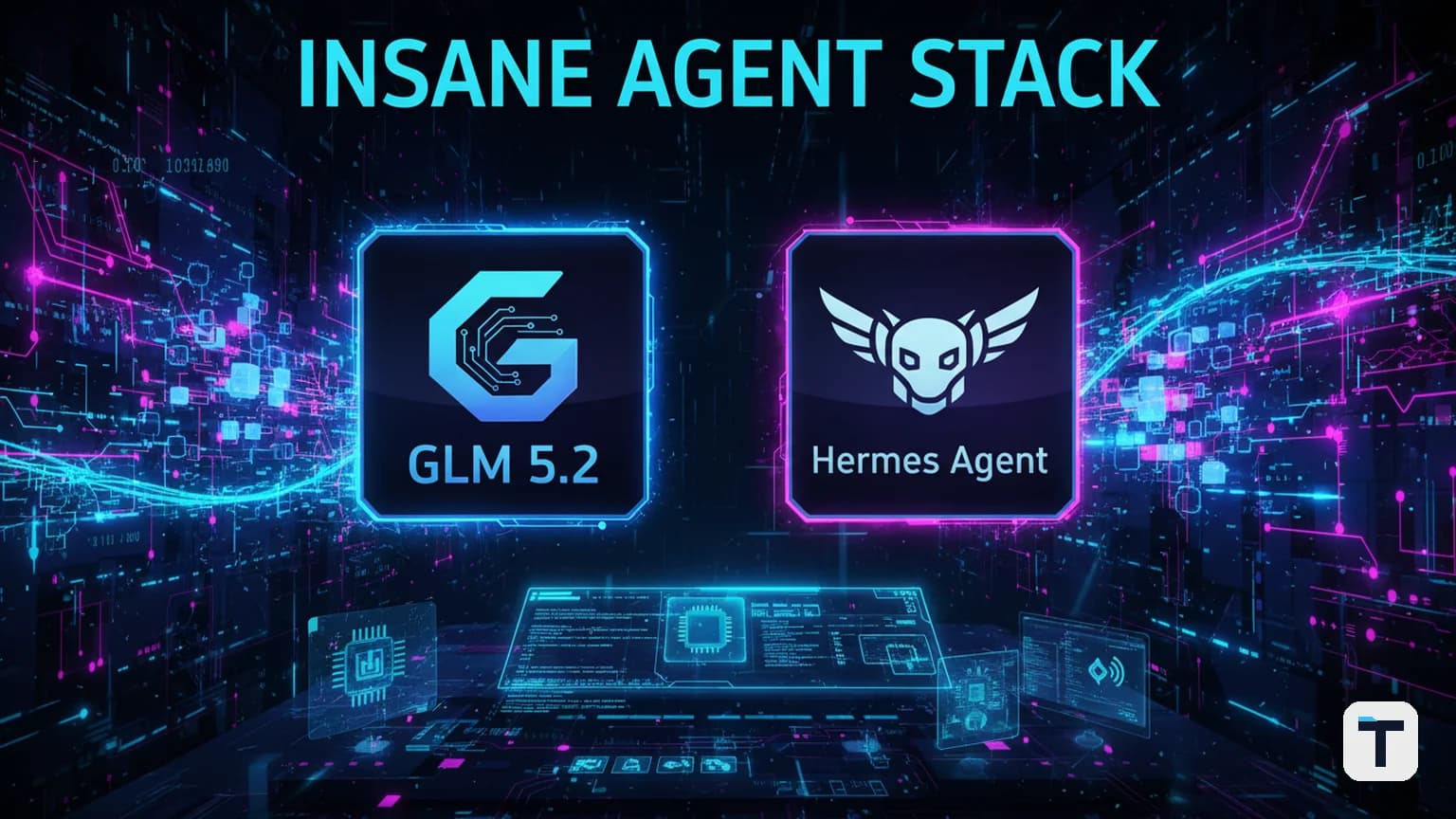

Verdict: The combination of Zhipu AI’s (Z.ai) GLM 5.2 and Nous Research’s Hermes Agent has created the first truly "insane" open-source agent station. By pairing a 1M-token context window with a self-improving agentic loop, builders can now run long-horizon engineering tasks that previously required $50/MTok frontier models for a fraction of the cost—with complete data sovereignty.
At-a-Glance: The Frontier Agent Station
- Engine: GLM 5.2 (753B MoE, 40B active parameters).
- Orchestrator: Hermes Agent (Persistent memory + Skill learning).
- Interface: Agent OS (Mission Control Dashboard).
- Key Advantage: MIT License weights bypass US export controls and provider "kill switches."
- Last Verified: June 20, 2026.
Q: What makes the GLM 5.2 and Hermes Agent combo so powerful?
A: It is the transition from a "Chatbot" to a "Station." While models like Claude 4.8 are powerful, they are tethered to closed APIs. GLM 5.2 provides frontier-level coding performance (81.0 on Terminal Bench 2.1) under an MIT License. When plugged into Hermes Agent, the system doesn't just respond; it learns from every task, saves successful workflows as reusable skills, and maintains state across a 1-million-token context window. This allows the agent to hold an entire repository in "active memory" without losing the plot halfway through a refactor.
Q: How does GLM 5.2 compare to GPT 5.5 and Claude Opus 4.8?
A: In the 2026 "Long-Horizon" benchmarks—which measure an agent's ability to work for hours on complex projects—GLM 5.2 is currently the strongest open-weights contender.
| Benchmark | GLM 5.2 (Z.ai) | GPT 5.5 (OpenAI) | Claude Opus 4.8 (Anthropic) |
|---|---|---|---|
| FrontierSWE | 74.4% | 72.6% | 75.1% |
| Terminal Bench 2.1 | 81.0 | 78.4% | 85.0% |
| SWE-bench Pro | 62.1% | 58.6% | 69.2% |
| License | MIT (Open) | Proprietary | Proprietary |
Data sources: Z.ai Official, Scale AI SEAL Leaderboard (June 2026).
While Opus 4.8 maintains a slight lead in raw reliability, GLM 5.2 actually surpasses GPT 5.5 in project-level engineering tasks (FrontierSWE). For teams building autonomous agent operating systems, this makes it the preferred "local-first" engine.
The "Agent OS" Pattern: Orchestrating a Digital Crew
The real breakthrough isn't just the model; it's the orchestration. Builders are moving away from single-agent chats toward a "Mission Control" approach using dashboards like Agent OS.
The 4-Role Team Workflow
Inside a Hermes Agent station, you can deploy a specific team structure that virtually eliminates the "hallucination" gap:
- The Researcher: Scans documentation and local files to build a context map.
- The Writer/Coder: Executes the primary implementation.
- The Editor: Refines the output for style and brand alignment.
- The Judge (The Secret Weapon): A high-reasoning profile that critiques the work against a rubric and forces the team to iterate until the goal is met.
This multi-agent pattern, running on GLM 5.2’s massive 1M context, allows for "parallel processing." You can have one agent drafting a social media content series while another maps out a customer welcome flow, all sharing the same memory layer.
Implementation: Setting Up Your Station
To run this stack today, you don't need a PhD; you need a system that supports model swapping.
- Install Hermes Agent: Use the open-source CLI from Nous Research.
- Configure Z.ai Provider: Add your GLM 5.2 API key or point to a local weights instance (requires ~400GB VRAM for full FP8).
- Set the Command: Use
hermes model set glm-5.2to switch the brain. - Deploy Agent OS: Use a dashboard to visualize the Kanban boards and task history.
For those running on limited hardware, the hosted GLM API is roughly 1/6th the cost of GPT 5.5, making high-volume agentic loops financially viable for small businesses.
What this means for you
The era of "single-tab AI" is over. If you are still prompting a chatbot to write one file at a time, you are falling behind. In 2026, the moat is your Agent Station—the specific combination of local memory, custom skills, and frontier-class open models like GLM 5.2. By building a local AI assistant that you truly own, you ensure that your business workflows remain online regardless of what happens in the proprietary AI market.
Related reading
FAQ
Q: Can I run GLM 5.2 on a regular laptop? A: No. The full 753B parameter model requires significant VRAM (8x H100 minimum for production inference). However, you can use the API for a fraction of a cent per prompt or run quantized versions if they become available.
Q: Is the 1M context window actually reliable? A: Yes. Unlike earlier long-context models that suffered from "lost in the middle" problems, GLM 5.2 uses a specialized MoE architecture that maintains high retrieval accuracy across the full 1 million tokens.
Q: Why choose GLM 5.2 over Claude Opus 4.8? A: Sovereignty and cost. GLM 5.2 is open-weights (MIT), meaning no one can revoke your access. It is also significantly cheaper to run at scale in agentic loops.
Q: Does Hermes Agent support other models? A: Yes. Hermes is model-agnostic. You can swap between GLM, Claude, GPT, and Llama 4 with a single command while keeping all your skills and memories intact.
Q: Is Agent OS free? A: The Agent OS pattern is a design philosophy, but specific dashboards like the one mentioned in the 2026 guides often require a subscription or membership (e.g., AIPB).
Discussion
0 comments