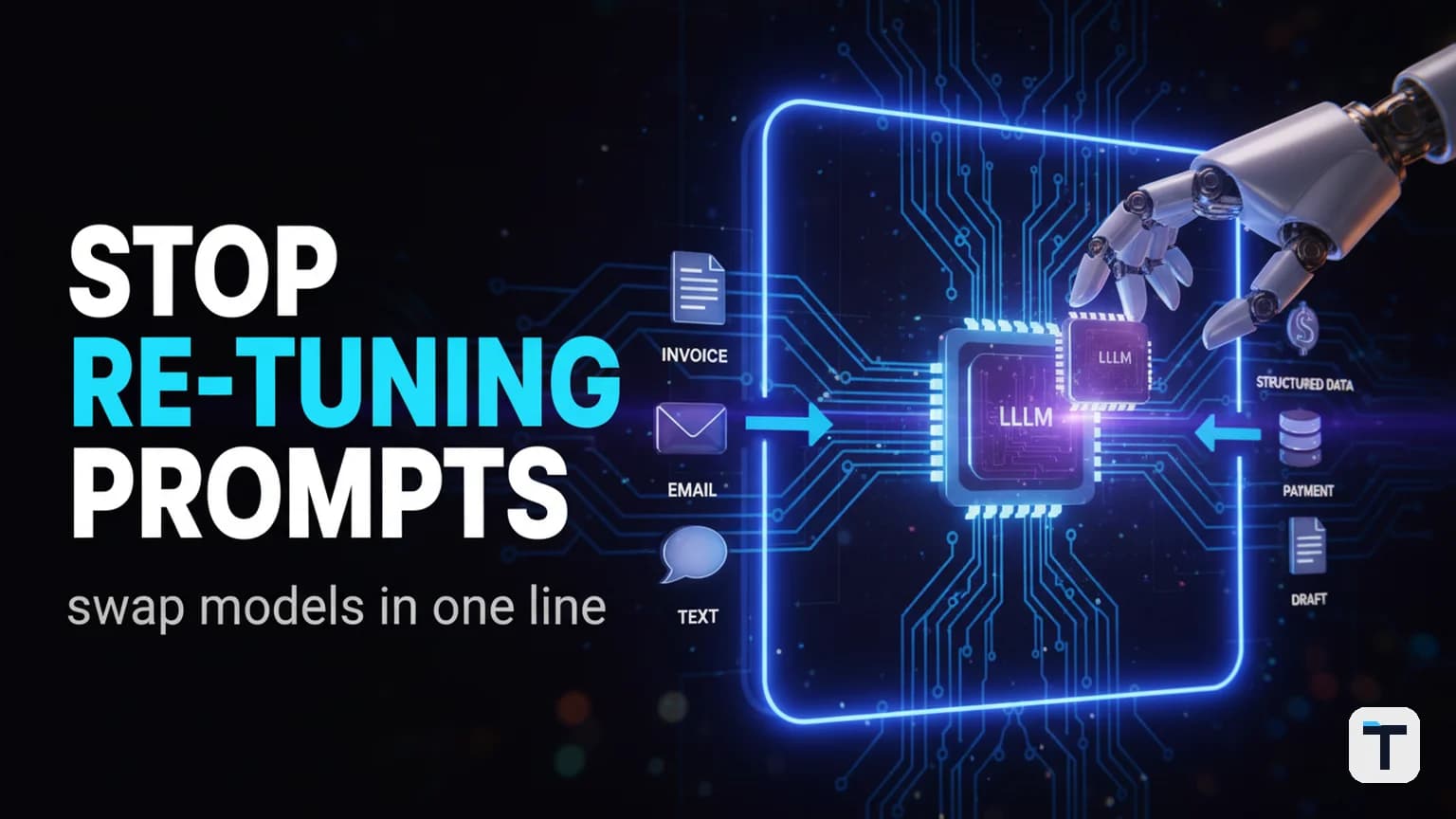

Verdict: DSPy is worth adopting for any repeated AI task where the prompt, model, or both might need to change. Treat your AI call like a function — a fixed contract for what goes in and what comes out — and let the model, prompt, and even the surrounding harness be swappable, searchable internals. That separation is the only documented way to survive the weekly churn of new models without rewriting your pipelines every quarter, and it's how Shopify cut a production metadata-extraction workload by roughly 550x without touching the business logic. If your team has written the same prompt twice, or rushed to re-tune it when GPT-5.6 shipped, this is the framework that stops that loop.
Last verified: 2026-07-24 — DSPy current PyPI release is 3.2.1 (May 2026); GitHub ~36,300 stars, MIT-licensed, ~6.1M monthly PyPI downloads. DSPy 4 with DSPy.flex and Qualitative Learning is on the roadmap, not yet released as stable. Pricing/versions change often — re-check before committing.
What is DSPy, in one sentence?
DSPy — short for Declarative Self-improving Python — is an open-source Python framework, originally from Stanford NLP, that lets you program language models instead of prompting them: you declare a typed signature for a task, and an optimizer searches for the model calls, prompts, few-shot examples, and (soon) surrounding harness code that best satisfy that signature against a metric you define (GitHub: stanfordnlp/dspy).
The non-obvious payoff is that the signature (the WHAT) stays constant while everything inside it (the HOW) becomes a search target you can swap in one line.
Why does separating the task from the model matter?
Separating the task from the model matters because the model is the part that changes fastest and the part you understand least. New frontier models ship roughly every few weeks — Gemini, Claude, GPT, Kimi, DeepSeek, Qwen — and each rewrite your favorite prompt in slightly different prose, breaking outputs you thought were solid. If your prompt is welded to one model's quirks, every release is a rewrite. If instead you've written your task as a stable signature ("invoice_text: str -> tax_amount: float, confidence: float"), the model is a line you change — and an optimizer can change it for you.
This is the precise condition that lets Shopify, Dropbox, Microsoft AI, Databricks, Moody's, AWS, Replit, and dozens of others run DSPy in production today (dspy.ai/community/use-cases). Each keeps a stable task interface and searches over the implementation as cheaper models or better techniques land.
How does "specs, code, evals" fully specify a task?
DSPy's thesis is that to automatically optimize an AI program — to let a search algorithm pick the implementation — you need three pieces, no more, no less. Each maps to a familiar software-engineering idea, applied to natural-language tasks.
| Pillar | Question it answers | How you express it | Software analogue |
|---|---|---|---|
| Specs (signatures + instructions) | What should happen? | A dspy.Signature declaring input/output fields in natural language, plus a free-form instruction |
A function signature + docstring |
| Code (hard constraints) | What MUST happen, no matter what? | Python if/raise guards and assertions around the model call — like "if no tax found, re-run with reasoning" or "if value < 0, surface for human review" |
Preconditions, postconditions, a type checker, a runtime assertion |
| Evals (examples + metric) | What does good look like? | A held-out set of labeled examples plus a Python metric function scoring each output |
A test suite that returns pass/fail (or a number) |
The three are deliberately minimal. Specs without code lets the model produce plausible-but-wrong outputs. Specs plus code without evals means you can search a model or prompt but you have no hill to climb — you can't tell a cheap Claude Haiku from a premium model on your data. With all three, the task is fully specified for optimization, and you can hand the search problem to an optimizer.
A load-bearing claim — the speaker's analogy — is that this mirrors how we already teach humans: you give a new hire a job description (spec), the rules they cannot break (code), and then you sit beside them and show them what a good ticket looks like until the long tail of "what looks right" sinks in (evals). Someone who only got a job description and a rulebook but never saw a good example would still struggle with edge cases — exactly the failure mode of zero-shot prompting on hard tasks.
What does optimization actually look like in DSPy?
DSPy introduces optimizers (originally called "teleprompters") — LM-driven algorithms that take your module + a training set + a metric and produce a compiled program. The optimization targets have moved over time, and watching the arc tells you where the framework is going.
| Era | What DSPy optimized | Why | Concrete optimizer |
|---|---|---|---|
| 2022–2023 | Few-shot examples | Base models (pre-ChatGPT) couldn't self-correct; good demonstrations were the dominant lever | BootstrapFewShot, BootstrapFewShotWithRandomSearch |
| 2023–2025 | Instructions (prompts) | Once models followed instructions reliably, auto-tuning the wording beat hand-crafting at scale | MIPROv2, COPRO |
| 2025–2026 | Reflective prompt evolution | Error-driven natural-language feedback outperforms RL on prompts at a fraction of the compute | dspy.GEPA |
| 2025 | Weights (fine-tuning) | Sometimes prompt optimization hits a ceiling and you need to distill into the model | BootstrapFinetune, BetterTogether |
| 2026 (roadmap) | Entire harnesses (code) | Tune not just the prompt but the retry loop, tool choice, and routing logic around the model call | dspy.flex (DSPy 4) |
This evolution is why DSPy calls itself "programming, not prompting" — the prompt is just one of several optimizable parameters, and increasingly the least interesting one.
The flagship optimizer today: GEPA
GEPA (Generalized Error-driven Prompt Augmentation) is the optimizer that produced the Shopify 550x result. It works by:
- Sampling many program trajectories on your training set.
- Asking the LM to reflect on its own traces in natural language — diagnose what went wrong.
- Proposing targeted prompt edits to address the diagnosed failures.
- Maintaining a Pareto frontier of prompts rather than just the single best, so complementary strengths combine.
The accompanying paper (Agrawal, Tan, Soylu, Ziems, Khare, Opsahl-Ong, Singhvi, Shandilya, Ryan, Jiang, Potts, Sen, Dimakis, Stoica, Klein, Zaharia, Khattab — UC Berkeley + Stanford) reports GEPA beats RL-based prompt optimizers on quality while using roughly 1/35th the compute, and was accepted as an oral presentation at ICLR 2026 (arXiv:2507.19457). That compute efficiency is exactly what makes 550x cost reductions plausible for production workloads, not just demos.
The optimizer family in one place
| Optimizer | What it tunes | Best for | Source |
|---|---|---|---|
BootstrapFewShot |
Few-shot demonstrations | Quick baseline, small datasets | DSPy docs |
MIPROv2 |
Instructions + demonstrations jointly | Mid-complexity pipelines | EMNLP 2024 paper |
dspy.GEPA |
Instructions via reflective evolution | Production cost reduction, sample efficiency | arXiv:2507.19457 |
BetterTogether |
Chains prompt optimization + fine-tuning | When you need weight-level gains | arXiv:2407.10930 |
| Multi-module GRPO | RL over modular programs (generalizes DeepSeek's GRPO) | Composing RL with prompt optimization | arXiv:2508.04660 |
GRPO deserves a sentence: it generalizes Group Relative Policy Optimization — the RL algorithm DeepSeek popularized for single-prompt training — to modular multi-prompt programs. The paper reports ~11% average accuracy gains across task types, and ~5% on top of prompt optimization alone (arXiv:2508.04660, accepted at ACM CAIS 2026).
How did Shopify cut costs by 550x?
Shopify used DSPy + GEPA for structured metadata extraction across all Shopify shops — extracting product attributes from listings at scale. The 550x figure refers to a ~550× reduction in yearly inference cost on that workload. The mechanism was: optimize the task with GEPA against evals, then swap the expensive frontier model for a cheap one that still cleared the eval bar (dspy.ai/community/use-cases).
The crucial part isn't the number — vendor self-reported numbers should always be read with that filter — it's how it was possible: because Shopify held the task signature and evals constant, changing the implementation (downgrading the model) was a one-line diff, not a re-engineering project. Compare that to a hand-prompted pipeline where "make it cheaper" means re-doing the entire prompt from scratch on a weaker model.
Confidence label: Vendor-claimed on the 550x figure. The number is published on DSPy's own community page and corroborated by an independent summary of the talk. We were unable to find Shopify's own engineering blog disclosing the exact workload, model names, or methodology, so treat the magnitude as directional, not audited.
What are DSPy.flex and Qualitative Learning (the DSPy 4 roadmap)?
Two features on the DSPy 4 horizon aim to automate the last pieces of human engineering.
DSPy.flex moves optimization from prompts to arbitrary functions. Instead of tuning the instructions or few-shot examples inside a fixed harness, flex can learn the entire harness — the retry logic, tool selection, routing, and control flow around a model call — as long as your task still has a measurable eval. The aspiration is that the harness itself becomes a search artifact, not a hand-built one.
This is not entirely new ground. DSPy's creator, Omar Khattab, demonstrated the direction outside the framework: an auto-optimized harness built around Claude Haiku ranked #1 on TerminalBench 2 at 76.4%, beating larger hand-engineered systems — reportedly the only auto-optimized entry in the field (MindStudio analysis, May 2026). The finding the harness — not the model — was the variable that mattered. DSPy.flex is the framework-level packaging of that idea.
Qualitative Learning tackles the hardest part of AI engineering: building evals for messy real-world tasks. The argument is threefold:
- Defining "good" is hard for complex problems — there's no clean metric.
- A binary "good/bad" verdict throws away the direction of improvement (what should change).
- Any eval dataset is a proxy for reality; reality is what actually happens in production.
The research question DSPy 4 is asking: can the model interpret the textual feedback already present in your production environment — user actions, trace logs, product analytics, even the model's own clarifying questions — and iteratively refine the eval and the hill it climbs? The status is explicitly research-stage, not a production feature you can pip-install today. But the bet is that mid-2026 models are now good enough at interpreting feedback that closing the loop from production signals to eval updates is feasible for the first time.
Is DSPy worth it for a small team or solo builder?
Yes, with a caveat. DSPy's value scales with how repeatable your task is and how often your models change. Below ~50 examples and a single model you don't plan to swap, hand-tuning a prompt is faster. Above that — or the moment a new model release tempts you — DSPy's separation saves more time than it costs to learn.
Concrete thresholds worth checking before adopting:
- You repeat the same AI task (extraction, classification, drafting, relevance judging, structured generation). One-off generations don't justify the overhead.
- You have or can label ~100+ examples for a metric. GEPA's sample efficiency helps, but you still need a hill.
- Your model costs matter. If you're routing every call through a frontier model and the bill is climbing, the Shopify pattern — optimize, then downgrade — is the highest-leverage move in the toolkit.
- You're tired of re-tuning prompts. If a model update broke a prompt you spent a week perfecting, the contract-boundary framing is exactly what stops that pain from recurring.
For a deeper look at the broader pattern — building AI work as reusable, composable functions rather than ad-hoc prompts — see our AI agent harness evolution guide, which traces the same "harness beats model" insight across a different lens, and our piece on organizing AI work like an operating system, which makes the case for treating repeated AI calls as first-class functions.
What does a DSPy signature look like in practice?
The smallest unit of DSPy is a signature — a typed declaration of input and output fields in natural language. Here is the canonical shape (paraphrased from the official docs and adapted to a generic small-business task — invoice tax extraction):
import dspy

class ExtractTax(dspy.Signature):
    """Extract the total tax amount from an invoice. If illegible, output zero."""
    invoice_text: str = dspy.InputField()
    tax_amount: float = dspy.OutputField()
    confidence: float = dspy.OutputField()
That's the spec — the WHAT. Attach a dspy.Predict(ExtractTax) for a vanilla call, or dspy.ChainOfThought(ExtractTax) to get reasoning. The code (the MUST) is enforced in your forward() — for example, "if vanilla extraction returns zero, re-run with ChainOfThought; if the value is negative, raise to a human." The evals are a Python function scoring (predicted_tax, gold_tax) pairs.
Swap the model with one line — dspy.configure(lm=dspy.LM("openai/gpt-5.6-mini")) — and the signature is unchanged. Compile with an optimizer and the prompt is also unchanged from your perspective; the optimizer rewrote it internally. Nothing in your integration breaks. This is the contract-boundary payoff in code form.
What does "the bitter lesson" have to do with DSPy?
The "bitter lesson" — Rich Sutton's 2019 argument that general methods that scale with compute eventually win over hand-crafted domain knowledge — shows up in DSPy as a practice: because your task boundary is fixed and your implementation is a search target, you can search over the cheap-and-scalable space (smaller models, better prompting, smarter harnesses) rather than paying engineers to hand-craft one expensive implementation. Shopify's 550x is the bitter lesson in miniature: the hand-crafted frontier-model pipeline lost to a searched cheaper implementation that cleared the same bar.
The reason most teams miss this lever is that hand-engineering a prompt feels productive — you can see the specific word changes — while re-running an optimizer feels like surrendering control. DSPy is the wager that the surrender is the cheapest move you can make, because each new model release reopens the search space and the optimizer refinds the answer faster than you can hand-tune.
How does DSPy relate to agentic workflows?
DSPy is complementary to agent orchestration frameworks (LangGraph, AutoGen, the broader agent ecosystem), not a replacement. The clean mental model is:
- The orchestrator manages state, tools, and the loop.
- Each DSPy module sits at one node in that graph as an optimizable, signature-bound call.
- You compile each module once per model tier you route to, cache the compiled artifacts, and route traffic by complexity.
This layered stack is exactly how the field has converged in 2026; our guide to building an AI agent team walks through the orchestration half of that pairing. The DSPy half is what makes the per-node prompts not become a maintenance crisis as you add agents.
For teams already feeling the cost pressure of running many agents in parallel — and most of the builders in our State of AI Engineering 2026 survey reported it as a first-class constraint — DSPy's ability to compile once, route to cheaper models is the cleanest mechanism for cutting the per-agent token bill without gutting reliability.
What this means for you
If you're a small-business owner or solo builder who runs the same AI task on a recurring basis — invoice extraction, email drafting, support classification, content moderation — the move is:
- Pick one task you currently prompt by hand for the same model.
- Write the signature — the inputs you give it, the outputs you want, in plain English.
- Write the hard rules in code — anything that must always be true (no negative tax, no PII leak, must mention a product name).
- Label 50–100 examples and write a metric function returning a number.
- Run
dspy.GEPA— even on a small task it's a one-evening project, and the cost-to-benefit math is favorable. - Once compiled, downgrade the model to the cheapest one that still clears your metric. This is where the real money shows up.
If you're a team lead or engineer at a company with a production LLM workload, the priority order is different but the signal is the same: the work that compounds is specifying the task boundary crisply (specs, code, evals), not_CODING the prompt. The prompt is a search target. The eval is the asset.
If you're deciding between DSPy and a hand-rolled prompt pipeline: the cheaper your per-call inference bill, the more DSPy's compile-once-deploy-cheap pattern pays for itself. For teams routing through frontier models like Gemini 3.6 Flash or Claude Fable 5 — where per-token cost is now the dominant line item — the model routing playbook is the adjacent piece: DSPy optimizes the task, then you route the optimized task to whatever model tier is cheapest that week.
FAQ
Q: Is DSPy free and open-source? A: Yes. DSPy is MIT-licensed and hosted at github.com/stanfordnlp/dspy. It's free to use commercially. The only costs are the language-model API calls you make through it.
Q: Do I have to fine-tune a model to use DSPy?
A: No. Fine-tuning (BootstrapFinetune, BetterTogether) is one optimizer family; dspy.GEPA and MIPROv2 optimize the prompt and few-shot examples, leaving the model weights untouched. Many production users (including Shopify) never fine-tune — they compile against a cheap model and route to it.
Q: How many labeled examples do I need?
A: DSPy's optimization works at the prompt level rather than the weight level, so smaller training sets suffice. Community guidance puts typical BootstrapFewShot runs at 100–500 examples; GEPA is deliberately sample-efficient — roughly 1/35th the compute of comparable RL-based optimizers per the paper (arXiv:2507.19457) — so you can get meaningful gains from tens of examples, with diminishing returns below that.
Q: Does DSPy work with any model provider?
A: Mostly yes. DSPy uses LiteLLM under the hood, so it routes to OpenAI, Anthropic, Google, Cohere, open-weight local models via vLLM, and dozens of others through a single dspy.LM("provider/model") call. The same signature can be compiled against multiple models and routed by complexity.
Q: What's the difference between DSPy and LangChain? A: LangChain is an orchestration framework — it manages chains, tools, memory, and state. DSPy is an optimization framework — it searches for the best prompts, few-shot examples, and (soon) harness code given a measurable task. They compose: LangGraph orchestrates the pipeline; each LangGraph node can call a compiled DSPy module. DSPy's distinctive contribution is the signature abstraction and the optimizer library, neither of which LangChain provides.
Q: Will DSPy become obsolete when models get smart enough ("AGI")? A: The framework's argument is the opposite: even an arbitrarily capable model still won't know your context, your data, or your long-tail of what "good" looks like — that's learned, not pre-trained. DSPy's last-mile-learning thesis is that you'll always need to specify the task (specs), enforce the invariants (code), and measure success (evals); smarter models just let you automate more of the implementation between those three. The three pillars persist; the optimization surface inside them grows.
Discussion
0 comments