
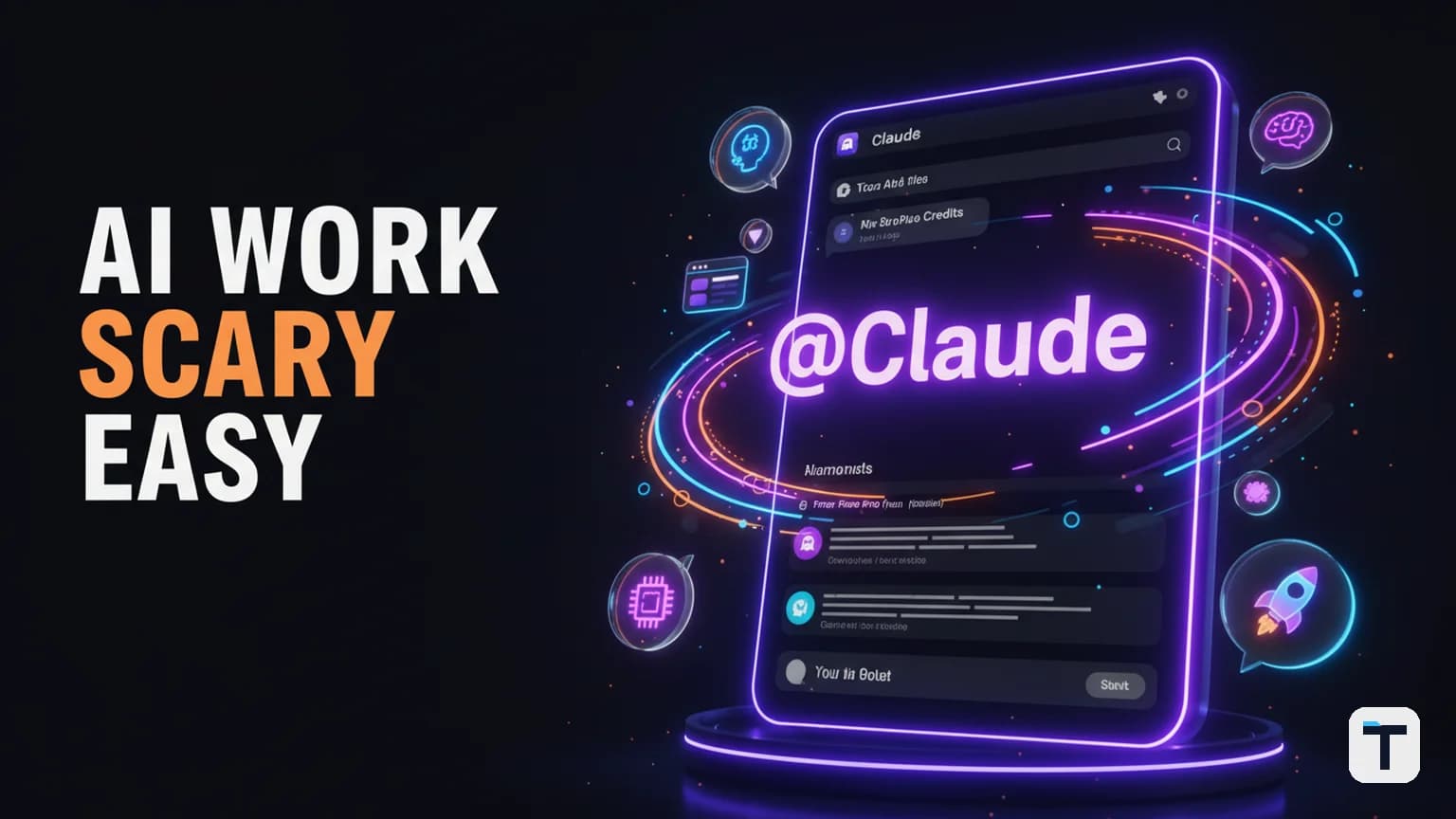
Last verified: June 27, 2026 · Status: Beta for Claude Team and Enterprise · Core Engine: Claude Opus 4.8 / Claude Code. Note: Only Workspace Owners or Primary Owners can initiate the setup process.
What is Claude Tag? (The Multiplayer AI)
Claude Tag is the evolution of the standalone chatbot. Instead of every employee starting fresh conversations in private windows, Claude Tag joins the shared spaces where your team already works. It acts under a persistent organization identity, remembers the institutional knowledge discussed in a channel, and can proactively follow up on unresolved threads.
Unlike a standard Slack integration that simply "talks," Claude Tag is an agentic system. It uses an ephemeral sandbox to run code, search connected data warehouses, and execute multi-step tasks independently while reporting its progress in-thread.
How Claude Tag Differs from the Standard Slack App
The primary difference is agency and memory. Traditional Slack integrations are reactive; Claude Tag is proactive.
| Feature | Standard Claude Slack App | Claude Tag (2026) |
|---|---|---|
| Identity | User-level chatbot | Shared Organizational Agent |
| Context | Single-conversation window | Persistent Channel/Workspace Memory |
| Execution | Text responses only | Code execution in sandboxes |
| Initiative | Wait for user prompt | Ambient "Proactive" mode |
| Access | Personal connectors | Admin-controlled toolsets |
The 65% Rule: How Anthropic Uses Claude Internally
The most compelling proof of Claude Tag's efficacy comes from Anthropic itself. According to Cat Wu, Anthropic’s internal product teams now route approximately 65% of all code changes through an internal version of Claude Tag.
Teams outside of engineering are seeing similar shifts:
- Product Teams: Using Claude to track and synthesize complex product metrics from connected data sources.
- Support Teams: Tagging Claude to triage tickets and identify common bug patterns across multiple channels.
- Leadership: Using the "AI Assistant Panel" to get instant status updates on cross-departmental projects without digging through threads.
Security & Permissions: Keeping Your Data Safe
One of the biggest hurdles for Enterprise AI is data leakage. Claude Tag addresses this with a three-tier inheritance model:
- Organization Level: Global credentials and repositories that apply everywhere.
- Workspace Level: Permissions specific to a Slack workspace, inheriting from the Org level.
- Channel Level: Granular access for sensitive groups (e.g., Legal or HR) that keeps tools and memory strictly isolated from the rest of the company.
Admins can view a full audit log of every action Claude takes, including who assigned the task and what data was accessed. For teams worried about "runaway" AI, you can set hard token spend limits at both the organization and channel levels.
3 Ways to Interact with Claude Tag in Slack
To get the most out of the system, your team should understand the three distinct interaction surfaces:
- Thread Mentions (@Claude): The primary way to work. Tagging Claude in a channel allows everyone to see its work, steer its progress, and pick up where others left off.
- Direct Messages (DMs): Used for private tasks. In a DM, Claude uses your personal account connectors and web search rather than the shared organization toolset.
- AI Assistant Panel: A persistent sidebar on the right side of Slack that allows you to interact with Claude from anywhere in the app without leaving your current view.
Practical Use Cases for Small Business
You don't need a 500-person engineering team to see ROI from Claude Tag. Because it shares the engine used in Claude Code, it is highly capable of building functional business tools from plain English requests.
1. Instant Business Calculators
By tagging Claude and describing your inputs (e.g., monthly traffic, conversion rate, and average order value), it can build and deploy a single-page HTML ROI calculator in minutes. This is ideal for sales teams needing quick client-facing tools.
2. Rapid Landing Page Prototyping
Marketing teams can describe a campaign (Headline, Benefits, Form, FAQ) and have Claude generate a structured HTML landing page draft. This synergizes perfectly with Claude Design 2.0 for high-fidelity refinement.
3. Automated Status Reporting
Tag Claude in a weekly project channel and ask: "Summarize the blockers discussed this week and draft a status email for the CEO." Because it has persistent channel memory, it doesn't need a recap—it already knows.
What this means for you
For the modern professional, the goal is no longer to "learn prompts," but to manage agents. Claude Tag is your first true "AI coworker." If you are already building an Agent-Ready Business Infrastructure, Claude Tag is the interface your team will use to interact with it daily.
Action Item: If you are a Slack Owner, follow our 4-Step Claude Tag Setup Blueprint to provision your first identity and test it in a private channel today.
FAQ
Q: Is Claude Tag different from the Claude Slack app? A: Yes. Claude Tag is a new agentic mode that replaces the old app. It features shared memory, tool access, and autonomous task execution.
Q: Who can set up Claude Tag? A: Only a Primary Owner or Owner in Slack can initiate the setup and provision the agent's identity.
Q: Can Claude Tag access my private channels? A: Only if specifically invited. Admins can control exactly which channels Claude has access to and what tools it can use in each.
Q: Does it cost extra? A: Claude Tag is currently in beta for Claude Team and Enterprise subscribers. Usage counts against your plan's token limits, and admins can set spending caps.
Q: How does the 65% code metric work? A: Anthropic reports that 65% of their internal product team's code is now generated by tagging their internal version of Claude Tag, proving its capability for high-stakes production work.
Every claim here is traced to a primary source, dated, and listed under Sources. Research and drafting are AI-assisted; editing, verification and publication are human decisions, and a person is accountable for what appears on this page. How we work →


Discussion
0 comments