
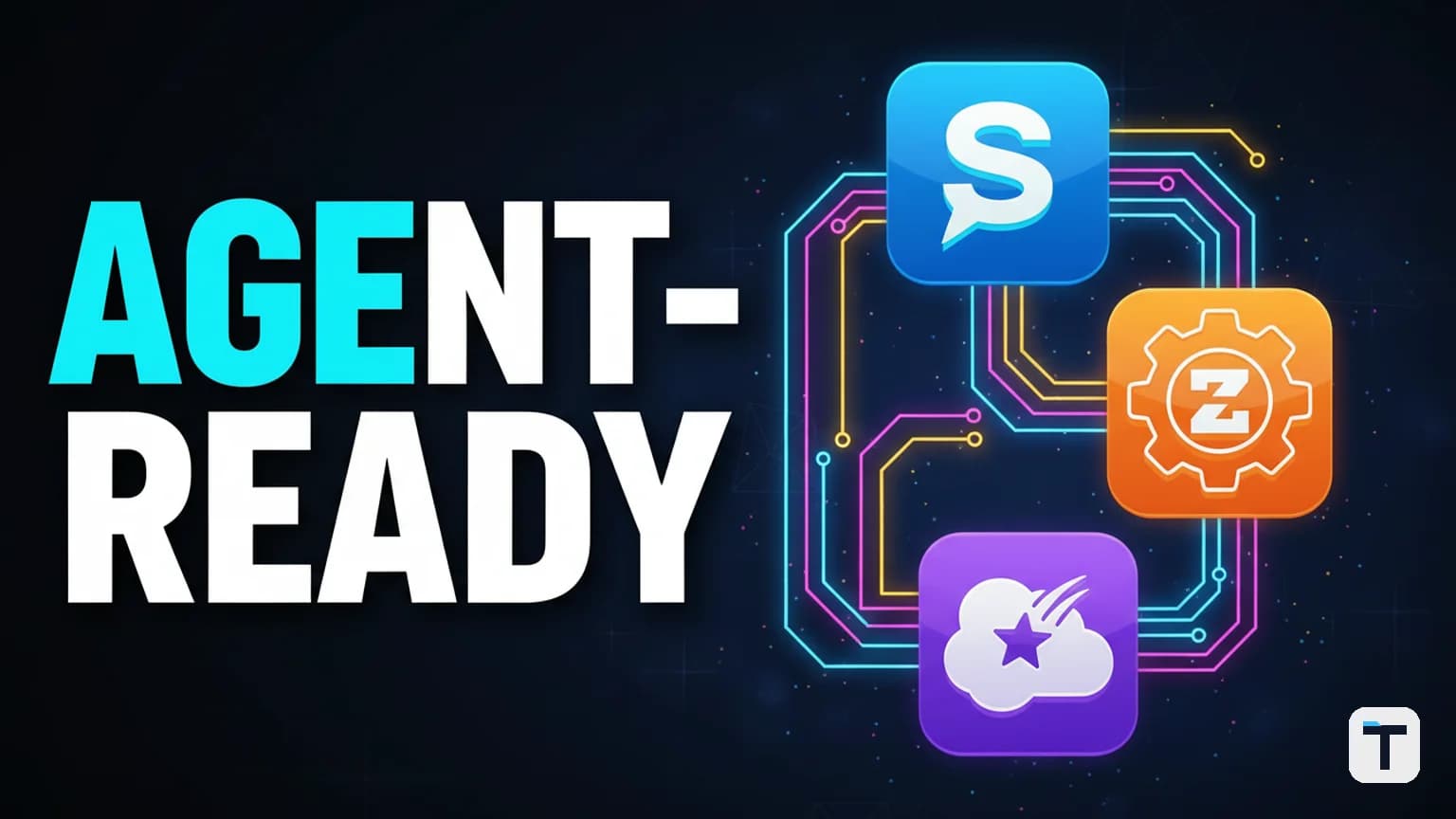
Last verified: 2026-06-26 · Best for: Small business owners, team leads, and ops managers · Volatile facts: Pricing and feature availability for Claude Tag and Zapier MCP change frequently.
The Shift: From AI Assistants to AI Coworkers
For the past two years, most businesses treated AI as a "sidecar"—a separate window where you copy-paste text and hope for a good response. In June 2026, that era is ending. With the launch of Claude Tag and Codeex Record & Replay, AI has moved from being a tool you use to a coworker that lives in your environment.
However, the "AI Coworker" era brings new risks. You wouldn't give a new human hire your master password and full access to your bank account on day one. You shouldn't do it with an agent either. Building an Agent-Ready Infrastructure is about creating the safety rails and visibility that allow these agents to work autonomously without breaking your business.
Infrastructure Pillar 1: Granular Permissions with Zapier MCP
The biggest bottleneck for AI agents is permissions. Traditional OAuth flows often grant "all or nothing" access. If you give an agent access to your Gmail, it can read your private medical records just as easily as it can send a client proposal.
Zapier MCP (Model Context Protocol), released in early 2026, solves this by introducing granular, action-specific permissions. Instead of full account access, you can now grant:
- Email: "Read and Draft only" for your primary account, but "Full Access" for a dedicated
agent@yourbusiness.comaccount. - Sheets: Access to a specific
CRM_Leadssheet, while blocking thePayrollsheet. - Slack: Permission to post in
#marketingbut not read#management-private.
This "Zero Trust" approach to AI allows you to scale agent workflows (like building an autonomous lead machine) without exposing sensitive data.
Infrastructure Pillar 2: Presence & Accessibility with Blue Rails
If your business isn't "agent-readable," you are invisible to the new AI economy. Search engines are being replaced by AI Answer Engines (GEO/AEO), and those engines increasingly use agents to transact, not just browse.
Blue Rails provides the infrastructure to make your site machine-legible. While traditional SEO focuses on human-friendly copy, Agentic SEO focuses on:
- llms.txt: A structured map of your site designed for agent consumption.
- HTTP 402 (x402) Endpoints: Allowing agents to make sub-cent micropayments ($0.001) to access your data or book your services.
- Agent Checkout: A machine-readable "Buy Now" button that an AI agent can understand and execute within defined budget boundaries.
By 2027, "agent-readiness" will be more valuable than a #1 ranking on a blue-link search page.
Infrastructure Pillar 3: Persistence with Claude Tag
One-on-one chats are silos. When you chat with AI in a private window, your team loses that context. Claude Tag (launched June 23, 2026) embeds AI directly into Slack as a persistent teammate.
Unlike the old "slash command" bots, Claude Tag:
- Builds Memory: It reads channel history and understands the context of a project over weeks.
- Works Multi-player: Anyone on the team can
@Claudeto pick up where another person left off. - Performs Background Tasks: It can schedule Salesforce updates every Monday or monitor error rates in real-time.
For a deeper dive, see our 4-step blueprint for Claude Tag setup.
Infrastructure Pillar 4: The Organizational "Second Brain"
To make your agents truly effective, they need access to your company's institutional knowledge. The "Second Brain" concept, popularized by the Codeex "Personal AGI" prompt, involves consolidating all meeting transcripts, emails, and documentation into a searchable Obsidian-backed knowledge base.
In a 12-hour automated "Record & Replay" session, tools like Codeex can now scan your entire digital history to build a private, local knowledge graph that agents can query. This prevents the common AI failure mode of "hallucinating" how your business operates.
What this means for you
If you are a small business owner, your priority in 2026 is no longer "learning to prompt." It is architecting your Agent OS.
- Audit your data silos: Start consolidating transcripts and docs into an Obsidian vault.
- Agent-proof your site: Run an "agent-readiness" scan (via Blue Rails) to see if agents can understand your pricing and services.
- Switch to Granular Auth: Move high-risk integrations to Zapier MCP to limit agent exposure.
Related reading
FAQ
Q: How much does it cost to set up an Agent-Ready Infrastructure? A: The entry cost is surprisingly low. Zapier MCP starts free for basic actions, and Blue Rails has a free visibility tier. The main cost is time (setting up the "Second Brain" vault) and your Claude Enterprise/Team subscription ($30+ per user/month).
Q: Is it safe to let agents transact on my behalf? A: Only if you use infrastructure with spending caps. Tools like Blue Rails allow you to set "per-agent" and "per-transaction" limits (e.g., "This agent can spend up to $50 on travel bookings without human approval").
Q: Does this replace my human team? A: No. It replaces the grunt work. By delegating the "find, verify, and fill" tasks to agents, your human team can focus on strategy, high-level design, and relationship management.
Q: What is the best model for these agentic tasks in 2026? A: While Claude Opus 4.8 is the leader for complex Slack tasks, the open-weight GLM 5.2 (released June 13, 2026) has become the top choice for low-cost, high-performance coding and background automation.
Every claim here is traced to a primary source, dated, and listed under Sources. Research and drafting are AI-assisted; editing, verification and publication are human decisions, and a person is accountable for what appears on this page. How we work →

Discussion
0 comments