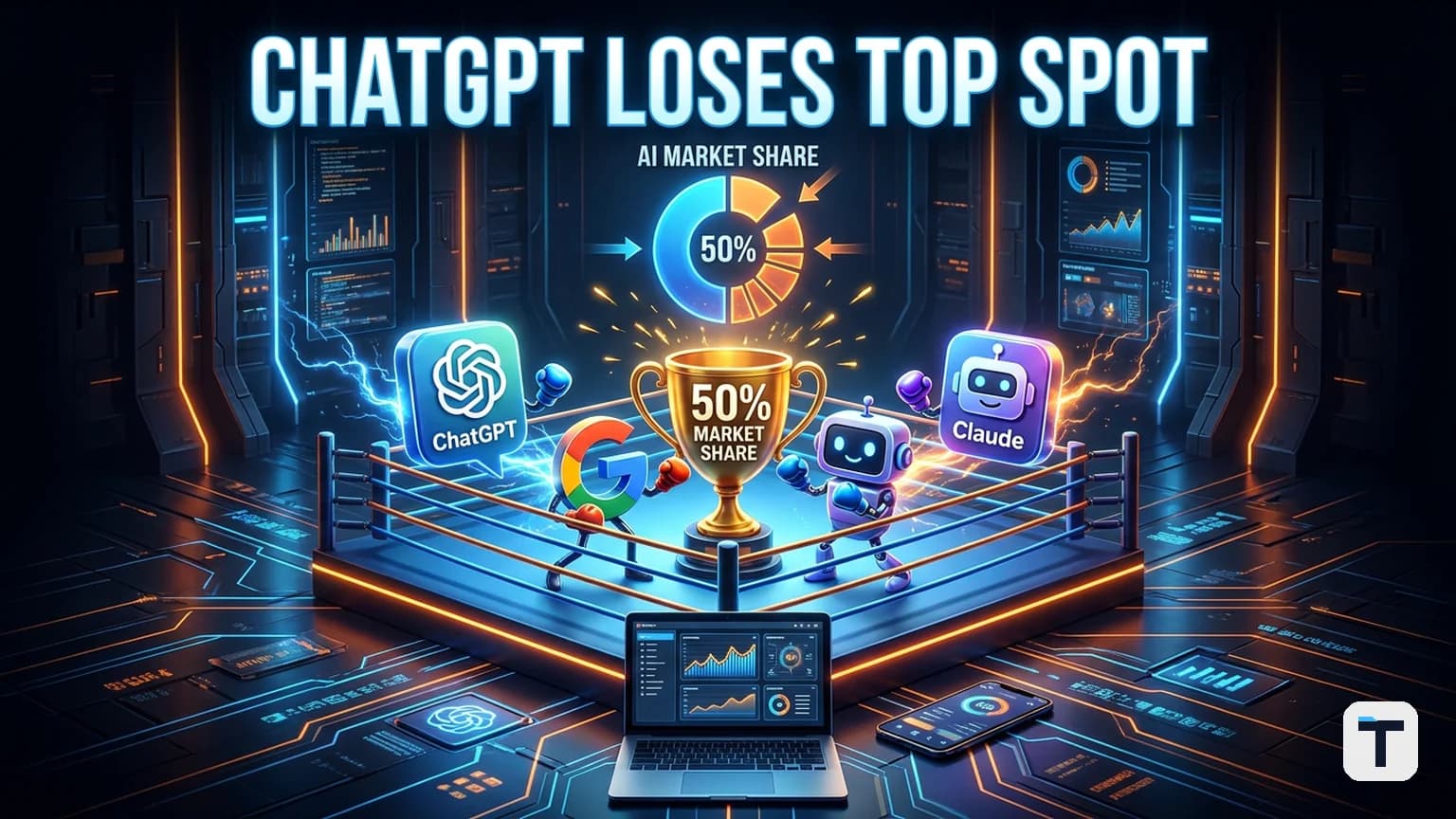

ChatGPT is still the largest AI assistant on earth, but its dominance is no longer absolute. According to Sensor Tower's State of AI 2026 report, ChatGPT's share of the AI assistant market dropped to 46.4% by the end of May 2026—down from over 50% in January. Google Gemini rose to 27.7%, while Anthropic Claude reached 10.3%. The rest—Grok, Perplexity, DeepSeek, Meta AI—each sit below 5%.
This is the first real sign that the AI assistant market is moving from a land-grab phase into a competition for retention, monetization, and trust. ChatGPT created the category, but owning the future of AI work is now an open contest.
Last verified: 2026-06-17
- ChatGPT: 1.1 billion MAU, 46.4% market share
- Gemini: 662 million MAU, 27.7% share
- Claude: 245 million MAU, 10.3% share
- Best for conversion: Claude (13% paid-subscription rate)
- Market shift: from user growth to retention + monetization
How did ChatGPT lose majority share while still growing?
The common mistake is to read this as ChatGPT shrinking. It isn't. ChatGPT became the fastest app in history to reach 1 billion monthly active users earlier this June, per Sensor Tower. OpenAI had last reported 900 million weekly active users in February 2026. So the absolute numbers are up; the share is down because the rest of the market grew faster.
Until January 2026, ChatGPT controlled more than half the AI assistant market. By May, that figure had fallen to 46.4%. The driver is simple: Gemini and Claude are finally large enough to matter at scale, and users are becoming more willing to switch between assistants depending on the task.
Sensor Tower's report shows that brand values and trust now influence choice alongside product quality. A clear example came after OpenAI announced its agreement with the U.S. Department of Defense in February 2026; U.S. ChatGPT uninstalls jumped 295% day-over-day, according to TechCrunch's analysis of Sensor Tower data.
Who is catching up, and why?
Google Gemini: distribution as a moat
Gemini's 27.7% share is powered by Google's ecosystem. Millions of users encounter Gemini through Google Search, Android, Workspace, and Chrome—without ever downloading a standalone app. That built-in distribution gives Gemini a structural advantage that no startup can copy.
For small businesses, this matters because Gemini is increasingly the assistant your customers, employees, and partners already have in their pockets. If your content, products, or services are not discoverable through Google's AI surfaces, you risk becoming invisible in the channel where the largest share of the non-ChatGPT audience lives.
Anthropic Claude: quality as a moat
Claude has built its 10.3% share the harder way: by becoming the tool of choice for professional, productivity-heavy work. Developers, writers, analysts, and operators have migrated to Claude for coding, long-form drafting, and reasoning tasks.
Two numbers stand out:
- 13% of Claude users pay for a subscription, the highest conversion rate among major AI assistants, per Sensor Tower.
- Claude's U.S. mobile average revenue per user rose from under $0.50 in September 2025 to $2.76 in May 2026.
That monetization performance suggests Claude's audience is not just larger; it is more committed. For businesses, Claude is the assistant to test first if you are doing serious knowledge work, software development, or content operations.
The long tail: under 5% each
Grok, Perplexity, DeepSeek, and Meta AI remain niche players by mobile-app market share. That does not make them irrelevant. Perplexity owns the search-native audience, Grok owns X's real-time conversation layer, DeepSeek owns price-sensitive developers, and Meta AI owns social distribution. But for mainstream small-business use, none has yet reached the scale or reliability of the top three.
What is actually changing in the AI market?
The headline is not just about share. The entire market is maturing:
| Trend | H1 2025 | H1 2026 (projected) | Change |
|---|---|---|---|
| AI app downloads | — | ~2.3 billion | Scale growth |
| Consumer spending on AI apps | $1.83 billion | >$4.2 billion | More than double |
| Time spent on Gen AI apps | 17.2 billion hours | ~36 billion hours | More than double |
Sources: Sensor Tower State of AI 2026 press release, TechCrunch analysis
However, both download and spending growth rates are slowing. That is the classic pattern of a maturing market: the pie is still expanding, but the easy growth is over. The next winners will be the companies that convert attention into revenue and loyalty, not just the ones that acquire users fastest.
How are the leaders trying to monetize?
OpenAI is diversifying beyond subscriptions. It began testing ads in ChatGPT in early 2026 and, by May, approximately 17% of daily ChatGPT users were seeing advertisements, according to Sensor Tower data reported by TechCrunch and MediaNama. OpenAI's own announcement says ads will remain limited to the free and Go tiers; Plus, Pro, Business, and Enterprise will stay ad-free.
The ad categories dominating early tests are software, shopping, media, entertainment, food, and dining. ChatGPT is also becoming a referral channel for retailers. Walmart, Target, and Costco have seen traffic from ChatGPT, while Amazon—whose crawlers block ChatGPT—has lagged in AI referral growth. Walmart has meanwhile embedded its own AI shopping assistant, Sparky, inside its app.
Amazon's own assistant, Rufus, tells a different story: Amazon says shoppers who use Rufus are 60% more likely to complete a purchase than non-users, and estimated Rufus could drive more than $10 billion in annual incremental sales.
What this means for you
If you run a small business, a team, or a solo operation, the fragmentation of AI assistants changes how you should think about tooling:
- Do not bet everything on one assistant. ChatGPT, Gemini, and Claude now each have credible strengths. Test all three for your actual workflows.
- Match the tool to the job. Use Claude for deep work and coding, Gemini if your workflow lives inside Google, and ChatGPT for breadth and plug-ins.
- Watch your discoverability in AI surfaces. Product recommendations, local services, and B2B vendors are increasingly being surfaced inside chat interfaces. Make sure your website content is structured so AI assistants can cite it accurately.
- Track pricing volatility. Subscription tiers, ad-supported free tiers, and usage-based pricing are all shifting fast. Re-assess your AI tooling budget quarterly.
- Prepare for a multi-assistant workflow. The era of one default chatbot is ending. Your team may soon use different assistants for search, coding, writing, and customer support.
Which AI assistant should your team use?
| Use case | Best fit today | Why |
|---|---|---|
| General business queries + integrations | Gemini | Native in Google Workspace, Search, Android |
| Coding, analysis, long-form writing | Claude | Strong retention, highest paid conversion, developer trust |
| Broad tasks, plugins, image generation | ChatGPT | Largest ecosystem, most third-party integrations |
| Real-time social/news tasks | Grok | Tied to X/Twitter data and conversation |
| Research-heavy search | Perplexity | Citation-first answers, web-native |
| Budget-conscious coding | DeepSeek | Low API cost, open model weights |
This is a snapshot, not a forever verdict. Model capabilities change monthly; re-test every quarter.
Related reading
FAQ
Q: Is ChatGPT losing users? A: No. ChatGPT's absolute user base is still growing. It recently crossed 1.1 billion monthly active users. Its share of the total AI assistant market is shrinking because Gemini and Claude are growing faster from smaller bases.
Q: Why did ChatGPT fall below 50% market share? A: Competition caught up. Gemini benefits from Google's built-in distribution, while Claude has built a reputation for productivity and coding. Users are also more willing to switch assistants based on trust and values, not just features.
Q: Which AI assistant is best for small business productivity? A: It depends on your workflow. Claude leads for deep reasoning, coding, and writing. Gemini is strongest if your team already uses Google Workspace. ChatGPT offers the broadest set of tools and integrations. Most teams should trial all three before standardizing.
Q: Is Claude really making money? A: Sensor Tower reports that 13% of Claude users pay for a subscription, the highest conversion rate among major AI assistants. Its U.S. mobile average revenue per user also rose sharply from under $0.50 in September 2025 to $2.76 in May 2026.
Q: Will ChatGPT ads affect business users? A: Probably not directly. OpenAI has said ads will be limited to the free and Go tiers. Plus, Pro, Business, and Enterprise tiers are expected to remain ad-free. However, ads may affect the consumer-facing experience and how brands appear inside ChatGPT.
Q: What does the AI assistant race mean for marketing? A: AI assistants are becoming discovery channels. If your product or service information is not structured, accurate, and citable online, you may lose visibility as users increasingly ask assistants for recommendations instead of searching the web directly.
Discussion
0 comments