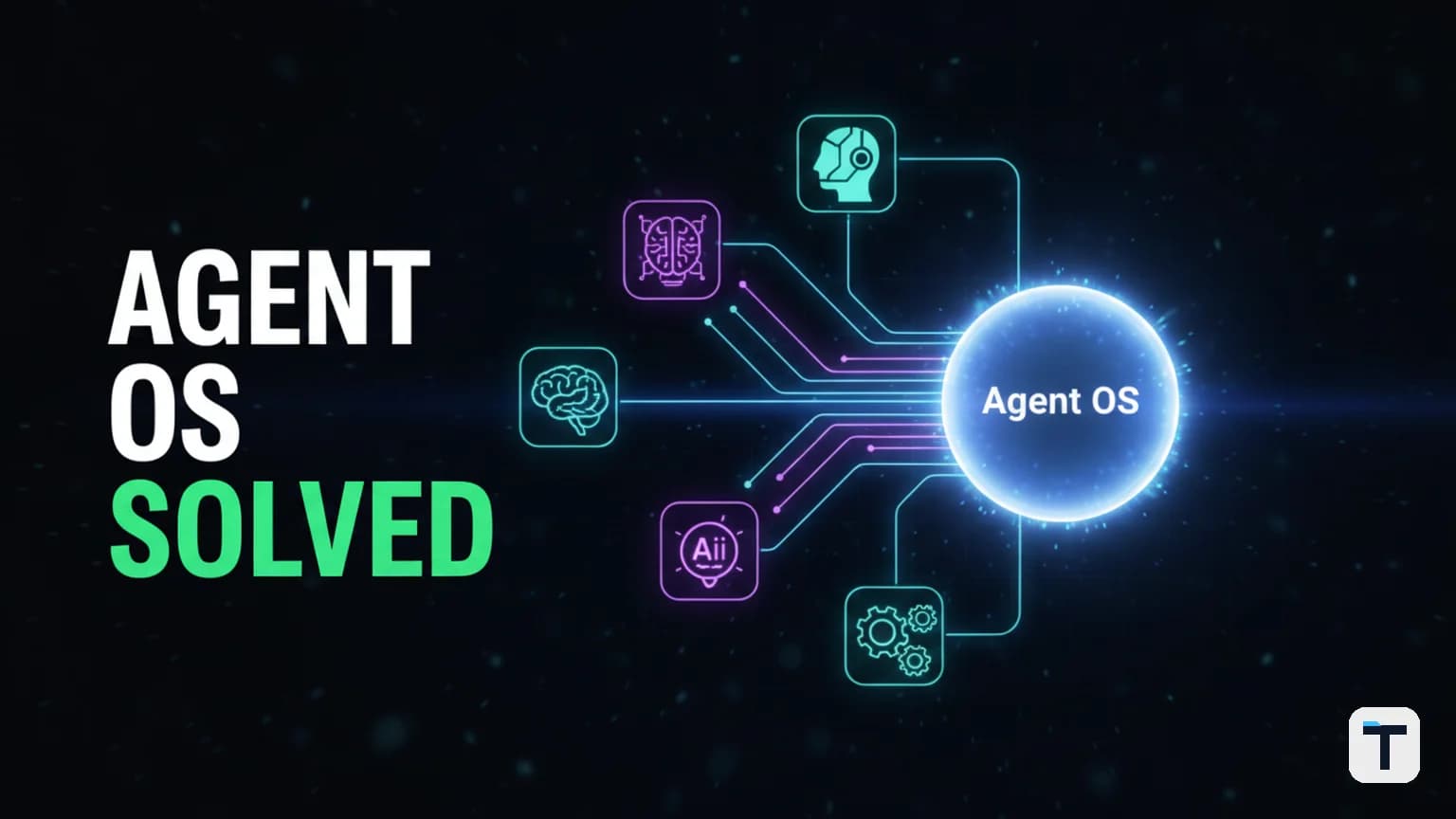

Verdict: For businesses aiming to scale their AI operations, deploying a centralized Agent Operating System (Agent OS) is the definitive solution to the fragmented performance and synchronization failures typical of isolated chatbot setups. By consolidating resource management, process scheduling, and shared memory into a single cognitive kernel, an Agent OS transforms disjointed tools into a highly reliable and customizable enterprise automation engine.
What is an Agent Operating System (Agent OS)?
An Agent Operating System is the core infrastructure that manages the runtime environment for autonomous AI agents, handling state, permissions, scheduling, and observability much like Linux handles processes for applications. It provides the kernel-level primitives required for enterprise-scale deployment, decoupling agent logic from underlying LLM models and API providers.
Unlike traditional scripts that run top-to-bottom and exit, autonomous agents loop, wait, react, and persist. Without an OS layer, developers must build bespoke memory managers, permission systems, and schedulers for every single agent, introducing significant infrastructure debt.
Why Your AI Setup Needs an Agent OS: Moving Beyond Isolated Chatbots
When companies attempt to scale AI by deploying standalone chatbots or isolated scripts, they inevitably hit a wall. According to a landmark study by MIT’s NANDA initiative, The GenAI Divide: State of AI in Business 2025, a staggering 95% of enterprise generative AI pilots fail to deliver a measurable ROI. The research—based on 150 interviews with business leaders and an analysis of 300 public AI deployments—revealed that these failures stem not from flawed underlying models, but from flawed enterprise integration and a "learning gap" between generic tools and operational workflows.
An Agent OS directly addresses this learning gap by providing five core system functions:
- Resource Management: Allocating API quotas, token usage limits, and compute budgets per agent process to prevent runaway costs.
- Process Scheduling: Determining which agent runs on what trigger (polling, webhooks, or schedules) and in what specific order.
- Shared Memory: Maintaining a unified, persistent state across different agents, sessions, and long-running execution blocks.
- Standardized I/O: Exposing databases, APIs, and file systems through uniform interfaces so agents can read state and write actions without bespoke glue code.
- Permissions & Security: Sandboxing agents within strict capability sets to prevent unauthorized access to sensitive company data or critical external operations.
For a deeper look into the foundational concepts of orchestration, see our guide on AI Agent OS: Orchestration & Workflows.
Overcoming Synchronization Challenges: Eliminating the AI "Amnesia"
A frequent pitfall in multi-agent systems is synchronization drift. In a fragmented architecture, one agent may update a database or execute a task, but sibling agents remain unaware of the change, causing them to "forget" the broader context or get trapped in loop blockers.
An Agent OS eliminates this cognitive amnesia by enforcing a centralized memory architecture. For instance, teams can implement a shared memory layout using local tools like an Obsidian vault, where orchestrating agents actively document their executions and sibling agents read from that exact same repository to guide their next steps. This guarantees that every agent operates with real-time, context-accurate data, boosting multi-file refactoring and execution reliability to industry-leading levels of up to 78%.
To learn more about maximizing your agent infrastructure, review our guide on The Rise of the Agent Operating System: Why Your Business Needs an 'AI Kernel' in 2026.
Customization Simplified: Building Tailored Solutions for Clients
Building custom AI capabilities doesn't require complex, fragile overhauls if you possess a modular Agent OS kernel. By standardizing the lower-level primitives, businesses can seamlessly attach new specialized "skill sections" or specific plugins—such as local video generation via ComfyUI or advanced open-weight reasoning models like GLM 5.2—which immediately become accessible to all agents inside the network.
When delivering AI solutions to external clients, the goal should be severe simplification. An Agent OS allows you to strip away complex backend reasoning streams from the client-facing dashboard, presenting the user with only the clear automations and tracking systems (such as lead management or automated SEO generation) they actually care about.
For an exploration of advanced automation platforms, read about how Antigravity 2.0: Google's AI Agent OS Unlocks Autonomous Workflows.
The Power of Collaboration: Advanced Multi-Agent Orchestration Patterns
An Agent OS elevates AI from simple, passive assistants to active, self-organizing teams through distinct architectural patterns:
| Orchestration Pattern | How It Works | Best Used For |
|---|---|---|
| Agent Mastermind (Group Chat) | Multiple specialist agents communicate in a shared, stateful room, critiquing each other's outputs to solve a single prompt. | Strategy planning, complex debugging, and cross-functional research. |
| End-to-End Pipelines | Sequential execution paths where an output from Agent A triggers the execution of Agent B (e.g., automated SEO discovery leading to autonomous text drafting and instant site deployment). | Content generation, automated report compiling, and data ingestion. |
| Model Fusion (Panel of Judges) | Querying up to five separate LLM providers simultaneously, feeding their responses to an independent judge model, and fusing the critique into one definitive, ultra-high-quality answer. | Mission-critical business decisions and structural architecture building. |
To understand how to move from basic prompting to structured orchestration, refer to our comprehensive guide on Mastering Your AI Agent Operating System: From Orchestration to Autonomous Workflows.
Designing Your Agent Stack: Standardizing on the Model Context Protocol (MCP)
Architecting a true Agent OS requires robust, open-source integration standards rather than vendor lock-in. The undisputed standard in 2026 is Anthropic’s Model Context Protocol (MCP), open-sourced in November 2024. In just 18 months, MCP has achieved over 97 million monthly SDK downloads and is backed by industry giants including OpenAI, Google, Microsoft, and AWS.
MCP acts as the "USB-C of the AI world," establishing a clean three-layer model: the MCP Host (the primary AI application like Claude Code), the MCP Client (the internal session manager), and the MCP Server (the connector providing the context, such as a PostgreSQL database or GitHub repository). Standardizing your Agent OS on MCP ensures your infrastructure remains model-agnostic, allowing you to swap between closed frontier models and open-weight models without changing a single line of integration code. The shift is so profound that even Anthropic itself relies on its own recursive agent workflows, with over 80% of its production code currently authored by Claude.
What This Means for You
Juggling isolated chatbots is a recipe for operational stalling and poor financial returns. To scale AI effectively in 2026, you must transition to an Agent Operating System architecture. Start by mapping your existing workflows into structured pipelines, standardizing your tool connections using the Model Context Protocol (MCP), and utilizing centralized local memory. By focusing on building a solid cognitive kernel, your business can shift from short-term AI experimentation to long-term, highly automated execution.
FAQ
Q: What is the core difference between an Agent OS and simply using multiple AI applications? A: An Agent OS provides a central infrastructure layer that manages shared state, resource scheduling, cost quotas, and sandboxed permissions globally, whereas multiple individual AI applications run in isolation without any shared context, leading to integration drift and coordination failure.
Q: How does the Model Context Protocol (MCP) fit into an Agent OS? A: MCP provides the standardized communication protocol between the AI model host and external data sources or tools. It functions as the plug-and-play I/O layer of the Agent OS, ensuring the entire system remains model-agnostic.
Q: Why do 95% of enterprise AI pilots fail according to the MIT study? A: The MIT NANDA report highlighted that failures are caused by poor enterprise integration and a "learning gap"—meaning businesses deploy generic individual chat tools instead of deep-fitting AI systems tightly integrated into specific back-office operational workflows.
Q: Can a non-technical small business implement an Agent OS? A: Yes. Modern Agent OS setups favor modular "no-code" or "low-code" dashboard environments where businesses can easily turn on pre-built MCP connectors for everyday tools like lead trackers, email clients, and database hubs without writing custom integration code.
Q: Is Model Fusion recommended for daily, rapid coding tasks? A: No. Model Fusion requires querying multiple models and passing them through a judge model, which can take 5 to 10 minutes per round. It is highly valuable for critical architectural decisions or final content reviews, but too slow for rapid, iterative daily workflows.
Every claim here is traced to a primary source, dated, and listed under Sources. Research and drafting are AI-assisted; editing, verification and publication are human decisions, and a person is accountable for what appears on this page. How we work →
Discussion
0 comments